Tag: physics

  • Amphibious Adaptation

    Amphibious Adaptation

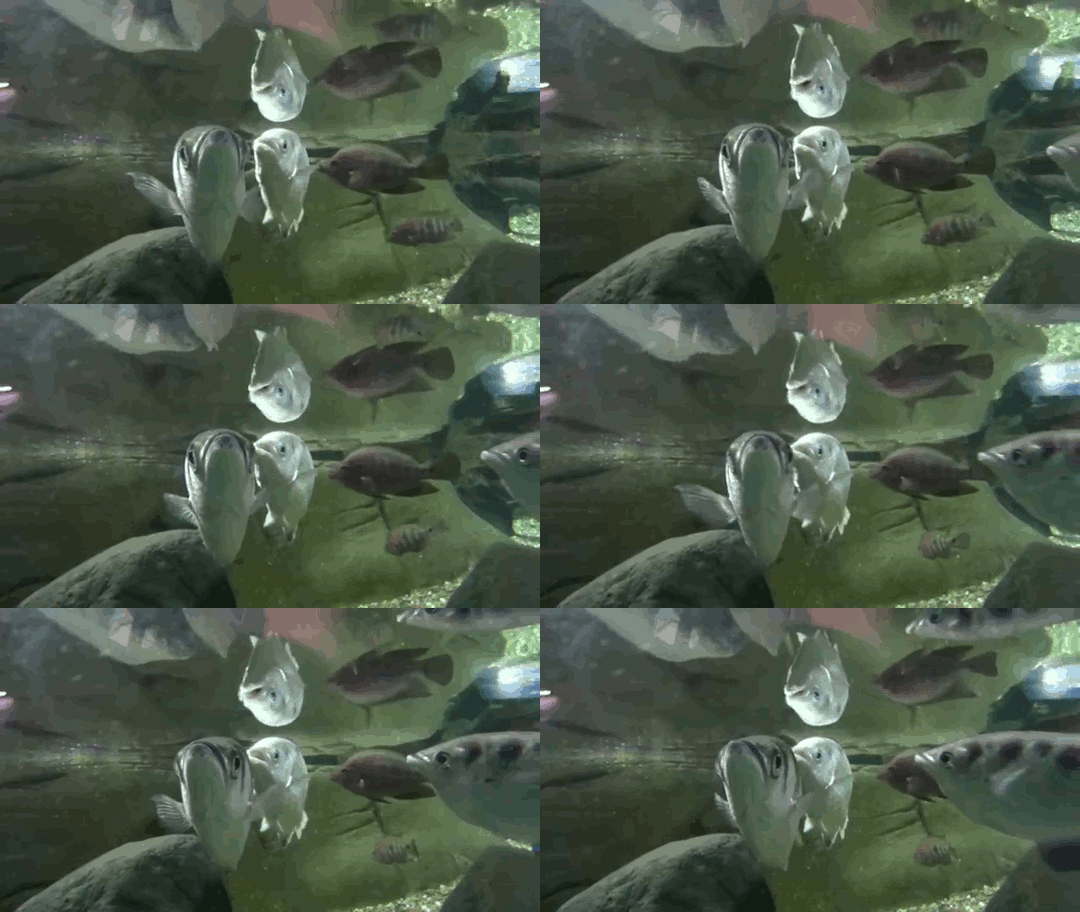
    Every year newts move to the water in the springtime to mate before returning to land for the rest of the year. This annual aquatic relocation is accompanied by changes in the newt’s body. Flaps of skin grow from their upper jaw to their lower jaw, partially closing their mouths at the corners. This can be seen in the left column of the animation compared to the center and right.

    Numerical simulation shows that this mouth change has a significant impact on the newt’s ability to hunt underwater. Newts are suction feeders, who open their jaws and expand their mouth cavity to suck in water and their prey. By closing off the corners of their mouths during their aquatic phase, the newts generate more suction, reaching peak flow velocities 10% to 50% higher than in their terrestrial form and enabling them to pull prey from 15% further away. When they leave the water, the newts lose the extra flaps so that their mouths can open wider for catching prey on land. (Image credit: S. Van Wassenbergh and E. Heiss, source)

  • Featured Video Play Icon

    “Memories of Paintings”

    In “Memories of Paintings,” Thomas Blanchard gives us an up-close view of fluids and mixing. It’s a calming and curious video made from combinations of paint, oil, oat milk, and soap. The fluids feather and intertwine, driven by differences in surface tension. Paint gets encapsulated by immiscible oil to create little islands of color that float and dance against the background. It’s a fun journey through effects that we witness daily but rarely take the time to watch. (Video credit: T. Blanchard; via Gizmodo)

  • Turbulence in the Solar Wind

    Turbulence in the Solar Wind

    One of the key features of turbulent flows is that they contain many different length scales. Look at the plume from an erupting volcano, and you’ll see eddies that are hundreds of meters across as well as tiny ones on the order of millimeters. This enormous difference in scale is one of the major challenges in simulating turbulent flows. Since energy enters at the large scale and is passed to smaller and smaller scales before being dissipated at the tiniest scales of the flow, properly simulating a turbulent flow requires resolving all of these length scales. This is especially challenging for applications like the solar wind – the  stream of charged particles that flows from the sun and gets diverted around the Earth by our magnetic field. The image above shows some of the turbulence in our solar wind. The structures seen in the flow range from the size of the Earth all the way to the scale of electrons! (Image credit: B. Loring, Berkeley Lab)

  • Flying in Cramped Quarters

    Flying in Cramped Quarters

    A new study has found that budgerigars (also commonly known as parakeets or budgies) fly at only two distinct speeds. The researchers flew the birds in a tapered tunnel to see how they navigated in response to widening or narrowing paths. What they found, regardless of the flight direction in the tunnel, is that the birds fly at approximately 9.5 m/s in areas wider than 2.5 times their wingspan and drop suddenly to a speed about half that when in narrower areas. The higher speed falls within the bird’s most energy-efficient range, suggesting that the birds may prefer flying at this condition. Insects like bumblebees also change speeds when entering cluttered environments, but the insects do so gradually, not suddenly like the budgerigars. The reason for this difference is not yet known, but it could relate to how the animals sense their environment or to differences in their flight efficiency when varying speed. (Image credit: J. Bendon; research credit: I. Schiffner and M. Srinivasan; submitted by Marc A.; h/t to Irmgard B.)

  • Featured Video Play Icon

    Flamethrowing

    Humans have long been fascinated by staring into flames, and the Slow Mo Guys carry on the grand tradition here with 4K, high-speed video of a flamethrower. Like firebreathers, a flamethrower’s fire is the result of a spray of tiny, volatile droplets of fuel. Once ignited, the spray becomes a turbulent jet of flames. Turbulent flows are known for having both large and small-scale structure, and there’s some really great close-ups showing this around the 2:00 mark. Also watch the edges of the flame, where the nearby air has gotten hot enough to shimmer. You can see how the trees in the background ripple and blur as the fire heats up the air and changes its density and refractive index. (Video credit: The Slow Mo Guys)

  • Arriving at Jupiter

    Arriving at Jupiter

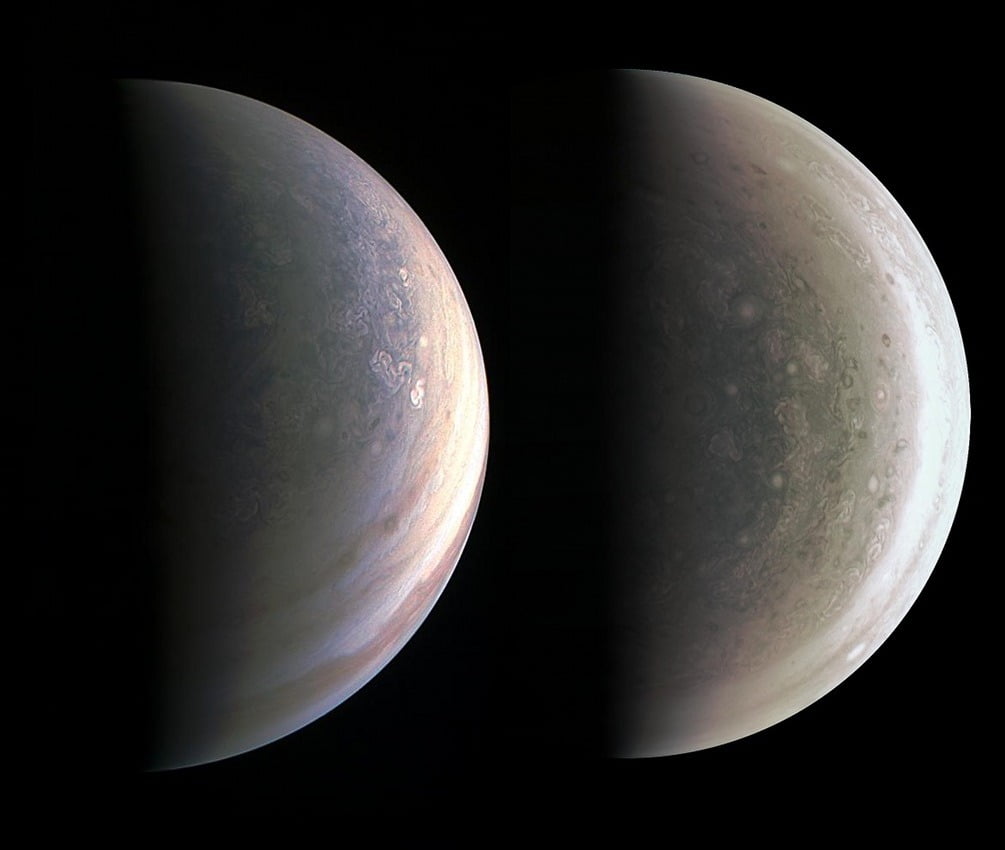
    Today all eyes turn to Jupiter where NASA’s Juno spacecraft will enter orbit around the gas giant. In preparation, Hubble and ground-based telescopes have been observing Jupiter in both the visible (upper right) and infrared (upper left) spectrum. The lower image shows a 1:5 scale model of Juno and a full-size replica of one of its solar panels; note the mannequin in the lower right corner for scale. 

    Juno is entering one of the harshest environments in the solar system with intense magnetic fields that trap lethal amounts of radiation around the planet. The lovely blue auroras Hubble sees around Jupiter’s poles are a never-ending hailstorm of solar wind particles hitting Jupiter’s atmosphere. Juno will be studying the structure of Jupiter’s magnetosphere, gravitational field, and its interior, hopefully helping scientists explain how the planet formed and the role it played in the formation of our solar system. (Image credits: infrared Jupiter – ESO/L. Fletcher; Jovian auroras – Hubble/ESA; Juno model and solar panel – N. Sharp)

  • Easy Squeezing

    Easy Squeezing

    Nearly everyone has struggled with the frustration of trying to get ketchup, toothpaste, or peanut butter out of a container. These fluids and fluid-like substances are notoriously difficult to budge because they prefer to wet and adhere to solid surfaces. One way to limit this adhesion is to use a superhydrophobic surface, like the one shown in the middle image. These surfaces use micro- and nanoscale roughness to trap air pockets underneath a liquid and reduce the amount of contact between the liquid and solid. But such surfaces are delicate and prone to failure. The slippery alternative offered by LiquiGlide is a liquid-impregnated surface, shown in the bottom image. Like a superhydrophobic surface, it consists of a textured solid but one that’s filled with a liquid lubricant that preferentially wets the solid. As a result, the liquid to be shed has little to no contact with the actual solid surface and therefore slides easily off! (Image credit: LiquiGlide, source; research credit: K. Varanasi et al.; suggested by cnsidero)

  • Denticles and Sharkskin

    Denticles and Sharkskin

    Look closely enough at a shark’s skin, and you will find it is covered in tiny, anvil-shaped denticles (lower left). To try and discover how and why these denticles help sharks, researchers are 3D printing denticles in different patterns onto flexible sheets to create biomimetic shark skin (lower right). 

    They test the artificial shark skin in a water tunnel by moving it with prescribed motions and measuring different characteristics, like the swimming speed attained and the power required. When compared to a smooth but flexible control surface, one pattern came out ahead. The staggered-overlapped denticle pattern (shown in C of the lower right figure) achieved swimming speeds 20% higher than the smooth control despite having far more surface area due to the denticles. The cost of that speed was only 13% greater than the smooth case on average, and was about equal to the smooth case for small amplitude motion. This suggests that the patterning of a shark’s skin may help it swim faster with little to no additional cost in effort.

    For more on shark hydrodynamics, check out my previous posts on the topic, and if you want even more shark science, check out these great videos. (Image credit: R. Espanto; J. Oeffner and G. Lauder; L. Wen et al.; research credit: L. Wen et al., 1, 2)

  • Resonating Bowls

    Resonating Bowls

    Rub your hands on the handles of a Chinese resonance bowl and you can generate a spray of tiny droplets. The key to this, as the name suggests, is vibration. Rubbing the handles vibrates the bowl, causing small oscillations in the bowl’s shape that are too small for us to see. But those vibrations do produce noticeable ripples on the water in the bowl. When you hit the right frequency and amplitude, those vibrations disturb the water enough that the up-and-down vibration at the surface actually ejects water droplets. The vibration of the bowl affects water near the wall most strongly, which is why that part of the bowl has the strongest reaction. It takes even larger amplitude vibrations to get droplets jumping in the middle of the bowl, but you can see that happening in this video of a Tibetan singing bowl. (Image/video credit: Crazy Russian Hacker, source)

  • Rayleigh-Taylor Waves

    Rayleigh-Taylor Waves

    Here on Earth, placing a denser fluid over a lighter one creates an unstable equilibrium. Thanks to gravity, the heavier, denser fluid wants to sink and the lighter fluid wants to rise. Any small disturbance will kick this into action, just like a tiny nudge can send a ball rolling down the hill. For the fluid, that nudge manifests as waviness in the interface between the two fluids. That waviness will quickly grow into billows like those shown above as the Rayleigh-Taylor instability takes over and the heavy (clear) fluid trades places with the lighter (green) fluid. You’ve probably witnessed this effect yourself when pouring milk into iced coffee. To see it in action, check out the video of this experiment or my FYFD video on the Rayleigh-Taylor instability. (Image credit: M. Davies Wykes)