Tag: physics

  • Featured Video Play Icon

    Kilauea’s Rivers of Lava

    Kilauea continues to erupt without signs of abating. Aerial video, like this footage from Mick Kalber, shows the scope of the flow. Lava spurts like a hellish fountain from various fissures, then forms a gravity current that slowly flows downhill toward the ocean. Some of the angles give you an excellent view of the texture atop the flowing lava; it looks relatively rope-like now before solidification, indicating pahoehoe flow. Whether the flow will transition to the rougher appearance of a’a lava remains to be seen; as the lava cools and crystallizes, it may develop a yield strength. That would make it similar to fluids like your toothpaste, which only flow once a critical force is applied. Stay safe, Hawaiians! (Image and video credit: M. Kalber; via Colossal)

  • Bouncing Off a Moving Wall

    Bouncing Off a Moving Wall

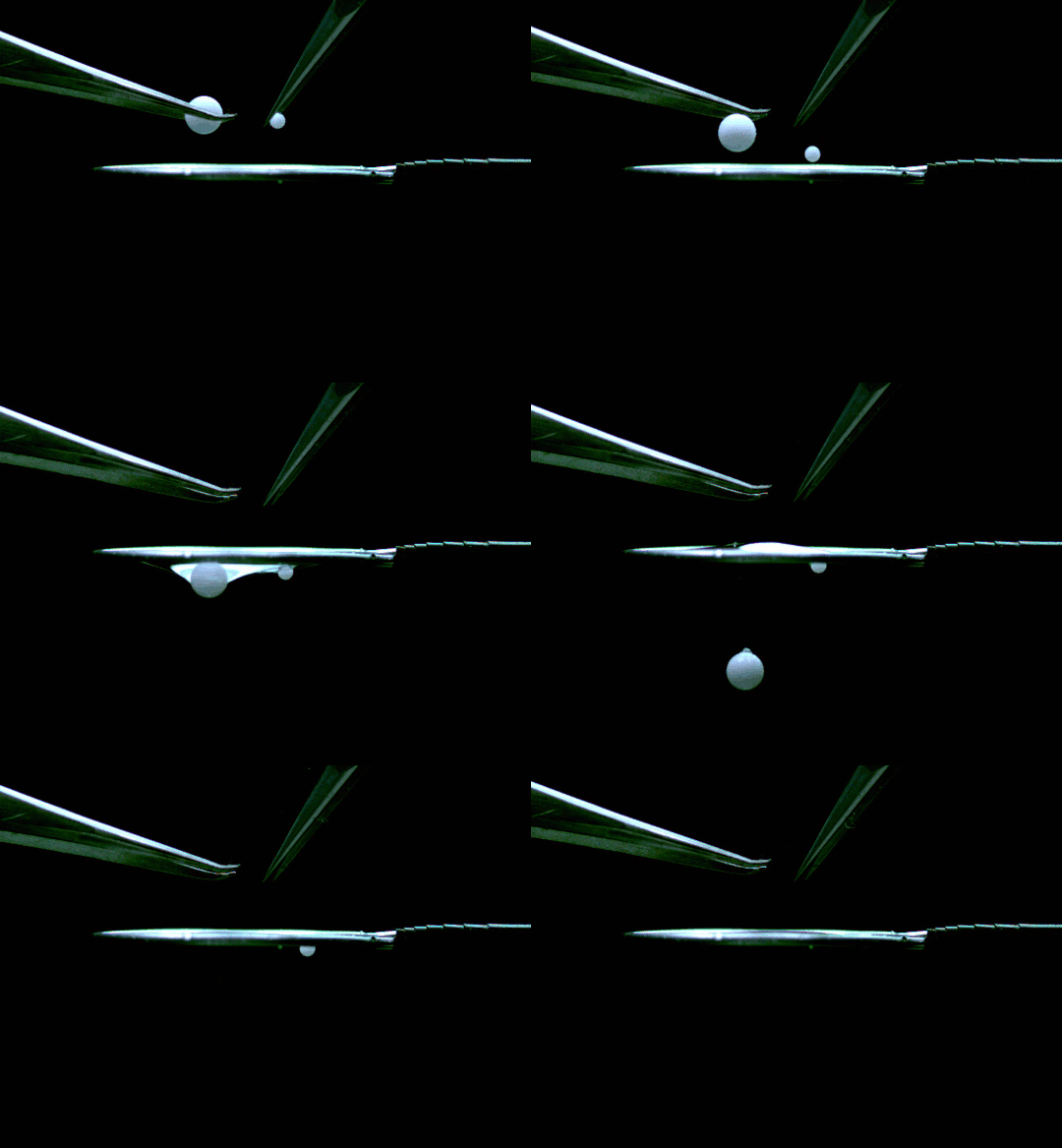
    There are many ways to repel droplets from a surface: water droplets will bounce off superhydrophobic surfaces due to their nanoscale structures; a vibrating liquid pool can keep droplets bouncing thanks to its deformation and a thin air layer trapped under the drop; and heated surfaces can repel droplets with the Leidenfrost effect by vaporizing a layer of liquid beneath the droplet. But all of these methods will only work for certain liquids under specific circumstances. 

    More recently, researchers have begun looking at a different way to repel droplets: moving the surface. The motion of the plate drags a layer of air with it; how thick that layer of air is depends on the plate’s speed. (Faster plates make thinner air layers.) Above a critical plate speed, a falling droplet will impact without touching the plate directly and will rebound completely. This works for many kinds of liquids – the researchers used silicone oil, water, and ethanol – across many droplet sizes and speeds. The key is that the air dragged by the plate deforms the droplet and creates a lift force. If that lift force is greater than the inertia of the droplet, it bounces. (Image and research credit: A. Gauthier et al., source)

  • Soapy Rainbows

    Soapy Rainbows

    The swirling psychedelic colors of a soap bubble come from the interference of light rays bouncing off the inner and outer surfaces of the film. As a result, the colors we see are directly related to the thickness of the soap film. Over time, as a film drains, black spots will appear in it. This happens where the bubble’s wall becomes thinner than the wavelength of visible light. Black spots will grow and merge as the film continues to thin. Then, when it’s too thin to hold together any longer, the bubble will pop and disappear. (Image credit: L. Shen et al., source)

  • Featured Video Play Icon

    The Many Shapes of Fish

    After visiting an aquarium or snorkeling near a reef, you may have wondered why fish come in so many different shapes. Given that all fish species need to get around underwater, why are some fish, like tuna, incredibly streamlined while others, like the box fish, are so, well, boxy? There are several major groupings for fish based on their shape and how they propel themselves, whether it’s by undulating their body and tail or primarily by flapping their fins. Which grouping a fish tends toward depends largely on its environment and needs. Open-water swimmers tend to use their bodies and tails. Their bodies are better streamlined, too, allowing them to outrace even some ships! Fish that live in more complicated environments, like along the seafloor or in a reef, tend to favor maneuverability over speed. These fish – which include rays, pufferfish, and surgeonfish – use their fins for their main propulsion. Many of these species are still faster swimmers than you or I, but their slower speeds have reduced their need for hydrodynamic streamlining, allowing these fish to evolve a wide variety of odd body shapes. (Video credit: TED-Ed)

  • Featured Video Play Icon

    Waves Below the Surface

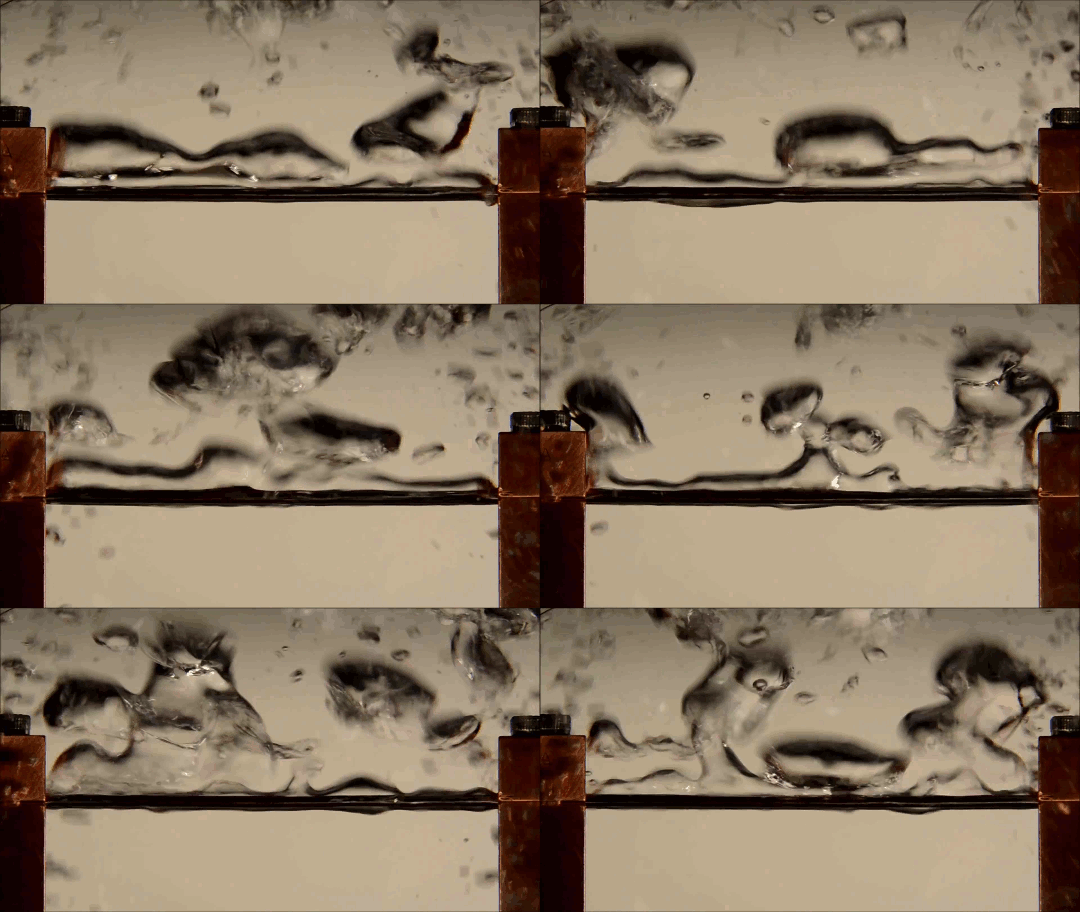
    Even a seemingly calm ocean can have a lot going on beneath the surface. Many layers of water at different temperatures and salinities make up the ocean. Both of those variables affect density, and one stable orientation for the layers is with lighter layers sitting atop denser ones. Any motion underwater can disturb the interface between those two layers, creating internal waves like the ones in this demo. In the actual ocean, these internal waves can be enormous – 800 meters or more in height! In regions like the Strait of Gibraltar where flowing tides encounter underwater topography, large internal waves are a daily occurrence. Internal waves can also show up in the atmosphere and are sometimes visible as long striped clouds. (Video and image credit: Cal Poly)

  • Featured Video Play Icon

    Rainbow Paint on a Speaker

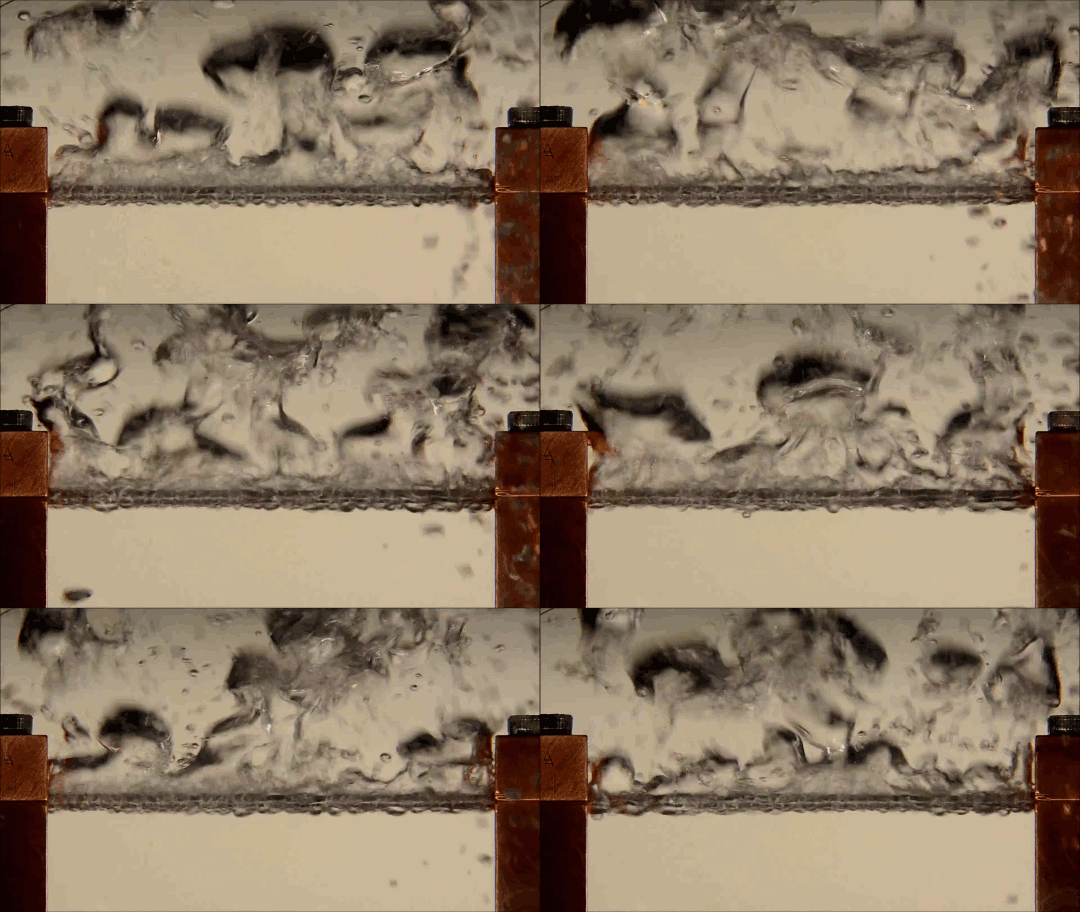
    Every year brings faster high-speed cameras and better quality imaging, so the Slow Mo Guys like to occasionally revisit topics they’ve done before, like paint vibrated on a speaker. The physics involved here are fantastic, so I’ll revisit the topic, too! In this version, Gav and Dan are using a pretty beefy speaker at a relatively high volume, so the paint gets a strong acceleration. As they note, the paint colors mix to brown almost immediately. In the high-speed footage, we can see why. 

    Watch how the individual strands of paint behave. As they fly upward, they stretch out and get thinner. That stretching has a side effect: it makes the paint spin. This is angular momentum of the paint being conserved. Just like a spinning ice skater who pulls his arms in, the paint spins faster as it gets thinner. This provides a lot of the mixing. Just look at how the different colors twist together! (Image and video credit: The Slow Mo Guys)

  • Using Air to Break Up Jets

    Using Air to Break Up Jets

    One method of breaking a liquid into droplets, or atomizing it, uses a slow liquid jet surrounded by an annulus of fast-moving gas. The gas along the outside of the liquid shears it, creating waves that the wind blowing past can amplify. This draws the liquid into thin ligaments that then break into droplets. This is a popular technique in rocket engines, where cryogenic liquid fuels often need to be atomized for efficient combustion. When things aren’t working exactly right, however, the liquid jet may start flapping instead of breaking up. In this case, the jet will swing back and forth, but only part of it will atomize. For a rocket engine, this would mean slower and less efficient combustion – never desirable outcomes! (Image credit: A. Delon et al.)

  • Featured Video Play Icon

    Sandy Wrinkles

    Water flowing back and forth over sand quickly forms a field of dune-like wrinkles. On the upstream side, the flow is a little faster, and it picks up grains of sand. When the flow slows on the downstream side of a bump, the sand gets deposited. In this way, small bumps in the sand continue growing larger. A similar process between wind and sand forms enormous dunes here on Earth and on Mars. These smaller water-driven wrinkles are very common in tidal areas and in sandy creeks. They can even build up and break down such that they create periodic waves that surge down the stream. (Image and video credit: amàco et al.)

  • Featured Video Play Icon

    “Water Ballet”

    Artist Kamiel Rongen uses common substances like paint, oil, eggs, and even air freshener to create what he calls “water ballet.” His videos are full of ethereal and surreal landscapes full of color and motion. Buoyancy (or the lack thereof) plays a major role in his work – fluids often spurt upward like alien creatures emerging from a chrysalis. I’ve been debating with myself whether the fluids are actually rising or if they’re falling in front of an upside-down camera, and I’m not completely certain either way! I think that’s a testament both to Rongen’s artistry and to the awesome physics involved. Check out the full video below and you can see many more examples of Rongen’s work on his website. (Image and video credit: K. Rongen; h/t to James H.)

  • Kilauea’s Lava Lake

    Kilauea’s Lava Lake

    Hawaii’s Kilauea Volcano continues to erupt, sending magma flowing through multiple fissures. The U.S. Geological Survey has sounded a warning, however, that the volcano could erupt more explosively. Hot spot volcanoes like Hawaii’s generally have more basaltic lava, which has a lower viscosity than more silica-rich magmas like those seen on continental plates. That makes Hawaii’s volcanoes less prone to explosive detonations like the 1980 Mt. St. Helens eruption. With less viscous lava, there’s less likelihood of plugging a magma chamber and causing a deadly buildup of pressure from toxic gases.

    But that doesn’t mean that there’s no risk. In particular, officials are concerned by the rapid draining of a lava lake near Kilauea’s summit. As illustrated below, if the lava level drops below the water table, that increases the likelihood of steam forming in the underground chambers through which lava flows. The rapid drainage has destabilized the walls around the lava lake, causing frequent rockfalls into the chamber. If those were to plug part of the chamber and cause a steam buildup, then there could be an explosive eruption that releases the pressure. To be clear: even if this were to happen, it would be nothing like the explosiveness of Mt. St. Helens. But it would include violent expulsions of rock and widespread ash-fall. (Image credits: USGS, source; via Gizmodo)