Tag: physics

  • Dissolving Candy

    Dissolving Candy

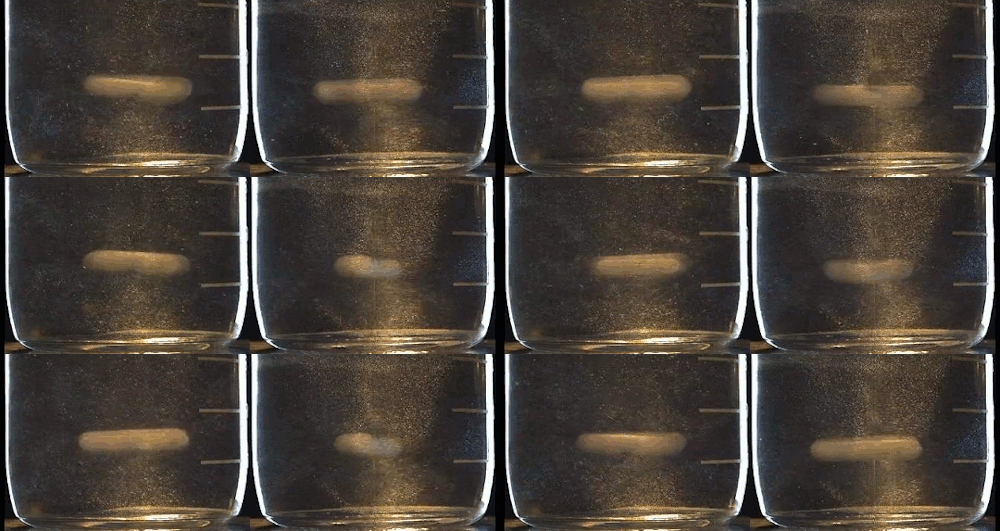
    In nature, solid surfaces often evolve over time in conjunction with the flows around them. This is how stalactites, canyons, and hoodoos all form and change over time. Here researchers examine a surface formed from hard candy that is dissolving from below. Over time, the initially flat surface develops a pitted appearance (top image, scale bar is 1 cm) with roughness that is approximately 1 mm in scale. Flow visualization (bottom row) suggests that these pits result from local flow where narrow, millimeter-sized dense plumes fall away from the surface. 

    As material dissolves from the candy, it forms a dense layer of sugar-water mixture near the solid surface. Once that layer grows to a critical thickness, it will be too unstable for viscosity to counter. At that point, the Rayleigh-Taylor instability takes over, causing the dense sugar-water layer to break up into narrow, sinking plumes. Although each area is evolving independently, the rate at which material dissolves is uniform everywhere, so the dissolving body retains the same shape over time. (Image and research credit: M. Davies Wykes et al., source)

  • Featured Video Play Icon

    Mimicking Hurricanes

    Hurricanes are a frequent and potentially deadly occurrence for many parts of the world. Although forecasting models have improved, there is still a lot about the physics of these storms that we don’t fully understand, in part because getting direct measurements from the real thing is so difficult and hazardous. Researchers at the University of Miami have instead built their own hurricane generator, capable of sustained 200 mph winds – strong enough to create Category 5 hurricane conditions. In this facility, they can study details of the storm up close, allowing them to distinguish effects from the scale of large waves down to the physics of the sea spray. Learn more and see the facility in action in the Science Friday video below. (Video credit: L. Groskin/Science Friday; image credits: L. Groskin/Science Friday, University of Miami, SUSTAIN Lab; submitted by Guillaume D.)

  • Soap Film Catenoid

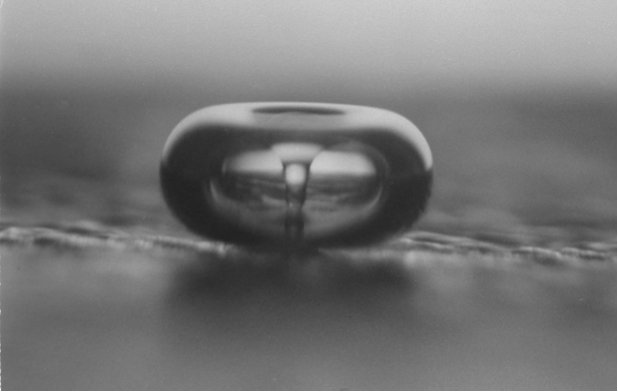
    Soap Film Catenoid

    Even very simple fluid systems can have surprising complexity. What you see here is a catenoid – the hourglass-like soap film that forms between two rings. In this case, the space in the center of the catenoid has a secondary film separating the top and bottom halves of the catenoid. When the rings are pulled apart, the waist of the catenoid and the secondary film inside it collapse. The secondary film gets thicker as its diameter decreases. (The fluid has to go somewhere, after all.) As the film thickens, the pressure inside it rises, eventually pushing some of the fluid out through the catenoid. This is what causes the fingers flowing down the lower half of the catenoid in the bottom two images. (Image and research credit: R. Goldstein et al.)

  • Featured Video Play Icon

    Bees, Squid, and Oil Plumes

    It’s time for another JFM/FYFD collab video! April’s video brings us a taste of spring with research on how bees carry pollen, squid-inspired robotics, and understanding the physics of underwater plumes like the one that occurred in the Deepwater Horizons spill eight years ago. Check it all out in the video below. (Image and video credit: T. Crawford and N. Sharp)

  • Fractal Fingers

    Fractal Fingers

    Dyed isopropyl alcohol atop a thin layer of acrylic medium spreads in a fractal fingering pattern. Although the shapes are reminiscent of the viscous fingers seen in in the Saffman-Taylor instability, these patterns are most likely a result of surface tension. The lower surface tension of the alcohol causes Marangoni forces to pull it outward. The branching shapes indicate an instability, likely driven by surface tension, but the details of the mechanism behind it are unclear. (Image credits: J. Nahabetian)

  • Impressionist Foams

    Impressionist Foams

    Imagine taking two panes of glass and setting them in a frame with a small gap between them. Then partially fill the gap with a mixture of dye, glycerol, water, and soap. After turning the frame over several times, the half of the frame will be filled with foamy bubbles. When you flip it again, the dyed glycerol-water will sink and penetrate the bubble layer, creating complex and beautiful patterns as it mixes. Some of the bubbles may get squeezed together until they coalesce into larger bubbles that shoot upward thanks to their increased buoyancy. Other smaller bubbles will wend their way upward as neighboring fluid shifts. If you examine the tracks left by individual bubbles, you can find patterns reminiscent of Impressionist paintings, as seen at the end of this Gallery of Fluid Motion video. (Image credit: A. Al Brahim et al., source)

  • Wild Extrusions

    Wild Extrusions

    In their continuing quest to squish all the things, the Hydraulic Press channel recently debuted a tool with a series of small holes they can extrude various substances through. The video features several great extrusions, including oobleck, temperature-sensitive putty, cheese, and crayons (above). Most of these substances are non-Newtonian fluids of some kind, and the extreme forces the hydraulic press causes makes for some wild effects.

    Many of the substances, including the crayons above, display signs of the sharkskin instability in their rough edges. When non-Newtonian fluids (like the paraffin wax in crayons) get extruded quickly, the material at the edges experiences a lot of friction and shear when trying to flow along the wall of the hole. When the fluid finally breaks free, the region along the outside accelerates to match the speed of fluid at the center of the extrusion. Parts of the mixture may resist that acceleration, resulting in the uneven edges seen above. (Video credit: Hydraulic Press Channel; GIF via Colossal)

  • The Catherine Wheel

    The Catherine Wheel

    When particles of different sizes fall in an avalanche, they separate out by size. Smaller particles form one layer with another layer of larger particles over the top. This happens because the smaller particles tend to fall in between the larger ones, similar to the percolation theory in the Brazil nut effect. In a slowly rotating drum, this size segregation during an avalanche forms a distinctive pattern (above) called a Catherine wheel pattern. Here, the gray layers form from smaller iron particles, while the white layers are large particles of sugar. Notice that the pattern starts to form during each avalanche, but it freezes in place after grains pile up against the drum wall and cause a shock wave to run back up the avalanche. (Image credit: J. Gray and V. Chugunov, reprinted in J. Gray, source)

  • Hydrofoils and Stability

    Hydrofoils and Stability

    Today’s fastest boats use hydrofoils to lift most of a boat’s hull out of the water. This greatly reduces the drag a boat experiences, but it can also make the boat difficult to handle. One style of hydrofoil boat, called a single-track hydrofoil, uses two hydrofoils in line with one another to support and steer the boat. The pilot can steer the lead hydrofoil into the direction of a fall to correct it. Stability-wise, this is the same way that you keep a bicycle upright. On a boat, the situation is a bit tougher to manage, and, like riding a bike, it takes practice. A group of students published a full mathematical model for the dynamics of this kind of boat, which allows designers to test a prototype’s stability early in the design process and enables student teams to use computer simulators to train their pilots to drive a boat before putting them out on the water, similar to the way that airplane pilots train. (Image credit: TU Delft Solar Boat Team, source; research credit: G. van Marrewijk et al., pdf; via TU Delft News; submitted by Marc A.)

  • Colorful Erosion

    Colorful Erosion

    Wind, water, and gravity are great sculptors of our world. This false-color satellite image shows the Ga’ara Depression in Iraq, which formed some 300 million years ago beneath a shallow sea. The steep cliffs along the southern edge of the depression continue moving southward as they’re eroded by wind and run-off. When infrequent but intense rains pour down the channels of the southern cliffs, it carves away sediment which the water carries onward. In the flatter basin, these sometimes-rivers slow and spread out, eventually dropping the sediment they carry into sandbars. The build-up of sandbars causes the slower-moving water to shift its course back-and-forth over time, creating the alluvial fans seen along the southern and western borders. (Image credit: J. Stevens, via NASA Earth Observatory)