Tag: levitation

  • Leidenfrost Without the Heat

    Leidenfrost Without the Heat

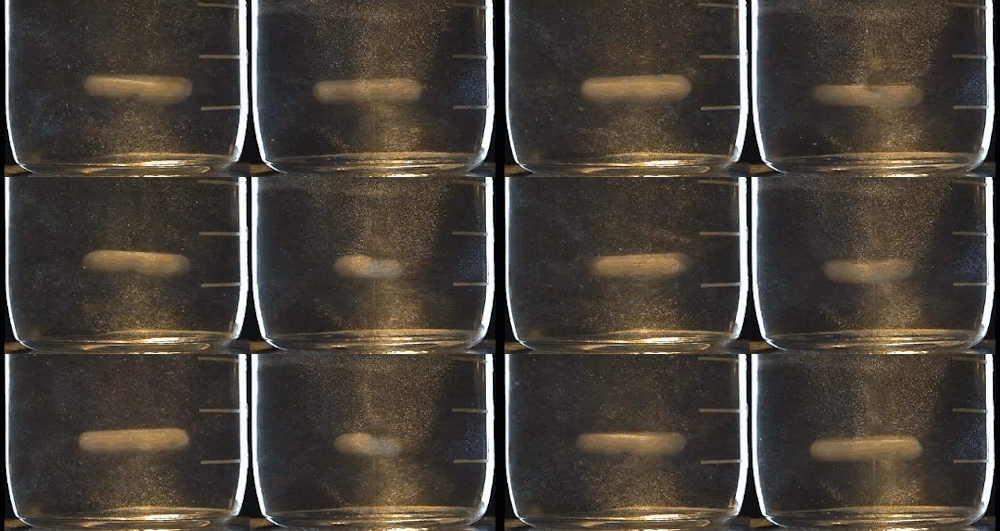
    Leidenfrost drops slide almost frictionlessly on a layer of their own vapor, generated by extremely hot surfaces nearby. But in this experiment researchers recreated many of the classic behaviors of a levitating Leidenfrost drop without the added heat. Instead, they supersaturated water droplets with carbon dioxide to create “fizzy droplets” that slide and self-propel along superhydrophobic surfaces.

    Initially, the drops don’t levitate. It takes a little while for the carbon dioxide layer to build up beneath them, as seen by the slowly appearing interference fringes in the second image. But once the layer forms, the drops behave like conventional Leidenfrost drops until their carbon dioxide is depleted. They’re even able to self-propel on a racheted surface (third image)! (Image and research credit: D. Panchanathan et al.; via Physics World; submitted by Kam-Yung Soh)
  • Levitating Cylinders by Lubrication

    Levitating Cylinders by Lubrication

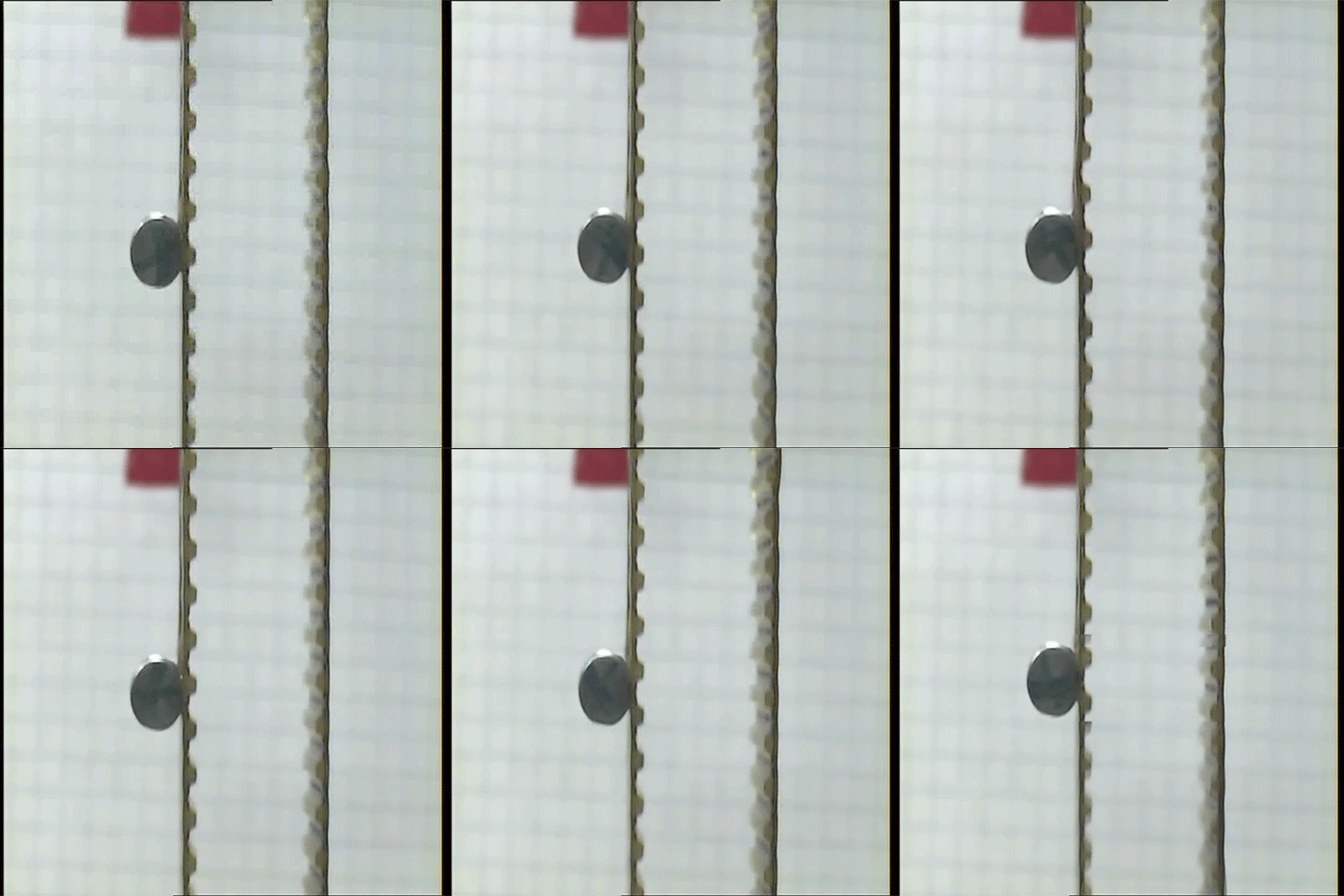
    Here’s a surprising example of defying gravity: if you coat a vertical treadmill in oil, a cylinder held next to it will levitate! A new paper delves into the mathematics behind this surprising situation, showing that the key to keeping the cylinder aloft is the pressure that forms where the oil layer splits around the disk. For a given cylinder size and mass, there’s a unique treadmill speed that will levitate it. By experimentally testing a range of cylinder sizes and masses, the authors validated their model and showed a simply scaling argument for predicting the belt speed needed for levitation. (Image and research credit: M. Dalwadi et al.; via Nature; submitted by Kam-Yung Soh)
  • Floating in Levitating Liquids

    Floating in Levitating Liquids

    When it comes to stability, nature can be amazingly counter-intuitive, as in this case of flotation on the underside of a levitating liquid. First things first: how is this liquid layer levitating? To answer that, consider a simpler system: a pendulum. There are two equilibrium positions for a pendulum: hanging straight down or pointing straight up. We don’t typically observe the latter position because it’s unstable; the slightest disturbance from that perfectly vertical situation will make it fall. But it’s possible to stabilize an inverted pendulum simply by shaking it up and down. The vibration creates a dynamic stability.

    The same physics, it turns out, holds for a layer of viscous fluid. With the right vibration, the denser fluid can levitate stably over a layer of air. Inside this vibrating layer, the rules of buoyancy are a little different because the vibration modifies the effects of gravity. As a result, bubbles deep in the liquid layer sink (Image 1). The researchers used this behavior to create their levitating layer (Image 2). The shaking also serves to stabilize objects floating on the underside of the liquid layer, allowing the boat in Image 3 to float upside down! (Image and research credit: B. Apffel et al.; via NYTimes; submitted by multiple sources)

  • Featured Video Play Icon

    Hydrodynamic Bearings

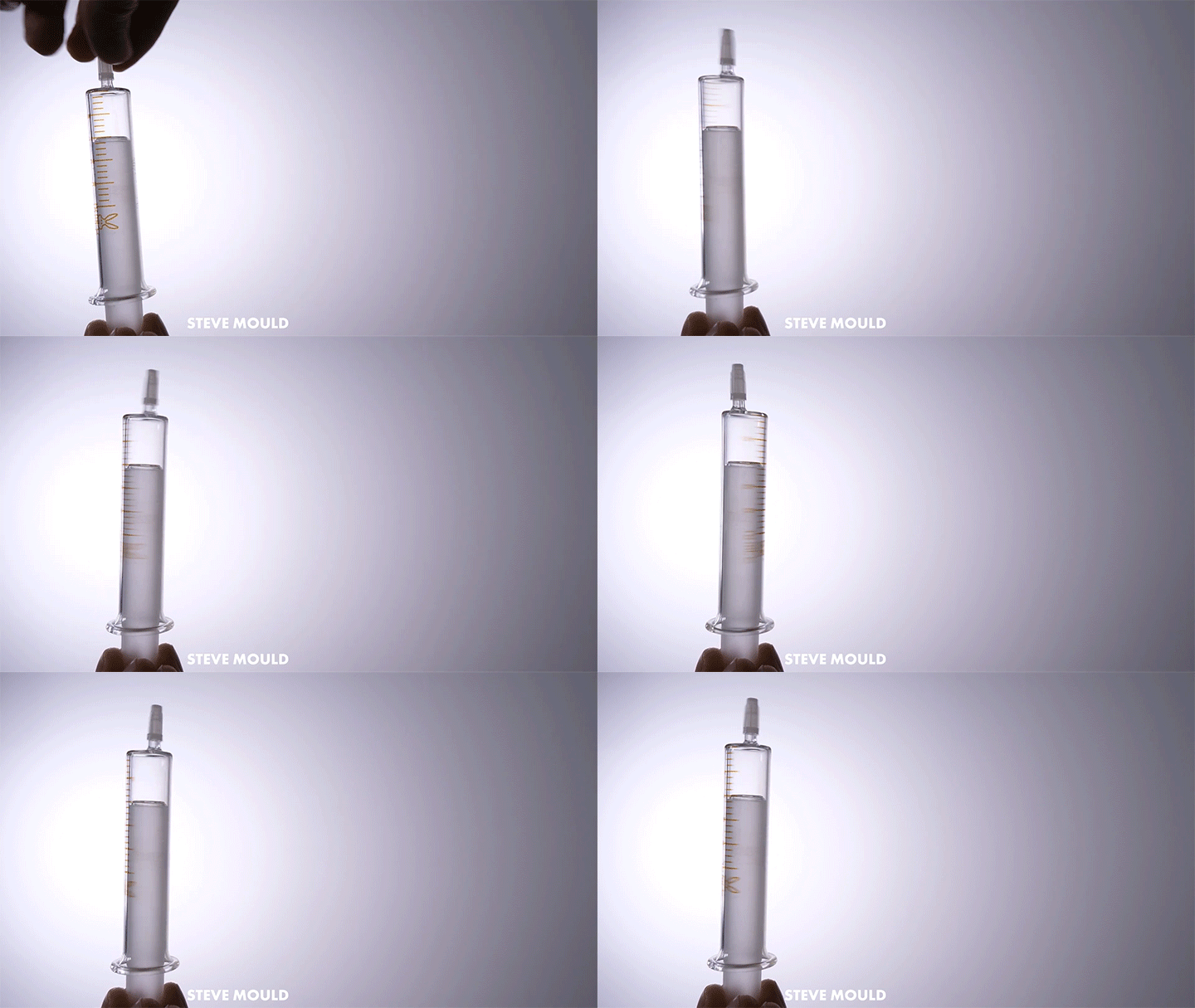
    If you twirl a glass syringe, it spins quite nicely, lubricated on a micron-thin layer of air. This is an example of a hydrodynamic bearing, a device where the viscosity of a fluid and relative motion of two closely-spaced surfaces provides the cushion necessary to keep the surfaces separate. In this video, Steve Mould explains the phenomenon in more detail and shares some awesome examples of this hydrodynamic levitation in action. (Image and video credit: S. Mould; submitted by clogwog)

  • Levitation Without Boiling

    Levitation Without Boiling

    One way to levitate droplets is to place them on a surface heated much higher than the droplet’s boiling point. This creates the Leidenfrost effect, where a droplet levitates on a thin layer of its own evaporating vapor. In this study, the situation is quite different.

    Although the underlying pool of liquid — here, silicone oil — is heated, its temperature is well below the boiling point of the water droplet. But the droplet still levitates over the pool, thanks to an air layer fed by convection. Aluminum powder in the oil reveals large-scale convection in the pool; note how the oil moves radially toward the droplet. That movement drags the air in contact with the oil with it, which forms the vapor layer keeping the droplet aloft.

    One side effect of this convection-driven levitation is that the droplet hovers over the coldest point in the oil. That fact suggests that users can manipulate the droplet’s motion by tuning the underlying heating. (Image and research credit: E. Mogilevskiy)

  • Featured Video Play Icon

    Sonic Tractor Beam

    Acoustic levitation uses the radiation forces generated by sound waves to trap small, lightweight particles at the nodes of standing waves. We’ve seen this a number of times previously, both with solid objects and liquid droplets. What makes this example particularly impressive, though, is that these researchers use an array of speakers to manipulate multiple objects at once. Check out the video above for a whole series of clips from the research. (Video credit: Science; research credit: A. Marzo and B. Drinkwater)

  • A Groovy Hovercraft

    A Groovy Hovercraft

    Not long ago, researchers discovered that droplets hovering over a hot grooved surface would self-propel. The extension to this was to investigate a hovercraft on a grooved, porous surface (top half of animation)–think an air hockey table with grooves. In that case, air inside the grooves flows from the point toward the edges, and it drags the hovercraft with it, thanks to viscosity. So the hovercraft travels in the direction opposite the points. This raised an obvious question: what happens if the hovercraft is grooved instead of the surface?

    That’s the situation we see in the bottom half of the animation. Air flows from the table and interacts with the grooves on the bottom of the hovercraft. And this time, the hovercraft propels in the direction of the points. That means there’s a completely different mechanism driving this levitation. When the grooves are onboard the hovercraft, pressure dominates over viscous effects. The air still gets directed down the grooves, but now, like a rocket, the exhaust pushes the hovercraft in the other direction – toward the points. For more on this work, check out the mathematical model of the problem and our interview with one of the researchers in the video below. (Research credit: H. de Maleprade et al.; image and video credit: N. Sharp and T. Crawford)

  • Wheeling Drops

    Wheeling Drops

    Leidenfrost drops – which skitter almost frictionlessly across extremely hot surfaces on a thin layer of their own vapor – are notoriously mobile. We’ve seen numerous methods of controlling their propulsion, often using specially-shaped surfaces. But it turns out that some Leidenfrost drops can self-propel even on a smooth, flat surface (top image). 

    Internally, large Leidenfrost drops have complicated, but symmetric flows that are driven by temperature and surface tension variations across the drop. But as the drop evaporates, that symmetry eventually gets broken, leaving behind a single large circulating flow. 

    Beneath the drop, that internal circulation affects the vapor layer. It causes the layer to take on an overall tilt, and the rotation, along with that slight angle in the vapor layer, causes the Leidenfrost drop to roll away like a wheel. (Image and research credit: A. Bouillant et al.; via NYTimes)

  • The Jumping Flea

    The Jumping Flea

    Nearly every lab has a magnetic stirrer for mixing fluids, but this ubiquitous tool still holds some surprises, like its ability to unexpectedly levitate. Magnetic stirrers consist of two main parts, a driving magnet that creates a rotating magnetic field, and a bar magnet – commonly referred to as the flea – that is submerged in the fluid to be stirred. When the driver’s rotating field is active, the flea will spin at the bottom of its container, keeping its magnetic field in sync with the driver.

    But if you place the flea in a viscous enough fluid, the drag forces on the flea can pull it out of sync with the driver’s field. Above a certain speed, the flea will jump so that its field repulses the driver’s. That makes the flea levitate as it spins. Depending on the interplay of viscous and magnetic forces, that spin can be unstable (left) or stable (right). The researchers suggest that this peculiar behavior could help artificial swimmers propel themselves or lead to new methods for measuring fluid viscosity. (Image and research credit: K. Baldwin et al.; via APS; submitted by Kam-Yung Soh)
  • Featured Video Play Icon

    Bouncing, Floating, and Jetting

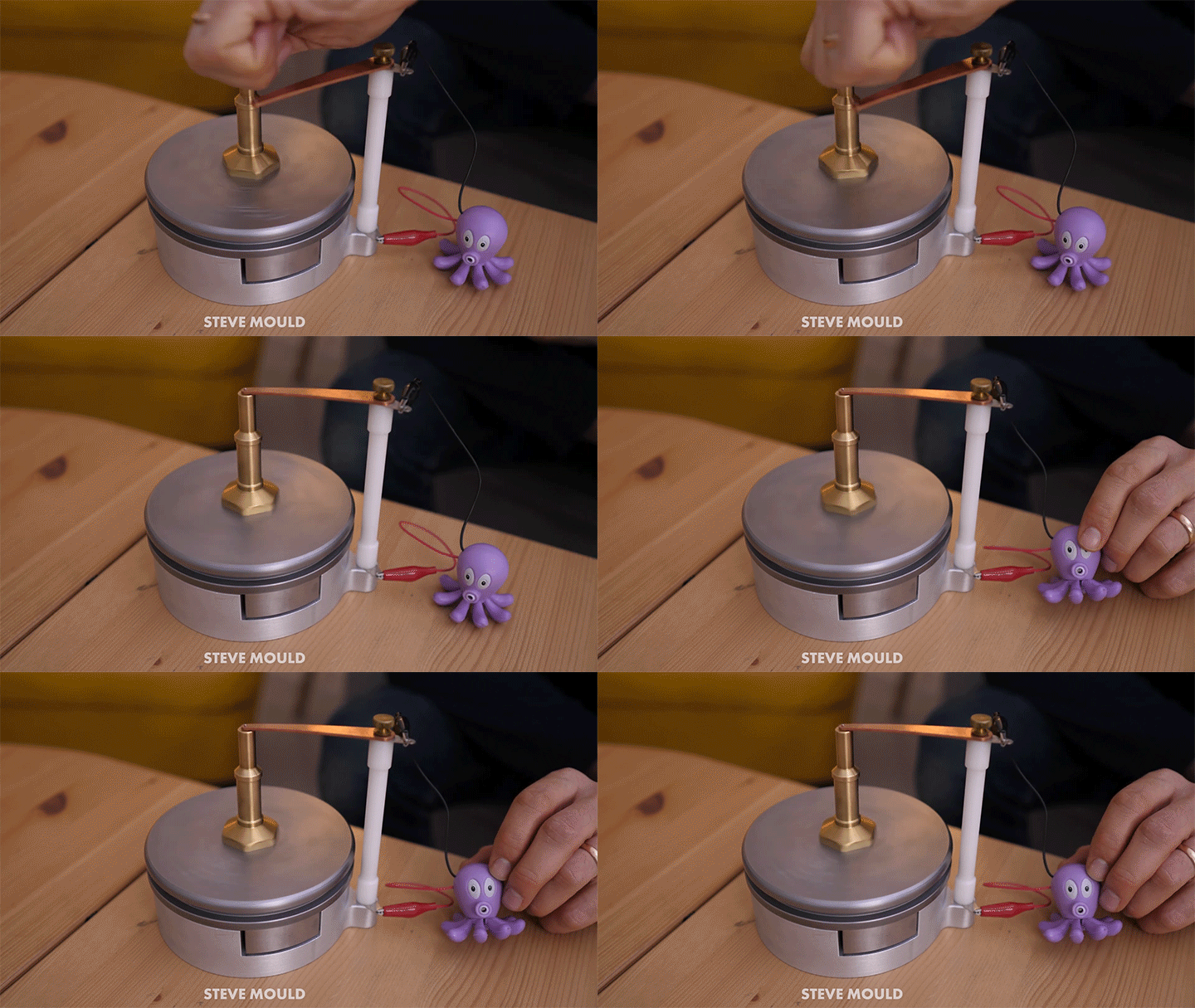
    Get inside some of the latest fluid dynamics research with the newest FYFD/JFM video. Here researchers discuss oil jets from citrus fruits, balls that can bounce off water, and self-propelled levitating plates. This is our third entry in an ongoing series featuring interviews from researchers at the 2017 APS DFD conference. Missed one of the previous ones? Not to worry – we’ve got you covered. (Video and image credit: N. Sharp and T. Crawford)