What happens when lava meets ice or water? Artists and geologists are working together to explore these interactions by melting crushed basalt and pouring it onto different substrates. Ice is their classic example; instead of melting instantly through the ice, the lava is so hot that it creates a layer of steam between it and the ice. This steam helps the lava flow due to lower friction while also insulating the ice from the lava. It’s an example of the Leidenfrost effect. The end result is a very bubbly lava flow thanks to the steam trying to escape through the viscous lava. (Video credit: Science Channel; submitted by @jchawner)
Tag: lava

Lava Coiling
It’s tough to get much closer to flowing lava than this video of freshly forming coastline in Hawaii. Lava is complex fluid, with viscous properties that vary significantly with chemical composition, temperature and deformation. Here, despite being very viscous, the lava flows quickly–perhaps even turbulently. Several times it forms a heap and even shows signs of the rope-coiling instability familiar from viscous fluids like honey. All in all, it’s quite mesmerizing. (Video credit: K. Singson; submitted by Stuart B.)

Lava-Driven Waterspouts
Seven waterspouts align as lava from the Hawaiian volcano Kilauea pours into the ocean in this striking photo from photographer Bruce Omori. Like many waterspouts–and their landbound cousins dust devils–these vortices are driven by variations in temperature and moisture content. Near the ocean surface, air and water vapor heated by the lava create a warm, moist layer beneath cooler, dry air. As the warm air rises, other air is drawn in by the low pressure left behind. Any residual vorticity in the incoming air gets magnified by conservation of angular momentum, like a spinning ice skater pulling her arms in. This creates the vortices, which are made visible by entrained steam and/or moisture condensing from the rising air. (Photo credit: B. Omori, via HPOTD; submitted by jshoer)

Stepping on Lava
What happens when you step on lava? (First off, don’t try this yourself.) Lava is both very dense and very viscous, so, as illustrated in the animation above, it does not give all that much under pressure. If you were to fall on it, you’d land, sink a little bit, and then get burned. It’s also interesting to note that the lava springs back after being indented. Basaltic lava like that found in Hawaii, where this clip originates, does have viscoelastic properties, which might explain the elasticity of the deformed fluid. (Image credit: A. Rivest, source video; via Gizmodo)
Bardarbunga Eruption
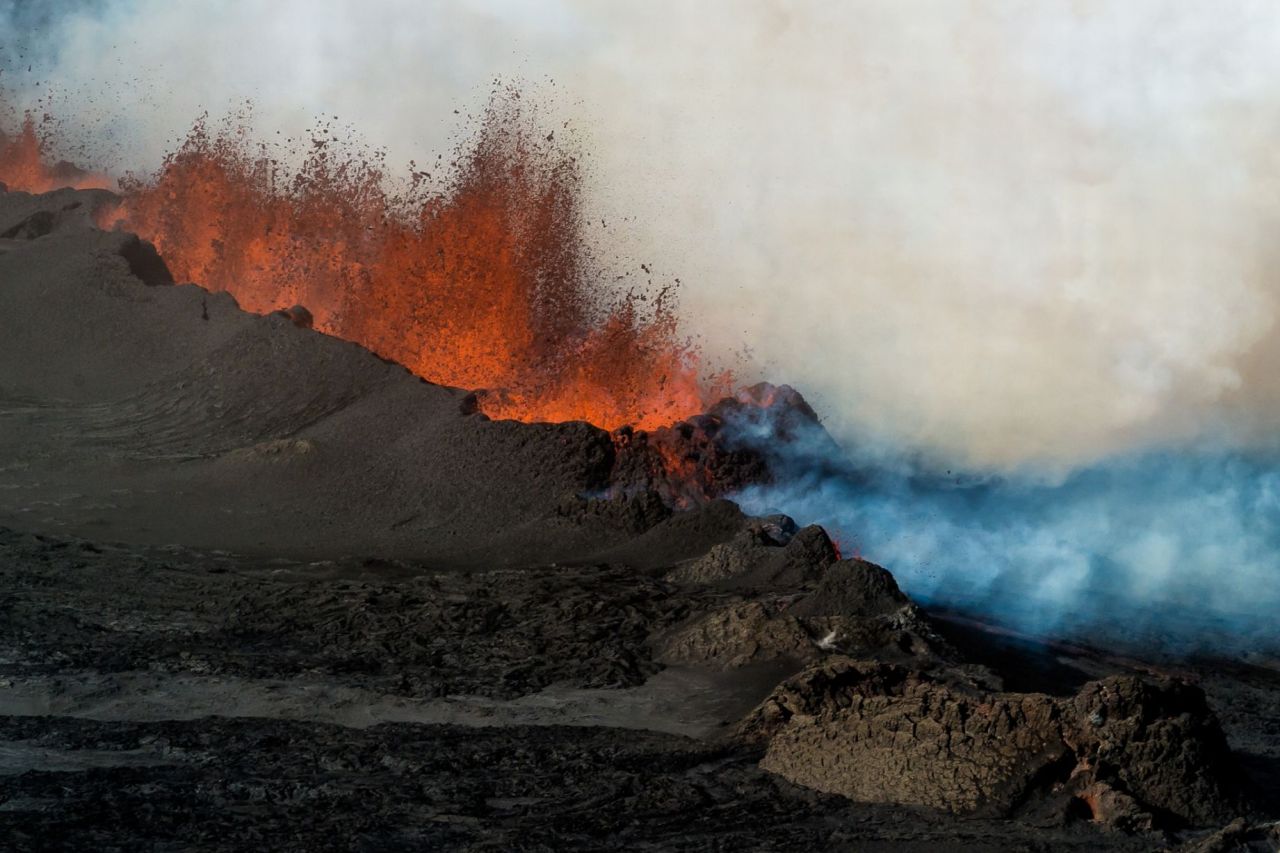
I thought I was done with volcanoes for this week, but DJI’s aerial footage from Iceland’s Bardarbunga eruption is too fantastic not to share. The eruption is over a month old now and more than 25,000 earthquakes have been registered in Iceland since this eruption began. The lava field covers more than 46 square kilometers, and experts remain unsure how long the eruption will continue. The lava itself is a basalt, which is lower in viscosity than more silica-rich lava. This lower viscosity means that the gases dissolved in the rising magma can escape more easily, like carbon dioxide fizzing out of a soda. If the lava’s viscosity were higher, those dissolved gases would generate a more explosive eruption as they try to escape. (Video credit: DJI; via Wired)

Lava Physics
Lava is rather fascinating as a fluid. Lava flow regimes range from extremely viscous creeping flows all the way to moderately turbulent channel flow. Lava itself also has a widely varying rheology, with its bulk properties like viscosity and its response to deformation changing strongly with temperature and composition. As lava cools, instabilities form in the fluid, causing the folding, coiling, branching, swirling, and fracturing associated with different types and classes of lava. (Image credit: E. Guddman, via Mirror)

Lava in Action
We’ve touched on volcanoes and the fluid dynamics of lava a couple of times here at FYFD, but over at Wired volcanologist Erik Klemetti has some wonderful photos and videos he took while visiting an active lava flow in Hawaii along with great explanations of the flow shapes and processes. Above we see him using a rock hammer to remove a sample from an active flow. Klemetti describes the lava’s behavior as taffy-like – extremely viscous and stretchy but prone to break like a plastic. Be sure to check out his posts! (Photo credit: E. Klemetti; submitted by @FlexMonkey)
Etna’s Eruption
After some rumblings in recent weeks, Italy’s Mt. Etna erupted overnight on February 19th, sending fountains of lava shooting into the dark. This impressive video from Klaus Dorschfeldt, a videographer for Italy’s National Institute for Geophysics and Vulcanology, shows the nighttime eruption, including the dark, turbulent outline of a pyroclastic flow of rock and hot gases escaping down the mountainside. Such flows can be devastating in their effect as they rush and spread down the mountain, flattening, burning, or engulfing everything in their path. When Mt. Vesuvius erupted in 79 A.D., it was the pyroclastic flow that buried the towns of Pompeii and Herculaneum. (Video credit: Klaus Dorschfeldt; via io9)
Creating Lava
In Syracuse, NY, artists and scientists work together to study volcanic flows by melting crushed basalt in a special furnace before releasing the lava into the parking lot. This particular flow is very prone to boiling behavior, likely because of the cold air and ground temperatures (less than 0 C). The outer layers of rock cool quickly, leaving bubble-shaped chambers which hotter lava can fill before melting out. (via It’s Okay To Be Smart; submitted by @jpshoer)

Martian Lava Coils

NASA’s HiRISE spacecraft has sent back images of lava coils left on the surface of Mars. These features form when lava flows of different speeds move past one another; they’re essentially Kelvin-Helmholtz waves–like the ones often seen in clouds–in the lava flow that have solidified into solid rock! On Earth these coils appear about a foot wide; the Martian versions are 100 feet across. (Photo credit: NASA/JPL/University of Arizona; via Wired; submitted by Brian L)