Tag: lava

  • Featured Video Play Icon

    Even Mountains Flow

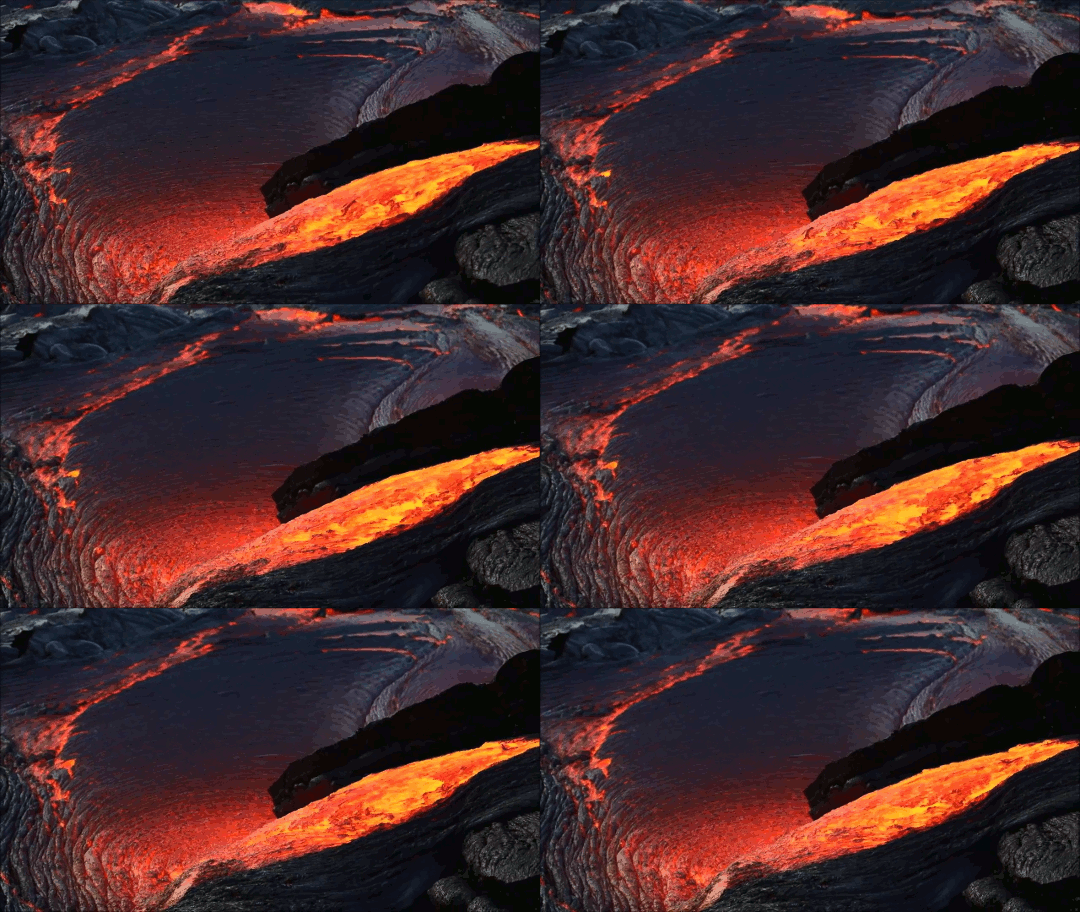
    Over about 5 months of 2018, the summit of Mount Kilauea slowly collapsed as the volcano erupted. Seen in timelapse, it’s a remarkable reminder of the ancient Greek philosopher Heraclitus’s observation, “Everything flows.” All things change, so given enough time, just about everything can flow.

    Fluid dynamicists actually capture this concept in a dimensionless ratio known as the Deborah number. Named for a Biblical prophet who states, “The mountains flow before the Lord,” the Deborah number is defined as the ratio between the time needed for a material to respond applied stress and the time over which the process is observed. In practice, a lower Deborah number indicates a more fluid-like material while a higher one represents more solid-like behavior.

    Be sure to check out the full video. There’s some spectacular lava flow footage near the end – definitely a small Deborah number! (Video and image credit: USGS via Science; research credit: C. Neal et al.)

  • Lava Bomb

    Lava Bomb

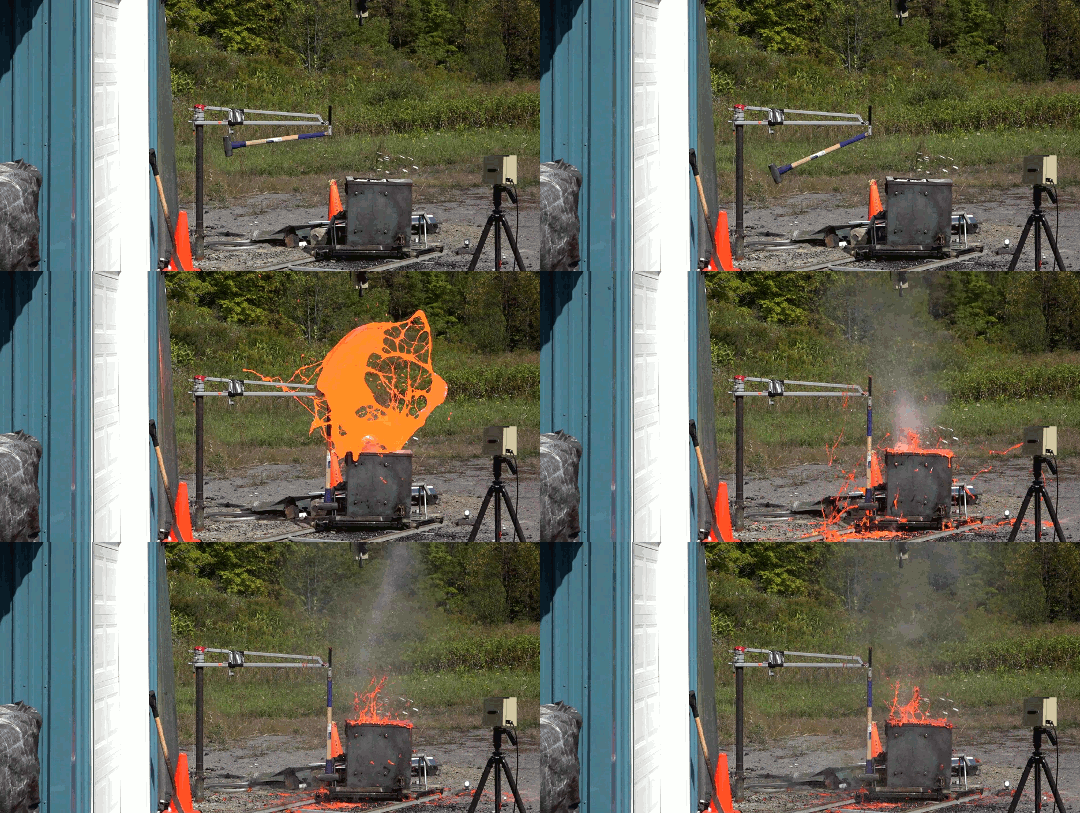
    What you see above is a homemade lava bomb. To systematically study what happens when groundwater meets lava, scientists melted basalt and created their own meter-scale explosion-on-demand. Inside the container, they can inject water and observe the resulting dynamics.

    Beneath the lava, the water forms what scientists call a domain. Thanks to the Leidenfrost effect, it can be protected from direct contact with the lava by a thin vapor layer that boils off it. If the water domain is large enough, buoyancy will pull it upward through the lava. Whether the water maintains a spherical shape or begins to distort and break up into smaller domains depends on the speed of its rise.

    At some point, though, either naturally or through an external trigger (like the sledgehammer you see above), the water and lava can contact, resulting in explosive vaporization of the water and an explosion. What’s visible at the surface depends on the depth at which the explosion takes place. Scientists are eager to characterize these variations, which will help them better predict the explosive danger of eruptions like Kilauea and Eyjafjallajökull. (Image and research credit: I. Sonder et al.; video credit: NYTimes; submitted by Kam-Yung Soh)

  • Lava Balls

    The continuing eruption of Kilauea is revealing phenomena rarely seen by those of us who are not volcanologists. One of the most surreal examples so far is colloquially known as a “lava boat,” seen above floating its way down a river of lava emanating from Fissure #8. The more technically accurate term is “accretionary lava ball,” but the colloquialism seems rather fitting, as long as this partially-solidified chunk of lava is still floating down the channel. 

    These lava balls form in a’a lava channels, which tend to be faster-moving and more turbulent. As chunks of lava solidify in the channel, they roll and gather more material, allowing them to get larger and larger. When broken open, the lava balls usually have a spiral interior as a result of this rolling formation. It’s essentially the lava equivalent of making a snowball. (Video credit: I. Marzo via M. Lincoln; via Ryan A.)

  • Featured Video Play Icon

    Kilauea’s Rivers of Lava

    Kilauea continues to erupt without signs of abating. Aerial video, like this footage from Mick Kalber, shows the scope of the flow. Lava spurts like a hellish fountain from various fissures, then forms a gravity current that slowly flows downhill toward the ocean. Some of the angles give you an excellent view of the texture atop the flowing lava; it looks relatively rope-like now before solidification, indicating pahoehoe flow. Whether the flow will transition to the rougher appearance of a’a lava remains to be seen; as the lava cools and crystallizes, it may develop a yield strength. That would make it similar to fluids like your toothpaste, which only flow once a critical force is applied. Stay safe, Hawaiians! (Image and video credit: M. Kalber; via Colossal)

  • Kilauea’s Lava Lake

    Kilauea’s Lava Lake

    Hawaii’s Kilauea Volcano continues to erupt, sending magma flowing through multiple fissures. The U.S. Geological Survey has sounded a warning, however, that the volcano could erupt more explosively. Hot spot volcanoes like Hawaii’s generally have more basaltic lava, which has a lower viscosity than more silica-rich magmas like those seen on continental plates. That makes Hawaii’s volcanoes less prone to explosive detonations like the 1980 Mt. St. Helens eruption. With less viscous lava, there’s less likelihood of plugging a magma chamber and causing a deadly buildup of pressure from toxic gases.

    But that doesn’t mean that there’s no risk. In particular, officials are concerned by the rapid draining of a lava lake near Kilauea’s summit. As illustrated below, if the lava level drops below the water table, that increases the likelihood of steam forming in the underground chambers through which lava flows. The rapid drainage has destabilized the walls around the lava lake, causing frequent rockfalls into the chamber. If those were to plug part of the chamber and cause a steam buildup, then there could be an explosive eruption that releases the pressure. To be clear: even if this were to happen, it would be nothing like the explosiveness of Mt. St. Helens. But it would include violent expulsions of rock and widespread ash-fall. (Image credits: USGS, source; via Gizmodo)

  • Galapagos Week: Lava Flows

    Galapagos Week: Lava Flows

    The Galapagos islands are geologically similar to the Hawaiian islands; both are archipelagos that were born and continue to be formed by lava flows originating from a volcanic hot spot. Lava from this type of volcano is high in basalt content, which affects both its flow properties and the formations it creates. Geologists have actually borrowed words from the Hawaiian language to describe the two main kinds of lava formations seen in basaltic flows: pahoehoe and a’a.

    Pahoehoe formations tend to be relatively smooth and often leave behind a pattern of rope-like coils (below). In contrast, a’a lava features are sharp, rough, and challenging to traverse. Both flows are gravity-driven, and which features a given eruption forms depends on many factors. Many flows will even begin with a pahoehoe section that stretches for several kilometers before transitioning to an a’a structure. Researchers believe the transition occurs when the lava crystallizes enough to develop a yield-strength, meaning that it will behave like a solid until enough force is applied to make it flow again. Toothpaste, ointment, and mud are similar so-called yield stress fluids which will only flow after a critical force is applied.  (Image credits: lava flow – Epic Lava Tours, source; pahoehoe lava – J. Shoer)

    Galapagos Week continues tomorrow here on FYFD. Check out previous posts.

  • Featured Video Play Icon

    Hawaii’s Lava

    Sometimes the best way to appreciate a flow is standing still. In “Hawaii – The Pace of Formation” filmmakers explore how the Big Island is constantly changing, from fresh lava flows to towering waterfalls. Much of the footage presented is timelapse, which gives viewers a different perspective on familiar subjects; it highlights the similarities between clouds and the ocean, and it reminds us that a lava flow and the syrup flowing down a stack of pancakes have a lot in common. To me, this is one of the most beautiful parts of fluid dynamics: physics of flows on different length-scales and time-scales – even in different fluids – are still very much the same. (Video credit: A. Mendez et al.)

  • Lava Flowing

    Lava Flowing

    Lava flows like these Hawaii’an ones are endlessly mesmerizing. This type of flow is gravity-driven; rather than being pushed by explosive pressure, the lava flows under its own weight and that of the lava upstream. In fact, fluid dynamicists refer to this kind of flow as a gravity current, a term also applied to avalanches, turbidity currents, and cold drafts that sneak under your door in the wintertime. How quickly these viscous flows spread depends on factors like the density and viscosity of the lava and on the volume of lava being released at the vent. As the lava cools, its viscosity increases rapidly, and an outer crust can solidify while molten lava continues to flow beneath. Be sure to check out the full video below for even more gorgeous views of lava.  (Image/video credit: J. Tarsen, source; via J. Hertzberg)

  • Reader Question: When Mercury Meets Lava

    Reader Question: When Mercury Meets Lava

    Reader lucondri asks:

    What happens when mercury touches lava?

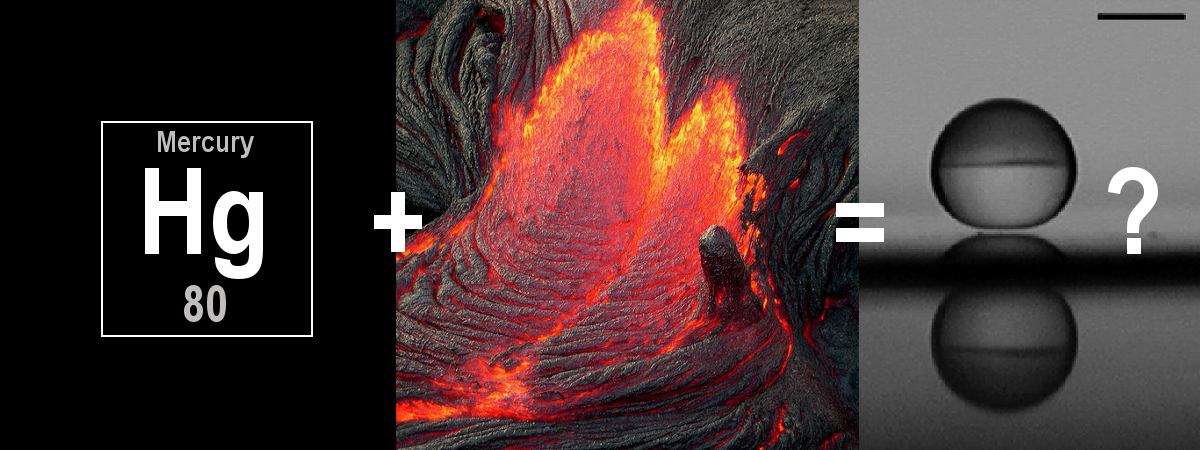
    That’s an interesting thought experiment, but hopefully no one tries it any time soon given mercury’s toxicity. So, what might happen? Mercury has a boiling point just under 630 Kelvin, and, although the temperature of molten lava varies, it’s between 970 and 1470 Kelvin when it first erupts. So mercury would definitely vaporize (i.e. boil) on contact with lava. (Again, this is very bad for anyone nearby.) If you’re curious what boiling liquid mercury looks like, wonder no further.

    Molten lava is much, much hotter than the boiling point of mercury, though, so there’s a possibility that the mercury won’t boil away instantly. This is because of the Leidenfrost effect, where a thin layer of vapor forms between a liquid and an extremely hot surface. The vapor has such low friction that the liquid can essentially skate across a surface, and it doesn’t boil away instantly because the vapor insulates it from the extreme heat. After some digging, I found a paper that placed the Leidenfrost temperature of mercury between about 850 and 950 Kelvin, meaning that fresh lava is probably hot enough to generate mercury Leidenfrost drops.

    So pouring a lot of mercury on lava will probably result in some boiling, but there’s also a good chance that it will form a bunch of skittering mercury droplets that will stick around awhile before they evaporate into toxic mercury gas. That said, it’s a lot easier and safer to watch awesome Leidenfrost drop videos with other liquids. (Collage credit: N.Sharp; images sources: Z. T. Jackson, and A.Biance)

  • Featured Video Play Icon

    When Lava Meets Ice

    What happens when lava meets ice or water? Artists and geologists are working together to explore these interactions by melting crushed basalt and pouring it onto different substrates. Ice is their classic example; instead of melting instantly through the ice, the lava is so hot that it creates a layer of steam between it and the ice. This steam helps the lava flow due to lower friction while also insulating the ice from the lava. It’s an example of the Leidenfrost effect. The end result is a very bubbly lava flow thanks to the steam trying to escape through the viscous lava. (Video credit: Science Channel; submitted by @jchawner)