Tag: instability

  • Featured Video Play Icon

    “Magic Fluids”

    In his short film, “Magic Fluids,” Roman De Giuli uses cyan, magenta, and yellow paints to generate a rainbow of macro colors. All the fluid motion you see is a practical effect, painstakingly created by layering paints and flow mediums of different densities. Like in Siqueiros’ “accidental painting” technique, the less dense paints will eventually rise through the upper layers and spread. De Giuli uses the effect for its motion, but the same physics is key for many artists who use acrylic pouring to paint. (Video and image credit: R. De Giuli)

  • Wave Clouds in the Front Range

    Wave Clouds in the Front Range

    Last Sunday night metro Denver was treated to a rare sight: clouds resembling breaking waves formed near sunset. These are Kelvin-Helmholtz clouds, and the comparison to ocean waves is apt, since the same physics is behind both. Winds were unusually calm near the ground Sunday night, but strong winds blew at the altitude just above the lower cloud layer. That velocity difference created strong shear where the two air layers met. With the cloud layer in place to differentiate the slower-moving air from the faster, we can what’s normally invisible: how the two air layers mix.

    The Denver Post has several more views of the wave clouds from around the area, and you can learn lots more about the Kelvin-Helmholtz instability here. (Image credit: R. Fields; via the Denver Post)

  • Featured Video Play Icon

    Driving Instabilities with a Twist

    Imagine that you want to study how two fluids mix when a lighter fluid is pushed into a denser one. Conceptually, it’s a straightforward situation. It would be like having a layer of oil under a layer of water and watching what happens. But how do you do that experimentally? Oil won’t naturally stay under water. If you flip the container over to start the experiment, you’ve added a bunch of extra motion from the rotation. And if you use a barrier to separate the two layers and then pull it out, you’ve added extra shear where they meet.

    To deal with challenges like these, researchers at Lehigh University spent five years designing and building the rotating wheel apparatus you see in the video above. Instead of relying on gravity to force the lighter fluid into a denser one, this set-up uses centrifugal force. The test fluids start out on the loading wheel, spinning in their naturally stable configuration. Then once both sides are rotating at the desired speed, the track flips, transferring the experiment onto the other wheel, which rotates in the opposite sense. This gives the fluids a sudden change in the direction of the centrifugal force and, once the apparatus completes shake-down, should give us new insight into the sort of mixing seen in fusion. (Video credit: Lehigh University; see also Turbulent Flow Design Group)

  • Pollock Avoided Coiling

    Pollock Avoided Coiling

    Streaks of black and gray in the Jackson Pollack painting the researchers studied.

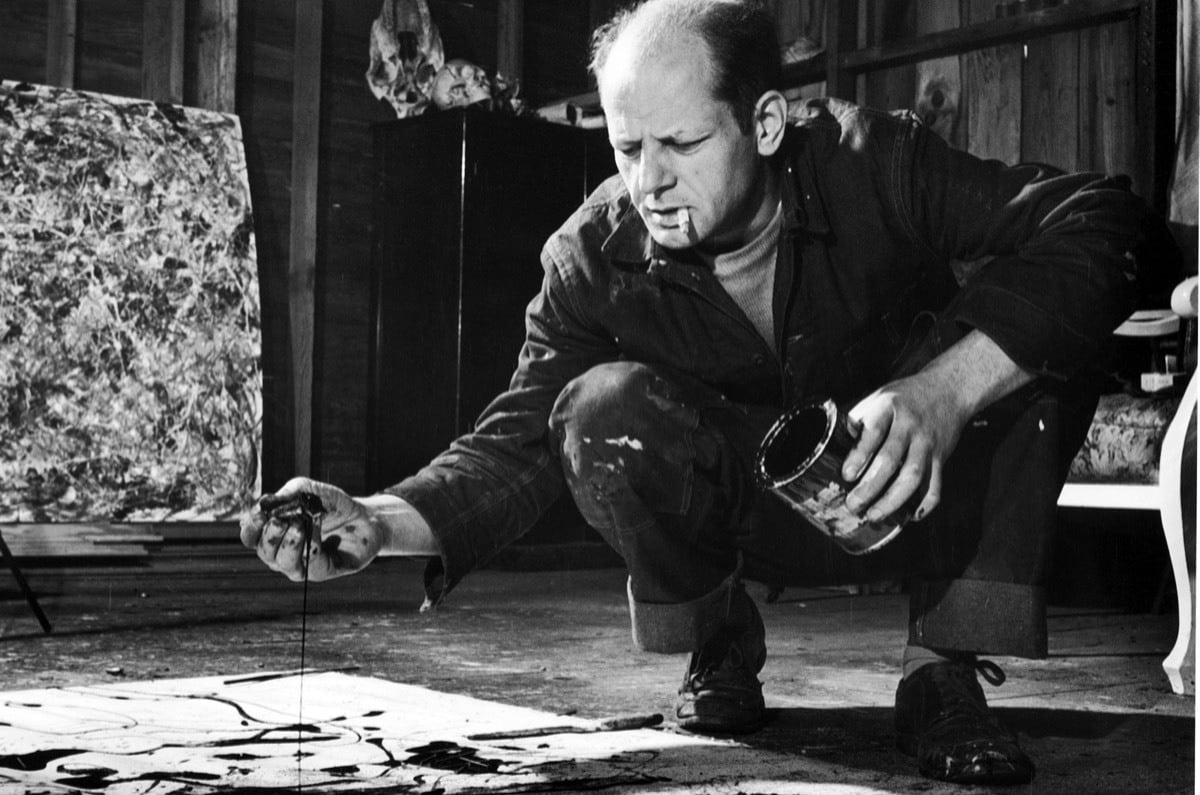
    Artists are often empirical masters of fluid dynamics, as they must be to achieve the effects they want. Jackson Pollock was particularly known for his so-called dripping technique, in which he dropped filaments of paint from brushes, cans, and even syringes as he moved around a horizontal canvas. (Scientifically speaking, this wasn’t really dripping since the paint wasn’t breaking up into droplets for the most part, but that’s another story.)

    What Pollock was doing, fluid dynamically speaking, is the subject of a new study. Researchers analyzed historical footage of Pollock painting to measure the typical heights from which he dropped paint and the speed at which he moved. Then they built their own apparatus to mimic the painting style with modern paints and study the flow regime Pollock’s technique falls into. 

    Since much of the paint falls in a steady stream, like syrup falling onto pancakes, the researchers wondered whether the paint was likely to coil the way other viscous fluids do. What they found, however, is that Pollock’s choice of height and speed when applying paint seems deliberately designed to avoid the coiling instability. That fact suggests that art historians might identify forged paintings in part from the presence of too much coiling among the paint filaments. (Image credits: photo – M. Holmes/LIFE, painting – J. Pollock; research credit: B. Palacios et al; via Ars Technica; submitted by Kam-Yung Soh)

  • Trails from a Delta Wing

    Trails from a Delta Wing

    Top-down view of green and red dyes streaming off a delta wing

    Rhodamine (red) and fluorescein (green) dyes highlight the complex flows around a delta wing. To visualize the flow, researchers painted the apex of the delta wing with rhodamine, which gets drawn into the core of the wing’s leading edge vortex. The green fluorescein dye was added to the wing’s trailing edge, where it gets pulled into the secondary structure of the vortices. A laser illuminates the flow, making even the most delicate wisps of dye shine. As the wake behind the wing develops, the dyes reveal growing instabilities along the vortices. Given time and space, these instabilities will grow large enough to destroy any order in the wake, leaving behind turbulence. (Image and research credit: S. Morris and C. Williamson; see also poster)

  • Featured Video Play Icon

    A Broken Monitor’s Fingers

    In this short video, the artists of Chemical Bouillon explore a broken LCD monitor and its liquid crystals. By sandwiching the fluid between thin, transparent sheets, they create dendritic shapes as the liquid crystals and other fluids (air? ink?) push into one another. There’s a lot here that’s likely connected to the Saffman-Taylor instability, but without knowing more details on the ingredients and set-up, it’s hard to speculate beyond that. (Video and image credit: Chemical Bouillon)

  • The Snowy Salt of the Dead Sea

    The Snowy Salt of the Dead Sea

    At nearly 10 times saltier than the ocean, the Dead Sea is one of the saltiest places on Earth, and since 1979, scientists have observed it growing even saltier as snow-like salt precipitates to the bottom of the lake. Numerical simulations have now confirmed that this salt-fall is the result of double-diffusive salt fingers.

    Here’s how the mechanism works: the upper layer of the lake is made up of warmer, saltier water covering deeper, colder waters. As the sun evaporates water near the surface, what’s left behind becomes saltier and heavier. Tiny pockets of this warm, salty water sink into colder regions and rapidly cool. The heat can move a lot more quickly than the salt, though, and since cold water cannot hold as much salt as warmer water, some of the salt precipitates out. That forms the falling crystals scientists observe sinking to the bottom of the lake. (Image and research credit: R. Ouillon et al.source; via Physics World; submitted by Kam-Yung Soh)

  • Featured Video Play Icon

    Fingers of Clay

    Take a mixture of a viscous liquid – like clay mud – and squeeze it between two glass plates and you’ll create a mostly-round layer of liquid. As you pry the two glass plates apart, air will push its way into that layer, forcing through the mud in a dendritic pattern. This is called the Saffman-Taylor instability or viscous fingering. It occurs because the interface between the air and mud is unstable.  (Image and video credit: amàco et al.)

  • Oil-on-Water Impact

    Oil-on-Water Impact

    Although many people have studied droplet impacts over the years, there’s been remarkably little work done with oil-on-water impacts. One of the things that makes this situation different is that the oil and water are completely immiscible, which means we can see aspects of the impact process that are invisible with, say, water-on-water impacts.

    The animation above shows an underwater view of the oil droplet’s impact. The energy of the initial impact creates an expanding crater and an unstable crown splash. That crown splash contains both water and oil. After it ejects some droplets, the rim stabilizes, but we can still see small perturbations along its edge as it starts to retract. In the water, high surface tension damps out these perturbations. Not so for the oil! As the crater retracts, the small disturbances along the rim get stretched into mushroom-shaped fingers that point inward toward the impact site. Because the index of refraction is different between oil and water, we can see the fingers clearly near the end of the animation. (Image and research credit: U. Jain et al.; submitted by Utkarsh J.)

  • Floccing Particles

    Floccing Particles

    Adding particles to a viscous fluid can create unexpected complications, thanks to the interplay of fluid and solid interactions. Here we see a dilute mixture of dark spherical particles suspended in a layer of fluid cushioned between the walls of an inner and outer cylinder. Initially, the particles are evenly distributed, but when the inner cylinder begins to rotate, it shears the fluid layer. Hydrodynamic forces assemble the particles together into loose conglomerates known as flocs. Once the particles form these log-like shapes, they remain stable thanks to the balance between viscous drag on particles and the attractive forces that pull particles toward one another. (Image and research credit: Z. Varga et al.; submitted by Thibaut D.)