Tag: geology

  • Scallops and Erosion

    Scallops and Erosion

    Although we often think of solids as immovable in the face of flow, the motion of air and water sculpts many parts of our world. One common pattern, seen both on surfaces that melt and those that dissolve into a flow, is called scalloping. Mathematical analysis shows that flat surfaces exposed to a flow that melts or dissolves them unavoidably develop these scallops. The surface becomes rougher as the scallops form, but the instability that drives them only works up to a specific level of roughness. Instead of the scallops becoming deeper and deeper, the flow shifts as the surface changes. Peaks in the surface erode faster than the valleys, which tends to keep the scallops relatively uniform in depth after they’ve formed. Scallops like these are often seen in soluble rocks like limestone or marble as well as in snow and ice. (Image credit: Seattle Times, G. Smith; research credit: P. Claudin et al., L. Ristroph)

  • Featured Video Play Icon

    Plate Tectonics

    We don’t typically think of the ground beneath our feet as anything but solid, but over geologically long time scales, even mountains can flow. Buoyant convection inside the Earth’s mantle is thought to drive the plate tectonics that have shaped the Earth as we know it. The video above explains some of the major processes and events that shaped the modern North American continent, including collisions, subduction, volcanism, and erosion. (Video credit: Ted-Ed)

  • Galapagos Week: Lava Flows

    Galapagos Week: Lava Flows

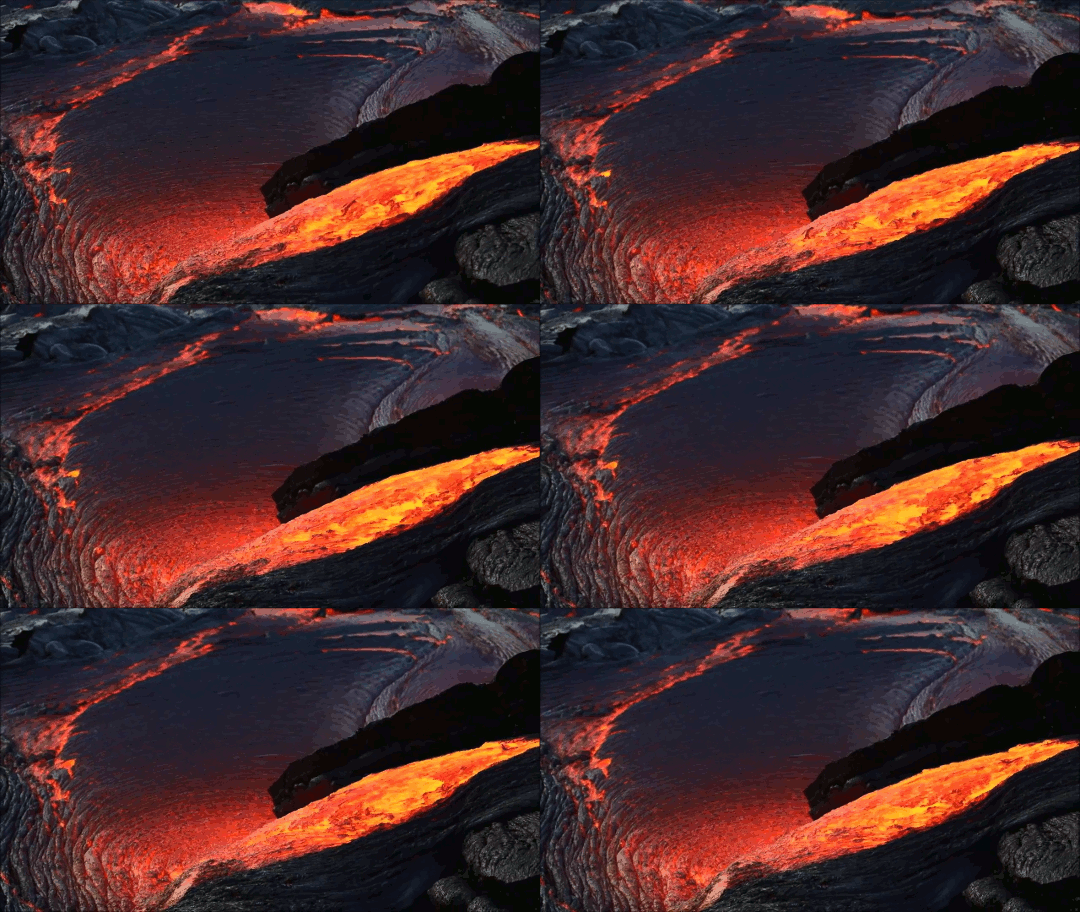
    The Galapagos islands are geologically similar to the Hawaiian islands; both are archipelagos that were born and continue to be formed by lava flows originating from a volcanic hot spot. Lava from this type of volcano is high in basalt content, which affects both its flow properties and the formations it creates. Geologists have actually borrowed words from the Hawaiian language to describe the two main kinds of lava formations seen in basaltic flows: pahoehoe and a’a.

    Pahoehoe formations tend to be relatively smooth and often leave behind a pattern of rope-like coils (below). In contrast, a’a lava features are sharp, rough, and challenging to traverse. Both flows are gravity-driven, and which features a given eruption forms depends on many factors. Many flows will even begin with a pahoehoe section that stretches for several kilometers before transitioning to an a’a structure. Researchers believe the transition occurs when the lava crystallizes enough to develop a yield-strength, meaning that it will behave like a solid until enough force is applied to make it flow again. Toothpaste, ointment, and mud are similar so-called yield stress fluids which will only flow after a critical force is applied.  (Image credits: lava flow – Epic Lava Tours, source; pahoehoe lava – J. Shoer)

    Galapagos Week continues tomorrow here on FYFD. Check out previous posts.

  • Review: “ABCs From Space”

    Review: “ABCs From Space”

    For me, one of the most fun aspects of studying science is seeking out examples of it in the world around us. Adam Voiland – who writes for NASA Earth Observatory, one of FYFD’s favorite sources for excellent fluids in action – takes this a step further with his children’s book “ABCs From Space: A Discovered Alphabet”. Voiland has sought out satellite imagery from around the world to illustrate all twenty-six letters, creating a lovely book for budding scientists of all sorts.

    Each letter has its own full-page image with no added text, like the G and H shown above. Younger children will have fun identifying and tracing out each letter. The back of the book provides more detail for older kids and adults, including brief descriptions of where and what each image shows, a map of all image locations, and some FAQs about satellite imagery and the geology, meteorology, and earth science on display. There are enough specifics to satisfy casual interest, but I suspect that science-inclined adults will find the book a fun springboard for more in-depth discussions with curious kids.

    Fluid dynamics itself makes a solid showing in the book. Several letters are formed by vortices (like G above) and various types of clouds, including the ship track clouds (like H) that form when water condenses on aerosols released by ship exhaust. There are also meandering rivers, creeping glaciers, and erosion features among the letters.

    I’m often asked about resources for teaching kids about fluid dynamics, and Voiland’s book is a great option for introducing that subject, as well as many other fields of science. (Image credits: A. Voiland/Simon & Schuster)

    Disclosure: I received a review copy of this book but was not otherwise compensated by the author or publisher. All opinions are my own. Additionally, this post contains affiliate links. Purchases made using these links do not cost you anything extra but may provide FYFD with a commission. Thanks!

  • Featured Video Play Icon

    Inside Earth’s Core

    Without our magnetic field, life as we know it could not exist on Earth. Instead, our atmosphere would be stripped away and the surface would be bombarded by charged particles in the solar wind. Relatively little is known about the dynamo process that governs our magnetic field, though it’s thought to be the result of liquid iron moving in the Earth’s outer core. The video above shows a slice of a recent 3D simulation of this liquid iron segment of our core. The colors show variations in the temperature, revealing vigorous convection in the core. This motion, combined with the spinning of the Earth, is the likely source of our magnetic field. Researchers hope that simulations like these can help us understand features we observe in our magnetic field – like local variations in field strength and the pole reversals in our geological record. (Video credit: N. Schaeffer et al.; CNRS via Gizmodo)

  • Surge Flows

    Surge Flows

    Sandy beaches can be a great place to play with neat flows. In a recent video, Frank Howarth describes playing with beach rivers on the Oregon coast and observing a surge flow there. Under the right conditions, a current flowing over sand will build up sand ripples large enough that they form miniature dams in the flow. This traps additional water, which eventually collapses the sand ripples, releasing a surge of water. The surge tends to smooth out the sand and cause the ripple-making process to start over. It’s a fairly unusual phenomenon, but it’s one known to happen seasonally in a few specific places, like at Medano Creek in Colorado’s Great Sand Dunes National Park. There the snowmelt-fed creek surges during the late spring and early summer, releasing a fresh wave every 20 seconds or so. (Image credit: F. Howarth, source; h/t to Sebastian E.)

  • Featured Video Play Icon

    Flowing Ice

    Glaciers are kind of bizarre. Despite being very solid, they still flow, sometimes on the order of a meter a day. This flow is driven by gravity and the incredible weight of the dense ice. Near the base of the glacier, the pressure is great enough to cause some localized melting. (Very high pressures actually decrease the melting point of water.) Glaciers also move through plastic deformation – this is the internal slippage Joe refers to in the video when he compares glaciers to a deck of cards. Despite their vast differences from typical fluid flows, glacial flows are often still described by the same equations of motion used in the rest of fluid dynamics! (Video credit: It’s Okay to Be Smart; via PBS Digital Studios)

  • Watching Flow Inside Rock

    Watching Flow Inside Rock

    Flow through porous substances has been a major interest in fluid dynamics for the last hundred years because rocks are porous. For most of that period, we’ve used Darcy’s law to calculate how a fluid flows through pores in a rock. (Incidentally, it can also be used for determining the perfect length of time for dunking a cookie in milk.) Often, however, there is more than one fluid in a pore – for example, both a liquid and a gas could be trapped there. In that case, researchers made a few assumptions that allowed them to extend Darcy’s law for these multiphase situations. For a long time, that was the best anyone could do because it was impossible to observe what’s actually happening in the pores inside an actual rock.

    Recently, however, scientists have begun observing these multiphase flows inside sandstone pores using x-ray imaging. They’re only able to take an image every 45 seconds or so, but even that is frequent enough to show that the flow is surprisingly unsteady. An example image is shown above. The colored areas show pores filled with nitrogen inside the rock. Brine is also being injected into the rock but not being shown. The colors indicate how connected the nitrogen-filled pores are to other pores nearby. Red areas are highly connected; blue have moderate connections; and green areas are smaller and have fewer connections. The network connections inside the rock change relatively rapidly, even with steady-state injection conditions. That varying connectivity implies that some of the injection energy is going into shifting interfaces around rather than actually moving the fluids through the pores. More work will be needed to unravel what’s really happening inside the porous network, but the results have far-reaching implications for understanding groundwater filtration, fossil fuel extraction, and, in the future, the possibility of carbon sequestration. (Image credit: C. Reynolds et al., source; submitted by Simon D.)

  • Glacial Remains

    Glacial Remains

    The high walls of this alpine canyon were cut by flowing glacial ice. This type of amphitheater-shaped valley is known as a cirque. The photo shows one of the Chicago Lakes on Mount Evans in the Colorado Rockies. The glacier that once sat here carved the steep walls you see in the background but also hollowed out a series of depressions like the ones shown in the figure below. When temperatures warmed and the glacier melted, it left behind a series of three small lakes, or tarns, like the one in the photo above. Cirques are found throughout the mountain ranges of the world. (Image credit: Mt. Evans – J. Shoer; cirque formation – DooFi)

    image
  • When the Mediterranean Flooded

    When the Mediterranean Flooded

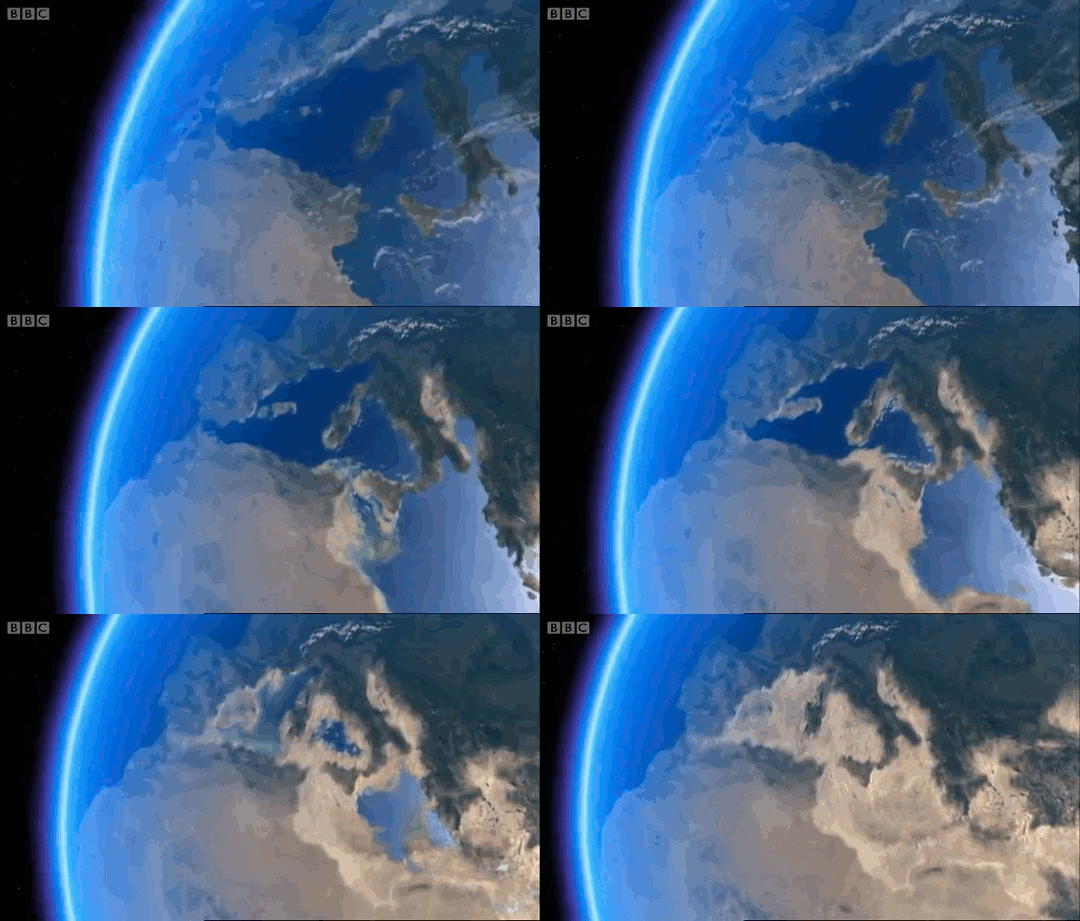
    Around 6 million years ago, the African and Eurasian plates moved together, cutting the Mediterranean Sea off from the Atlantic. Without an influx of water from the Atlantic, evaporation began removing more water from the Mediterranean than rivers could replace. The sea dried out almost completely over the course of a couple thousand years.

    About 5.3 million years ago, the Straits of Gibraltar reopened, creating a massive flood into the Mediterranean known as the Zanclean Flood. Water rushed down the straits and into the Mediterranean at speeds as high as 40 m/s (90 mph). At its peak, the Zanclean Flood is estimated to have reached rates 1000 times greater than the volumetric flow rate of the Amazon River.

    A similar breach flood occurred in the Black Sea within the past 10,000 years when the Bosporus became unblocked. That flood likely had a devastating impact on Neolithic societies in the area and may be the inspiration for the floods described in the Epic of Gilgamesh and the Bible. (Image credit: BBC, source)