These strange flower-like formations appear in a former limestone quarry in France. The black that you see is bitumen, or asphalt. These dendritic structures appear in spots where the rock has fractured. Originally, two rock faces met here, with a thin layer of bitumen glued between them. As one face pulled away, air began to seep into the space between, slowly injecting itself into the more viscous bitumen. Just as we observe in the laboratory, the air and bitumen formed viscous fingers, creating a classic pattern known as the Saffman-Taylor instability. It’s so cool to see an example of this in nature! You can see more photos of the formations here. (Image credit: P. Thomas)
Tag: geology

Lava Flowing
Lava flows like these Hawaii’an ones are endlessly mesmerizing. This type of flow is gravity-driven; rather than being pushed by explosive pressure, the lava flows under its own weight and that of the lava upstream. In fact, fluid dynamicists refer to this kind of flow as a gravity current, a term also applied to avalanches, turbidity currents, and cold drafts that sneak under your door in the wintertime. How quickly these viscous flows spread depends on factors like the density and viscosity of the lava and on the volume of lava being released at the vent. As the lava cools, its viscosity increases rapidly, and an outer crust can solidify while molten lava continues to flow beneath. Be sure to check out the full video below for even more gorgeous views of lava. (Image/video credit: J. Tarsen, source; via J. Hertzberg)

Pyroclastic Flow
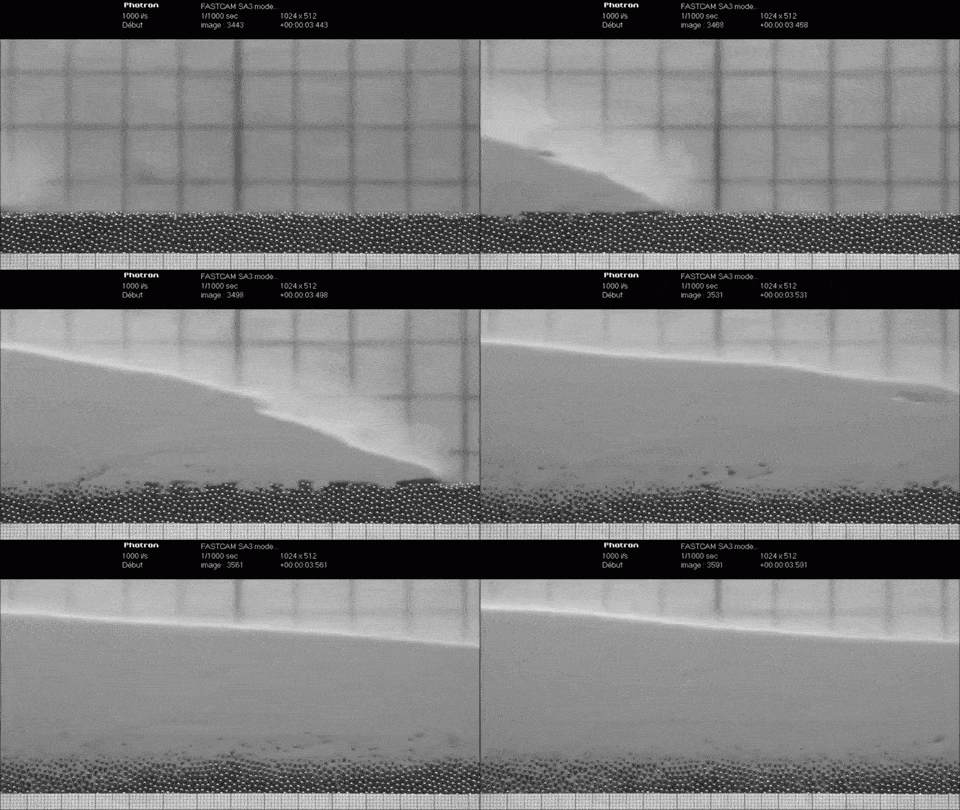
Major volcanic eruptions can be accompanied by pyroclastic flows, a mixture of rock and hot gases capable of burying entire cities, as happened in Pompeii when Mt. Vesuvius erupted in 79 C.E. For even larger eruptions, such as the one at Peach Spring Caldera some 18.8 million years ago, the pyroclastic flow can be powerful enough to move half-meter-sized blocks of rock more than 150 km from the epicenter. Through observations of these deposits, experiments like the one above, and modeling, researchers were able to deduce that the Peach Spring pyroclastic flow must have been quite dense and flowed at speeds between 5 – 20 m/s for 2.5 – 10 hours! Dense, relatively slow-moving pyroclastic flows can pick up large rocks (simulated in the experiment with large metal beads) both through shear and because their speed generates low pressure that lifts the rocks so that they get swept along by the current. (Image credit: O. Roche et al., source)

Sand Ripples in Tidal Flats
Sand, winds, and waves can interact to form remarkable and complex patterns. These sand ripples from the tidal flats of Cape Cod are a testament to such interactions. When a fluid like air or water flows over a flat bed of sand, it can shear and lift grains of sand, moving them to a new location. Very quickly, turbulence within the flow disturbs the initially smooth surface and begins to form the wavelike crests we see. Because the change in surface shape alters the nearby air or water flow, there is a trend toward self-organization and persistence. In other words, once the ripples form, they’re reinforced by their effect on the wind or water that formed them. Once rippled, the surface does not tend to smooth back out. (Image credit: N. Sharp; research credit: F. Sotiropoulos and A. Khosronejad)

Underwater Landslides
Turbidity currents are a gravity-driven, sediment-laden flow, like a landslide or avalanche that occurs underwater. They are extremely turbulent flows with a well-defined leading edge, called a head. Turbidity currents are often triggered by earthquakes, which shake loose sediments previously deposited in underwater mountains and canyons. Once suspended, these sediments make the fluid denser than surrounding water, causing the turbidity current to flow downhill until its energy is expended and its sediment settles to form a turbidite deposit. By sampling cores from the seafloor, scientists studying turbidites can determine when and where magnitude 8+ earthquakes have occurred over the past 12,000+ years! (Video credit: A. Teijen et al.; submitted by Simon H.)
Do you enjoy FYFD and want to help support it? Then please consider becoming a patron!

Pluto: Subsurface Convection
Pluto’s rich and unexpected surface features indicate the dwarf planet is still geologically active. This is one of the largest surprises of the New Horizons mission because it was assumed that Pluto was too small, too isolated, and too old for such activity. Instead, its cryovolcanoes and surface convection cells point to significant and vigorous convection in Pluto’s mantle, likely heated by the decay of radioactive elements in its core. The simulation above shows a representation of mantle convection on Earth, simulated over billions of years.
Mantle convection is described by the dimensionless Rayleigh number, which compares the effects of thermal conduction to those of convection. Above a fluid’s critical Rayleigh number, convection is the driving process in heat transfer. In Pluto’s case, if one assumes a mantle of pure water ice, the Rayleigh number is about 1600, barely enough to surpass the critical point where convection dominates. If, instead, one assumes a mantle containing 5% ammonia, the resulting composition has a Rayleigh number of more than 10,000–well past the critical point and large enough to support the vigorous convection necessary to explain Pluto’s surface features. (Video credit: W. Bangerth and T. Heister; Pluto research credit: A. Trowbridge et al.; via Purdue University)
This concludes FYFD’s week of exploring Pluto’s fluid dynamics. You can see previous posts in the series here.

Pluto: Convection in Sputnik Planum
The icy plain of Sputnik Planum, located in Pluto’s heart-shaped Tombaugh Reggio, is criss-crossed with troughs that divide the plain into polygons. The current interpretation of these features is that they are the result of thermal convection. As with Rayleigh-Benard convection cells on Earth, the interior of the polygons is formed by the upwelling of warmer, buoyant material, and the troughs between cells mark locations where cooled material convects back into the mantle. On Pluto, these cells consist of nitrogen ice (and occasional water ice like the dirty black chunk seen in the upper right photo) that slowly rises and sinks from the planet’s surface, constantly refreshing the surface features. This would explain why Sputnik Planum is missing evidence of typical older features like impact craters. (Image credits: NASA/JHU APL/SwRI)
Join FYFD all this week for a look at fluid dynamics and planetary science on Pluto! Check out the previous posts here.

Pluto: Cryovolcanoes

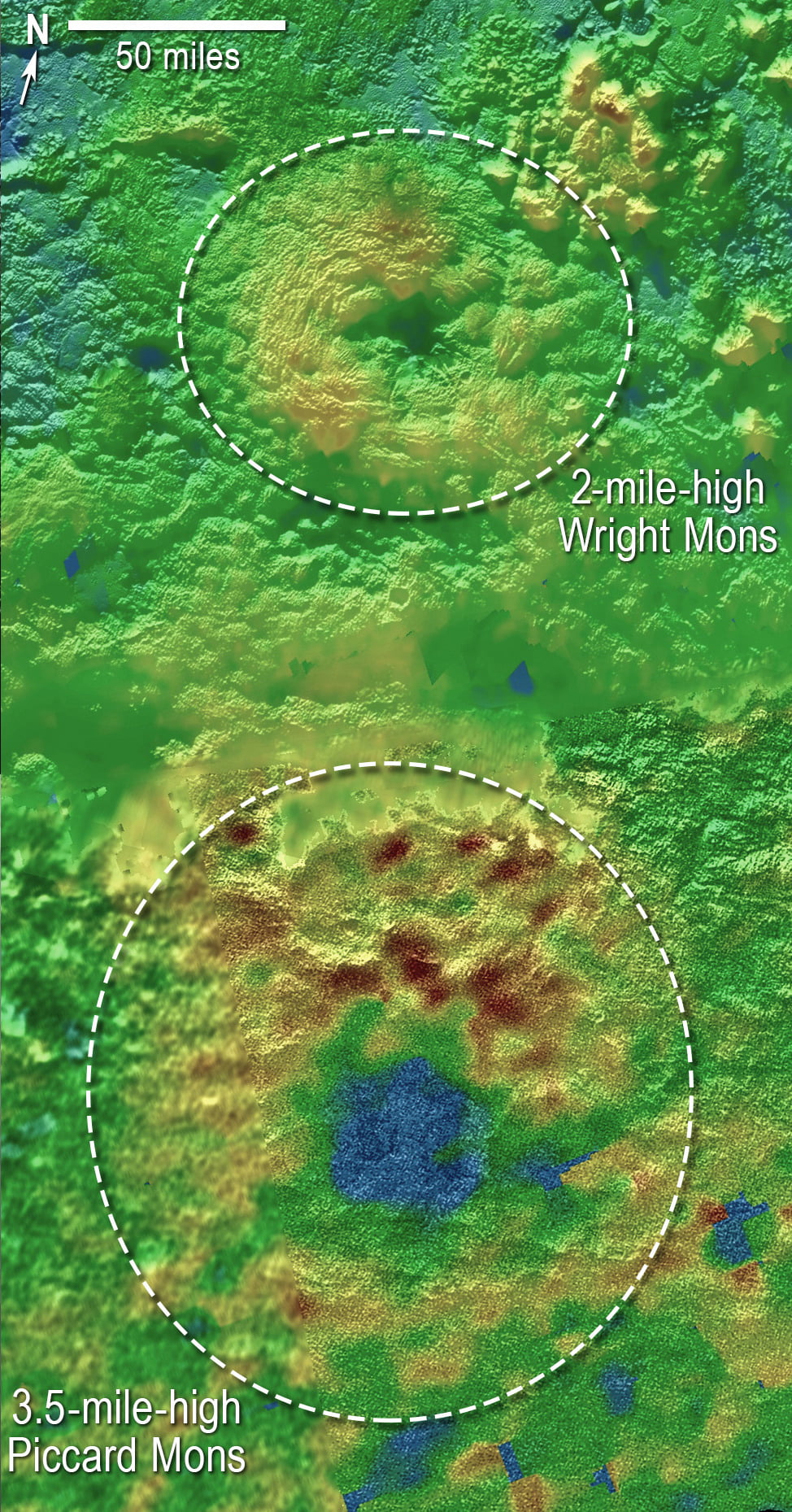
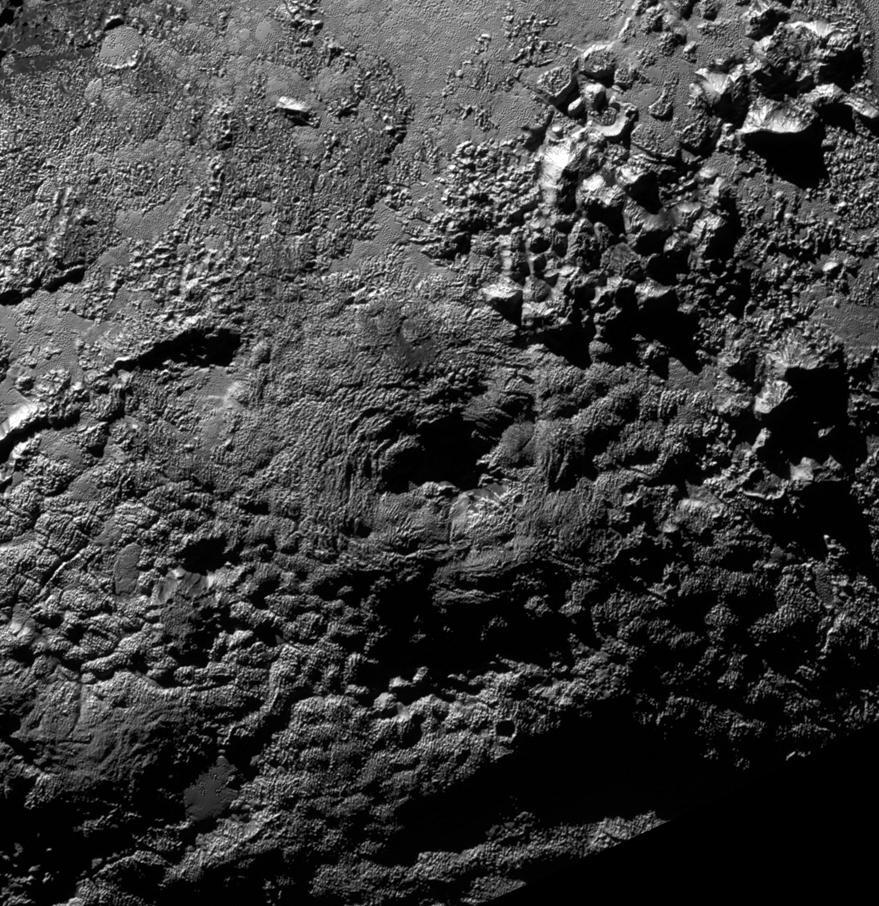
Since its flyby last summer, NASA’s New Horizons mission has had planetary scientists questioning all our assumptions about Pluto and its fellow cold, icy worlds on the outskirts of the solar system. The two mountainous features above, the 4-km tall Wright Mons and 5.6-km tall Piccard Mons, are part of the mystery. Both mountains have a large depression in the middle, and their appearance from orbit is consistent with volcanoes seen on Earth and other planets. But instead of rock, these mountains are formed from water ice, and rather than spewing hot magma, it’s believed that these mountains are cryovolcanoes that erupt with a slurry of water, nitrogen, ammonia, or methane. Since no active eruptions were recorded during the flyby, scientists cannot be certain of the hypothesis, but it does explain the observed features. Check out the video below for a terrestrial demonstration of a “cryovolcano”. (Photo credits: NASA/JHU APL/SwRI; video credit: A. Cheri/U. Wash)
Join FYFD all this week for a look at the fluid dynamics and planetary science of Pluto!

How the Grand Canyon Formed
The Grand Canyon is a monument to the power of water, air, and time. In this video from It’s Okay To Be Smart, Joe Hanson describes the formation of the Grand Canyon – from the ancient oceans that created its many layers to the tectonic upthrusts that eventually created the Colorado River that continues to cut through the Canyon’s rocks today. Fluid dynamics play a major role in the geology of the Grand Canyon, whether it’s in the mantle convection that helps drive plate tectonics or the sedimentation that builds and erodes rock layers. (Video credit: It’s Okay To Be Smart)

Barchan Dunes

Crescent-shaped barchan dunes are common on both Earth (top image) and Mars (bottom image). They form in areas where the wind comes predominantly from one direction. As the wind blows, it deposits sand on the gently sloping windward face of the dune. The leeward face of the dune is steeper; its shape is set by the sand’s angle of repose–essentially the steepest angle the sand can maintain without an avalanche. Barchan dunes are very mobile, moving between one and a hundred meters per year. They have also been seen moving through one another or moving along in formation. (Image credits: Google Earth, NASA/JPL/University of Arizona)