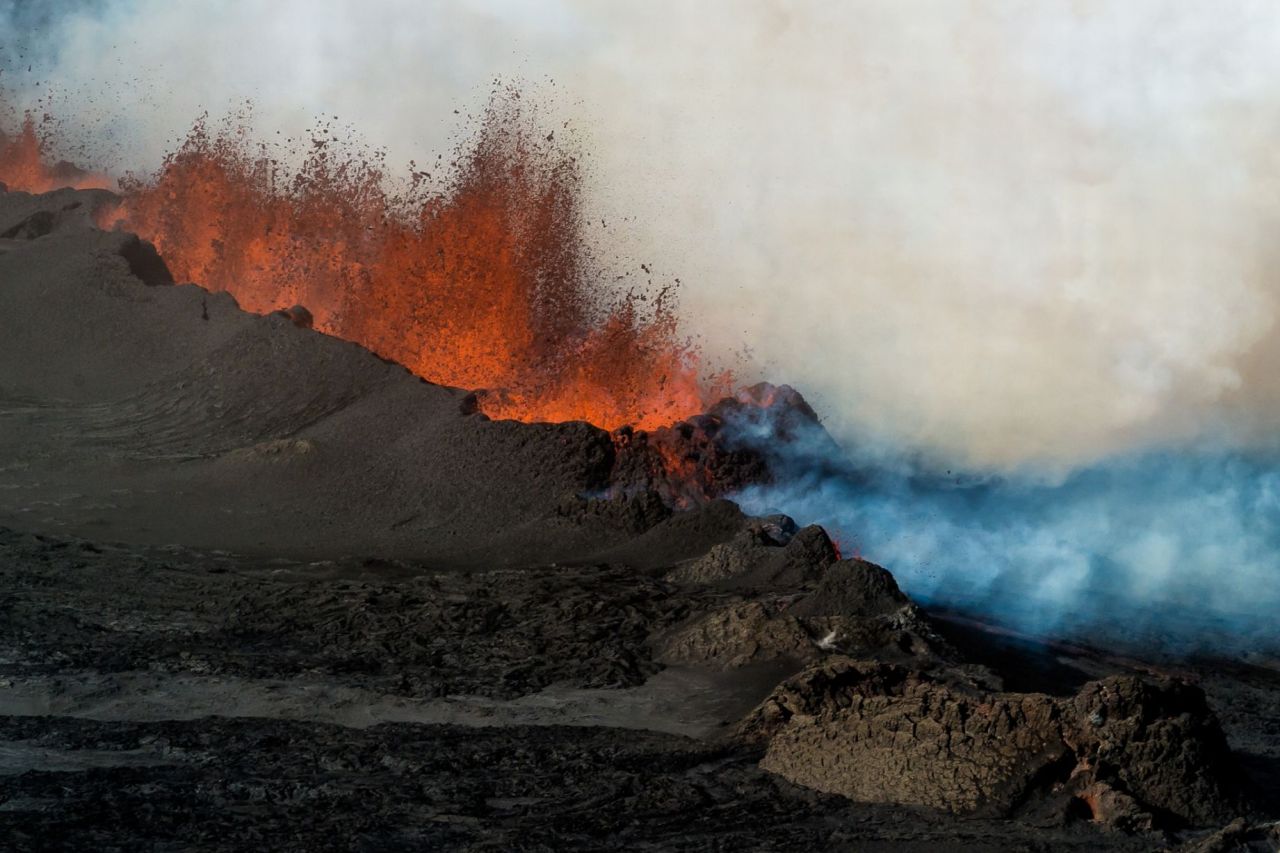
I thought I was done with volcanoes for this week, but DJI’s aerial footage from Iceland’s Bardarbunga eruption is too fantastic not to share. The eruption is over a month old now and more than 25,000 earthquakes have been registered in Iceland since this eruption began. The lava field covers more than 46 square kilometers, and experts remain unsure how long the eruption will continue. The lava itself is a basalt, which is lower in viscosity than more silica-rich lava. This lower viscosity means that the gases dissolved in the rising magma can escape more easily, like carbon dioxide fizzing out of a soda. If the lava’s viscosity were higher, those dissolved gases would generate a more explosive eruption as they try to escape. (Video credit: DJI; via Wired)
Tag: geology

Lava Physics
Lava is rather fascinating as a fluid. Lava flow regimes range from extremely viscous creeping flows all the way to moderately turbulent channel flow. Lava itself also has a widely varying rheology, with its bulk properties like viscosity and its response to deformation changing strongly with temperature and composition. As lava cools, instabilities form in the fluid, causing the folding, coiling, branching, swirling, and fracturing associated with different types and classes of lava. (Image credit: E. Guddman, via Mirror)

Glacier Flows
These astronaut photos show Patagonian glaciers as seen from space. Glaciers form over many years when snow accumulates in larger amounts than it melts or sublimates. Over time the snow collects and is compacted into a dense ice which slowly flows downslope due to gravity. Many of the dark streaks in the photos are moraines, sediment formations deposited by the movement of the ice. Lateral moraines often line the edges of a glacier, and when two or more glaciers flow together, like in the lower left corner of both photos, the lateral moraines of each of the glaciers combine to form a medial moraine running through the combined glacial flow. (Photo credits: M. Hopkins and K. Wakata)

Engineering Sediment Transport
Sediment transport via fluid motion is a major factor in engineering, geology, and ecology. This video shows two common forms of sediment transport: particle suspension and saltation. Suspension, in which the fluid carries small solid particles, is visible high in the blue water layer. Saltation occurs closer to the surface when loose particles are picked up by the flow before being redeposited downstream. Watch some of the individual particles near the surface to see the process. Kuchta has several more demo videos of flow in this desktop flume, sold by Little River Research & Design. (Video credit: M. Kuchta; submitted by gravelbar)

How Erosion Shapes a Flow
Erosion creates all manner of strange shapes as wind and water cut away at solids. But why does the interaction of the fluid and solid result in the geometries we observe? Above is a collage from an experiment in which a soft clay sphere was immersed in a water tunnel. After 70 minutes, the sphere had worn into a roughly conical body (Image A) reminiscent of a re-entry capsule. Images B and C show instantaneous streaklines around the clay at 10 minutes and 70 minutes, respectively. Images D and E show diagrams of the flowfield seen in B and C. Fast-moving flow above and below the stagnation point (SP) wears the front of the body into a conical shape, whereas the recirculating vortices aft of the separation point (SL) create a sloped shoulder and flattened back in the clay. The results are consistent with a model in which erosion tries to create uniform shear stress at the solid surface – essentially the process is keeping the frictional force between the fluid and air constant along the surface. This makes sense. If a region’s shear stress is higher, it will be worn more quickly than the surrounding solid, causing it to recede and experience decreased shear stress (relative to the surrounding area) as a result. (Image credit: L. Ristroph et al.)

Fluids Round-up – 20 October 2013
Some very cool fluids applications in this week’s fluids round-up. On to the links!
- Like many colleges, MIT has campus myths about those unbelievably windy spots. But, unlike many others, they have a CFD analysis deconstructing the myths.
- Even rocks can behave like fluids sometimes. Check out this article from @s_i_r_h_c on fluid instabilities left behind in rocks.
- Reader Julian de Charentenay demonstrates some DIY aerodynamic analysis on Pixar’s Lightning McQueen. One of the neat features here is using photos of an object to construct a 3D model, a technique I used in my own research at one point.
- Physics.org explains why teapots drip.
- Phys.org reviews a paper suggesting that fluid dynamics influenced the evolution of lung structure.
- io9 discusses new research on how the brain gets rid of waste products, which includes experiments with flow visualization in mice brains.
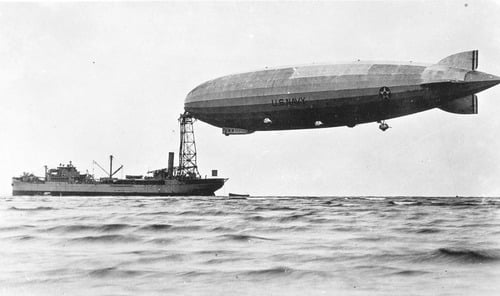
- Finally, our lead image shows the airship USS Los Angeles moored to the USS Patoka and comes from The Atlantic’s In Focus series on airships past and present.
ETA: I somehow forgot to include the first of the upcoming APS presentations to get wide media recognition: Law of Urination, which has shown up all over the place.
(Photo credit: San Diego Air and Space Museum Archive/In Focus)
Geyser Physics
Three basic components are necessary for a geyser: water, an intense geothermal heat source, and an appropriate plumbing system. In order to achieve an explosive eruption, the plumbing of a geyser includes both a reservoir in which water can gather as well as some constrictions that encourage the build-up of pressure. A cycle begins with geothermally heated water and groundwater filling the reservoir. As the water level increases, the pressure at the bottom of the reservoir increases. This allows the water to become superheated–hotter than its boiling point at standard pressure. Eventually, the water will boil even at high pressure. When this happens, steam bubbles rise to the surface and burst through the vent, spilling some of the water and thereby reducing the pressure on the water underneath. With the sudden drop in pressure, the superheated water will flash into steam, erupting into a violent boil and ejecting a huge jet of steam and water. For more on the process, check out this animation by Brian Davis, or to see what a geyser looks like on the inside, check out Eric King’s video. (Video credit: Valmurec; idea via Eric K.)

Antarctic Ice Flows

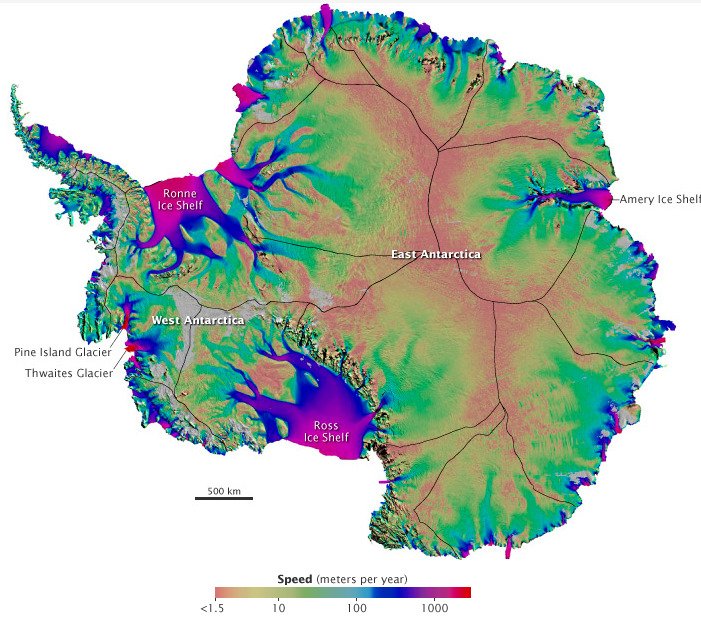
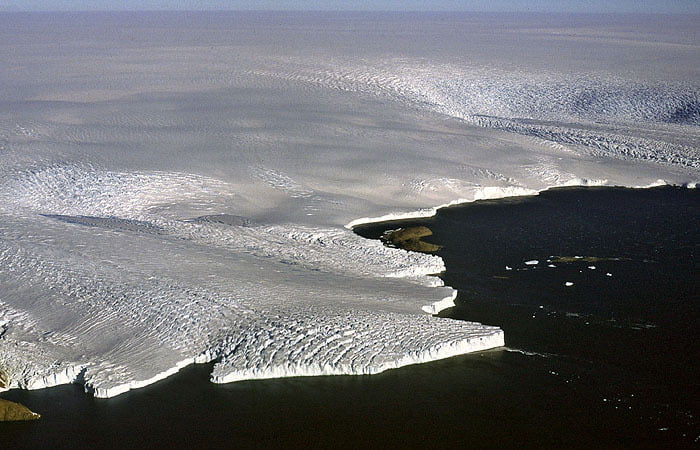
Even frozen ice moves and flows, though too slowly to see with the naked eye. By combining satellite imagery from NASA, JAXA, CSA, and ESA, researchers were able to map the flow of ice across Antarctica, discovering ice streams (shown in blue and purple above) that can move hundreds of meters a year. The dynamics of this motion are still poorly understood, with theoretical advances underway. These ice sheets sit atop bedrock that is itself below sea level. A thin layer of water exists between the ice sheet and the bedrock, acting as a lubricant and allowing the ice to slide against the bedrock. To see animations of Antarctic ice flow, see this compilation film. (Photo credits: E. Rignot/NASA JPL/UC Irvine #; M. J. Hambrey #)

Martian Lava Coils

NASA’s HiRISE spacecraft has sent back images of lava coils left on the surface of Mars. These features form when lava flows of different speeds move past one another; they’re essentially Kelvin-Helmholtz waves–like the ones often seen in clouds–in the lava flow that have solidified into solid rock! On Earth these coils appear about a foot wide; the Martian versions are 100 feet across. (Photo credit: NASA/JPL/University of Arizona; via Wired; submitted by Brian L)
Pāhoehoe Lava
Lava flows come in many varieties but one of the most captivating is the pāhoehoe flow, meaning “smooth, unbroken lava” in the native Hawaiian. This type of basaltic lava features a smooth or undulating surface formed by the fluid lava beneath a cooler, congealing surface crust. They often feature low viscosity (by the standards of lava) and very high temperatures between 1100 and 1200 degrees Celsius. Here the flow shows features of viscous fluids like honey, including rope-coiling motions.