Tag: freezing

  • Bendable Ice

    Bendable Ice

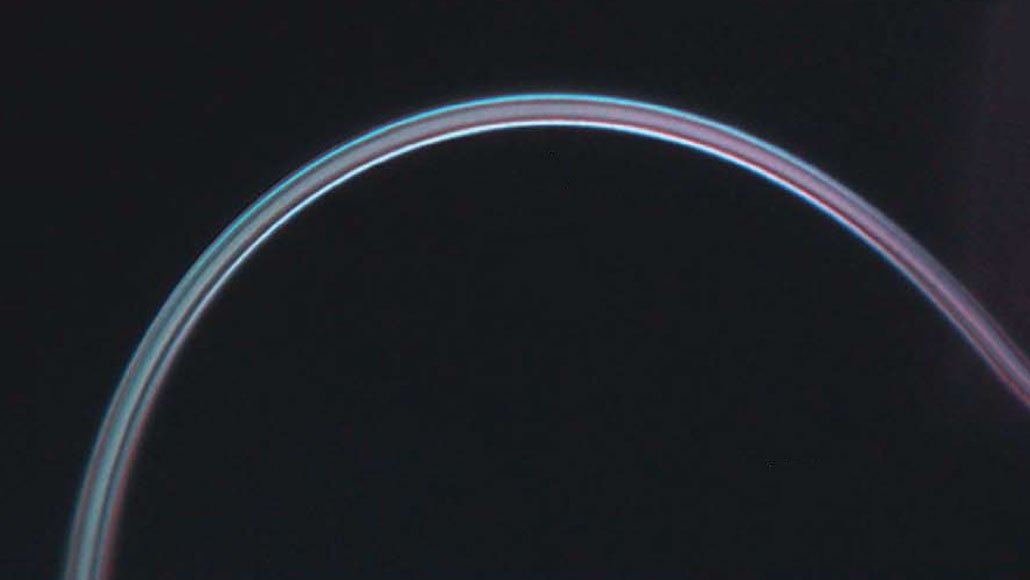
    Ice — as we typically encounter it — is extremely brittle and easily broken. That’s due to defects in the ice, places where atoms have settled into a spot that does not match the perfect crystalline alignment. Because tiny defect-free threads of ice made by researchers turn out to be wildly flexible!

    To make these perfect ice strands, each of which is a tiny fraction of the thickness of a human hair, researchers applied an electric voltage to a needle in a water-vapor-filled chamber. The technique condensed ice microfibers with perfect crystal structures in a matter of seconds. When bent, the microfibers actually shift from one crystalline arrangement to another in order to carry stress, and once the force is removed, the thread reverts back to its initial straight form. (Image and research credit: P. Xu et al.; via Science News; submitted by Kam-Yung Soh)
  • Mushy Layers

    Mushy Layers

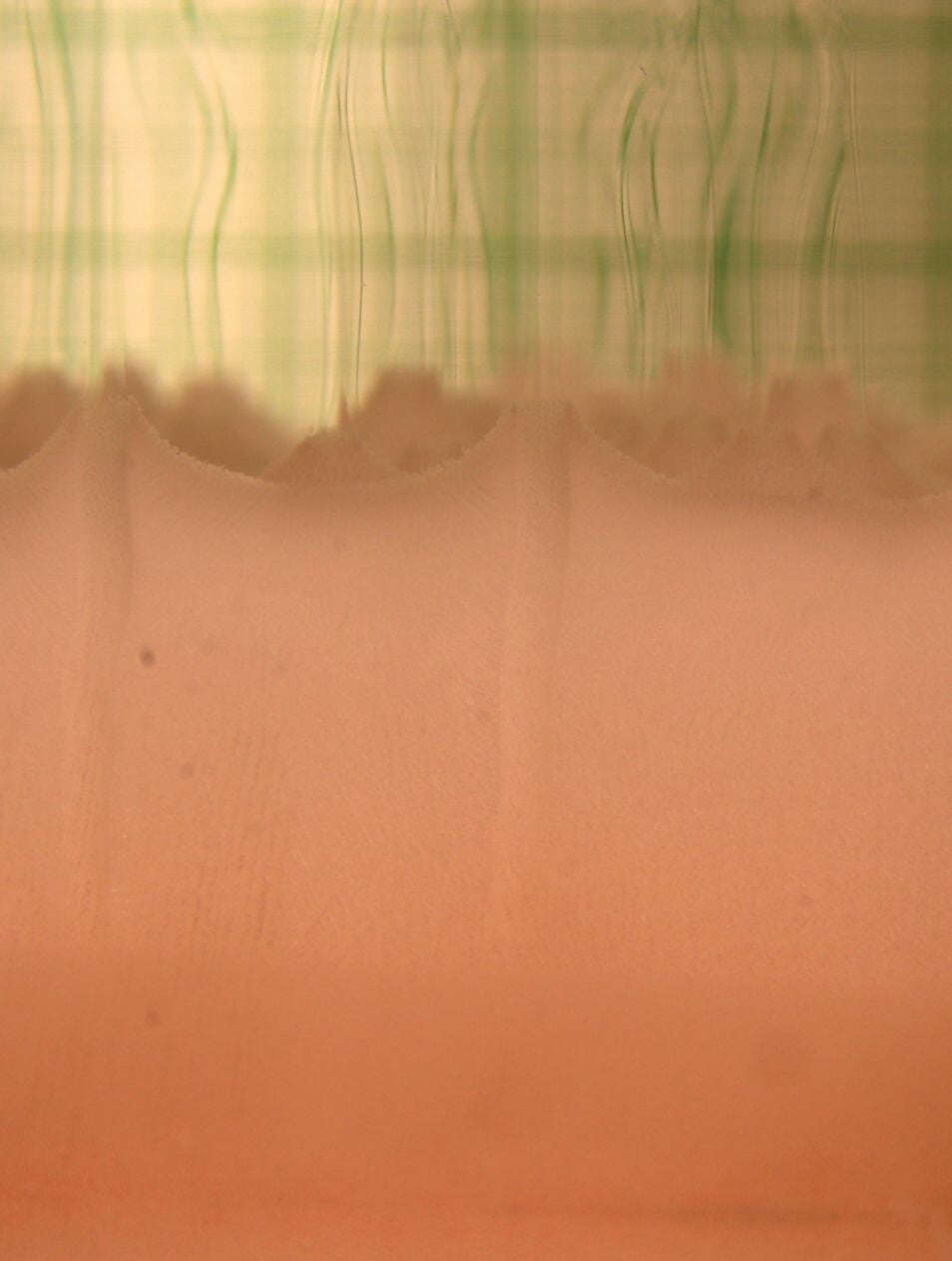
    In many geophysical and metallurgical processes, there is a stage with a porous layer of liquid-infused solid known as a mushy layer. Such layers form in sea ice, in cooling metals, and even in the depths of our mantle. Within the mushy layer, temperature, density, and concentration can vary dramatically from one location to another.

    The image above shows a mushy layer made from a mixture of water and ammonium chloride. Above the mushy layer, green plumes drift upward, carrying lighter fluid. Look closely within the mushy layer and you’ll see narrow channels feeding up to the surface. These are known as chimneys. In sea ice, chimneys like these carry salty brine out of the ice and into the seawater, increasing its salinity. See this Physics Today article for more details on the dynamics of mushy layers. (Image credit: J. Kyselica; via Physics Today)

  • Snowflake Still-Life

    Snowflake Still-Life

    To take these high-resolution images of individual snowflakes, Nathan Myhrvold and his collaborators built a special camera. Their apparatus keeps the snowflakes chilled despite the strong illumination cast on them. It uses a 500 microsecond shutter and focus-stacking to produce incredibly detailed portraits of these ephemeral subjects. Each snowflake’s shape is the result of the temperature and humidity that crystal experienced as it grew. Since these are natural snowflakes, no two are alike, but, with enough environmental control, it is possible to make twin snowflakes. (Image credit: N. Myhrvold; via Colossal)

  • Featured Video Play Icon

    Filming the Brinicle

    It may have been 10 years since the BBC filmed the first timelapse of a growing brinicle, but the footage is just as amazing now as it was then! This video gives you the behind-the-scenes story of what it took to capture this natural wonder under the Antarctic ice. It’s incredible to see the shots of sinking brine streaming off the brinicles, too. The difference in density (and thus refractive index) of the brine and the ocean water is substantial enough that your eye can actually pick them out as separate fluids. I once went snorkeling in an area with similarly varied salinity and it was completely bizarre watching everything suddenly go wavy and blurry as I swam. (Image and video credit: BBC)

  • Fractal Frost

    Fractal Frost

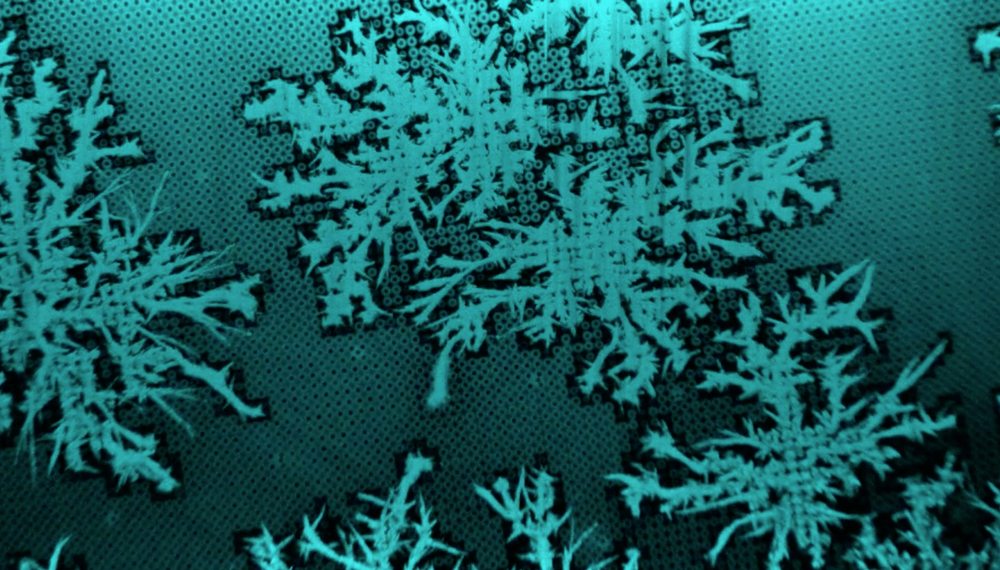
    As nightly temperatures drop in the northern latitudes, many of us are beginning to wake up to frosty patterns on leaves, windows, and cars. Frost‘s spread is a complex dance between evaporation and nucleation, as seen in this recent study.

    Here, researchers watched frost grow on a surface covered in 30-micrometer-wide micropillars. The pillars serve as anchor points for droplets, making frosting easier to observe. At low humidity levels (Image 1), droplets evaporate so quickly that frost regions remain isolated and do not interact. At high humidity levels (Image 3), on the other hand, the droplets evaporate so slowly that they’re able to poach water vapor from their neighbors to form frost spikes. When a spike touches another droplet, it freezes the region almost instantly. As a result, the frost spreads quickly and covers nearly every part of the surface. At intermediate humidity levels (Image 2), though, this frost chain reaction and evaporation compete, causing the frost to grow in fractals. (Image and research credit: L. Hauer et al.; via APS Physics)

  • Freezing Splats

    Freezing Splats

    In fluid physics, there’s often a tug of war between different effects. For droplets falling onto a surface colder than their freezing point, the hydrodynamics of impact, sudden heat transfer, and solidification processes all compete to determine how quickly and in what form droplets freeze.

    The images above form a series based on changing the height from which the droplet falls. Each image is divided into two synchronized parts. On the left, we see a visible light, top-down view of the freezing droplet; on the right, we see an infrared view of freezing. As the height of impact increases, the shape of the frozen drop becomes more elaborate, moving from a flat splat with a small conical tip all the way to one with a concentric double-ring in its center. (Image and research credit: M. Hu et al.)

  • Fallstreak Holes

    Fallstreak Holes

    Occasionally clouds appear to have a hole in them; these are known as fallstreak holes or hole-punch clouds. To form, the water droplets in the cloud must be supercooled; in other words, they must be colder than their freezing point but still in liquid form. When disturbed — say, by the temperature drop caused by flowing over an airplane wing — the supercooled water droplets will suddenly freeze. This typically kicks off a chain reaction in which many droplets freeze and the heavy ice crystals fall out of the sky, leaving behind a void in the cloud. Because airplanes are particularly good at creating these fallstreak holes, they’re often seen near busy airports. (Image credit: J. Stevens/NASA; via NASA Earth Observatory)

  • Lake Stars

    Lake Stars

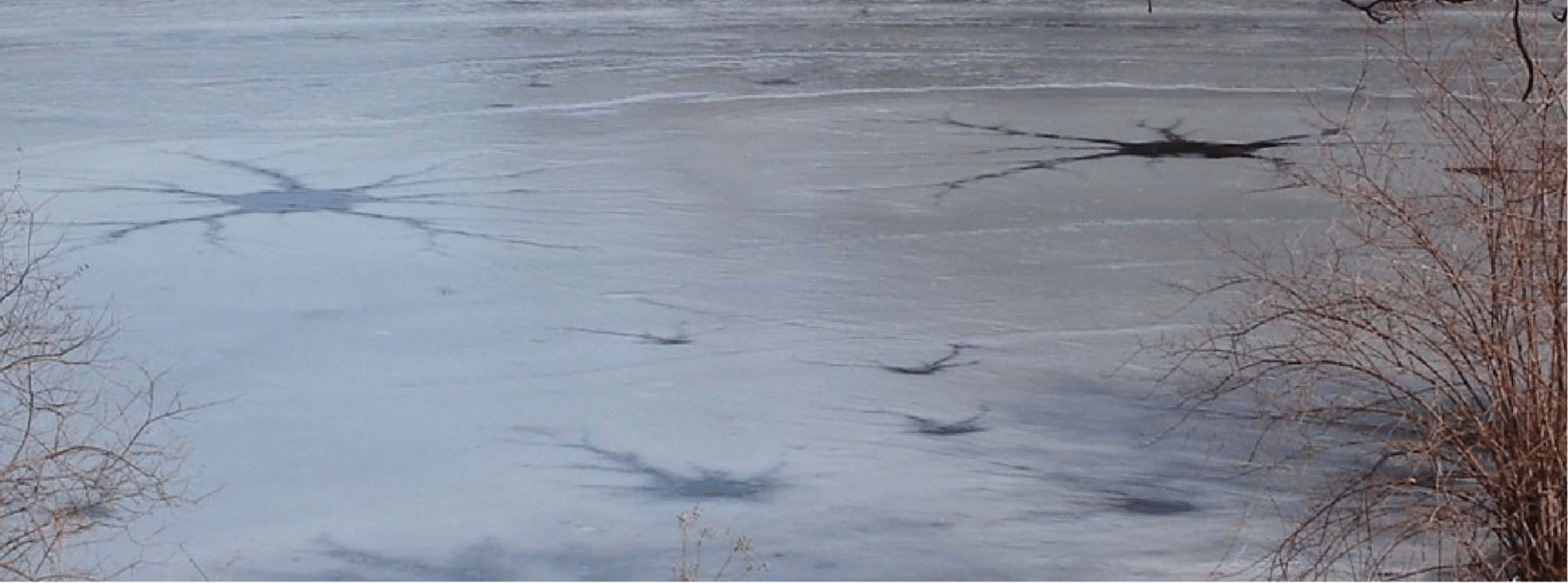
    As snow-covered frozen lakes melt, stars appear on their surface. These lake stars form around holes in the ice where (relatively) warm water seeps up into the slush layer. The stars form through a competition between thermal effects and flow through the porous snow. Researchers have built mathematical models that capture the first-order effects, like predicting the number of arms a star will form. (Image and research credit: V. Tsai and J. Wettlaufer; submitted by keeonn)

  • Dual Structure of Water

    Dual Structure of Water

    Water is so ubiquitous in our lives that we rarely recognize just how strange it is. For example, when pure liquid water is supercooled well below its freezing temperature, it takes on not one but two molecular arrangements, one of which is high-density and one of which is low-density. Theory had posited this configuration for some time, but only recently has experimental evidence supported it.

    The experimental challenge was water’s rapid crystallization in the temperature region of interest. Any time water was held at those temperatures in order to study it, it would crystallize before researchers could make their observations. To get around this, a team studied extremely thin layers of water which they heated with a laser before rapidly cooling. By repeating this heating-and-cooling cycle many times, they were able to measure water properties that only make sense if it conforms to the two-density theory. (Image credit: T. Holland/Pacific Northwest National Laboratory; research credit: L. Kringle et al.; via Science News; submitted by Kam-Yung Soh)

  • The Best of FYFD 2020

    The Best of FYFD 2020

    2020 was certainly a strange year, and I confess that I mostly want to congratulate all of us for making it through and then look forward to a better, happier, healthier 2021. But for tradition and posterity’s sake, here were your top FYFD posts of 2020:

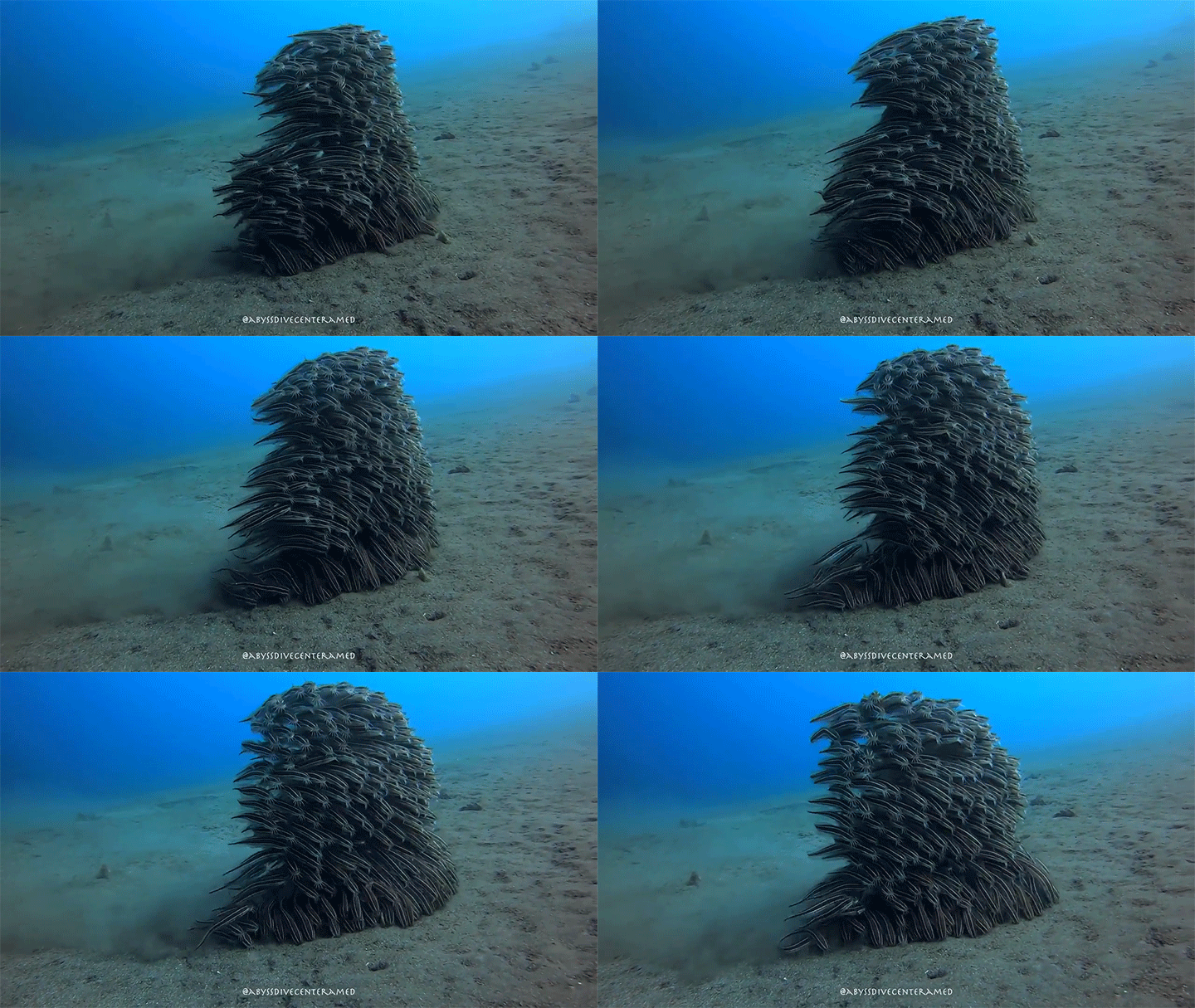
    1. Juvenile catfish collectively convect for protection
    2. Gliding birds get extra lift from their tails
    3. How well do masks work?
    4. Droplets dig into hot powder
    5. Updating undergraduate heat transfer
    6. Branching light in soap bubbles
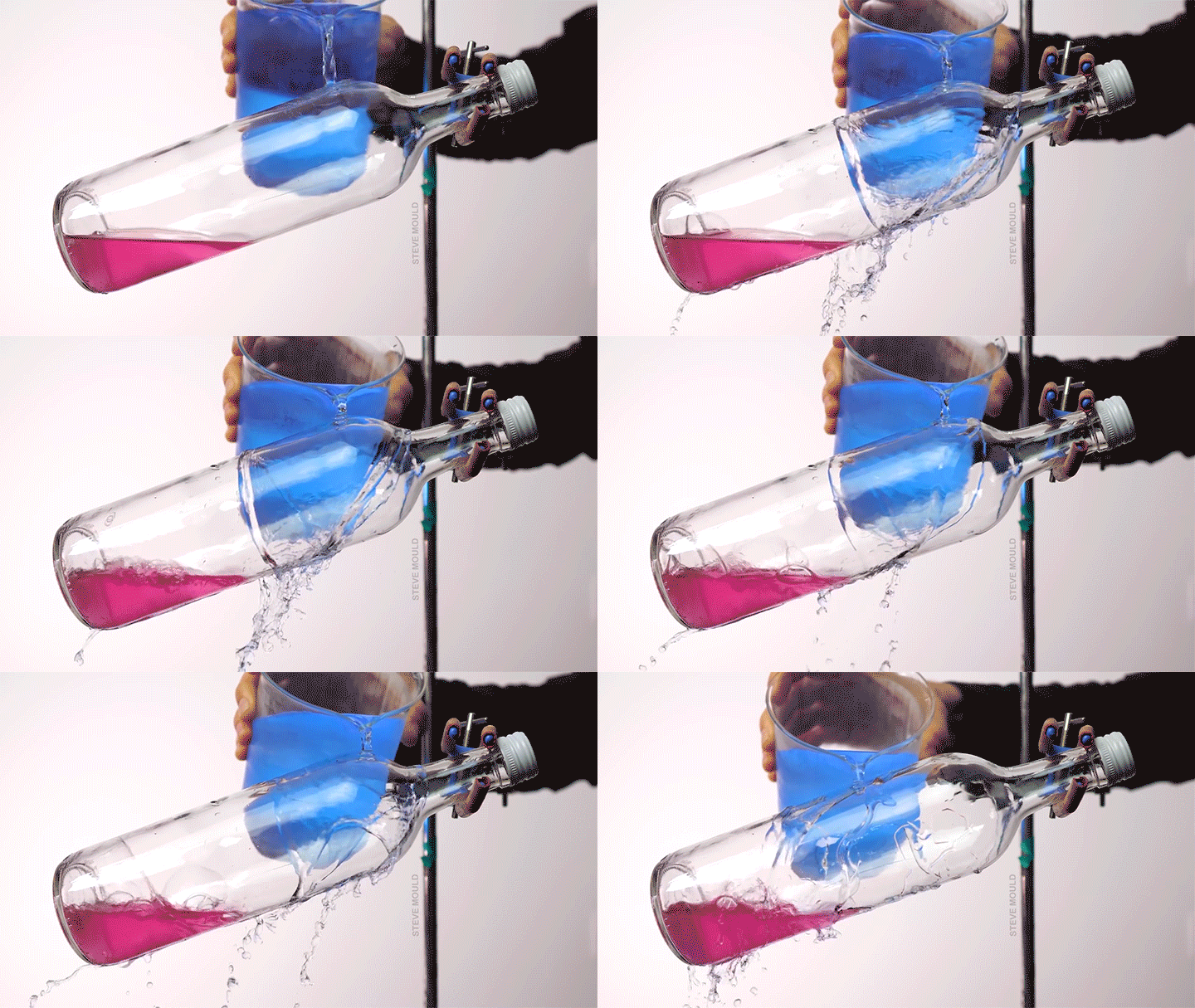
    7. Boiling water using ice water
    8. Concentric patterns on freezing and thawing ice
    9. Bouncing off superhydrophobic defects
    10. To beat surface tension, tadpoles blow bubbles

    There’s a good mix of topics here! A little bit of biophysics, some research, some phenomena, and some good, old-fashioned fluid dynamics.

    If you enjoy FYFD, please remember that it’s primarily reader-supported. You can help support the site by becoming a patronmaking a one-time donationbuying some merch, or simply by sharing on social media. Happy New Year!

    (Image credits: catfish – Abyss Dive Center, owl – J. Usherwood et al., masks – It’s Okay to Be Smart, droplet – C. Kalelkar and H. Sai, boundary layer – J. Lienhard, bubble – A. Patsyk et al., boiling – S. Mould, ice – D. Spitzer, defects – The Lutetium Project, tadpoles – K. Schwenk and J. Phillips)