Much as I try to keep from getting repetitious, this was just too neat to pass up. This new music video for The Glitch Mob’s “Becoming Harmonious” is built around the standing Faraday waves that form on a water-filled subwoofer. The vibration patterns, along with judicious use of strobe lighting, produce some fantastic and kaleidoscopic effects. (Video credit: The Glitch Mob/Susi Sie; submitted by @krekr)
Tag: fluids as art

“High Ball Stepper”
The recently released music video for Jack White’s “High Ball Stepper” is a fantastic marriage of science and art. The audio is paired with visuals based around vibration effects using both granular materials and fluids. There are many examples of Faraday waves, the rippling patterns formed when a fluid interface becomes unstable under vibration. There are also cymatic patterns and even finger-like protrusions formed by when shear-thickening non-Newtonian fluids get agitated. (Video credit: J. White, B. Swank and J. Cathcart; submitted by Mike and Marius)

Kelvin Wakes
Ducks, boats, and other objects moving along water create a distinctive V-shaped pattern known as a Kelvin wake. As the boat moves, it creates disturbance waves of many different wavelengths. The constructive interference of the slower waves compresses them into the shock wave that forms either arm of the V. Sometimes evenly spaced wavelets occur along the arms as well. Between the arms are curved waves that result from other excited wave components. The pattern was first derived by Lord Kelvin as universally true at all speeds – at least for an ideal fluid – but practically speaking, water depth and propeller effects can make a difference. Recently, some physicists have even suggested that above a certain point, an object’s speed can affect the wake shape, but this remains contentious. (Image credit: K. Leidorf; via Colossal; submitted by Peter)

“Wallwave Vibration”


Loris Cecchini’s “Wallwave Vibration” series is strongly reminiscent of Faraday wave patterns. The Faraday instability occurs when a fluid interface (usually air-liquid though it can also be two immiscible liquids) is vibrated. Above a critical frequency, the flat interface becomes unstable and nonlinear standing waves form. If the excitation is strong enough, the instability can produce very chaotic behaviors, like tiny sprays of droplets or jets that shoot out like fountains. In a series of fluid-filled cells, the chaotic behaviors can even form synchronous effects above a certain vibration amplitude. (Image credit: L. Cecchini; submitted by buckitdrop)

“Demersal”

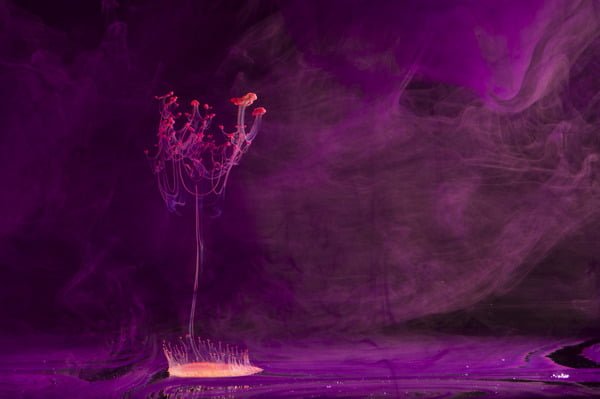

The ethereal shapes of inks and paints falling through water make fascinating subjects. Here the ink appears to rise because the photographs are upside-down. The fluid forms mushroom-like plumes and little vortex rings. The strands that split apart into tiny lace-like fingers are an example of the Rayleigh-Taylor instability, which occurs when a denser fluid sinks into a less dense one. Similar fingering can occur on much grander scales, as well, like in the Crab Nebula. These images come from photographer Luka Klikovac’s “Demersal” series. (Photo credit: L. Klikovac)
Happy Valentine’s Day!
What can you do with a 7 x 7 grid of miniature vortex cannons? Why, make floating vortex hearts, of course. Happy Valentine’s Day from FYFD! (Video credit: D. Schulze/bitsbeauty; via Colossal)

Convective Impressionism


Buoyant convection, driven by temperature-dependent changes in density, is a major force here on Earth. It’s responsible for mixing in the oceans, governs the shape of flames, and drives weather patterns. The images above show flow patterns caused by buoyant convection. The colors come from liquid crystal beads immersed in the fluid; red indicates cooler fluid and blue indicates warmer fluid. You can see plumes of warmer fluid rising in some of the photos. At the same time, though, the images are beautiful simply as art and are strongly reminiscent of works by Vincent van Gogh. (Image credit: J. Zhang et al.)

Wind and Waves Visualized

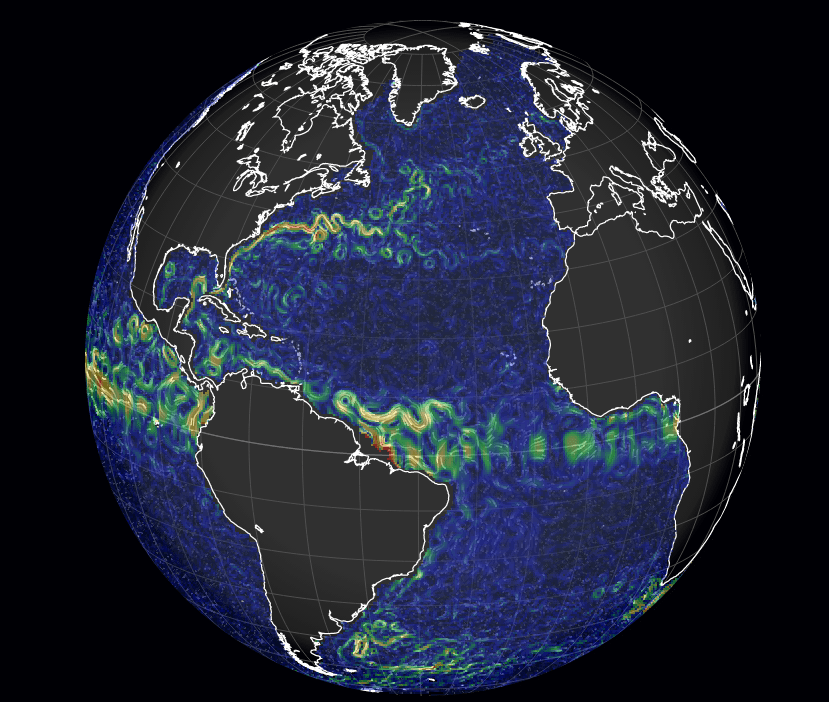
Much like the wind map we featured previously, designer Cameron Beccario’s visualizations of wind and ocean surface current data draw from near-real-time sources to create a stunning picture of fluid dynamics on a planetary scale. The number of options in terms of projections and data are really quite incredible, and you’ll want to play around to get a real sense for it. Want to see the wind and total precipitable water at 1000 hPa? Here you go. Maybe you prefer studying Pacific ocean currents. All the data are there to play with. People often wonder why weather forecasts aren’t always right, but, when you look at the scale and complexity of these flows, it’s almost a wonder that we can predict them at all. (Image credits:C. Beccario/earth; via skunkbear and io9)
Inksplosion
Chemical Bouillon are a trio of artists who use the chemistry of surface reactions to create abstract videos full of exploding and imploding droplets and colors. As chemicals react, local concentrations at the interface vary, which changes the local surface tension. These gradients drive flow from areas of low surface tension to those of higher surface tension. This is called the Marangoni effect – the same behavior that drives tears in a glass of wine. Chemical Bouillon have a whole YouTube channel dedicated to these kinds of videos, with everything from inks to ferrofluids. Be sure to take a look at some of their other videos and, if you like them, subscribe. (Video credit: Chemical Bouillon)
“Porgrave”
Artist Sandro Bocci uses macro imagery of fluids in his new piece “Porgrave” to create scenes reminiscent of celestial landscapes and the first moments of life. Surface tension, the Marangoni effect, and diffusion create pulsating motion in some frames whereas immiscible liquids form untouchable islands in others. “Porgrave” reminds me of work by Pery Burge and Julia Cuddy as well as sequences from films like 2001 and The Fountain, both of which created some of their effects with macro photography of fluids. Still images from “Porgrave” are available on Bocci’s site. (Video credit and submission: S. Bocci)
ETA: This article originally misprinted the artist’s name as “Sandro Bocchi” and has been updated with the correct spelling.