Tag: fluids as art

  • Featured Video Play Icon

    The World in a Droplet

    Capturing refracted images in a droplet is a popular pastime among high-speed photographers, and in this solo Slow Mo Guy outing, we get to see that process in video. Physically, the subject is a simple drop of water, which on impact with a pool, rebounds into a Worthington jet and ejects one or more droplets from its tip. Despite hundreds of years of study, it’s still a joy to watch, especially at 12,000 frames per second.

    It’s also not the easiest image to capture, and one thing I rather enjoy about this video is how it gives you a sense of the trial and error involved in capturing just the right view. Even without having to worry about the timing issues, there is a lot of fiddling with lenses, focus, lights, and positioning — something familiar not just to photographers and videographers but to many researchers as well! (Image and video credit: The Slow Mo Guys)

  • Featured Video Play Icon

    “Otherworld, Vol. 1”

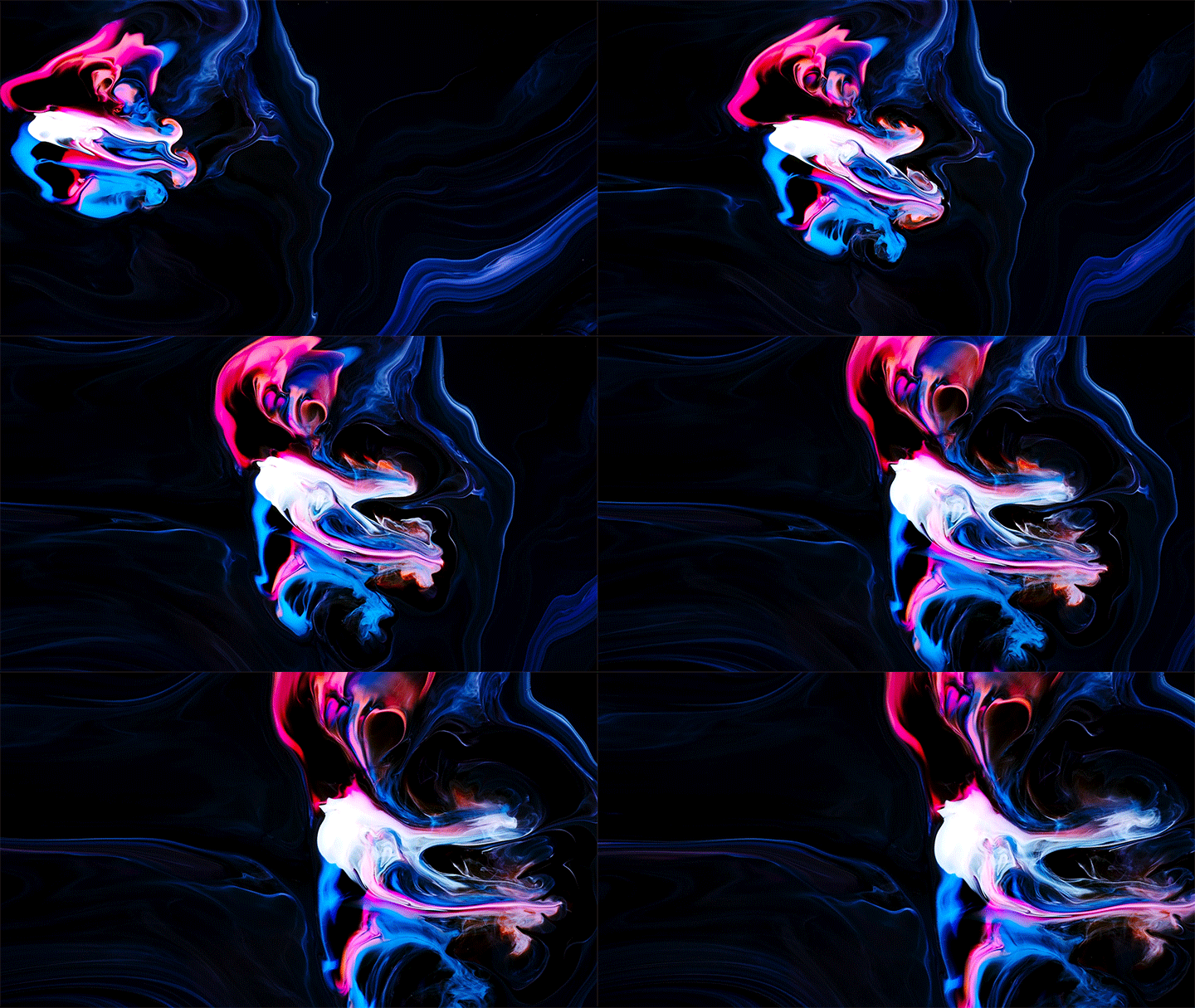
    Roman De Giuli’s “Otherworld, Volume 1” is a beautiful exploration of color and flow. Glittery particulates act as tracers in the flow, reminiscent of the way rheoscopic fluids do. In many sequences, the glitter lends a sense of texture to the flow. Without context, I cannot say whether those are true flow features, but they certainly remind me of instabilities like Tollmien-Schlichting waves. (Image and video credit: R. De Giuli)

  • Captured by Waves

    Captured by Waves

    Acoustic levitation and optical tweezers both use waves — of sound and light, respectively — to trap and control particles. Water waves also have the power to move and capture objects, as shown in this award-winning poster from the 2019 Gallery of Fluid Motion. The central image shows a submerged disk, its position controlled by the arc-shaped wavemaker at work on the water’s surface. The complicated pattern of reflection and refraction of the waves we see on the surface draws the disk to a focal point and holds it there.

    On the bottom right, a composite image shows the same effect in action on a submerged triangular disk driven by a straight wavemaker. As the waves pass over the object, they’re refracted, and that change in wave motion creates a flow that pulls the object along until it settles at the wave’s focus. (Image and research credit: A. Sherif and L. Ristroph)

  • Featured Video Play Icon

    Bouncing Off Defects

    The splash of a drop impacting a surface depends on many factors — among them droplet speed and size, air pressure, and surface characteristics. In this award-winning video from the 2019 Gallery of Fluid Motion, we see how the geometry of a superhydrophobic surface can alter a splash.

    When a drop falls on a protruding superhydrophobic surface, like the apex of a cone, it can be pierced from the inside, completely changing how the droplet rebounds and breaks up. The variations the video walks us through are all relatively simple, but resulting splashes may surprise you nevertheless. (Image and video credit: The Lutetium Project)

  • Featured Video Play Icon

    A Dance of Hydrogen Bubbles

    Hydrogen bubbles rise off zinc submerged in hydrocholoric acid in this short film from the Beauty of Science team. In high-speed video, the rise of the bubbles is stately and mesmerizing. Notice how the smallest bubbles appear as perfect spheres; for them, surface tension is strong enough to maintain that spherical shape even against the viscous drag of their buoyant rise. Larger bubbles, formed from mergers both seen and unseen, have a harder time staying round. In them, surface tension must battle gravitational forces and drag from the surrounding fluid. (Image and video credit: Beauty of Science; via Laughing Squid)

  • River Avon

    River Avon

    One of the challenges in fluid dynamics is considering the instantaneous versus the average. Many flows — especially turbulent ones — are different at every point in space and in time. That’s a lot of data to collect and to wrap one’s head around. So often researchers will average turbulent measurements over a period of time and break that information down into two variables: an average velocity and a fluctuating one.

    What does that have to do with this image? Well, by capturing the River Avon’s flow near Pulteney Bridge as a long exposure, photographer Peter Leadbetter gives us a look at the river’s “averaged” flow. The long exposure smooths out some of the intermittent features visible in a faster picture, and instead draws our attention to the overall path of the flow and regions that may behave differently, like those near the wall in the foreground. The averaging researchers do is much the same. It will erase or obscure some features while making the large-scale patterns more obvious. (Image credit: P. Leadbetter; submitted by Ioanna S.)

  • Featured Video Play Icon

    Spinning Ink Out of Markers

    I have to say I’m grateful that my classmates in school never discovered the mess-generating superpower of felt-tipped markers. As the Slow Mo Guys demonstrate here, when you spin or fling these markers, ink will stream out of them. That’s due, in part, to the air vents present near the tips. Markers (and other pens) have those to equalize the pressure between the outside and the ink reservoir; otherwise, the ink won’t flow to the felt tip as it should. Is anyone else surprised by the sheer volume of liquid ink apparently contained in these pens? (Image and video credit: The Slow Mo Guys)

  • Twirling Liquids

    Twirling Liquids

    What do you get when you spin a splash? I expect the result is a lot like these whirling fluid structures captured by photographer Hélène Caillaud. I love the fantastical shapes she creates as sheets and filaments are flung outward. These liquid sculptures look like everything from the perfect martini glass to the skirts of a flamenco dancer. Check out the full gallery of images, and be sure to look around at Caillaud’s other stunning liquid art while you’re there. (Images credit: H. Caillaud)

  • Featured Video Play Icon

    Waltzing Defects

    Liquid crystals are a peculiar state of matter with both liquid and crystalline properties. In this video, a microfluidic device breaks water into droplets surrounded by a shell of liquid crystal. Because the molecular structure of the liquid crystals is helical and cannot pack neatly in a spherical shell, there are visible defects in the liquid crystal shells. Given time, those defects can merge as the liquid crystal shell thickens. (Image and video credit: The Lutetium Project)

  • “Ornitographies”

    “Ornitographies”

    If birds left trails in the sky, what would they look like? This is the question that haunted photographer Xavi Bou and inspired him to create his “Ornitographies” series. Using video of birds in flight, he combines frames to construct these snapshots of flight. In them, birds become streaklines feathered with wingbeats.

    I love how the technique highlights the patterns of flapping flight. A bird flying steadily over a lake becomes a wavy line with consistent, perfectly matched up- and downstrokes, whereas a bird just taking off has short, fast wingbeats that slowly lengthen and steady out as the bird gets aloft. Flocks of birds turn into a tornado of swirling lines as they land or take-off en mass. (Image credit: X. Bou; via Flow Vis)