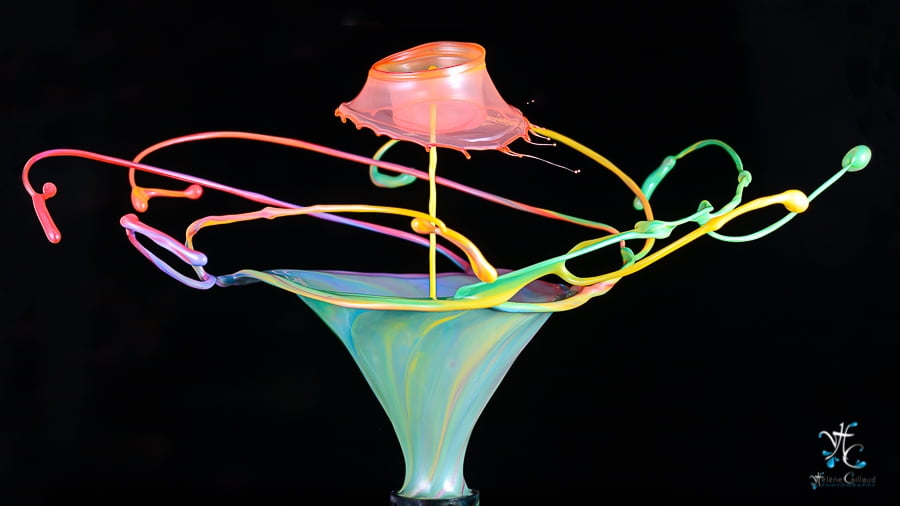
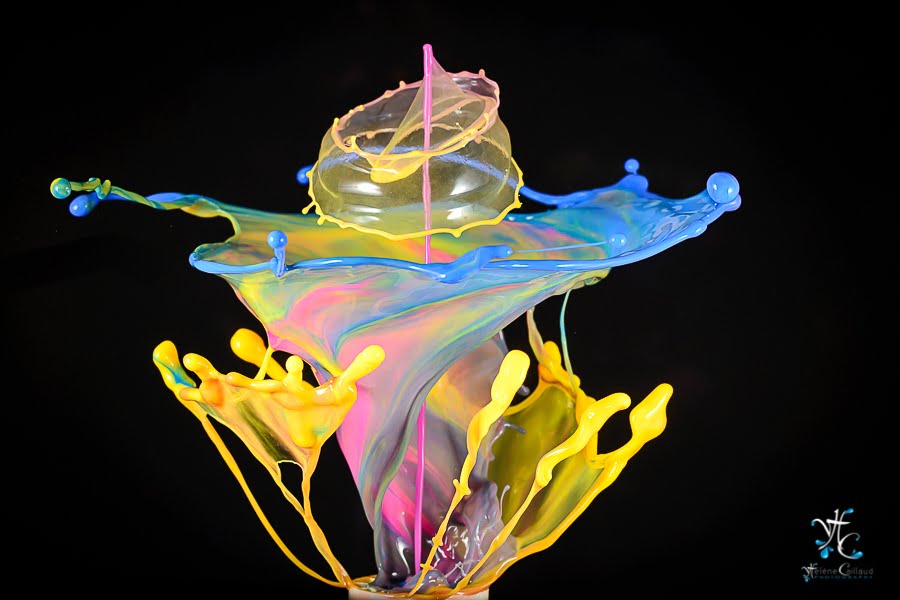
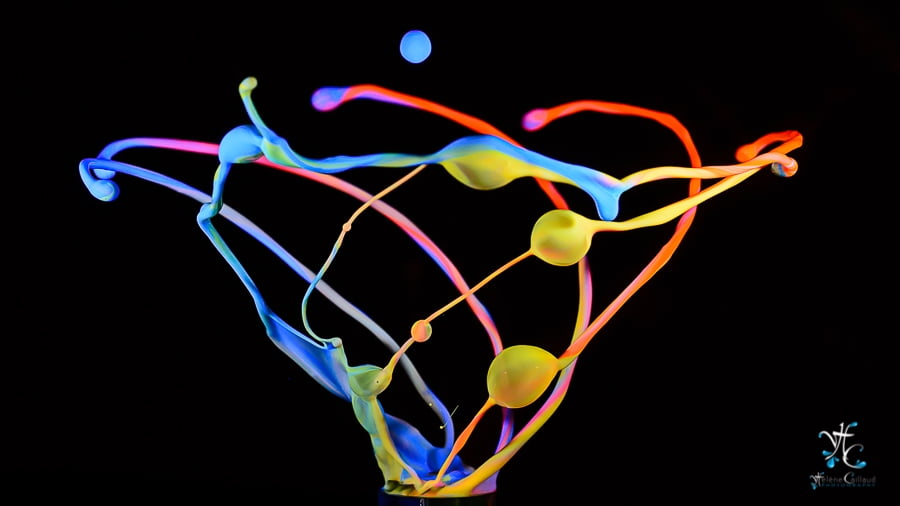
In his short film, “Magic Fluids,” Roman De Giuli uses cyan, magenta, and yellow paints to generate a rainbow of macro colors. All the fluid motion you see is a practical effect, painstakingly created by layering paints and flow mediums of different densities. Like in Siqueiros’ “accidental painting” technique, the less dense paints will eventually rise through the upper layers and spread. De Giuli uses the effect for its motion, but the same physics is key for many artists who use acrylic pouring to paint. (Video and image credit: R. De Giuli)
Tag: fluids as art

“Magic Fluids”

“Stormscapes 4”
Frightening as they can be in the moment, storms have a power and majesty all their own. I’ve never seen a better way to capture that than through timelapse, and photographer Nicolaus Wegner offers a great one in “Stormscapes 4″. I particularly like how his frame captures the motion of storms and how they shear, rotate, and billow as they evolve. With a quick glance upward, it’s easy to miss that motion, even if it is fundamental to these storms. Sit back and enjoy. (Video and image credit: N. Wegner)

“Mocean”
Ocean waves are endlessly fascinating to watch. In “Mocean,” cinematographer Chris Bryan captures them in ways few ever see, thanks to his high-speed camera. Honestly, this film is so gorgeous that I don’t want to distract you with the science, so just go watch!
…
All done? Pretty wonderful, right? There’s nothing quite like seeing those holes break and expand through sheets of water, tearing what looked solid into a spray of droplets that bleed salt into the atmosphere. Or how about those rib vortices underneath the waves? Or the cloud-like turbulence of the waves breaking overhead? How fortunate we are to see and capture and share such beauty! (Video and image credit: C. Bryan; via RedShark; submitted by Michael F.)

“Silk”
With the right lighting and eye, billowing streaks of dye and paint can become the ethereal wisps of silk. Artist Susi Sie explores this dichotomy in “Silk,” a short, fluidic film made entirely in macro. Sometimes there’s astounding beauty in the complexity of a fluid filmed up close. (Video and image credit: S. Sie)

“Transient 2”
Where cold and warm air meet, our atmosphere churns with energy. From the turbulence of supercell thunderclouds to the immense electrical discharge of lightning, there’s much that’s breathtaking about stormy skies. Photographer Dustin Farrell explores them, with a special emphasis on lightning, in his short film, “Transient 2″.
As seen in high-speed video, lightning strikes begin with tree-like leaders that split and spread, searching out the path of least resistance. Once that line from cloud to ground is discovered, electrons flow along a plasma channel that arcs from sky to earth. The estimated temperatures in the core of this plasma reach 50,000 Kelvin, far hotter than the Sun’s surface. It’s this heating that generates the blue-white glow of a lightning bolt. The heating also expands the air nearby explosively, producing the shock wave we hear as a crash of thunder. (Images and video credit: D. Farrell et al.; via Colossal)

A Broken Monitor’s Fingers
In this short video, the artists of Chemical Bouillon explore a broken LCD monitor and its liquid crystals. By sandwiching the fluid between thin, transparent sheets, they create dendritic shapes as the liquid crystals and other fluids (air? ink?) push into one another. There’s a lot here that’s likely connected to the Saffman-Taylor instability, but without knowing more details on the ingredients and set-up, it’s hard to speculate beyond that. (Video and image credit: Chemical Bouillon)

Getting Cold
Just as some chemical reactions produce heat, many chemical combinations absorb heat. In “Getting Cold,” the Beauty of Science team demonstrates this by showing endothermic processes in both visible and infrared light. Combinations that appear humdrum from our normal perspective suddenly become vibrant and interesting when we see the temperature variations accompanying them.
Evaporation is a good example. As humans, we sweat so that when our sweat evaporates off our skin, it takes heat away with it. Water (the main ingredient in sweat) isn’t the fastest evaporating liquid, however. Here it’s shown alongside ethyl acetate, a common ingredient in nail polish remover. And anyone who’s used nail polish remover is familiar with the chill it leaves behind as it evaporates. Just look how much colder and darker it is when evaporating! (Video and image credit: Beauty of Science)

Explosive Flame Fronts
Though they look like jellyfish or space creatures, these images from photographer Linden Gledhill are actually explosions. What you’re seeing is the detonation of hydrogen gas with oxygen. The teal sphere with its wavy surface marks the flame front, and the crisp, stringy edges seen here and there in the foreground are the remains of a soap bubble that held the hydrogen before it sparked. You can see a similar set-up (using methane rather than hydrogen) in action here, and you can see other artistic takes on combustion in previous posts like this one. (Image credit: L. Gledhill, Flickr)

The Drama of Turbulence
Photographer Jason Wright captures dramatic views of Hawaiian landscapes. Moments like these remind us of the spectacular power of the ocean and atmosphere around us. Just look at all that incredible turbulence! See more of Wright’s work on his Instagram and website. (Image credit: J. Wright; via Colossal)

“Emergence”
Artist Susi Sie explores fluidic worlds through her macro lens. In “Emergence,” her focus is on ferrofluids immersed in other liquids. Beginning with tiny droplets traversing the thin fluid channels of a foam, she allows the unique qualities of ferrofluids to slowly take center stage. Dark blobs grow into curvy labyrinths as a magnetic fields come into play. Until ultimately the magnetic nature of the fluid becomes undeniable as scattered droplets elongate into miniature compass needles and swing around to follow the field lines. (Video and image credit: S. Sie)