Eric Mesplé is an artist, but he’s also a blacksmith, welder, programmer, engineer, and innovator. Many of his sculptures feature ferrofluids, magnetic liquid whose movement is driven by electromagnets Mesplé designs and builds himself. In this video from Wired, we get a behind-the-scenes look at some of his work, and to me, one of the big takeaways is just how clearly science, engineering, and technology are married to art in Mesplé’s work. I imagine this is true of many of today’s artists! (Video credit: Wired)
Tag: fluids as art

A Year From Geostationary Orbit
Our planet is a complex fluid dynamical system, and one of the best ways to watch nature at work is through timelapse. This short film takes us through an entire year, from December 2015 to December 2016, as viewed from a geostationary weather satellite centered over Oceania.
The imagery is rather hypnotic, with clouds swirling day and night across the full field of view. Watch closely, though, and you’ll see a lot of neat phenomena from typhoons forming in the Pacific to wave clouds streaming from the islands of Japan. You can also see clouds blossoming (especially during the day) over the humid rainforests of Oceania.
There are neat non-fluids phenomena, too, like a total solar eclipse and the permanent sunlight of Arctic and Antarctic summers. What do you notice? (Image and video credit: F. Dierich)

Expanding Water Beads
In this timelapse, we see hydrogel beads expanding as they absorb water. There are some interesting subtleties to the physics here. Notice how, in the Petri dish segments, the beads shift from a single crystalline structure to several smaller structures. I suspect those shifts are driven by the dropping water level, which changes how surface tension interacts with the beads’ shape to create attractive forces between beads.
Another interesting point comes as the beads expand through and out of the glass of water. Initially, the water level doesn’t change in the glass. This is because the water beads are taking up the same volume as the water that they’ve absorbed. But once the beads emerge past the water’s initial height, the water level drops dramatically. That’s because the beads are still absorbing what little water is left and continuing to expand in volume. (Image and video credit: Temponaut)

‘Aila’Au: Forest Eater
The 2018 eruption of Kilauea was a dramatic example of nature’s power. This short film shows both some familiar views of that eruption as well as new ones. I found the slow-moving wall of cooling a’a lava eating the forest particularly intriguing, not least thanks to the glass-like sound of the lava advancing. Whether slow-moving or fast, lava’s destructive power is incredible to watch. (Video and image credit: Page Films)

“Focus, Vol. 1”
In “Focus, Vol. 1,” photographer Roman De Giuli follows colorful droplets as they roll along, chase one another, and burst. You may notice that many of the drops seem attracted to one another. This is actually a surface tension effect caused by the dimples the droplets create on the surface; it’s the same effect responsible for Cheerios clumping together in your milk. Interestingly, though, the oil coating the drops doesn’t seem to drain quickly enough for the clumping drops to actually coalesce. (Image and video credit: R. De Giuli)

“Dendrite Fractals”
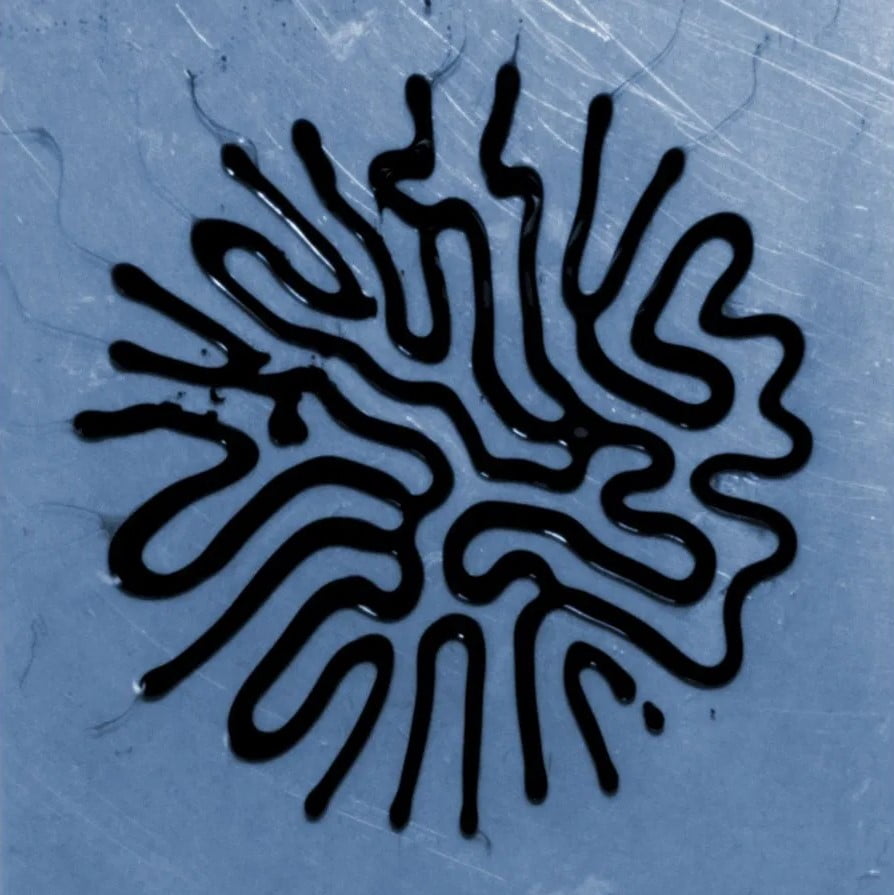
In this short film from the Chemical Bouillon team, dark ink drops spread in dendritic fractal patterns after being deposited on an unknown transparent liquid. Although the patterns look similar to those of the Saffman-Taylor instability, I suspect what we see here is actually driven by surface tension and not viscosity.
The authors describe the ink they used as a “special old” “tree ink,” which — putting on my fountain pen aficionado hat — probably means some variety of iron gall ink. These inks draw on chemicals extracted from trees and other plants to create a permanent, waterproof ink. They tend to be highly acidic, which could play a role in the pattern formation seen here. (Video and image credit: Chemical Bouillon)

Frozen Wavelets
Photographer Eric Gross captured these surreal alpine landscapes in Colorado’s Rocky Mountains. Although the lake’s surface appears to have frozen waves, the prevailing theory is that these mounds and divots occur when snowdrifts form atop the lake, melt and refreeze. Over multiple melting and freezing cycles, the lake builds up with what appear to be wind-driven waves frozen in time. (Image credit: E. Gross; via Colossal)

Colorful Dissipation
Colorful eddies swirl in this short video from photographer Karl Gaff. Formed near the boundary at the bottom of the frame, these eddies act to dissipate some of the energy in the flow. Structures like these are key in turbulent flows, where energy must pass from large eddies to smaller and smaller ones until they reach a size where viscosity can extinguish them. (Video, image, and submission credit: K. Gaff)
P.S. – Today’s post is FYFD’s 2,500th! Crazy, right? That means we have a pretty enormous archive. Want to explore? Click here for a random post.

“The Other Side”
“The Other Side” is a short film imagining fluids on the other side of people’s eyes. The fast-paced editing makes this one feel rather different from Thomas Blanchard’s other films, which often take the time to linger on the mixing of soaps, inks, and paints that form the bulk of the imagery. There are hints of ferrofluids here, too, but like much of the action, if you blink you’ll miss it.
Strange as it may sound, there’s actually a strong connection between eyes and fluid dynamics, whether you’re considering the optimal length for eyelashes, the way a tear film coats the eye, or how vision changes in microgravity. (Image and video credit: T. Blanchard)

Paint Versus Hydrogel
In this bizarre short film, we get to see a battle between dissolution and absorption. I think the Chemical Bouillon team has coated hydrogel beads in a layer of paint and then immersed them in water. As the beads absorb water, they expand and grow, tearing their fragile outer layer of paint to smithereens.
One thing that struck me when watching several of the sequences is just how regular the hole spacing in the paint is for the round hydrogels. That hints at an orderly breakdown in the solid paint layer while the interior hydrogel polymer symmetrically expands. It’s a little like watching holes grow in a splash curtain. (Video and image credit: Chemical Bouillon)