Tag: fluidization

  • Featured Video Play Icon

    Instabilities in a Particle Flow

    Even though particles are not (strictly speaking) a fluid, they often behave like one. Here, researchers investigate what happens when two layers of particles–with different size and density–slide down an incline together. The video is tilted so that the flow instead appears from left to right.

    When the larger, denser particles sit atop a layer of smaller, lighter particles, shear between the two layers causes a Kelvin-Helmholtz instability that runs in the direction of the flow. This creates a wavy interface that lets some small particles work upward while large particles shift downward.

    At the same time, a slice across the flow shows that plumes of small particles are pushing up toward the surface, driven by a Rayleigh-Taylor instability. The researchers also look at what happens when the particles are fluidized by injecting a gas able to lift the particles. (Video and image credit: M. Ibrahim et al.; via GFM)
  • Swimming Through Mud

    Swimming Through Mud

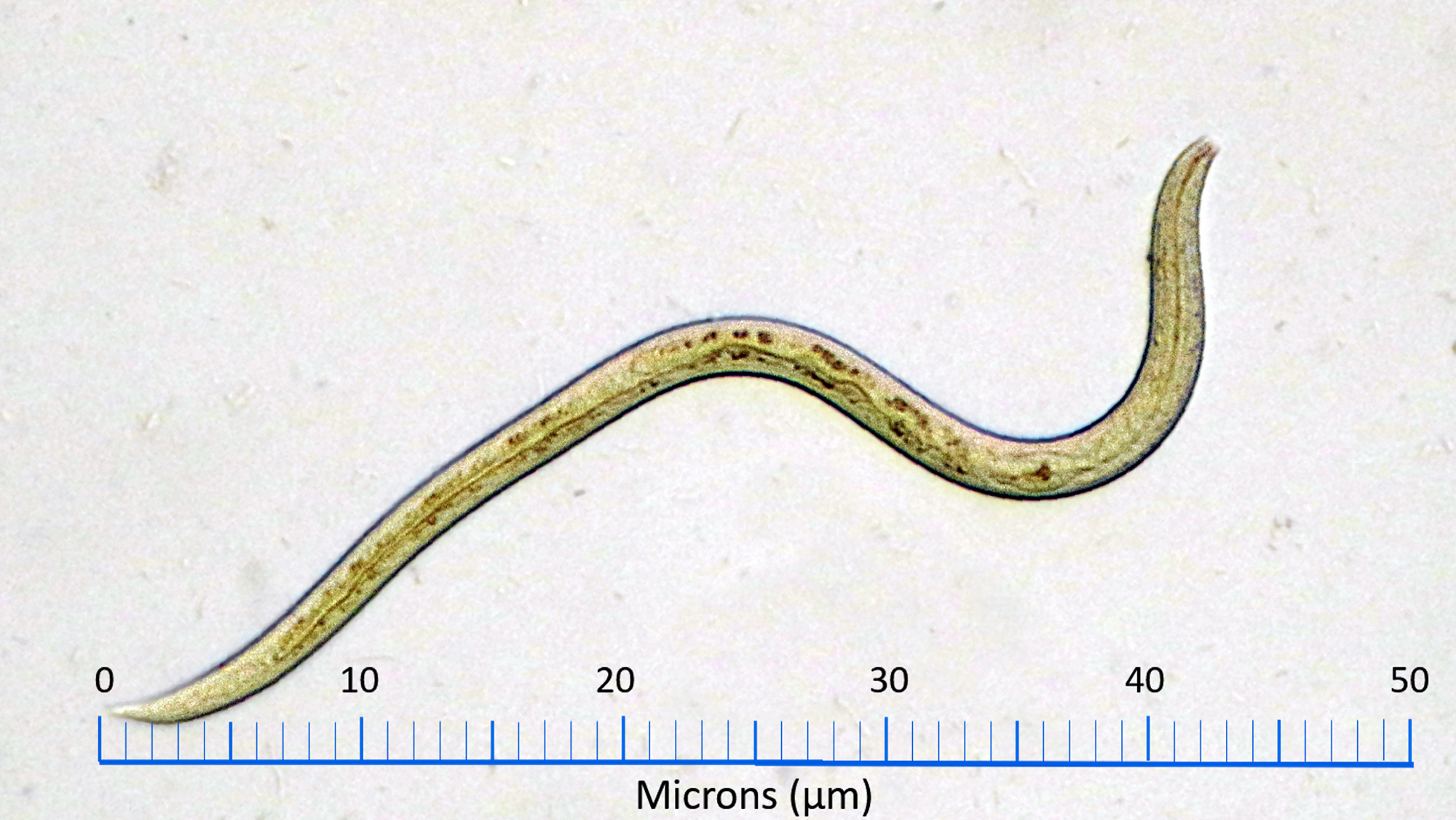
    At the bottom of ponds, nematodes and other creatures swim in a world of mud. They squirm their way through a sediment of dirt particles suspended in water. Mud, of course, is notoriously impossible to see through, so to understand these creatures’ movements, scientists turn instead to biorobotics. Here, a team uses a magnetic head attached to an elastic tail to mimic these tiny creatures.

    To drive the robot’s motion, they use an oscillating magnetic field, which forces the magnetic head to rotate. Combined with the elastic tail and the drag caused by surrounding materials, this causes the robot to swim in a fashion similar to its biological inspirations.

    A biomimetic robot swims through immersed grains. The robot's magnetic head is forced with an oscillating magnetic field. It swims through an underwater bed of hydrogel beads, whose diameter is smaller than that of the robot's head.
    A biomimetic robot swims through immersed grains. The robot’s magnetic head is forced with an oscillating magnetic field. It swims through an underwater bed of hydrogel beads, with diameters smaller than that of the robot’s head.

    To mimic the muddy environment of a pond’s bottom, scientists used a bed of hydrogel beads immersed in water. Looking at the experimental video above, you’ll see no sign of the beads. That’s because the hydrogel beads have nearly the same index of refraction as water. Once you pour water in, they seem to disappear. That allows the researchers to focus instead on the robot’s motion. In other experiments, they added dye to the beads so that they could see how they moved around the robot.

    They found that the robot’s motion fluidizes the grains around it. Effectively, the robot’s motion creates an area with fewer grains and more water for it to move through. Once it’s passed, however, more grains settle in, and the bed returns to a denser packing. (Image credit: nematode – P. Garcelon, experiment – A. Biswas et al.; research credit: A. Biswas et al.)

  • Granular Instabilities

    Granular Instabilities

    Granular mixtures show surprising similarities to fluids, even though their underlying physics differ. The latest example of this is a Rayleigh-Taylor-like instability that occurs when heavy particles sit atop lighter ones. By combining vertical vibration and an upward gas flow, researchers found that the lighter particles form fingers and bubbles that seep up between the heavier grains (upper left). Visually, it looks remarkably similar to a lava lamp or other Rayleigh-Taylor-driven instability (upper right).

    But the physics behind the two are distinctly different. In the fluid, buoyancy drives the instability while surface tension acts as a stabilizing force. There’s no surface tension in a granular material, though. Instead, the drag force from gas flowing upward provides the vertical impetus while friction between the grains – essentially an effective viscosity – replaces surface tension as a stabilizing influence.

    The similarities don’t stop there, though. When the researchers tested a “bubble” of heavy grains suspended in lighter ones (lower left), they found that, instead of sinking, the granular bubble split in two and drifted downward on a diagonal. Eventually, those daughter bubbles also split. Again, visually, this looks a lot like what happens to a drop of ink or food coloring falling through water (lower right), but the physics aren’t the same at all. 

    In the fluid, the breakup happens when a falling vortex ring splits. In the granular example, gas moving upward tends to channel around the heavy grains because they’re harder to move through. Eventually, this builds up a solidified region under the bubble. When the heavy grains can’t move directly down, they split and sink through the surrounding suspended particles until they build up another jammed area and have to split again. (Image credits: granular RTI – C. McLaren et al.; RTI simulation – M. Stock; bag instability – D. Zillis; research credit: C. McLaren et al.; submitted by Kam-Yung Soh)

  • Featured Video Play Icon

    A Hot Tub, Turned Fluidized Bed

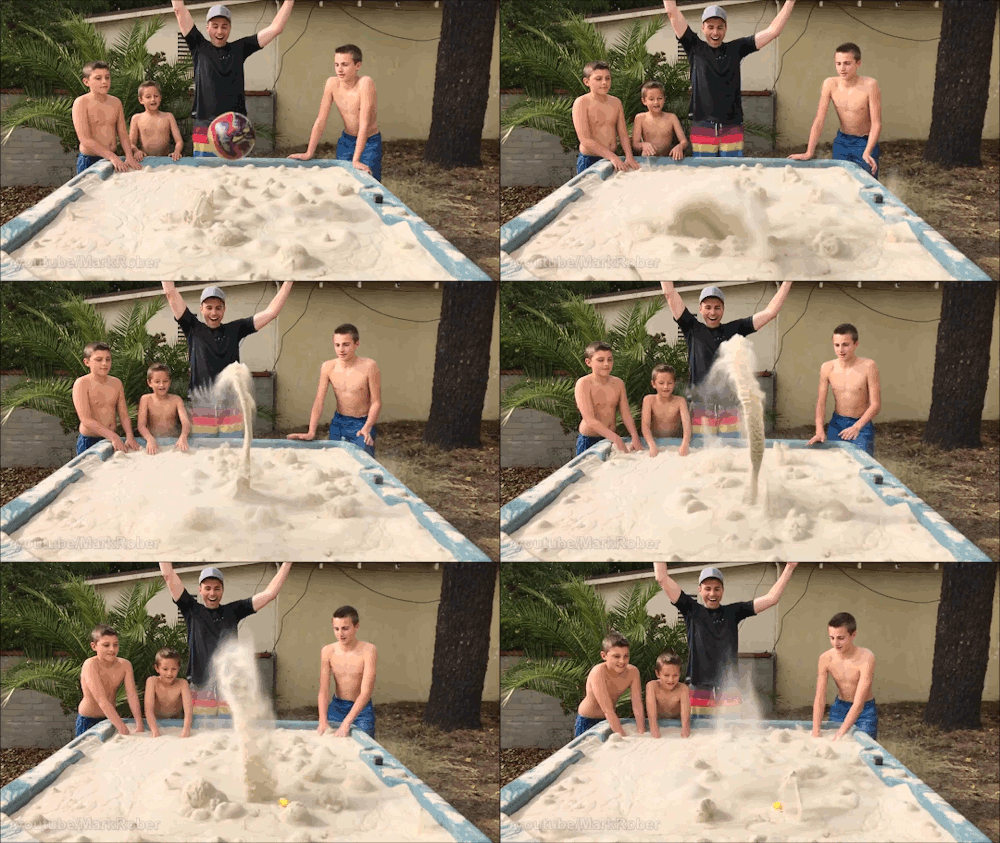
    Fluidized beds continue to be all the rage among science YouTubers, but Mark Rober supersizes his by turning a broken hot tub into a massive bath of bubbling sand. His video includes a nice explanation of how a granular material like sand gets fluidized as well as how to make your own miniature bed. One of my favorite moments is shown in the animation below. When Mark drops a bowling ball into the fluidized bed, it creates a remarkably liquid-like splash. The ball sprays a splash curtain of sand up on impact and sinks into its own cavity. When the cavity seals behind the ball, it shoots up a tall jet of sand, just like a Worthington jet in water. Even with air fluidizing it, the sand doesn’t have surface tension, though, so the jet breaks up quite differently than water! (Video and image credit: M. Rober; submitted by clogwog)

  • Featured Video Play Icon

    Build Your Own Fluidized Bed

    Previously, we featured some GIFs of bubbling, fluidized sand (below). Inspired by the same video, Dianna from Physics Girl decided to build her own set-up, discovering along the way that it’s a little tougher than you might think. To work well, you’ll need very fine, dry particles and a good way to uniformly distribute the air so it doesn’t simply bubble up in one spot. And if you accidentally apply too much air pressure, you may get a face full of sand. The final results are very fun, though, and hopefully Dianna’s lessons learned will help any other DIYers interested in trying this experiment at home. For a little more on the physics here and in related topics, check out some of our previous posts on fluidization, soil liquefaction, quicksand, and dam failures. (Video credit: Physics Girl; image credit: R. Cheng, source)

  • Turning Sand Into a Fluid

    Turning Sand Into a Fluid

    Pumping air through a bed of sand can make the grains behave just like a liquid. This process is called fluidization. Air introduced at the bottom of the bed forces its way upward through the sand grains. With a high flow rate, the space between sand grains gets larger, eventually reaching a point where the aerodynamic forces on a grain of sand equal gravitational forces. At this point the sand grains are essentially suspended in the air flow and behave like a fluid themselves. Light, buoyant objects – like the red ball above – can float in the fluidized sand; heavier, denser objects will sink. Fluidization has many useful properties – like good mixing and large surface contact between solid and fluid phases – that make it popular in industrial applications. For a similar (but potentially less playful) process, check out soil liquefaction. (Image credits: R. Cheng, source; via Gizmodo; submitted by Justin)

  • Featured Video Play Icon

    Asteroid Impact

    I often receive questions about how fluids react to extremely hard and fast impacts. Some people wonder if there’s a regime where a fluid like water will react like a solid. In reality, nature works the opposite way. Striking a solid hard enough and fast enough makes it behave like a fluid. The video above shows a simulated impact of a 500-km asteroid in the Pacific Ocean. (Be sure to watch with captions on.) The impact rips 10 km off the crust of the Earth and sends a hypersonic shock wave of destruction around the entire Earth. There’s a strong resemblance in the asteroid impact to droplet impacts and splashes. Much of this has to do with the energy of impact. The asteroid’s kinetic (and, indeed, potential) energy prior to impact is enormous, and conservation of energy means that energy has to go somewhere. It’s that energy that vaporizes the oceans and fluidizes part of the Earth’s surface. That kinetic energy rips the orderly structure of solids apart and turns it effectively into a granular fluid. (Video credit: Discovery Channel; via J. Hertzberg)

  • Featured Video Play Icon

    Particle-Tracking in Granular Flows

    One of the challenges of experimental fluid dynamics is gathering sufficient data in environments that can be fast-changing, visually dense, and sometimes harsh. Ideally, researchers want to gather as much data–velocities, temperatures, pressures–at as many points as possible and do so without disturbing the flow with a probe. No technique can provide everything, and thus new diagnostics are always under development. This video shows a new particle tracking method developed for fluidized granular flows where the high concentration of particles makes other techniques unsuitable. Such flows are often seen in industrial applications in chemical processing, pharmaceuticals, and powder transport. Interestingly, the technique can also be used in particle-seeded fluid flows like those normally studied with particle image velocimetry (PIV). (Video credit: F. Shaffer and B. Gopalan; submitted by @ASoutolglesias)

  • Featured Video Play Icon

    Fluidized Sand

    What’s shown in this video are some pretty spectacular demonstrations of fluidization, where a gas is introduced at the bottom of a bed of granular particles–like sand. At the critical gas velocity, the aerodynamic forces exerted on each particle by the gas will balance the gravitational force on the particle and it will become suspended. All of a sudden, the macroscopic behavior of the solid particles will be like that of a fluid; you can even make it “boil”!