Tag: fluid dynamics

  • Martian Glaciers

    Martian Glaciers

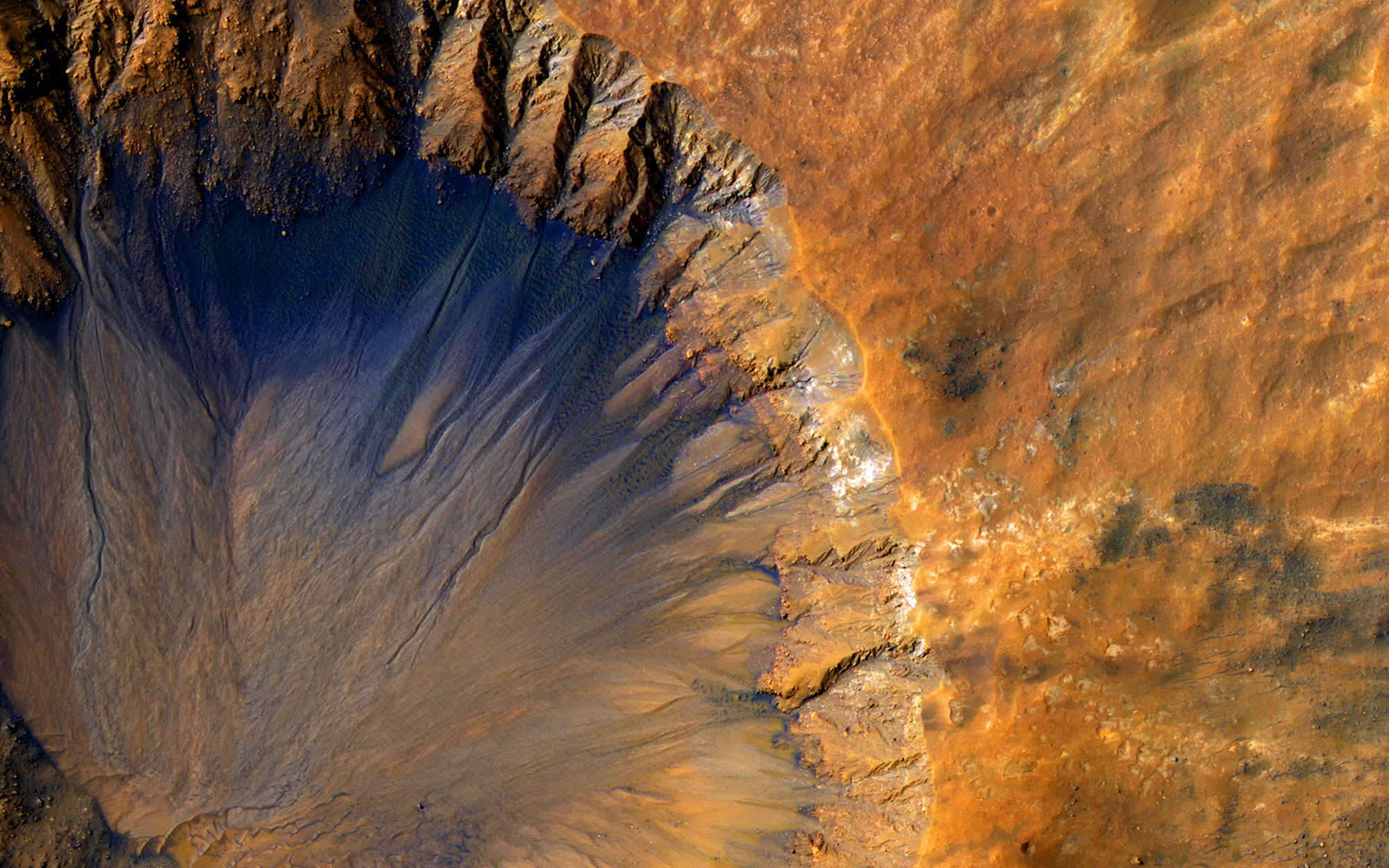
    On Earth, glaciers slide on lubricating layers of water, leaving complex landscapes like fjords and drumlins in their wake. Mars — though once home to enormous ice masses — lacks those geological features. Scientists assumed, therefore, that Martian ice stayed frozen and unmoving. But a new study demonstrates that is not the case.

    Researchers used computational modeling to simulate two identical glaciers: one under Earth-like conditions and one under the lower gravity of Mars. They found that Martian glaciers did indeed move, but Mars’s lower gravity, combined with better water drainage beneath the ice, meant that they moved exceedingly slowly. Martian glaciers did erode the landscape but into different features than on Earth. Instead of forming moraines and drumlins, a large Martian glacier would instead carve channels and eskar ridges, geological features found on Mars today. (Image credit: NASA/JPL-CalTech/Uni. of Arizona; research credit: A. Grau Galofre et al.; via AGU; submitted by Kam-Yung Soh)

  • Jupiter’s Frosted Clouds

    Jupiter’s Frosted Clouds

    This 3D rendering of Jupiter's cloud tops is based on flyby data from the JunoCam instrument. It's not a true physical image of the cloud tops, though scientists are working on a calibration for that. Instead, the elevations shown here are based on the intensity of visible light registered by the instrument. This measure correlates with cloud height, but there are exceptions.
    This 3D rendering of Jupiter’s cloud tops is based on flyby data from the JunoCam instrument. It’s not a true physical image of the cloud tops, though scientists are working on a calibration for that. Instead, the elevations shown here are based on the intensity of visible light registered by the instrument. This measure correlates with cloud height, but there are exceptions.

    New 3D renderings of Jovian clouds show textured swirls akin to a cupcake’s sculpted frosting. The images are based on flyby data from the JunoCam instrument. Because illumination of the clouds is generally brightest for the highest clouds, the team has rendered elevation based on brightest. While this is somewhat physical, it’s not exactly what Jupiter looks like. For that, Juno scientists are working on a calibration that will translate these initial renderings into a truer physical model. Nevertheless, the results are stunning, especially the flyover video embedded over here! (Image credit: 3D renders – NASA / JPL-Caltech / SwRI / MSSS / G. Eichstädt, image pair – G. Eichstädt et al.; via phys.org; submitted by Kam-Yung Soh)

    Cross your eyes to see this image pair as a 3D image of Jupiter's cloud tops.
    Cross your eyes to see this image pair as a 3D image of Jupiter’s cloud tops. The brighter regions will appear closer than the darker ones.
  • Rising Through Turbulence

    Rising Through Turbulence

    Plankton — microscopic creatures with often limited swimming abilities — can face daily journeys of hundreds of vertical meters in the ocean. That’s a daunting prospect for any tiny swimmer. A new mathematical model suggests that plankton can have an easier time of it, though, by riding turbulent currents.

    The researchers modeled an individual planktar (singular of plankton) capable of sensing nearby velocity gradients and rotating its body to control its swimming direction. With this simple set of controls, their simulated planktar was able to “surf” turbulent currents, covering vertical distances at twice its normal swimming speed despite its curvy path.

    Currently, there’s no direct experimental evidence that plankton do this, but it does seem to make sense of experimenters’ observations. With the model’s results to guide them, experimentalists are looking for microswimmers actively orienting themselves based on turbulence. (Image credit: top – B. de Kort, illustration – R. Monthiller et al.; research credit: R. Monthiller et al.; via APS Physics)

  • Featured Video Play Icon

    How Gas Pump Nozzles Work

    Ever wonder how a gas pump shuts off when the tank is full? You might guess that there’s a sophisticated electronic sensor hidden in there. But there isn’t! Gas pumps use an entirely mechanical technique to sense a full tank and shut off flow, as Steve Mould demonstrates in this video.

    There are two key components — one fluid mechanical and one based on mechanical linkages — inside the handle. The part that senses a full tank is a Venturi tube, shown in Image 2. The top section of the Venturi tube contains a constriction, where (incompressible) flow is forced to speed up. That increase in speed creates a drop in pressure, which is reflected by the movement of the water in the curved tube below the constriction.

    Notice that when there’s no flow through the top tube, the water level is equal on either side of the lower, curved tube. That means that the outside air pressure (connected to the short arm) equals the pressure in the constriction (connected to the long arm). When air is flowing through the constriction, the water level shifts. The water in the short arm gets pushed down while the water in the long arm gets sucked up. That change means that the air pressure outside the tube is now higher than pressure in the constriction.

    I’ll let Steve explain what that means for the gas pump! (Image and video credit: S. Mould)

  • Flowers Through a Hazy Veil

    Flowers Through a Hazy Veil

    A smoke-like haze obscures colorful bouquets in these photographs from artist Robert Peek. To achieve the effect, Peek submerges his subjects underwater with white dye that sinks due to its greater density. The wakes traced by the dye are impressively laminar, so the dye must drift rather slowly past each petal. The overall effect is beautifully dream-like. You can find more of Peek’s work on Behance and Instagram. (Image credit: R. Peek; via Colossal)

  • Mixing the Perfect Batter

    Mixing the Perfect Batter

    In baking, there’s a point when wet and dry ingredients get combined to form the batter (or dough) that eventually becomes a tasty treat. Experienced bakers know that the ratio of wet-to-dry must be just right for the final product. Too dry and the mixture won’t come together; too wet and the final product is a soggy mess.

    Mixing liquids and powders is ubiquitous outside the kitchen, too. Ceramics, concrete, laundry detergent, chocolate — all involve this critical step. To understand how these mixtures transition from fluid to clustered granules to granulations (think wet sand), researchers carefully studied a mixture of glass spheres and glycerol. When there were relatively few particles in the mixture (in technical terms, a smaller “particle volume fraction”), the mixture was fully fluid (top image, orange background). When the ratio of particles-to-liquid was high, the mixture was granular (blue background). And in-between these ratios, whether the mixture formed clumps, or granules, depended on how it was mixed (green background). Vigorous mixing (top row) formed large granules, which consisted of a wet, jammed interior and an outer layer of dry particles (lower image).

    Their observations allowed the researchers to predict what ratio of liquid and powder is needed, and how much mixing is necessary, to create a desired outcome. (Image and research credit: D. Hodgson et al.; via Physics Today)

    A cross-section of a granule, showing the wet, jammed interior (left) surrounded by a region of dry particles (center, enclosed between red dashes).
    A cross-section of a granule, showing the wet, jammed interior (left) surrounded by a region of dry particles (center, enclosed between red dashes).
  • Featured Video Play Icon

    Leaky Resonance

    Some resonators aren’t perfect — nor are they meant to be! Here, researchers experiment with resonance using a disk shaking up and down over a pool of water. The disk never touches the water, but its movement makes the air above the water move in and out, like a miniature, changeable wind. The air flow distorts the water surface, creating waves just tens of microns high. Beneath the disk, the water forms standing waves, indicating resonance.

    But the waves don’t stay under the disk. Beyond its edge, we see traveling waves moving outward, carrying some of the disk’s energy with them. This leakage is actually how many musical instruments, like a guitar, work. When the guitar strings are plucked, their vibrations are transmitted into the body of the guitar through its bridge, where the strings are anchored. The body acts as a resonator, amplifying the sound, some of which leaks out the sound hole. (Image and video credit: U. Jain et al.)

  • Zen Stones

    Zen Stones

    On Lake Baikal, where Siberian winters are long and cold but have little precipitation, you can find a strange phenomenon: stones that balance on a thin spire of ice. Known as Zen stones — thanks to their visual similarity to stacks of balanced stones in Japanese Zen gardens — these natural oddities rely on time and sublimation, a transition from ice to vapor without melting.

    The process is simple. Toss a stone on the ice and wait. As the sun shines, the ice will sublimate, transforming from ice directly to vapor at an estimated rate of ~2 mm per day, for Lake Baikal’s typical weather. But the stone’s presence acts like an umbrella, protecting some of the ice beneath it from the sunlight that is critical for sublimation. As a result of this umbrella effect, a thin column of ice remains beneath the stone.

    In the lab, researchers were able to recreate the process in less time by tweaking the temperature, humidity, and irradiance to enhance sublimation. Instead of stones, they used metal disks, but their Zen stones made their ice columns just the same. (Image and research credit: N. Taberlet and N. Plihon; via Physics Today)

    A lab Zen stone, formed from a disk of aluminum atop a column of ice.
    A lab Zen stone, formed from a disk of aluminum atop a column of ice.
  • Featured Video Play Icon

    Dolphins Playing With Bubble Rings

    Blow a jet of air underwater and you can make a bubble ring. It takes some practice for humans, or you can use a device. In this video, a team introduced wild dolphins to a bubble-ring-making machine and observed how the dolphins reacted. After some initial wariness, the animals played with them for hours, creating games and having fun. Note that there are some dolphins who create their own bubble rings to play with, so it’s hard to say that these particular dolphins have never seen a bubble ring before. But even if they have seen the bubbles, they wouldn’t have seen a machine making them. (Image and video credit: BBC Earth)

  • Bird Photographer of the Year 2022

    Bird Photographer of the Year 2022

    Try as we might, humans cannot understand fluid dynamics as birds do. Whether they are primarily flyers or swimmers, birds have an innate understanding of lift and other aerodynamic forces that put the best engineers to shame. Shown here are a subset of winners from the 2022 Bird Photographer of the Year competition, each of them showing off fluid dynamics in some fashion. Hummingbirds hover, droplets shine like diamonds, and divers brace for impact. You can peruse more winner at BPOTY’s website. (Image credits: Various; see alt text of individual images)