This video shows an ultrasonically levitated 3 mm drop of propylene glycol changing shape. A couple of things are happening here. Firstly, the drop is suspended due to the acoustic radiation pressure from intense ultrasonic sound waves being produced by a transducer vibrating at 30kHz. Then the power input to the ultrasonic transducer is increased, which strengthens the acoustic field, and this is what causes the drop to flatten. Currently, acoustic levitation is used for containerless processing of very pure materials or chemicals. As with many methods for levitation, it is currently restricted to objects of relatively light weight. (Video credit: J. R. Saylor et al, Clemson University)
Tag: fluid dynamics

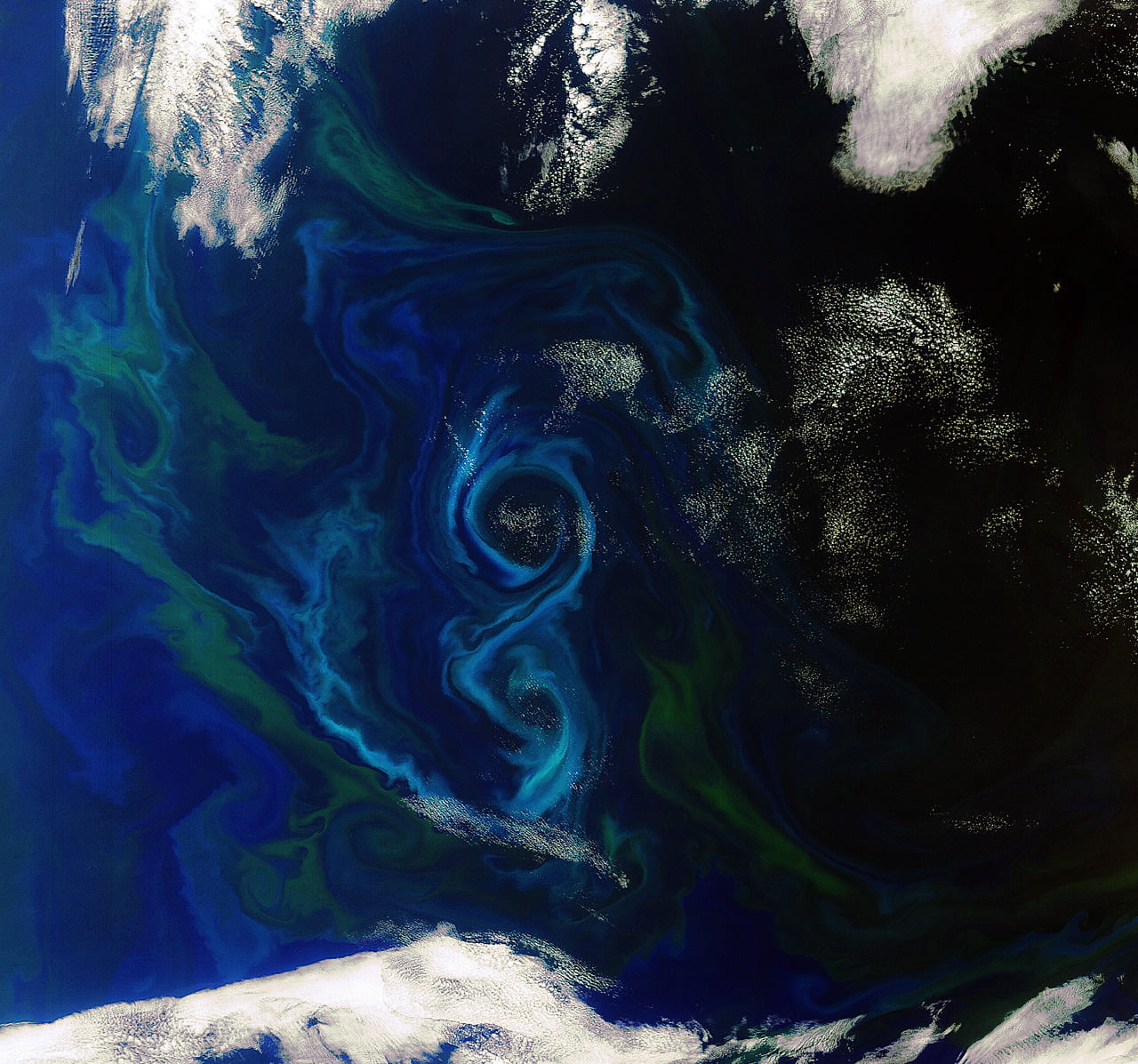
Oceanic Swirls
Mixing of surface waters with deeper ocean currents brings together the minerals and nutrients used by phytoplankton, resulting in gorgeous swirls of color in the ocean. These phytoplankton blooms are most common in the spring and summer, and while lovely, can be harmful to other marine life, either through the production of toxins or by depleting the waters of oxygen. Because the phytoplankton move according to the wind and waves, they can also form a sort of natural flow visualization. (Photo credit: ESA)
———-
While FYFD is not blacking out for SOPA/PIPA, we would like to take a moment to register our protest and encourage those of you who are Americans to take a moment to let Congress know that you don’t approve of these bills. Although we agree that protection of copyright holders rights is important, the measures proposed in these bills reach far beyond that line. FYFD, as a site that reposts photos and videos primarily created by others, could be taken down as a result of these bills, despite the purpose of the website as a tool for educational outreach and dissemination of science. Please support a free and uncensored Internet!

Dove in Flight
This spectacular high-speed video shows a dove in flight. Note how its wings flex through its stroke and the way the wings rotate over the course of the downstroke and reversal. There is incredible beauty and complexity in this motion. The change in wing shape and angle of attack is what allows the bird to maximize the lift it generates. Note also how the outer feathers flare during the downstroke. This promotes turbulence in the air moving near the wing, which prevents separated flow that would cause the dove to stall. (See also: how owls stay silent. Video credit: W. Hoebink and X. van der Sar, Vliegkunstenaars project)
Inside a Blender
[original media no longer available]
High-speed video visualizes the complicated flow field inside a blender. Note that the video is placed in reverse for artistic effect. This flowfield is clearly too turbulent for reversible flow. That said, it is possible to mix two fluids and then unmix them, under the right circumstances.
The Invisible Forces Behind a Lighter
This high-speed schlieren video reveals the ignition of a butane lighter. The schlieren optical technique exaggerates differences in refractive index caused by density variations, enabling experimentalists to see thermal eddies, shock waves, and other phenomena invisible to the naked eye. Here a jet of butane shoots upward from the lighter as a valve is released. Then the spark from the lighter ignites the butane gas near the bottom of the jet. A flame front the propagates outward and upward, completing the lighting process. (submitted by @Mark_K_Quinn)

Cloud Streets from Space
Cloud streets flowing south across Bristol Bay hit the Shishaldin and Pavlof volcanoes, which part the air flow into distinctive swirls called von Karman vortex streets. As air flows around the volcano, a vortex is shed first on one side, then the other. Although the usual example for this type of flow is the wake of a cylinder, vortex streets can extend behind any non-aerodynamic body immersed in a flow. The same phenomenon is responsible for the singing of power lines in the wind. As astronaut Dan Burbank observes, “It’s classic aerodynamics, but on a thousands of miles scale.” (Photo credit: Dan Burbank, NASA)
Staining Patterns
This timelapse video shows a particulate suspension as it dries and the pattern formation that results. The mixture of silicon dioxide particles and water is spread over a glass slide. As the water evaporates, capillary action generates a flow toward the edges, but the fluid meniscus pins larger particles to the glass, trapping them. As more and more water evaporates, smaller particles are trapped, causing the formation of uneven stripes in the particulate deposits. You’ve probably seen these patterns before on the side of a muddy car after a rainy day! (See also: how coffee rings form; Video credit: Bjornar Sandnes)

Worthington Jet
A drop of sugar syrup falls into a pool of methylated spirits, producing a Worthington jet and several ejected droplets. Although surface tension holds the jet in a smooth shape, the refractive index of the spirits reveals the turbulent mixing within the jet. (Photo credit: Rebecca Ing)
Sloshing to Dampen
In this high-speed video, two flexible spheres are dropped from the same height. The one on the left is filled with air, the other is partially filled with a liquid. Although both spheres rebound to nearly the same height after the first bounce, their behavior differs drastically after that. The sloshing of the liquid inside the sphere acts as a damper, absorbing energy that would otherwise cause the ball to continue bouncing. The effects of contained liquids sloshing are important for understanding the dynamics of tankers, fuel on spacecrafts, and even how to walk without spilling your coffee.
Fragmenting Raindrops
This numerical simulation demonstrates the fragmentation of droplets of water falling through a quiescent medium–essentially how a raindrop behaves. As the initial droplet falls, drag forces deform the droplet, contorting it until surface tension causes it to break into smaller droplets, which can themselves be broken up by the same mechanisms.