Tag: fluid dynamics

  • Tracking Coastal Sediment Loss

    Tracking Coastal Sediment Loss

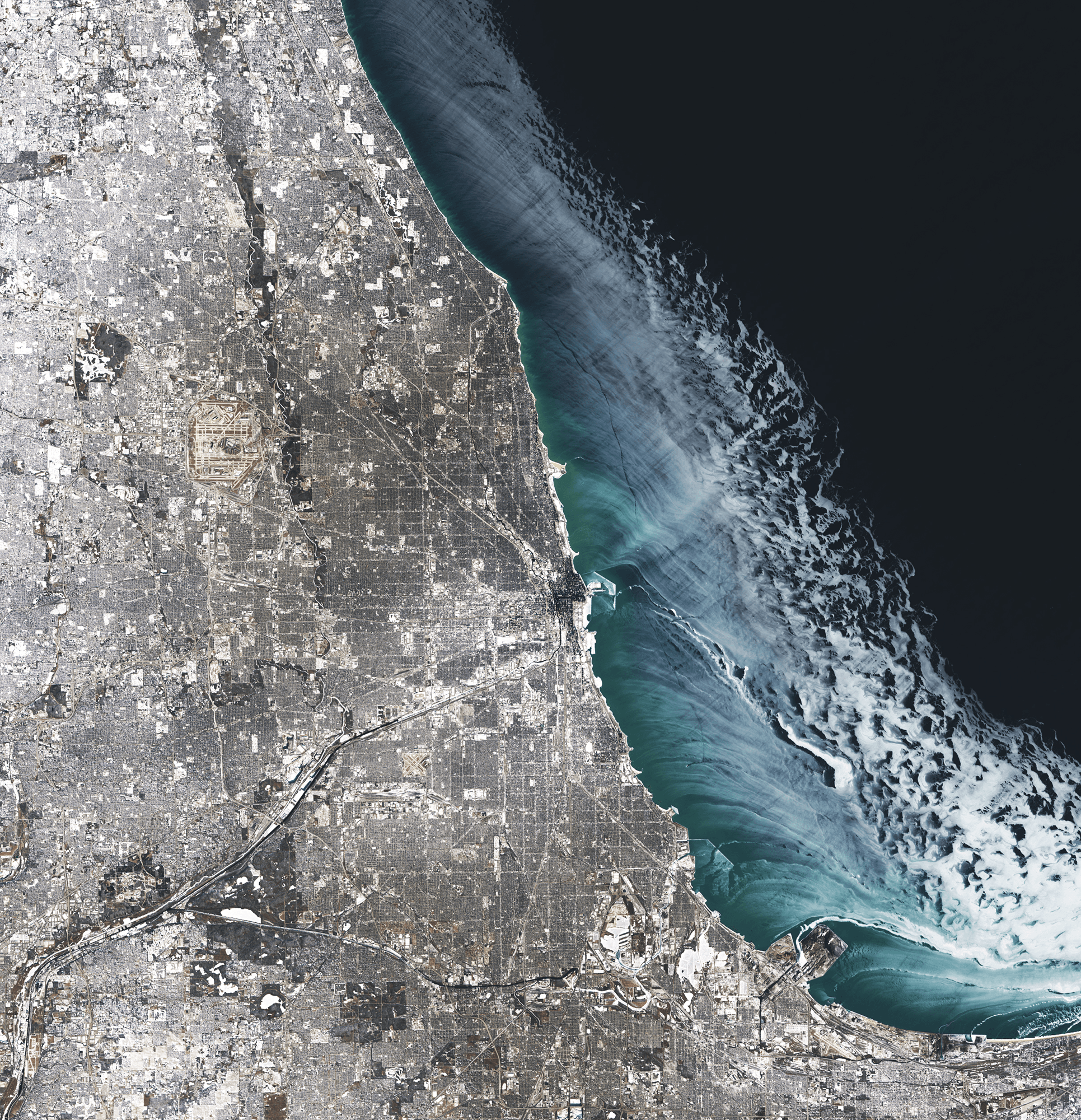
    Shorelines rely on an influx of sediment to counter what’s lost to erosion by waves and currents. But tracking that sediment flux is challenging in coastal regions where salt, waves, and storms batter delicate instruments. Instead, researchers have turned to remote sensing through high-resolution satellites like Landsat to monitor these areas. Researchers built an algorithm to analyze coastal imagery, validated with local sediment measurements; once built, they deployed it in a free tool that lets anyone build a 40-year timeline of a coastal area’s sediment history.

    Looking at thousands of sites around the world, the team found coastal sediment is on the decline, especially along sandy and muddy coastlines. Where has the sediment gone? It’s likely that human-built infrastructure — both on coasts and upstream along rivers — is disrupting the natural flow of sediments that would replenish these regions. (Image credit: NASA; research credit: W. Teng et al.; via Eos)

  • Featured Video Play Icon

    Cavitation Near Soft Surfaces

    Collapsing cavitation bubbles are sometimes used to break up kidney stones, and they may find other uses in medicine as well. Here, researchers investigate the collapse of laser-triggered cavitation bubbles near tissue-mimicking hydrogel. The bubbles take on a very different form than they do near solid surfaces. Near hydrogel, the bubbles become mushroom-shaped. During their collapse, they release a rainy microjet that moves at nearly 2,000 meters per second! Even at 5 million frames per second, the jet is practically a blink-and-you-miss-it phenomenon. (Image and video credit: D. Preso et al.)

    Fediverse Reactions
  • Strata of Starlings

    Strata of Starlings

    Starlings come together in groups of up to thousands of birds for the protection of numbers. These flocks form spellbinding, undulating masses known as murmurations, where the movement of individual starlings sends waves spreading from neighbor to neighbor through the group. One bird’s effort to dodge a hawk triggers a giant, spreading ripple in the flock.

    To capture the flowing nature of the murmuration, photographer and scientist Kathryn Cooper layers multiple images of the starlings atop one another. The birds themselves become pathlines marking the murmuration’s motion. The final images are surprisingly varied in form. Some flocks resemble a downpour of rain; others the dangling branches of a tree. (Image credit: K. Cooper; via Colossal)

    Fediverse Reactions
  • Tracking Tonga’s Boom

    Tracking Tonga’s Boom

    When the Hunga Tonga-Hunga Ha’apai volcano erupted in January 2022, its effects were felt — and heard — thousands of kilometers away. A new study analyzes crowdsourced data (largely from Aotearoa New Zealand) to estimate the audible impact of the eruption. The researchers found that the volume, arrival time, and nature of the rolling rumble reported by survey takers correlated well with seismic measurements. But humans provided data that monitoring equipment couldn’t. For example, reports of shaking buildings and rattling windows let researchers estimate the shock wave‘s overpressure far from the volcano. The team suggests that acting quickly to collect human impressions of rare events like this one can add valuable data that’s otherwise overlooked. (Image credit: NASA; research credit: M. Clive et al.; via Gizmodo)

  • Featured Video Play Icon

    How Cooling Towers Work

    Power plants (and other industrial settings) often need to cool water to control plant temperatures. This usually requires cooling towers like the iconic curved towers seen at nuclear power plants. Towers like these use little to no moving parts — instead relying cleverly on heat transfer, buoyancy, and thermodynamics — to move and cool massive amounts of water. Grady breaks them down in terms of operation, structural engineering, and fluid/thermal dynamics in this Practical Engineering video. Grady’s videos are always great, but I especially love how this one tackles a highly visible piece of infrastructure from multiple engineering perspectives. (Video and image credit: Practical Engineering)

    Fediverse Reactions
  • A New Mantle Viscosity Shift

    A New Mantle Viscosity Shift

    The rough picture of Earth’s interior — a crust, mantle, and core — is well-known, but the details of its inner structure are more difficult to pin down. A recent study analyzed seismic wave data with a machine learning algorithm to identify regions of the mantle where waves slowed down. These shifts in seismic wave speed occur in areas where the mantle’s viscosity changes; a higher viscosity makes waves travel slower.

    The team found seismic wave speed shifts at depths of 400 and 650 kilometers, corresponding to known viscosity changes. But they found shifts at 1050 and 1500 kilometers, as well — the first time anyone has shown a global viscosity shift at those depths. Their analysis suggests a higher viscosity in this mid-mantle transition zone, which could affect how tectonic plates, which rely on these slow mantle flows, move. (Image credit: NASA; research credit: K. O’Farrell and Y. Wang; via Eos)

  • Jets, Shocks, and a Windblown Cavity

    Jets, Shocks, and a Windblown Cavity

    As material collapses onto a protostar, these young stars often form stellar jets that point outward along their axis of rotation. Made up of plasma, these jets shoot into the surrounding material, their interactions creating bright parabolic cavities like the one seen here. This is half of LDN 1471; the protostar’s other jet and cavity are hidden by dust but presumably mirror the bright shape seen here. (The protostar itself is the bright spot at the parabola’s peak.) Although the cavity is visibly striated, it’s not currently known what causes this feature. Perhaps some form of magnetohydrodynamic instability? (Image credit: NASA/Hubble/ESA/J. Schmidt; via APOD)

    Fediverse Reactions
  • “Flowing Kelp”

    “Flowing Kelp”

    This CUPOTY-shortlisted photo by Sigfrido Zimmerman shows giant kelp drifting in the current. At the base of each blade is an inflated bladder that helps keep the algae buoyant. The blades themselves are furrowed on their surface, with patterns reminiscent of sand ripples. Though giant kelp can grow to as large as 60 meters, the species lives in constant flux, pushed and pulled by the currents that run along its length. (Image credit: S. Zimmerman/CUPOTY; via Colossal)

    Fediverse Reactions
  • Holding Steady

    Holding Steady

    Before a mammalian cell divides, the spindle — a protein structure — divides the cell’s genetic material in two. As it does, the cytoplasm inside the cell forms a toroidal flow (below, left). Researchers wondered how the spindle manages to stay in place with this flow; the spindle sits just where the flow diverges, a spot that seems ripe for unstable shifts in position. But, contrary to expectations, their analysis showed that — although a smaller spindle would be unstable in that spot — the protein spindle is large enough that its size distorts the cell’s flow and creates a pressure that moves it back into place if it shifts. (Image credit: top – ColiN00B, illustration – W. Liao and E. Lauga; research credit: W. Liao and E. Lauga; via APS Physics)

    Left: illustration of the toroidal flow near the spindle (purple) in a cell. Right: schematic of flow near the spindle's fixed point.
    Left: illustration of the toroidal flow near the spindle (purple) in a cell. Right: schematic of flow near the spindle’s fixed point.
    Fediverse Reactions
  • The Best of FYFD 2024

    The Best of FYFD 2024

    Welcome to another year and another look back at FYFD’s most popular posts. (You can find previous editions, too, for 2023, 2022, 2021, 2020, 2019, 2018, 2017, 2016, 2015, and 2014. Whew, that’s a lot!) Here are some of 2024’s most popular topics:

    This year’s topics are a good mix: fundamental research, civil engineering applications, geophysics, astrophysics, art, and one good old-fashioned brain teaser. Interested in what 2025 will hold? There are lots of ways to follow along so that you don’t miss a post.

    And if you enjoy FYFD, please remember that it’s a reader-supported website. I don’t run ads, and it’s been years since my last sponsored post. You can help support the site by becoming a patronbuying some merch, or simply by sharing on social media. And if you find yourself struggling to remember to check the website, remember you can get FYFD in your inbox every two weeks with our newsletter. Happy New Year!

    (Image credits: dam – Practical Engineering, ants – C. Chen et al., supernova – NOIRLab, sprinkler – K. Wang et al., wave tank – L-P. Euvé et al., “Dew Point” – L. Clark, paint – M. Huisman et al., iceberg – D. Fox, flame trough – S. Mould, sign – B. Willen, comet – S. Li, light pillars – N. Liao, chair – MIT News, Faraday instability – G. Louis et al., prominence – A. Vanoni)

    Fediverse Reactions