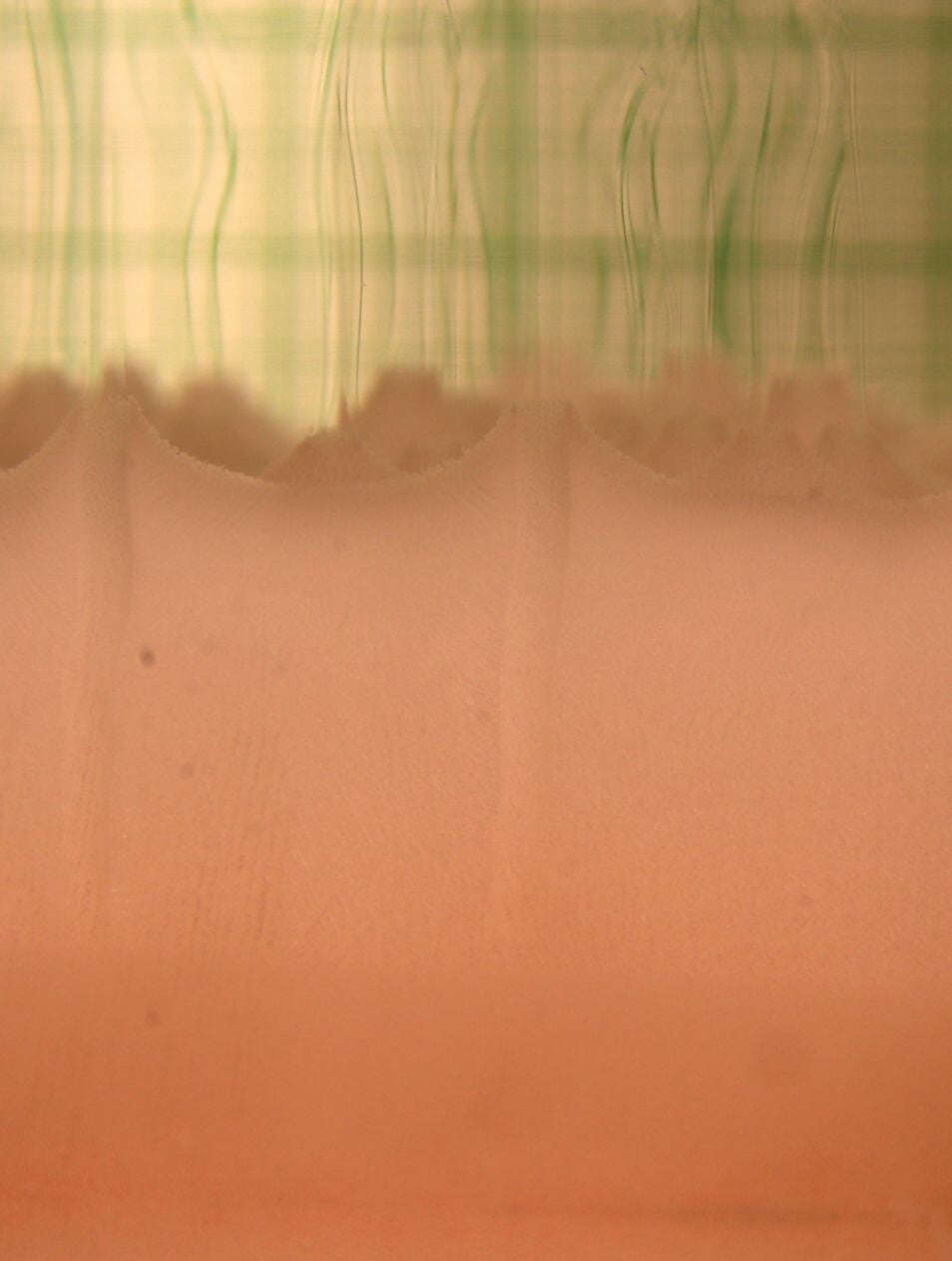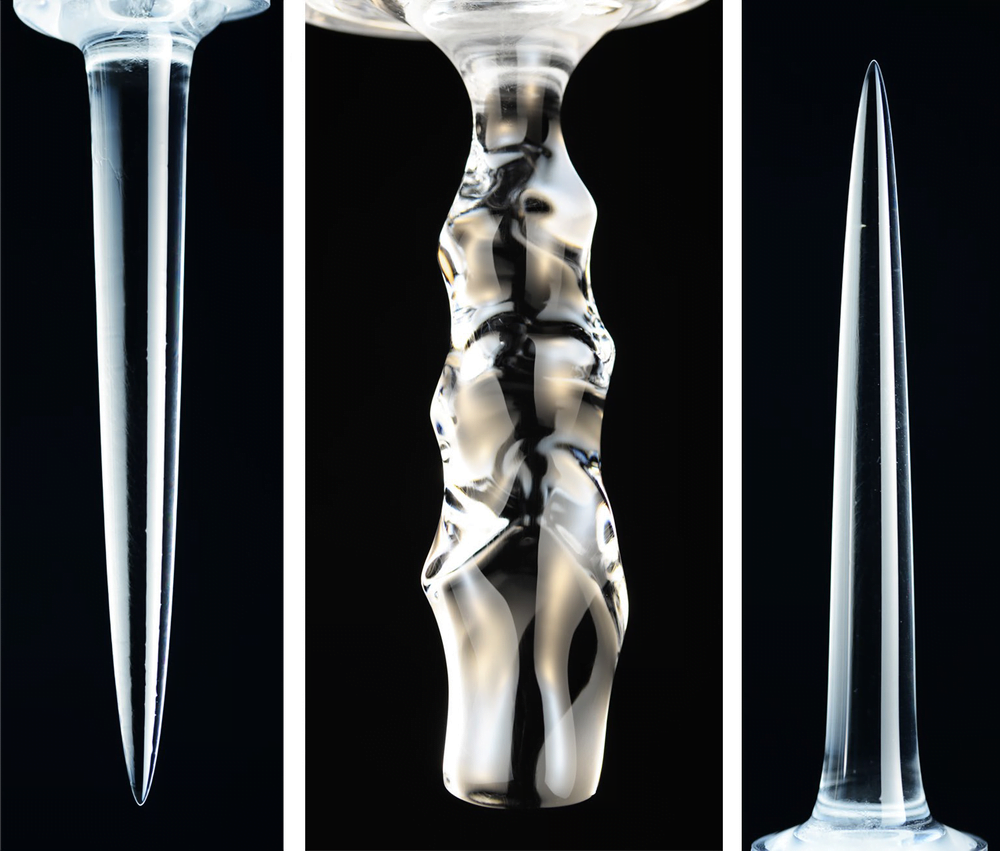
It may have been 10 years since the BBC filmed the first timelapse of a growing brinicle, but the footage is just as amazing now as it was then! This video gives you the behind-the-scenes story of what it took to capture this natural wonder under the Antarctic ice. It’s incredible to see the shots of sinking brine streaming off the brinicles, too. The difference in density (and thus refractive index) of the brine and the ocean water is substantial enough that your eye can actually pick them out as separate fluids. I once went snorkeling in an area with similarly varied salinity and it was completely bizarre watching everything suddenly go wavy and blurry as I swam. (Image and video credit: BBC)
Tag: fluid dynamics

“The Green Reapers”
This short film from artist Thomas Blanchard focuses on carnivorous plants and their prey. These plants — including Venus fly traps, sundews, and pitcher plants — rely on fluids both to attract and capture their prey. Plants like the Venus fly trap build turgor pressure in their cells to move and prop open their leaves. Once triggered, a mechanical release allows the fluid pressure to snap the trap closed. Sweet-smelling fluids invite insects in, only to become nightmarishly difficult to escape once prey try to unstick themselves from the highly viscoelastic liquids. (Video and image credit: T. Blanchard; via Colossal)

Driven From Equilibrium
With the right application of force, liquids can take on shapes that defy our intuition. Here researchers sandwiched two immiscible oils between glass slides and applied an electric field. Because the two oils have different electrical responses, charges build along the interface between them. These charges lead to non-trivial electrohydrodynamic flows and a multitude of bizarre shapes. They observed polygonal droplets, streaming droplet lattices, and spinning filaments among others. As long as the electric field remains on, the wild behaviors continue; once the field is turned off, the oils relax back to typical, rounded drops. (Image, video, and research credit: G. Raju et al.; via Physics World)

The Bubbly Escape
Sometimes experiments don’t work as planned and, instead of answers, they lead to more questions. In this video, we see an experiment looking at an air bubble trapped beneath a cone. It’s the same situation you get by holding a mug upside-down in a sink full of water but with inclined walls. As the cone moves downward, it squeezes the trapped air bubble. A film of air gets pushed along the walls of the cone, eventually forming finger-like bubbles that wrap around the edge of the cone and get entrained into the vortex ring outside the cone.
Clearly, there is some kind of instability that drives the air bubble to form these fingers rather than spreading uniformly. But the big question is which one? Is this a density-driven Rayleigh-Taylor instability caused by air getting pushed into water? Or is it a Saffman-Taylor instability causes by the less viscous air forcing its way into the more viscous water? What do you think? (Image and submission credit: U. Jain)


Spreading By Island
How does a droplet sinking through an immiscible liquid settle onto a surface? Conventional wisdom suggests that the settling drop will slowly squeeze the ambient fluid film out of the way, form a liquid bridge to the solid beneath, and spread onto the surface. But for some droplets, that’s not how it goes.
While watching a glycerol droplet settle through silicone oil, researchers discovered a new mechanism for wetting. Initially, the silicone oil drained from beneath the drop, as expected. But then the thinning of the film stalled. Tiny bright spots (above) appeared beneath the light and dark interference fringes of the parent drop. These are spots of glycerol, formed when material from the main drop dissolved into the oil and then nucleated onto the solid surface below. Over time, the island-like spots of glycerol grew. Eventually one grew large enough to coalesce with its parent drop (below), causing the glycerol to quickly spread over the solid surface!

Islands of liquid (darker rings) grow beneath a parent drop (brighter rings) until reaching a size where they coalesce, causing the interference fringes to disappear. The key to this phenomenon seems to be that immiscibility isn’t perfect. Even trace amounts of solubility between the drop and surrounding fluid are enough to allow these islands to form. And once formed, the islands will grow as long as the drop fluid and the solid surface are chemically attractive. (Image, research, and submission credit: S. Borkar and A. Ramachandran; see also Nature Behind the Paper)

Ice and Dunes
Although dunes are usually associated with scorching climates, they can form in any desert, including in the frozen steppes of western Mongolia. This sunrise photo, taken by an astronaut aboard the ISS, shows Ulaagchinii Khar Nuur. The ice-covered Khar Nuur Lake surrounds two islands, Big and Small Avgash, and cold dunes form textured streaks on either side. The low sun angle accentuates the dunes, making every rippling crest clear. (Image credit: NASA; via NASA Earth Observatory)

Yosemite in Winter
Waterfalls, fog, and snow wreathe Yosemite in these beautiful winter landscapes by photographer Michael Shainblum. I love how the tendrils of water and mist give you a real sense of the flow, even in still photos. Check out more of Shainblum’s photography on his Instagram and go behind-the-scenes on his Yosemite trip with this video. (Image credit: M. Shainblum; via Colossal)

Falling Pancake Drops
Despite their round appearance, the droplets you see here are actually shaped like little pancakes. They’re sandwiched inside a Hele-Shaw cell, essentially two plates with a viscous fluid between them. As these droplets fall through the cell, some remain steady and rounded (Image 1), while others experience instabilities (Images 2 and 3). By varying the ratio of the ambient fluid’s viscosity relative to the drop, the authors found two different kinds of breakup. In the first type (Image 2), droplet breakup occurred due to perturbations inside the drop itself. In the second type (Image 3), the viscosity of the ambient fluid is closer to that of the drop and intrusions of the ambient fluid into the drop break it apart. (Image and research credit: C. Toupoint et al.)

Ink-Based Propulsion
In this video, Steve Mould explores an interesting phenomenon: propulsion via ballpoint pen ink. Placing ink on one side of a leaf or piece of paper turns it into a boat with a dramatic dye-filled wake. It’s not 100% clear what’s happening here, though I agree with Steve that there are likely several effects contributing.
Firstly, there’s the Marangoni effect, the flow that happens from an area of low surface tension to high surface tension. This is what propels a soap boat as well as many water-walking insects. I think this is a big one here, and not just because the ink has surfactants. As any component of the ballpoint ink spreads, its varying concentration is going to trigger this effect.
Secondly, there’s a rocket effect. Rockets operate on a fairly simple principle: throw mass out the back in order to go forward. These dye boats are also doing this to some extent.
And finally there’s some chemistry going on. Some kind of reaction seems to be taking place between one or more of the ink components and the water in order to create the semi-solid layer of dye. Presumably this is why the dye doesn’t simply dissolve as it does in some of Steve’s other experiments.
I figure some of my readers who are better versed in interfacial dynamics, rheology, and surface chemistry than I am will have some more insights. What do you think is going on here? (Video and image credit: S. Mould)

Swimming in Line
When swimming in open waters, it pays to keep your ducks (or your goslings!) in a row. A recent study examined the waves generated behind adult water fowl and found that babies following directly behind them benefit from their wake. In the right spot behind its mother, a duckling sees 158% less wave-drag than it would when swimming solo. That’s such a large reduction that the duckling actually gets pulled along! And the advantage doesn’t just help one duckling; a properly-placed duckling passes the benefit on to its siblings as well. So any duckling that stays in line has a much easier time keeping up, but those who slip out of the ideal spot will have a much tougher time. (Image credit: D. Spohr; research credit: Z. Yuan et al.; via Science News; submitted by Kam-Yung Soh)