Tag: flow visualization

  • Featured Video Play Icon

    Simulating the Earth

    Computational fluid dynamics and supercomputing are increasingly powerful tools for tracking and understanding the complex dynamics of our planet. The videos above and below are NASA visualizations of carbon dioxide in Earth’s atmosphere over the course of a full year. They are constructed by taking real-world measurements of atmospheric conditions and carbon emissions and feeding them into a computational model that simulates the physics of our planet’s oceans and atmosphere. The result is a visualization of where and how carbon dioxide moves around our planet.

    There are distinctive patterns that emerge in a visualization like this. Because the Northern Hemisphere contains more landmass and more countries emitting carbon, it contains the highest concentrations of carbon dioxide, but winds move those emissions far from their source. As seasons change and plants begin photosynthesizing in the Northern Hemisphere, concentrations of carbon dioxide decrease as plants take it up. When the seasons change again, that carbon is re-released.

    These visualizations underscore the fact that these carbon emissions impact everyone on our planet–nature does not recognize political borders–and so we share a joint responsibility in whatever actions we take. (Video credit: NASA Goddard; h/t to Chris for the second vid)

  • Featured Video Play Icon

    Visualizing Flow with Snowfall

    One of the challenges in engineering and operating wind turbines is that full-scale turbines rarely behave as predicted in smaller-scale laboratory experiments and simulations. One way to reconcile these differences (and discover what our experiments and simulations are missing) is to take the experiments out into the field. One research group has done this by using snowfall to visualize the flow around wind turbines. In this video, they share some of their observations, which include interactions of tip vortices with one another and with the vortex from the tower. My favorite part starts around 1:50 where you can observe tip vortices leap-frogging one another behind the wind turbine! (Video credit: Y. Liu et al.)

  • The Sound of a Balloon Popping

    The Sound of a Balloon Popping

    The pop of an overfilled balloon is enough to make anyone jump, but you’ve probably never seen it like this. The photo above uses an optical technique known as schlieren photography that reveals changes in density of a transparent gas like air. The shredded rubber of the balloon is still visible in black, and around the balloon there’s an expanding spherical shock wave. It’s the sudden release of energy when the balloon ruptures and the gas inside begins to expand that causes the shock wave. Notice, though, that the gas from the balloon is still clearly visible and balloon-shaped–much like a water balloon that’s just popped. From that clear delineation, I would say that this balloon was filled with a different gas than air–otherwise the density shouldn’t be different enough to make the interior gas distinguishable.  (Image credit: G. Settles)

  • Featured Video Play Icon

    “Chemical Poetry”

    In “Chemical Poetry” artists Roman Hill and Paul Mignot use fluid dynamics to create incredible and engaging visuals. With a stunningly close eye to fluids mixing and chemicals reacting, their imagery feels like gazing on primordial acts of creation or destruction. There’s even a sequence that feels like you’re watching an explosion in slow-motion, but there’s no CGI in any of it. This is just the beauty of physics laid bare, revealing the dances driven by surface tension, the undulations of a fluid’s surface, and the dendritic spread of one fluid into another – all cleverly lit and filmed for maximum effect. It is well worth taking the time to watch the whole video and check out more of their work. (Image/video credit and submission: NANO; GIFs via freshphotons)

  • Starfish Vortices

    Starfish Vortices

    Starfish larvae, like other microorganisms, use tiny hair-like cilia to move the fluid around them. By beating these cilia in opposite directions on different parts of their bodies, the larvae create vortices, as seen in the flow visualization above. The starfish larvae don’t use these vortices for swimming – to swim, you’d want to push all the fluid in the same direction. Instead the vortices help the larvae feed. The more vortices they create, the more it stirs the fluid around them and draws in algae from far away. The larvae actually switch gears regularly, using few vortices when they want to swim and more when they want to eat. Check out the full video below to see the full explanation and more beautiful footage.  (Image/video credit: W. Gilpin et al.)

  • Saturnian Clouds

    Saturnian Clouds

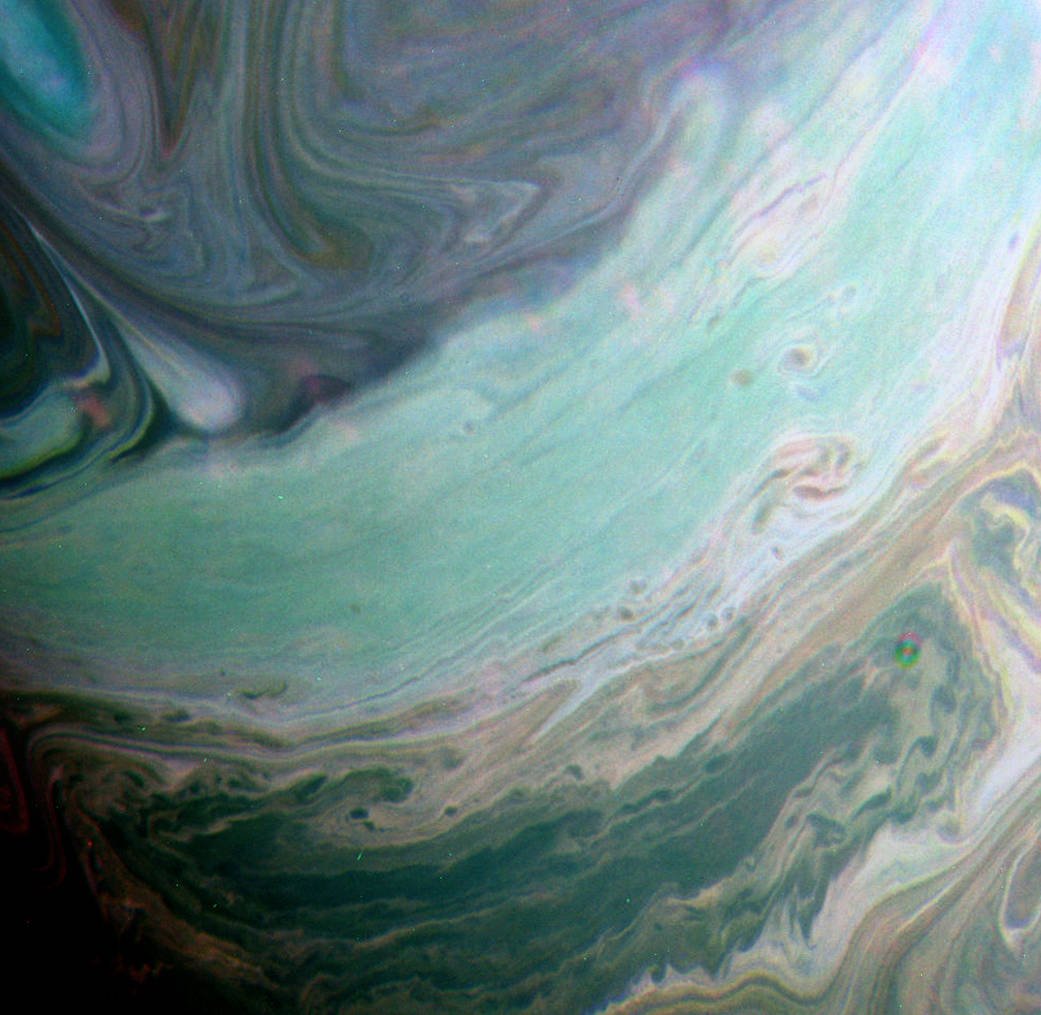
    It may look like an oil slick, but the photo above actually shows the clouds of Saturn. The false-color composite image reveals the gas giant in infrared, at wavelengths longer than those visible to the human eye. NASA uses this infrared photography to identify different chemical compositions in Saturn’s atmosphere based on how they reflect sunlight. You can see an example of how they construct these images here. This detail shot appears to show cloud bands of different compositions mixing. You can see hints of shear instabilities forming along the edges  where the light and dark bands meet. (Image credit: NASA; via Gizmodo)

  • Featured Video Play Icon

    Coarsening in a Soap Film

    Flow in a soap film is driven by gravity’s efforts to thin the film and surface tension’s attempts to stabilize variations in thickness. Because evaporation guarantees that the soap film will eventually dry out, gravity typically wins the battle and causes a soap film to rupture. This video takes a close look at what happens in the film just before it ruptures. Black dots form in the thinnest region of the flow. These areas are not holes, but they appear black because they are thinner than any wavelength of visible light. Before rupture, the black dots begin coalescing with one another, first due to diffusion and later more rapidly due to convection in the soap film. Ultimately, the black dots are the harbingers of doom for the fragile bubble. (Video credit: L. Shen et al.)

  • Featured Video Play Icon

    Fluorescein Ghosts

    Fluorescein is a popular chemical for flow visualization, and, as this video from Shanks FX demonstrates, it’s not hard to extract from highlighters if you’d like to experiment with it yourself. Fluorescein can also be purchased in powder form, but it’s typically rendered into a dye before use. When dripped into water, it can leave behind ghostly glowing wakes. Happy Halloween! (Video credit: Shanks FX)

    In other news, I am back from my vacation! Thanks again to Claire from Brilliant Botany for looking out for everything while I was gone. – Nicole

  • Fluid Fingers

    Fluid Fingers

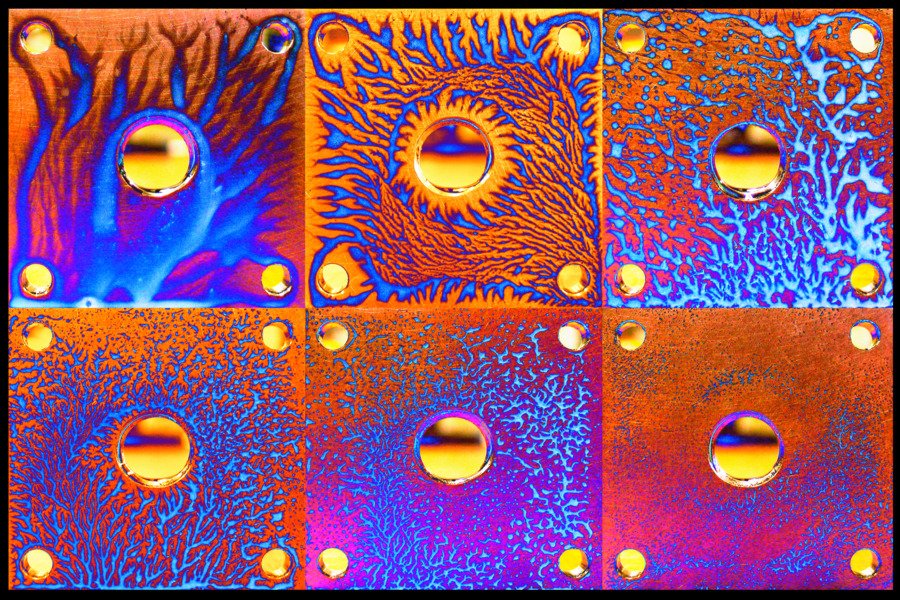
    Fluid phenomena can show up in unexpected places. The collage above shows patterns formed when an aluminum block is lifted during wet sanding, a polishing technique. The dendritic fingers are formed from oil and the slurry of sanded particles being polished away. They are an example of the Saffman-Taylor instability, which forms when less viscous fluids (oil) protrude into a more viscous one (the slurry). Each image contains a different concentration of oil, resulting in very different fingering patterns. (Image credit: D. Lopez)

  • Vortex Wake in Quebec

    Vortex Wake in Quebec

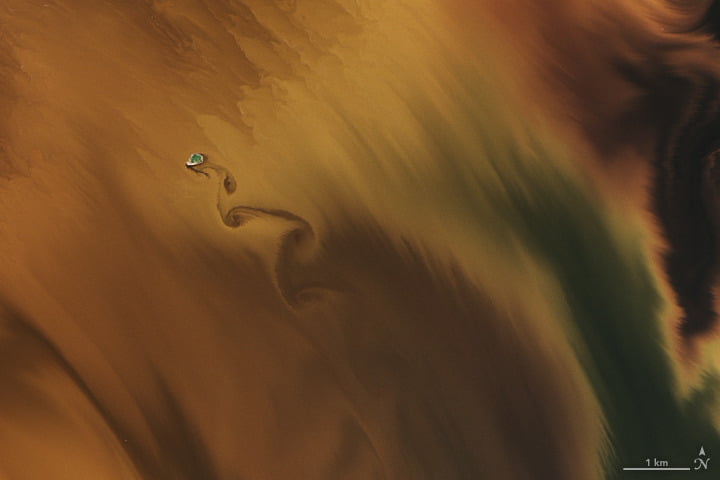
    These satellite images show Rupert Bay in northern Quebec. Sediment and tannins have stained the bay’s waters various shades of brown, which helps show the dynamic flows of the area. Rivers empty into the bay, but the tide appears to be coming in from the northwest as well. The flow is just right to create a wake of alternating vortices off a tiny island near the center of the bay. This pattern is known as a von Karman vortex street and often appears in the wake of spheres, cylinders, and, yes, islands. (Image credit: NASA Earth Observatory; submitted by Adam V.)