This short but spectacular timelapse video shows the Grand Canyon filled with fog. This phenomenon, known as a temperature inversion, occurs when a warm layer of air traps cold, moist air near the ground. As the inversion develops in the video, you can see wisps of clouds popping up in the canyon, seemingly out of nowhere, as moisture evaporated from the surface condenses in the cool air. Once fog fills the canyon, it flows and laps against the canyon’s sides, much like waves on the ocean. In fact, the physics here is quite similar, just at a much slower speed. (Video and image credit: H. Mehmedinovic / SKYGLOWPROJECT; via Gizmodo; submitted by Ian S.)
Tag: flow visualization

Spots of Turbulence
One of the enduring mysteries of fluid dynamics lies in the transition between smooth laminar flow and chaotic turbulent flow in the area near a wall. That region, known as the boundary layer, has a major impact on drag and other effects. The process begins with disturbances that are too tiny to see or measure, but eventually, those disturbances can grow large enough to generated an isolated turbulent spot, like the one imaged above. Flow in the photograph is from left to right. Turbulent spots have a distinctive wedge-like shape that expands as the spot grows and widens. These turbulent spots can merge together to create still larger spots, and when a surface eventually becomes completely covered in them, we call it fully-developed turbulent flow. (Image credit: M. Gad-El-Hak et al.)

When Chaos is Not So Chaotic
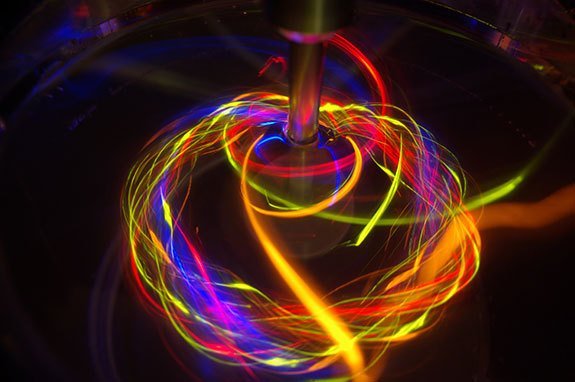
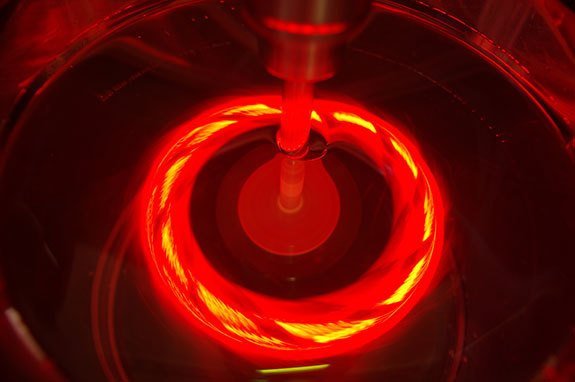
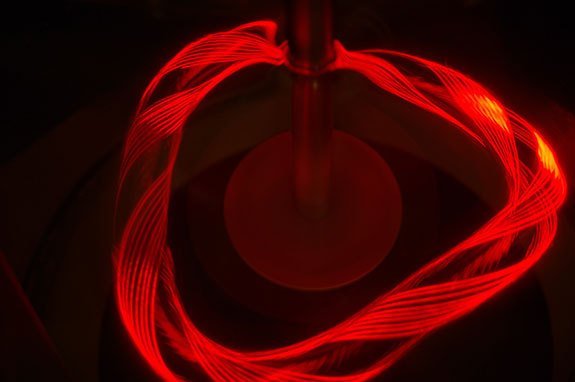
In industry, tanks are often agitated or stirred to mix different elements. The goal is to create a laminar but chaotic flow field throughout the mixture. Introducing particles to such a system reveals that things are not quite as chaotic as they might seem. The photographs above show the pathlines of various large, glowing particles initially poured into the tank from above. Over time, the particles scatter off of structures in the mixed sections of the tank and end up trapped in vortex tubes that form above and below the agitator. Once trapped in the vortex tube, the particles follow helical paths inside the tube, creating patterns like those seen in the lower two photos. (Image and research credit: S. Wang et al., 1, 2, 3)

Flow Above the Treetops
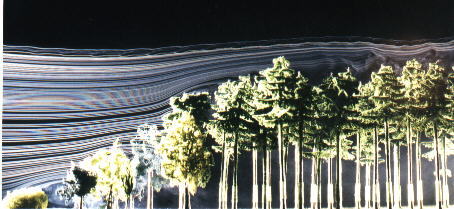
As this smoke visualization shows, trees have a significant impact on airflow around them. Flow in the image is from left to right. On the left, the upstream air is traveling in smooth, laminar lines that are quickly disrupted as the flow moves into the trees. After the first shorter trees, flow inside the wooded area has been broken up and slowed. Above the canopy, the smoke streaklines have also slowed and become more turbulent. Understanding how wind and trees interact is important in a variety of applications, including when adding renewable energy options to buildings and when predicting the spread of forest fires. (Image credit: W. Frank et al.)

Fanning the Flame
A fan’s blade passes through the hot air rising above a flame in this iconic image by high-speed photography pioneer Harold Edgerton. This photo uses an optical technique known as schlieren photography that makes density differences in transparent media like air visible. Because of its lower density, the hot plume of air above the flame rises. When the fan blade swings past, it sheds a vortex off its tip and the rising air from the flame gets pulled into the vortex to make it visible. To the left, a ghostly counter-rotating vortex sits on the opposite side of the fan blade. (Photo credit: H. Edgerton and K. Vandiver)

Bottle Rocket Shock Diamonds
Mach diamonds or shock diamonds can often be seen in the exhaust of rocket engines. Here they’re shown in high-speed video of a bottle rocket’s launch. The rocket’s exhaust exits at a pressure that is higher than the surrounding atmosphere, which causes the exhaust to bulge outward and forms two expansion fans, seen in pink, to lower the pressure. The pressure actually drops too low, however, causing shock waves, seen in turquoise, to form in order to raise the exhaust’s pressure. This back-and-forth between shock waves and expansion fans continues, forming the diamond shapes we see. Each subsequent set gets weaker as the exhaust closes in on the right pressure, and ultimately the series of diamonds fades into turbulence. (Image credit: P. Peterson and P. Taylor, source)

Breaking Down Vortices
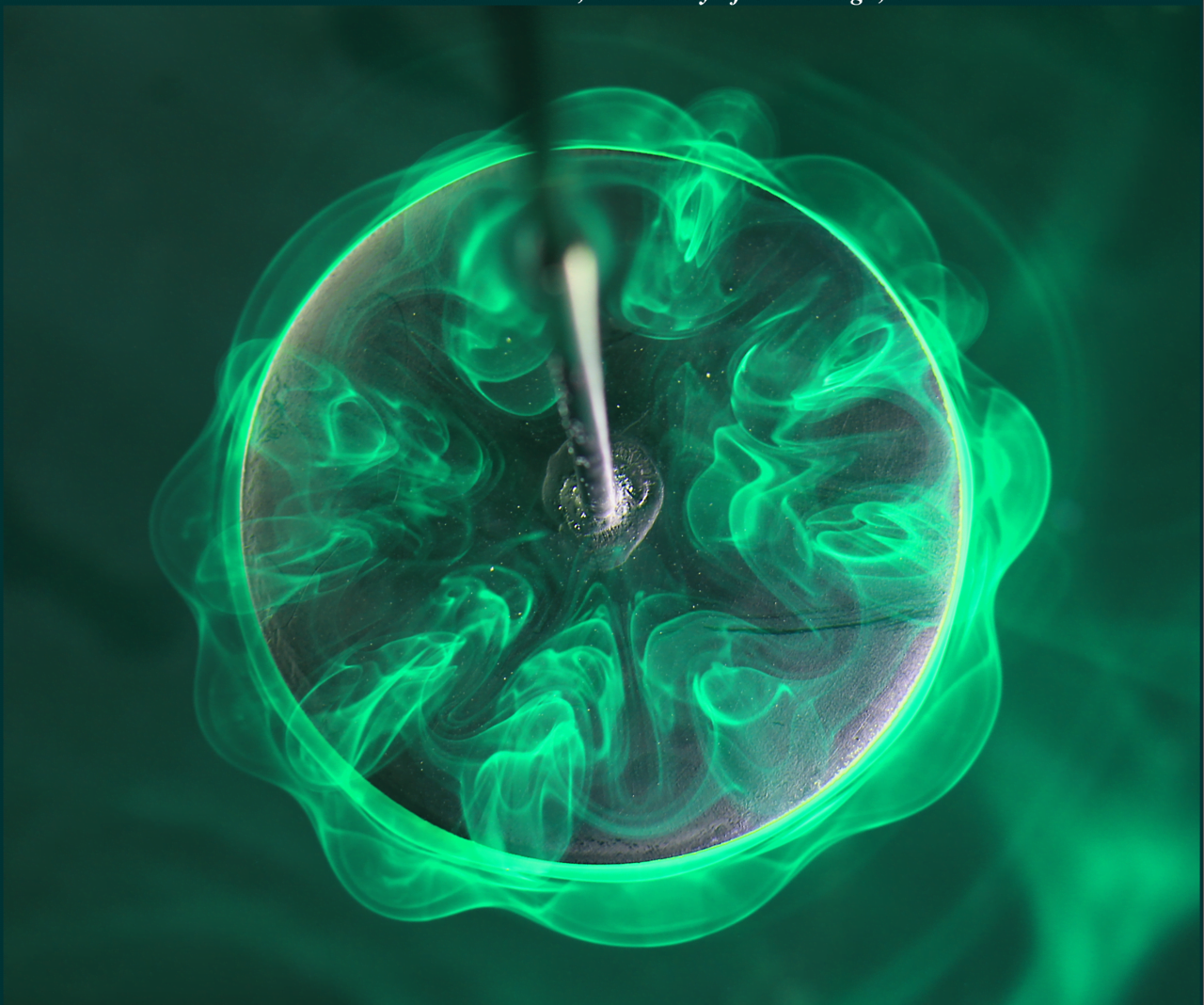
Vortex rings are ubiquitous in nature, showing up in droplet impacts, in propulsion, and even in volcanic eruptions. Understanding the interaction and breakdown of multiple vortices with one another is therefore key. The image above shows a circular disk that’s being oscillated up and down (in and out of the page). As the disk moves and changes direction, it generates vortices that interact with one another. Here some of those interactions are visualized with fluorescent dye. The overlapping vortices form complex and beautiful shapes on their way to breakdown. (Image credit: J. Deng et al., poster, paper)

Shocks on a Wing

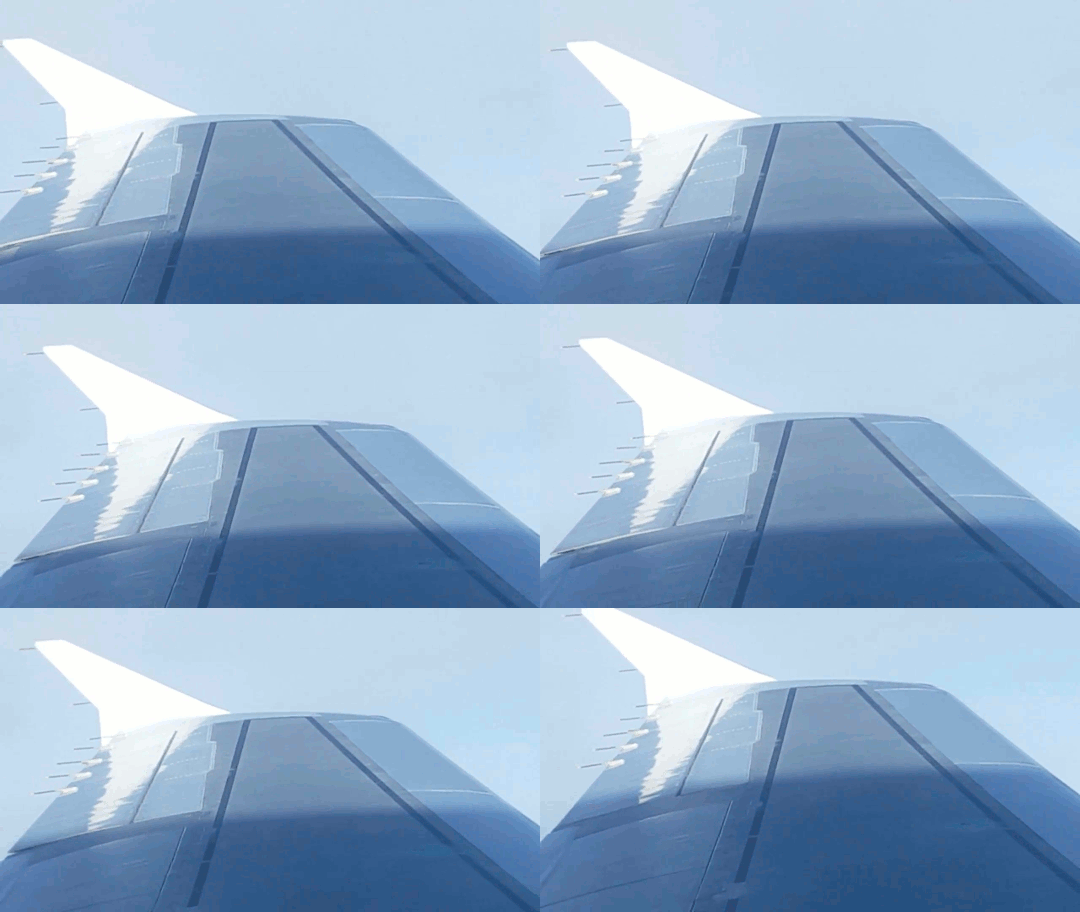
Commercial airliners fly in what is known as the transonic regime at Mach numbers between 0.8 and 1.0. While the airplane itself never exceeds the speed of sound, that doesn’t mean that there aren’t localized regions where air flows over the airplane at speeds above Mach 1. In fact, it’s actually possible sometimes to see shock waves on the top of airliner’s wings with nothing more than your eyes. The animations above show shock waves sitting about 50-60% of the way down the wing’s chord on a Boeing 737 (top) and Airbus A-320 (bottom). The shock wave looks like an unsteady visual aberration sitting a little ways forward of the wing’s control surfaces.
The wings themselves are shaped so that these little shock waves are relatively stationary and remain upstream of the flaps pilots use for control. Otherwise, the sharp pressure change across a shock wave sitting over a control surface could make moving that surface difficult. This was one of the challenges pilots first trying to break the sound barrier faced. (Image credits: R. Corman, source; agermannamedhans, source)

Happy Valentine’s Day
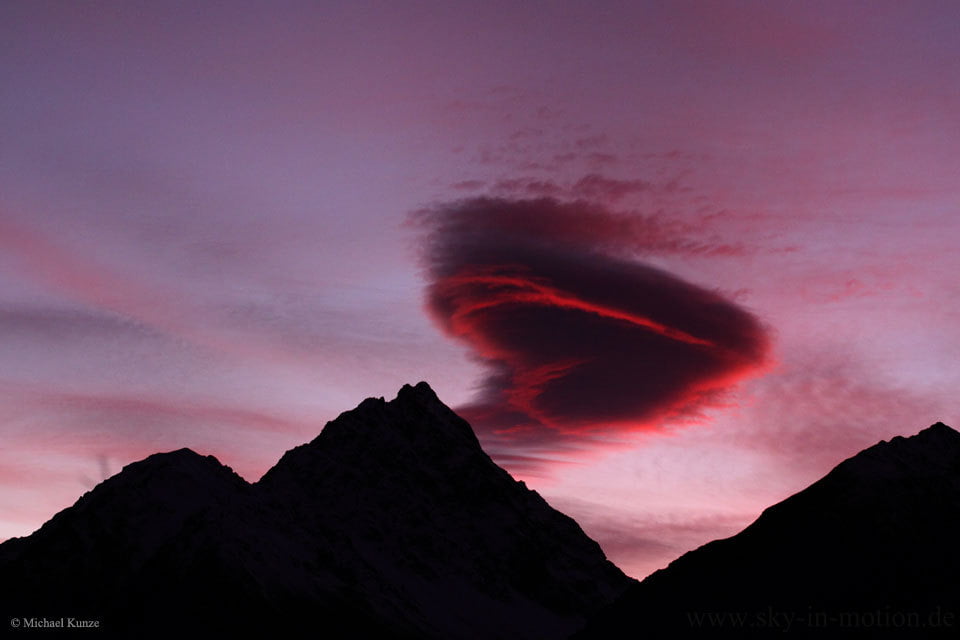
This heart-shaped atmospheric apparition is a lenticular cloud captured over the mountains of New Zealand. As you can see in the companion video, the cloud itself remains stationary over the mountain. This is a key feature of lenticular clouds, which form when air flowing over/around an obstacle drops below the dew point. This causes moisture in the air to condense for a time before it descends and warms once more. Thus, even though air is continuously flowing past, what we see is a stationary, lens-shaped cloud. Happy Valentine’s Day from FYFD! (Image credit: M. Kunze, video; via APOD)

Popping
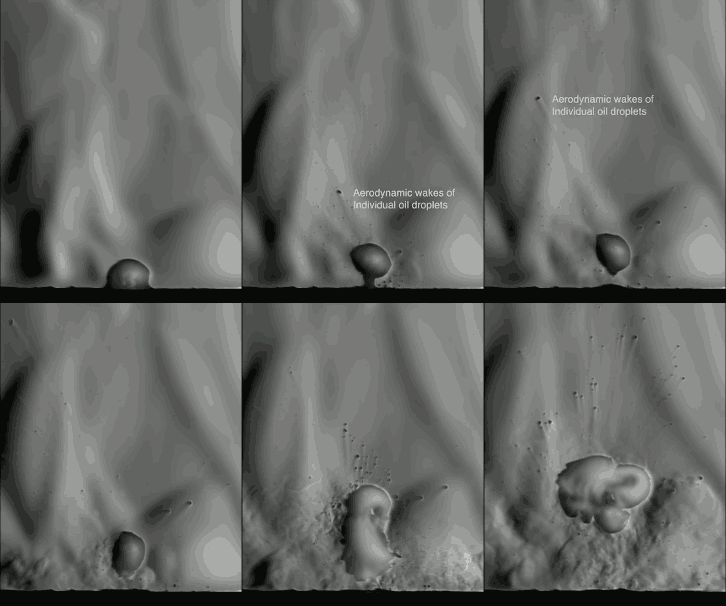
Popcorn’s explosive pop looks pretty cool in high-speed video, but just watching it with a regular camera doesn’t show everything that’s going on. If we take a look at it through schlieren optics, the kernel’s pop looks even more extraordinary:

The schlieren technique reveals density differences in the gases around the corn–effectively allowing us to see what is invisible to the naked eye. The popcorn kernel acts like a pressure vessel until the expansion of steam inside causes its shell to rupture. The first hints of escaping steam send droplets of oil shooting upward. The kernel may hop as steam pours out the rupture point, causing the turbulent billowing seen in the animation above. As the heat causes legs of starch to expand out of the kernel, they can push off the ground and propel the popcorn higher. As for the eponymous popping sound, that is the result of escaping water vapor, not the actual rupture or rebound of the kernel! See more of the invisible world surrounding a popping kernel in the video below. (Image credits: Warped Perception, source; Bell Labs Ireland, source; WP video via Gizmodo; BLI video submitted by Kevin)