Tag: flow visualization

  • Turbulence and Bioluminescence

    Turbulence and Bioluminescence

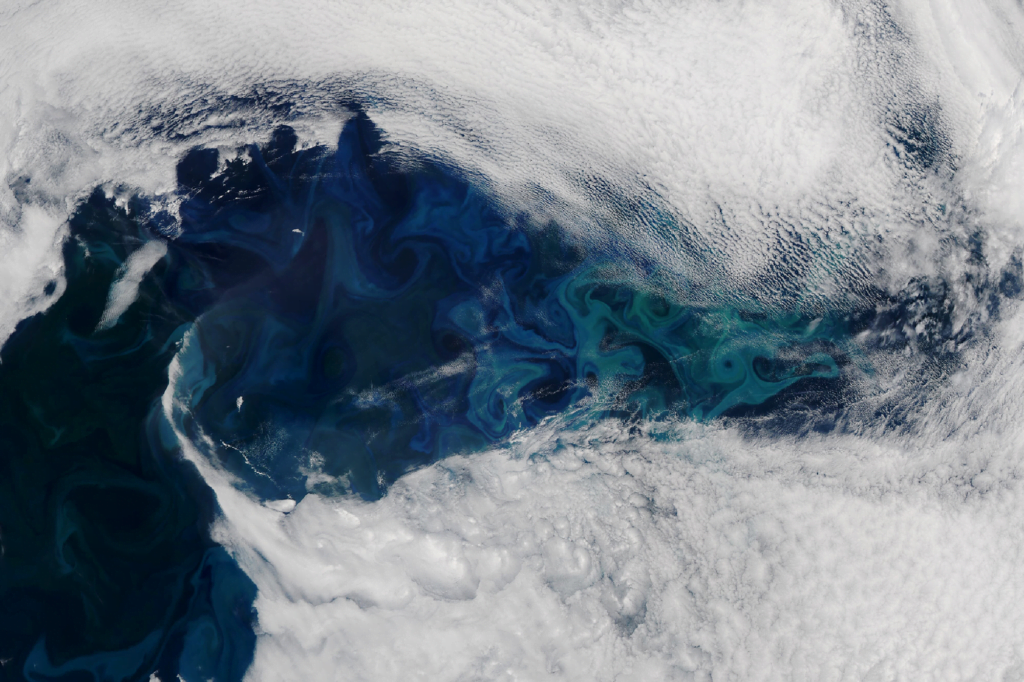
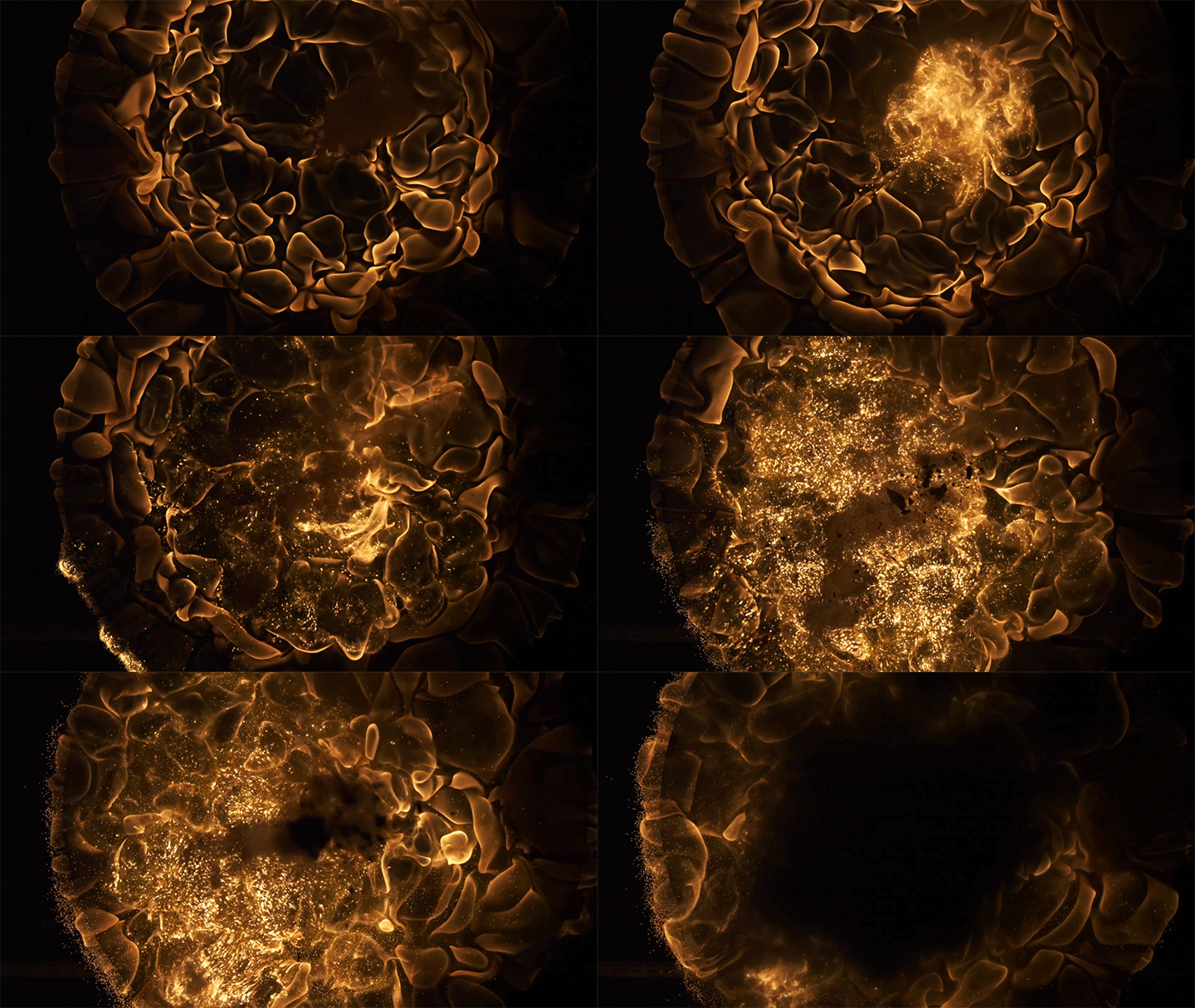
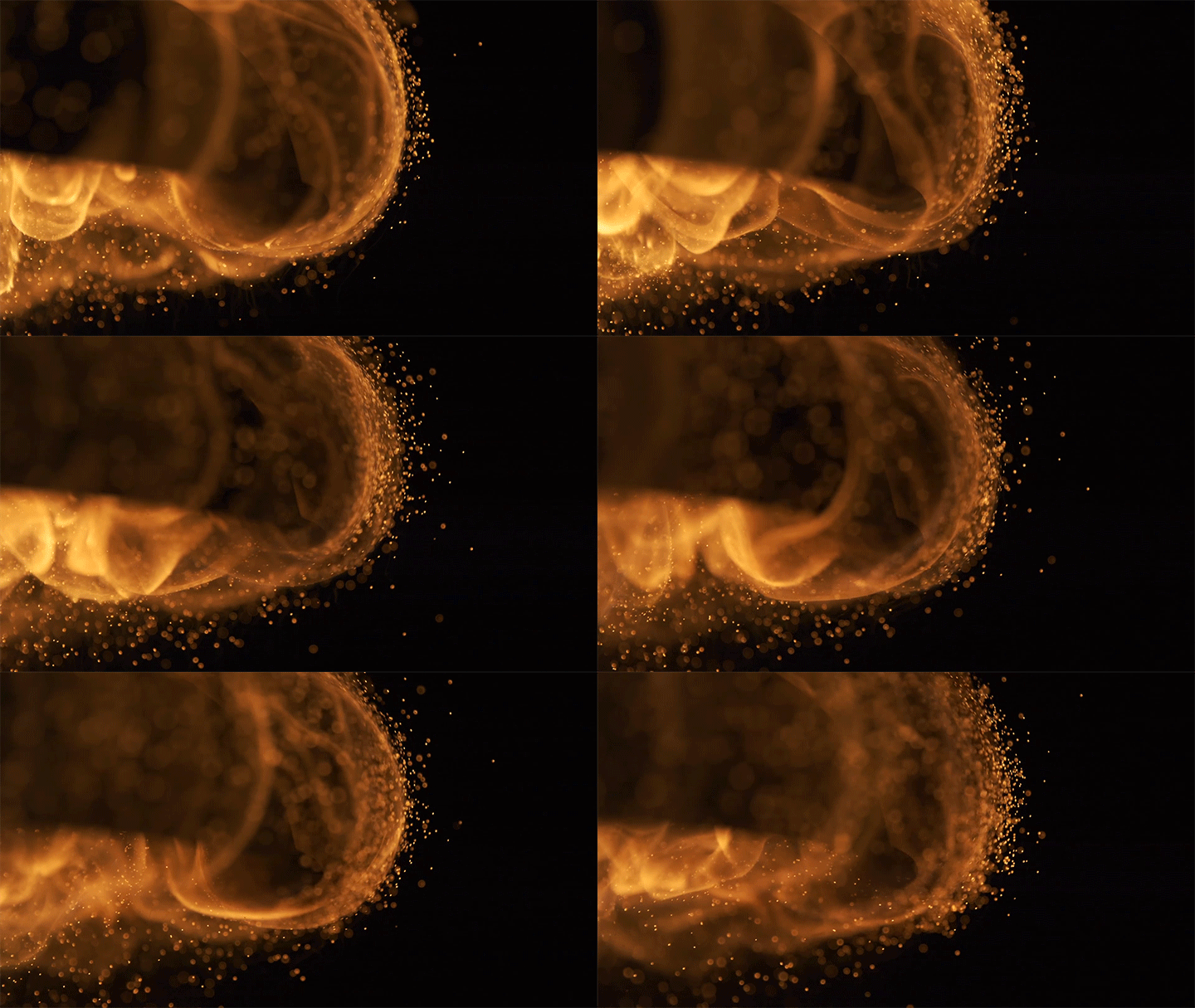
    If you’ve ever seen crashing waves glowing blue, you’ve been treated to bioluminescence. Although many creatures can bioluminesce, tiny dinoflagellates–a type of marine phytoplankton–are one of the easiest to spot. These microscopic organisms create a flash of light in response to viscous stresses. Their response to flow-induced stresses is so robust that they can be used to visualize stress fields.

    In a new study, researchers explored how turbulence affects the dinoflagellate’s luminescence. They mathematically modeled the dinoflagellate as an elastic dumbbell that emitted light based on its extent and rate of deformation. Then they explored how this model dinoflagellate behaved in different types of turbulent flows. They found that the fluctuations and intermittency of turbulent flows both encouraged the radiant displays. (Image credit: T. McKinnon; research credit: P. Kumar and J. Picardo)
    Fediverse Reactions
  • Thunderstorms Make Trees Glow

    Thunderstorms Make Trees Glow

    Scientists have long hypothesized that the high electrical charge of thunderstorms could produce an opposite charge in the ground that would discharge from the forest canopy. But this phenomenon, known as a corona, had never been observed on actual trees. A new study, however, has observed this ghostly ultraviolet (UV) glow from the tips of sweetgum leaves and loblolly pine needles during thunderstorms.

    Catching these coronae in action required a new kind of UV detector that was ultra-sensitive to the particular band of UV-light emitted by coronas, hot fires, or mercury lamps. Since the latter two weren’t present during the team’s field observations, they were able to conclude that the light they detected came from coronae.

    The group observed that corona discharges were transient, jumping from leaf to leaf and branch to branch across the forest canopy. For any creature capable of detecting that glow by eye, it must be incredible to watch the treetops lit by their own ever-shifting auroras during every thunderstorm. (Image credit: W. Brune; research credit: P. McFarland et al.; via SciAm)

    A UV corona forms on tree leaves beneath a thunderstorm.
  • Featured Video Play Icon

    Making Sound Visible

    Sound is not something we can typically see, though there are ways to visualize it, including cymatics and special acoustic cameras. This video pursues a different tactic: using schlieren photography and stroboscopic lighting to show how sound waves reflect and deflect. It’s no easy feat, but one worth enjoying–especially when others have already done the hard part for you! (Video and image credit: All Things Physics; submitted by David J.)

  • Mixing Bubble Caps

    Mixing Bubble Caps

    When bubbles form atop the ocean or in our cups, they typically live short lives. Although the bubble can exchange fluid with the pool below, this only happens at the foot of the bubble cap. There, thinner patches form and, due to their buoyancy, rise up along the bubble’s surface. Over time, these lighter, thinner patches reduce the amount of fluid in the cap–causing the bubble to thin and eventually burst.

    A research poster showing how external turbulence affects the plumes that thin a bubble cap.

    Here, researchers show that thinning–visible in the dark blue plumes rising up the bubble cap–when there’s no turbulence in the surrounding air. But as turbulence outside the bubble increases, the thinner patches stretch and deform across the cap. In the image series, turbulence increases moving from top to bottom. (Image credit: T. Aurégan and L. Deike)

  • “Arctic Fox in Blizzard”

    “Arctic Fox in Blizzard”

    A blue arctic fox bears the wind and snow of a Norwegian blizzard in this image by photographer Klaus Hellmich. The wind is strong enough to move snowflakes several centimeters in the time the camera’s shutter is open. This leaves the image full of streaklines that reveal the paths taken by the wind and snow. This visualization technique is useful in the lab, too. (Image credit: K. Hellmich; via Colossal)

    "Arctic Fox in Blizzard" by Klaus Hellmich.
    Fediverse Reactions
  • Featured Video Play Icon

    Swirling Without Blades

    A ring of hydrogen bubbles rises, rotating clockwise, in this video of electrolysis. But there are no fan blades to cause this swirl, so why do the bubbles rotate? The answer is a Lorentz force induced by the electromagnetic set-up of the experiment. Watch to see how researchers manipulate the Lorentz force to affect the flow. (Video and image credit: Y. Cho et al.)

  • Featured Video Play Icon

    Understanding Schlieren

    Schlieren techniques are one of my favorite forms of flow visualization. They cleverly make the invisible visible through an optical set-up that’s sensitive to changes in density. They’re great–as seen in the examples here–for seeing local buoyant flows like the plumes that rise from a candle, or for making gases like carbon dioxide visible. They’re also excellent for visualizing shock waves.

    In this video, physicist David Jackson explains how one particular flavor of schlieren–one using a spherical mirror–works. There are lots of other possible schlieren set-ups, too, though each one has its quirks. (Video and image credit: All Things Physics; submitted by David J.)

    Fediverse Reactions
  • Inside Cepheid Variable Stars

    Inside Cepheid Variable Stars

    Cepheid variable stars pulsate in brightness over regular periods. That’s one reason astronomers use them as a standard candle to judge distances–even for stars well outside our galaxy. In this image, researchers display a simulation of convection inside a Cepheid eight times more massive than our sun. The colors represent vorticity, with zero vorticity in white.(Image credit: M. Stuck and J. Pratt)

    A research poster showing a simulation of convection inside a Cepheid variable star with 8 solar masses.
    Fediverse Reactions
  • Featured Video Play Icon

    Recreating Atmospheric Rivers

    During the winter months, those of us living in the mid-latitudes sometimes experience atmospheric rivers. Formed from the interaction of cold winter storms with warm, moist tropical air, atmospheric rivers can deliver intense rainfall across long distances. In this video, the UCLA SpinLab team shows how you can recreate the effect with a relatively simple and affordable DIYnamics apparatus. (Video and image credit: UCLA SpinLab)

  • “Broken Water, Like Broken Glass”

    “Broken Water, Like Broken Glass”

    How can you break water? By accelerating it so quickly that the pressure drop forms cavitation bubbles. Here, a steel piston rests against a transparent plate, all underwater. When a hammer strike accelerates the piston away at around 1000g, the severe pressure drop tears the water into bubbles (bottom, left). As the bubbles expand, the nearby piston squishes them into pancakes (bottom, center). As they continue growing, the bubbles press into one another, squeezing thin ridges of water between them. The result (center) resembles broken glass. (Image credit: J. da Silva et al.)

    A research poster showing cavitation in water between a plate and piston.
    Fediverse Reactions