Tag: flow visualization

  • Growing Downstream

    Growing Downstream

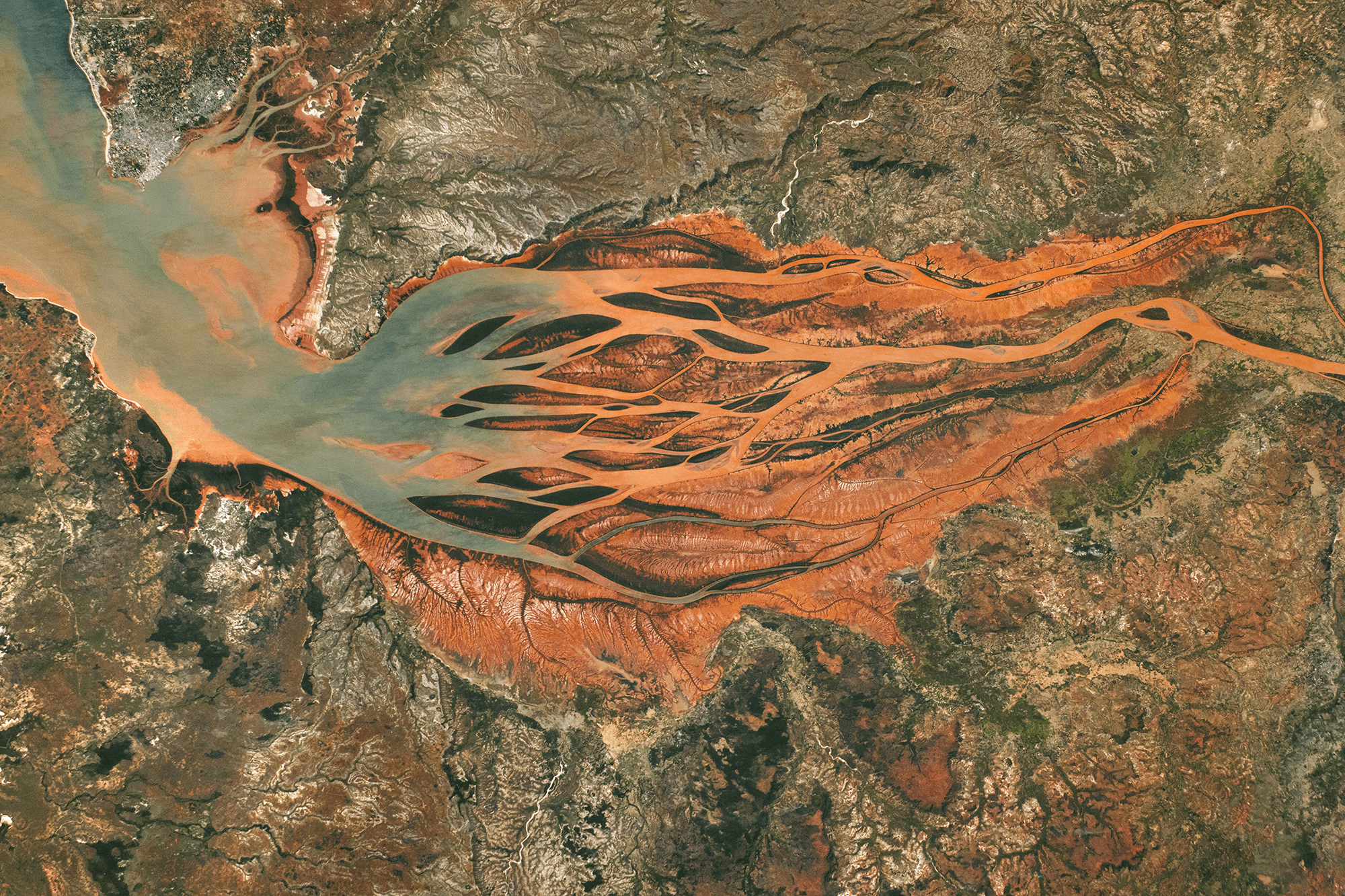
    This astronaut photo shows Madagascar’s largest estuary, as of 2024. On the right side, the Betsiboka River flows northwest (right to left, in the image). Less than 100 years ago, most of the estuary was navigable by ships, but now more than half of it is taken up by the river delta. Upstream on the river, extensive logging and expansions to farmland have caused severe soil erosion; the river carries that sediment downstream, dyeing the waters reddish-orange. As the river branches and the flow slows, that sediment falls out of suspension, building up islands and seeding new sand bars further downstream.

    A difference of 40 years. A 2024 astronaut photo of the Betsiboka River delta compared with one from 1984 (inset). Several islands are labeled in both images. Notice how new islands have formed upstream of the ones seen in 1984.
    A difference of 40 years. A 2024 astronaut photo of the Betsiboka River delta compared with one from 1984 (inset). Several islands are labeled in both images. Notice how new islands have formed upstream of the ones seen in 1984.

    In the image above, you can compare the 2024 delta to the way it looked in 1984. Letters A, B, C, and D mark the downstream-most islands from 1984. Today newer islands and sand bars sit even further downstream. (Image credit: NASA; via NASA Earth Observatory)
  • Lines of Ice Eddies

    Lines of Ice Eddies

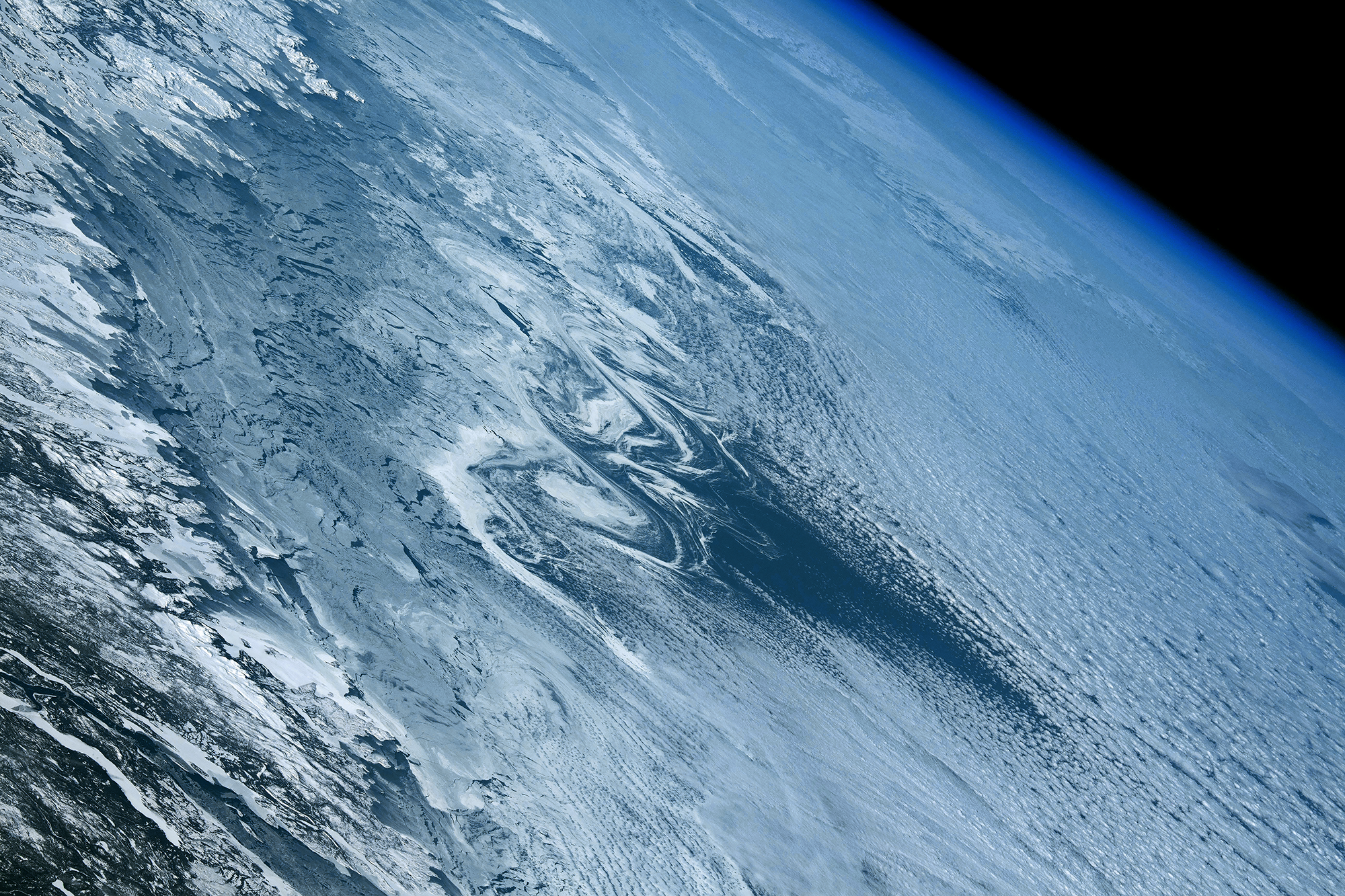
    In February 2024, the North Atlantic’s sea ice reached its furthest extent of the season, limning the coastline with tens of kilometers of ice. These images — both capturing the Labrador coast on the same day — show the swirling patterns marking the wispy edges of ice field. In this region, the ice is likely following an eddy in the ocean below. Eddies like these can form along the edges where warm and cold currents meet. An ice eddy is particularly special, though, as the water must be warm enough to fragment the sea ice, but not so warm that it melts the smaller ice pieces. (Image credit: top – NASA, lower – M. Garrison; via NASA Earth Observatory)

    This satellite image shows sea ice off the Labrador coast, on the same day in February 2024.
    This satellite image shows sea ice off the Labrador coast, on the same day in February 2024.
  • Featured Video Play Icon

    Convection in Blue

    Convection cells like these are all around us — in the clouds, on the Sun, and in our pans — but we rarely get to watch them in action. Convection results from densities differing in different areas of a fluid. Under gravity’s influence, having a dense fluid over a lighter one is unstable; the dense fluid will always sink and the lighter one will rise. When that motion has to take place across a large surface area, we often end up with cells like the ones seen here.

    Convection cells in an alcohol-paint mixture.
    Convection cells in an alcohol-paint mixture.

    What drives the density differences in the fluid? That depends. Often there’s a temperature difference that drives warmer fluid to rise and cool fluid to sink. But that’s not always the source of convection. Evaporating a volatile chemical — like alcohol — out of a mixture can also create the density differences needed for convection. That may be the source of the convection we see here in a mixture of paint and alcohol. (Video and image credit: W. Zhu; via Nikon Small World in Motion)

  • “Last Breath of Autumn”

    “Last Breath of Autumn”

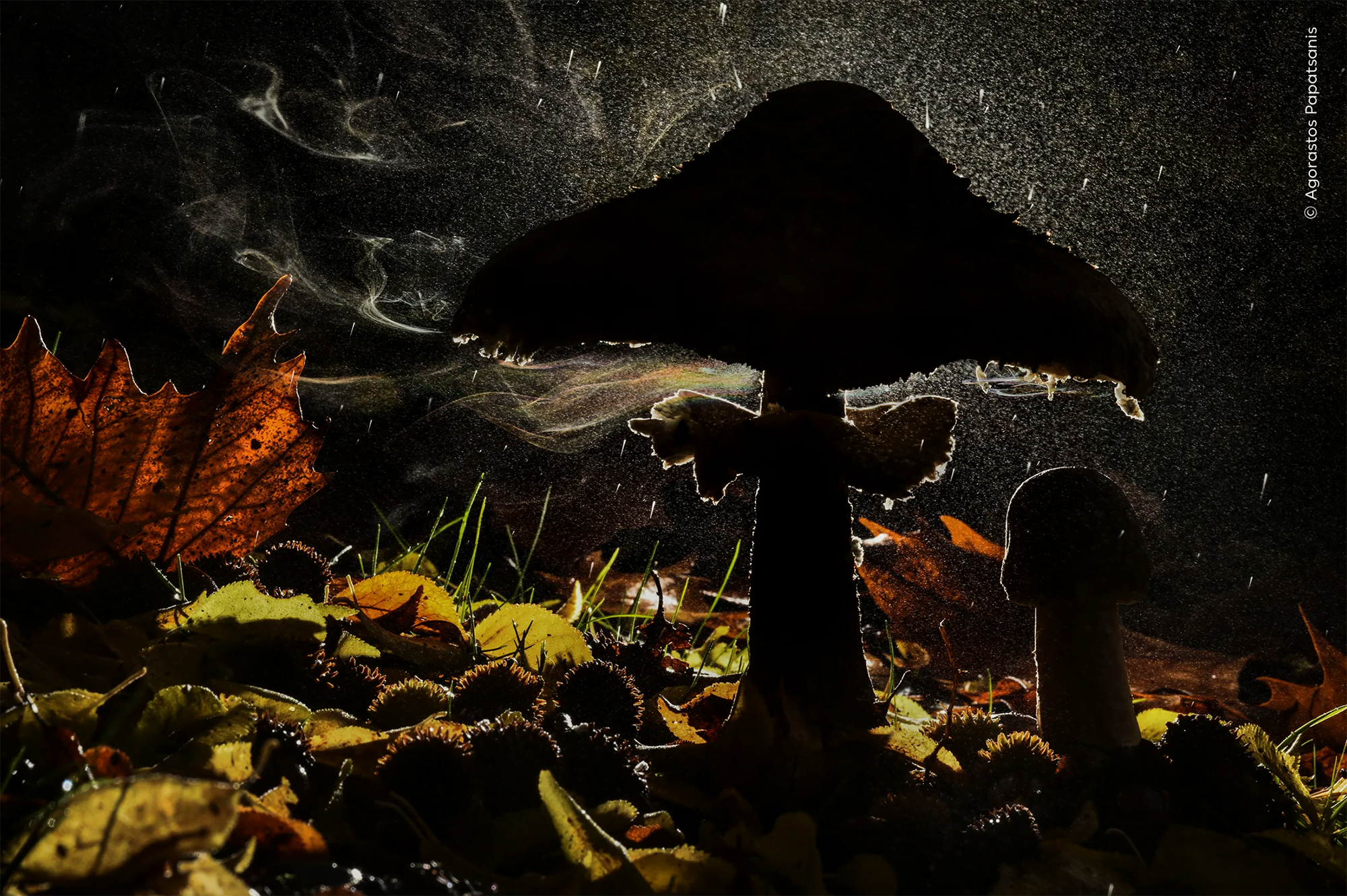
    On a rainy autumn day, Agorastos Papatsanis headed to the forest in search of fungi. There he captured this fairytale-like scene with falling rain and drifting spores. Near the forest floor, any breeze is slight, so mushrooms use their own humidity to move air and spread their spores. As water evaporates from the mushroom’s cap, it cools the air nearby, causing it to spread outward. Since that water vapor is lighter than air, it rises, too, carrying the mushroom’s spores along with it. (Image credit: A. Papatsanis; via Wildlife PotY)

  • Featured Video Play Icon

    “Colors of Glacial Rivers”

    As glaciers flow, they grind down rock, creating fine sediment that dyes waterways a milky color. In Jan Erik Waider’s aerial film, we get a bird’s eye view of the result, watching pockets of sediment move downstream in pulsating waves and swirls. Along the coast, ocean waves pass over the internal ones, creating a mesmerizing crisscrossed wavescape. You can also compare Waider’s aerial footage to Roman De Giuli’s tabletop-scale films and be amazed by their similarities. (Image and video credit: J. Waider; via Colossal)

  • Peering Inside Viscous Fingering

    Peering Inside Viscous Fingering

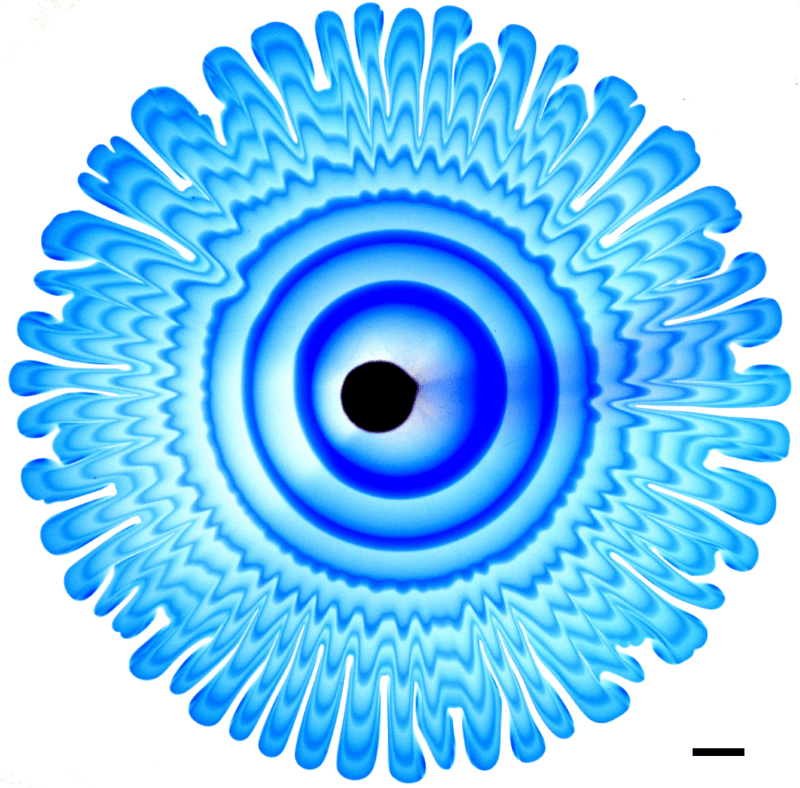
    Viscous fingers form when a low-viscosity fluid is pumped into a narrow, viscous-fluid-filled gap. The branching pattern that forms depends on the ratio of the two viscosities, among other factors. To better understand what goes on inside these fingers, researchers carefully alternated injecting dyed and undyed fluid. This creates a pattern of concentric rings that deform as the fingers spread.

    In this particular study, the initial fluid and injected fluids are miscible, meaning that they can mix into one another. In modeling their experiments, the team found that this mixing created stratification — i.e., layers of fluids with different densities — in the narrow gap between their plates. The stratification’s effects were large enough that the model required a correction term for them; that’s a bit surprising because we’d usually expect that the tiny third-dimension of the gap would be too small to matter! (Image and research credit: S. Gowan et al.)

  • Featured Video Play Icon

    Billowing Ouzo

    Pour the Greek liquor ouzo into water, and your glass will billow with a milky, white cloud, formed from tiny oil droplets. The drink’s unusual dynamics come from the interactions of three ingredients: water, oil, and ethanol. Ethanol is able to dissolve in both water and oil, but water and oil themselves do not mix.

    In this video, researchers explore the turbulent effects of pouring ouzo into water. In particular, pouring from the top creates a fountain-like effect, due to a tug-of-war between the ouzo’s momentum and its buoyancy. Momentum wants the ouzo to push down into the water, and buoyancy tries to lift it back up. For an extra neat effect, they also show what happens when the ouzo is confined to a 2D plane and what happens when momentum and buoyancy act together instead of oppositely. (Image and video credit: Y. Lee et al.)

    Fediverse Reactions
  • Featured Video Play Icon

    Breaking Down a Water-Powered Timer

    In his latest “cutaway” video, Steve Mould takes a look at how you can nest siphons to create a system that periodically flushes itself. This kind of water-powered timer is useful in, say, public restrooms with a urinal system that collectively flushes every once in a while. In the video, Mould talks through each step of the system and some of the challenges he ran into when trying to create a pseudo-2D version of it. As is often the case with these videos, it’s a strangely satisfying process to watch. (Video and image credit: S. Mould)

  • Shaped Splashes

    Shaped Splashes

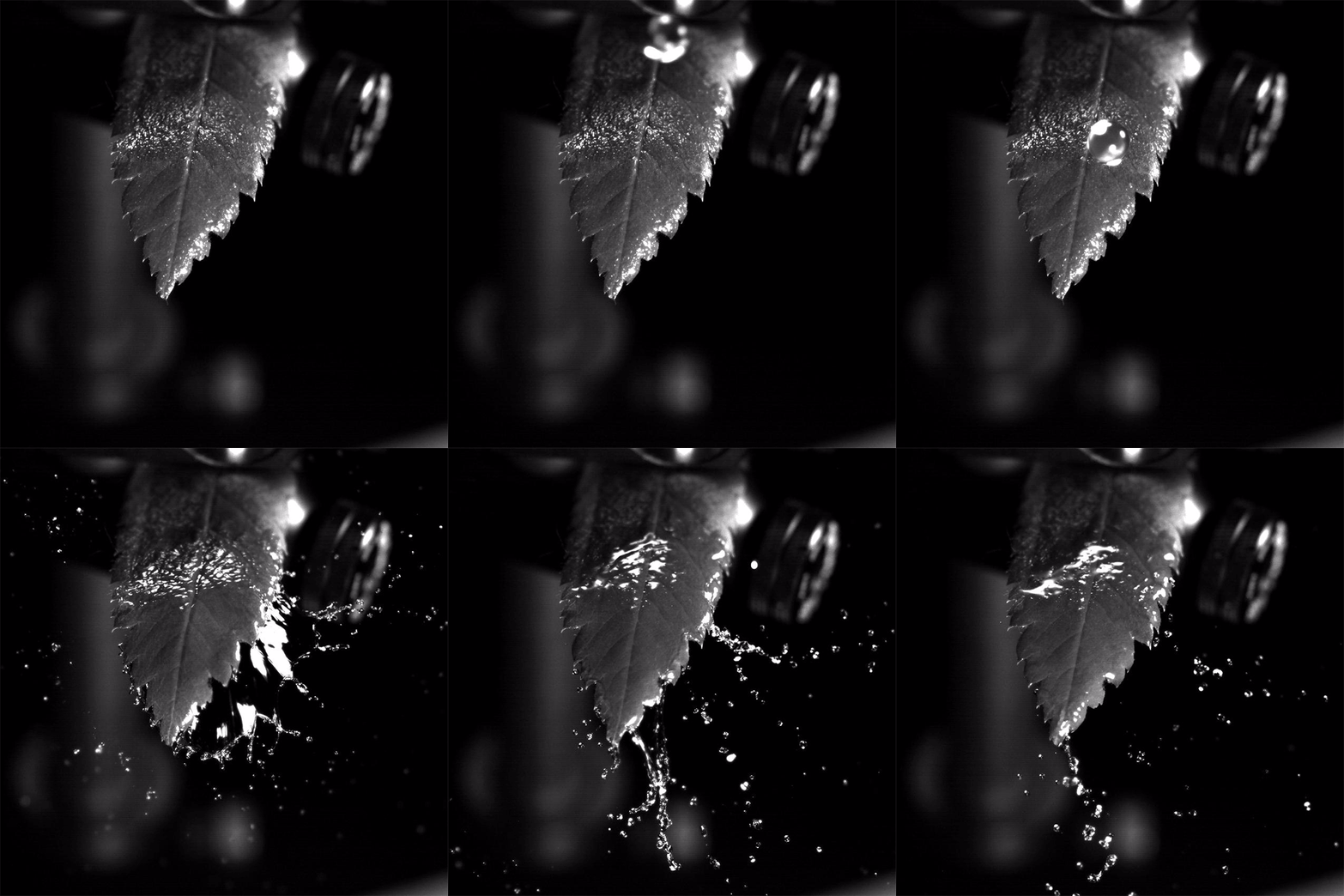
    When a raindrop hits a leaf, it spreads out into a rimmed sheet that breaks up into droplets. These tiny drops can carry dust, spores, and even pathogens as they fly off. But many leaves aren’t smooth-edged; instead they have serrations or teeth. How does that affect a splash? That’s the question at the heart of today’s study.

    A water drop hits a star-shaped pillar and breaks up.
    A water drop hits a star-shaped pillar and breaks up.

    To simplify from a leaf’s shape, the team studied water dropping onto star-shaped pillars. As seen above and below, the pillar’s edge shaped the splash sheet, with the sheet extending further in the edge’s troughs. This asymmetry extends into the rim also, concentrating the liquid — and the subsequent spray of droplets — along lines that extend from the edge’s troughs and peaks.

    A viscous water-glycerol drop hits a star-shaped pillar, spreads, and breaks into droplets.
    A viscous water-glycerol drop hits a star-shaped pillar, spreads, and breaks into droplets.

    The team found that, in addition to sending drops along a preferred direction, the shaped edge made the droplets larger and faster than a smooth edge did. (Image and research credit: T. Bauer and T. Gilet)

  • Featured Video Play Icon

    The Art of French Drains

    Civil engineers face a constant challenge trying to protect their structures from water — both above and below the ground. Subsurface water can build up enough pressure to lift and damage structures, so engineers use subsurface infrastructure — like French drains — to control the water underground. Despite the name (and my title pun), French drains have nothing to do with France. Instead, they are named for Henry French, an author who described their construction and use in the 19th century. These drains use a combination of rocks, mechanical filters, and perforated pipeline to guide subsurface water and drain it away from foundations. (Video and image credit: Practical Engineering)