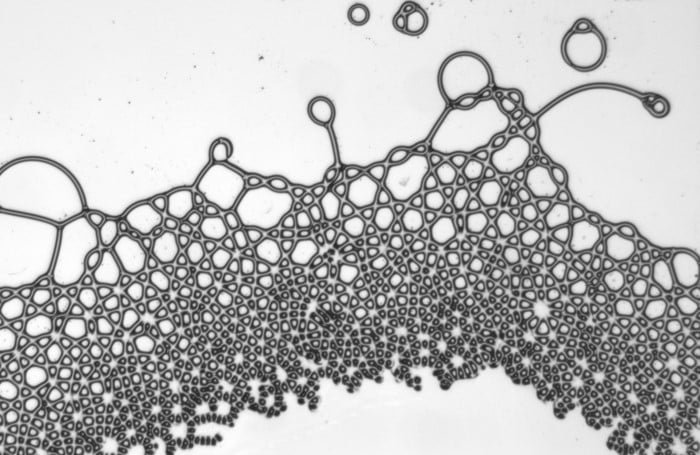
To our eyes, a soap bubble appears to pop instantly, but when observed in high-speed video, the process is far more complex. In this video, the Slow Mo Guys pop human-sized bubbles, giving us an opportunity to appreciate the rupture process at speeds up to 50,000 frames per second.
Once the rupture starts, the hole spreads very symmetrically. But as the hole grows, the remaining soap film starts distorting. As Gav and Dan observe, the far side of the bubble actually wrinkles up before the rupture front arrives and tears the remaining fluid into droplets! (Image and video credit: The Slow Mo Guys)
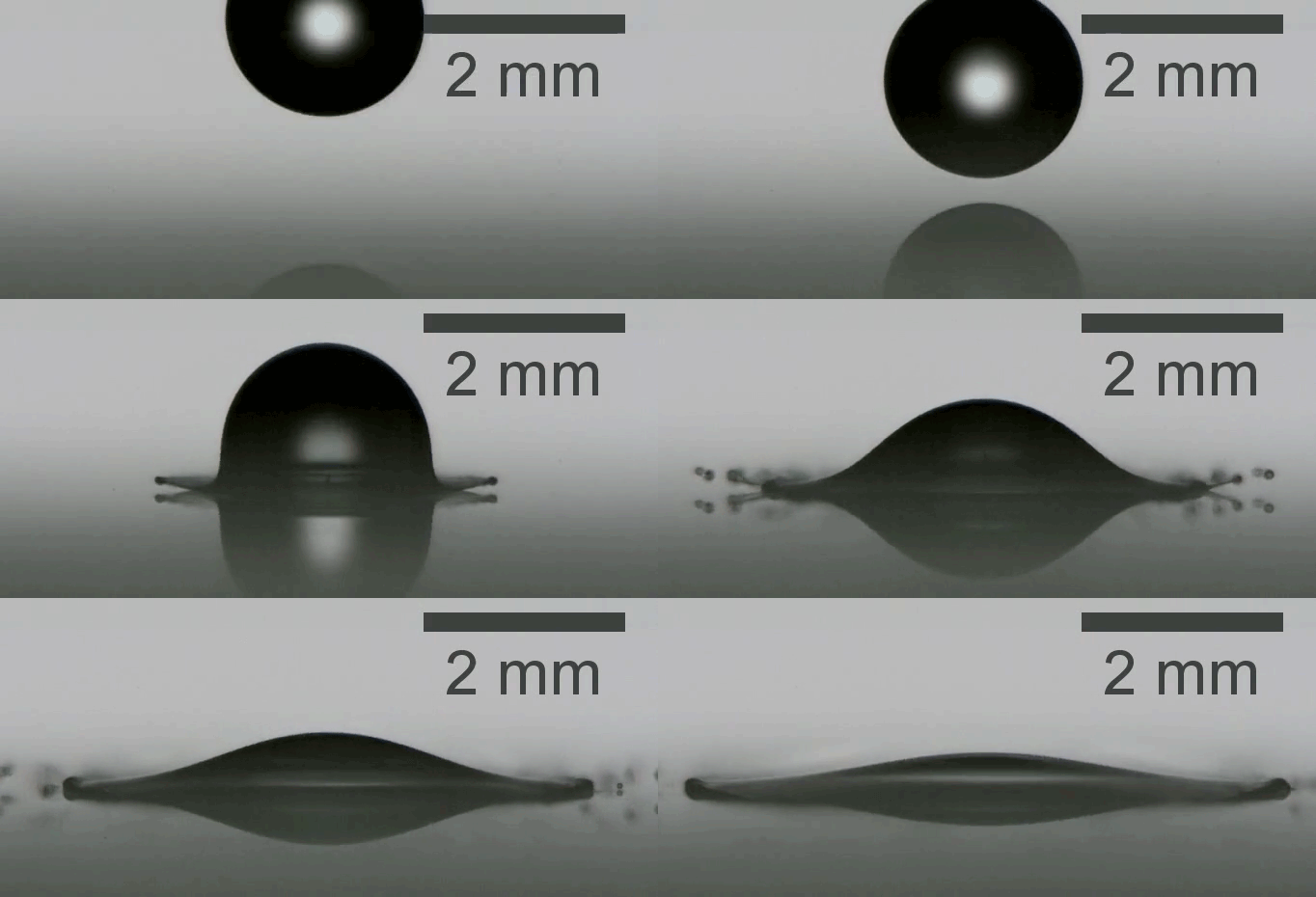
The splash of a droplet is a surprisingly complex phenomenon, depending not only on the droplet’s characteristics but also the surrounding air pressure, the roughness and temperature of the impact surface, and the surface’s curvature. In this study, researchers investigated the effects of surface curvature on splashing, finding that it’s harder for a drop to splash on spheres of smaller radius than ones with a larger radius of curvature.
In Image 1, the falling droplet coats the 2-mm sphere with no sign of splashing. But as the radius gets larger (Images 2 and 3), splashing becomes more and more pronounced. They found that the splash suppression is due to a modification of the lift force on the leading edge of the lamella, the thin liquid layer created as the drop impacts and spread. (Image, research, and submission credit: T. Sykes et al.; also available here)
When a droplet falls on a mesh surface, some of the liquid can burst through the holes (top row). But subsequent drops have a harder time penetrating the prewetted mesh. After a few drops have impacted (rows 2-3), the wetted mesh can completely suppress penetration (rows 4-5). The authors found that the taller drops sitting atop the mesh were better at stopping penetration from an incoming drop. (Image and research credit: L. Xu et al.)
Marangoni bursting takes place in alcohol-water droplets; as the alcohol evaporates, surface tension changes across the liquid surface, generating a flow that tears the original drop into smaller droplets. Here researchers add a twist to the experiment using PMMA, an additive that dissolves well in alcohol but poorly in water. As the alcohol evaporates, the PMMA precipitates back out of the water-rich droplet, forming yarn-like strands. (Image and video credit: C. Seyfert and A. Marin)
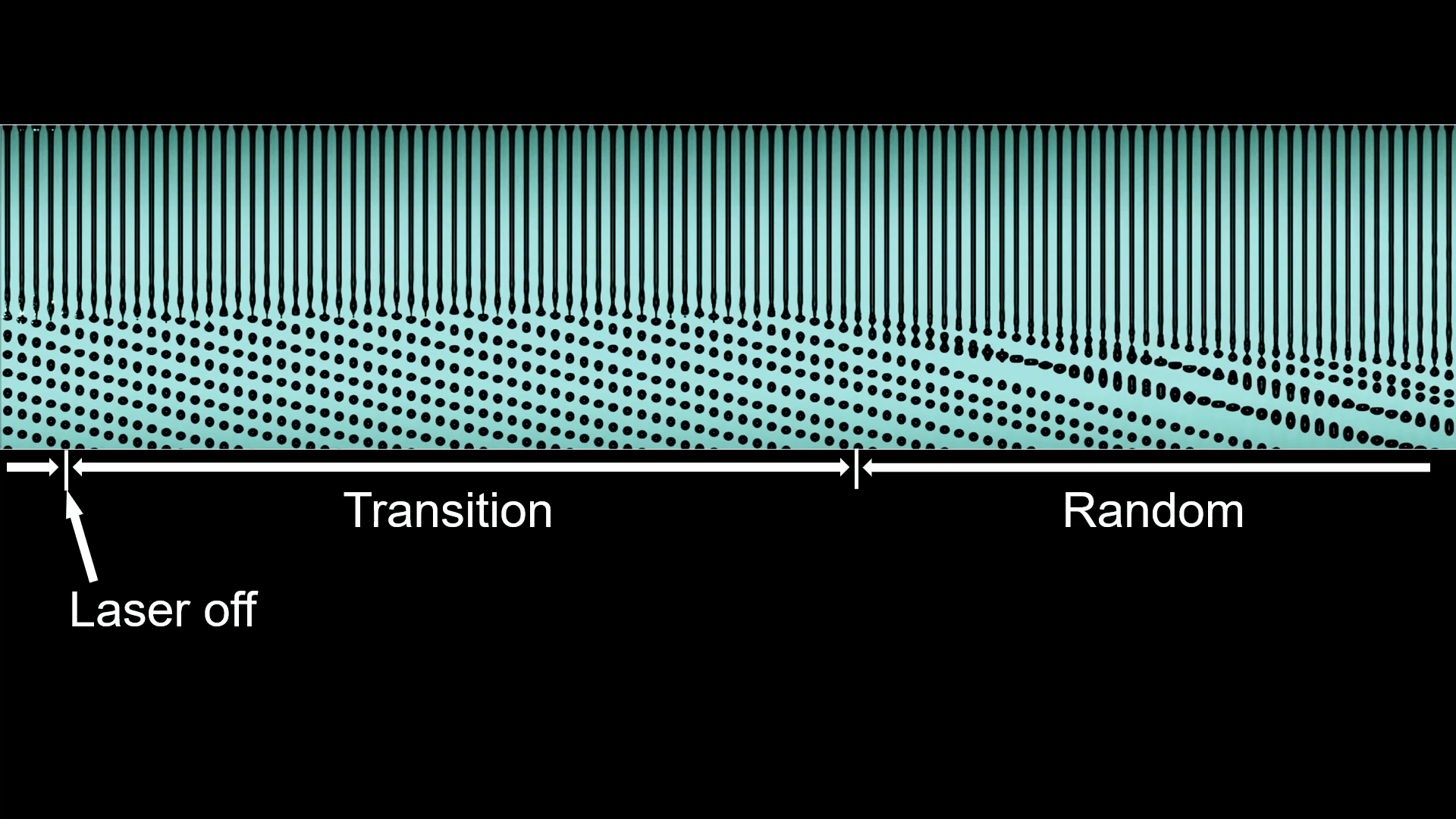
A falling stream of water will naturally break up into droplets via the Plateau-Rayleigh instability. Those droplets are random, unless something like vibration of the nozzle sets their size. In this study, though, researchers found that shining a laser beam on the stream can trigger an orderly break-up with droplets that are consistent in size and spacing.
The optofluidic phenomenon depends on a few different effects. The changing curvature of the liquid stream reflects the laser light, some of which undergoes total internal reflection and travels up the jet as if it were a fiber optic cable. Look closely in the right side of the second image, and you’ll see a periodic flicker of green light at the mouth of the nozzle. Those flashes of green reveal that the liquid jet is guiding the light upstream in bursts, each of which exerts an optical pressure that triggers the Plateau-Rayleigh instability.
When the laser first turns on, there’s a transition period before the orderly break-up begins, and, likewise, turning the laser off triggers a transition from orderly to random (top image). (Image and research credit: H. Liu et al.; via APS Physics; submitted by Kam-Yung Soh)
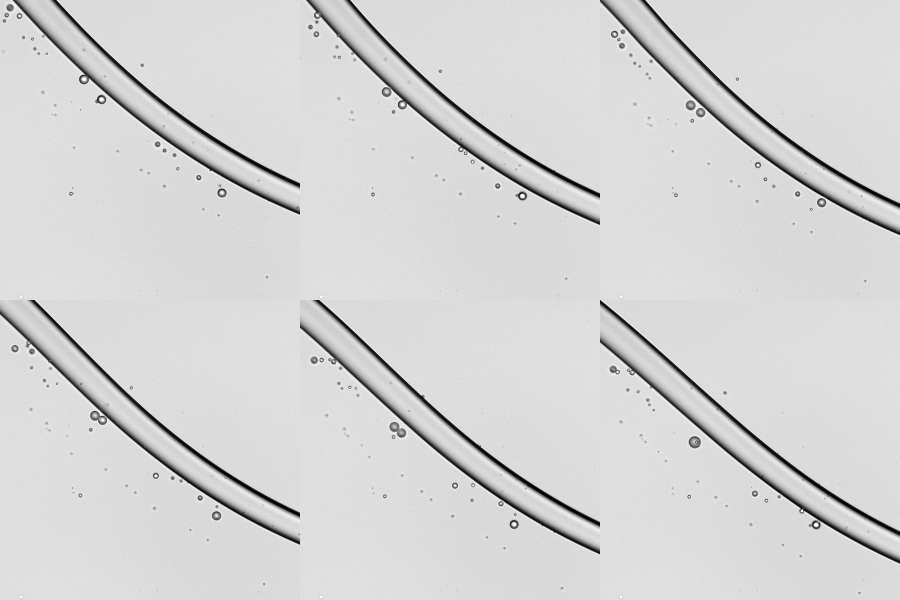
When pulled, viscous liquids stretch into ligaments that thin and then break into droplets. In this video, researchers investigate how these ligaments break up, depending on their composition. The initial views show the break-up of a water-glycerol ligament (Image 1) and an oil ligament (Image 2). By placing a water droplet inside oil, the researchers got quite different results, including oil-encapsulated droplets (Image 3). The technique could be useful for making compound droplets, even with more than two components. (Image and video credit: V. Thiévenaz and A. Sauret)
With the right application of force, liquids can take on shapes that defy our intuition. Here researchers sandwiched two immiscible oils between glass slides and applied an electric field. Because the two oils have different electrical responses, charges build along the interface between them. These charges lead to non-trivial electrohydrodynamic flows and a multitude of bizarre shapes. They observed polygonal droplets, streaming droplet lattices, and spinning filaments among others. As long as the electric field remains on, the wild behaviors continue; once the field is turned off, the oils relax back to typical, rounded drops. (Image, video, and research credit: G. Raju et al.; via Physics World)
How does a droplet sinking through an immiscible liquid settle onto a surface? Conventional wisdom suggests that the settling drop will slowly squeeze the ambient fluid film out of the way, form a liquid bridge to the solid beneath, and spread onto the surface. But for some droplets, that’s not how it goes.
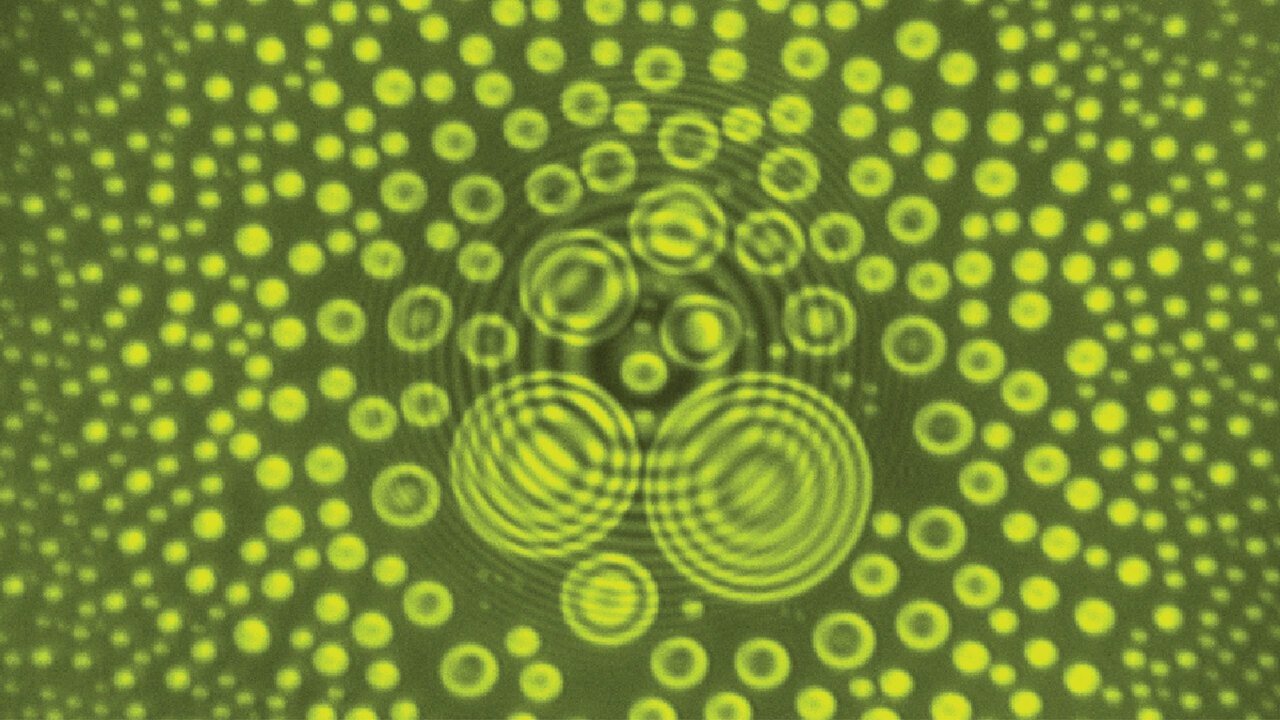
While watching a glycerol droplet settle through silicone oil, researchers discovered a new mechanism for wetting. Initially, the silicone oil drained from beneath the drop, as expected. But then the thinning of the film stalled. Tiny bright spots (above) appeared beneath the light and dark interference fringes of the parent drop. These are spots of glycerol, formed when material from the main drop dissolved into the oil and then nucleated onto the solid surface below. Over time, the island-like spots of glycerol grew. Eventually one grew large enough to coalesce with its parent drop (below), causing the glycerol to quickly spread over the solid surface!
Islands of liquid (darker rings) grow beneath a parent drop (brighter rings) until reaching a size where they coalesce, causing the interference fringes to disappear.
The key to this phenomenon seems to be that immiscibility isn’t perfect. Even trace amounts of solubility between the drop and surrounding fluid are enough to allow these islands to form. And once formed, the islands will grow as long as the drop fluid and the solid surface are chemically attractive. (Image, research, and submission credit: S. Borkar and A. Ramachandran; see also Nature Behind the Paper)
Two well-timed and properly aligned droplets combine to create these umbrella-like fluid sculptures. The initial drop creates a jet that shoots upward. When the second drop hits that jet, it forms an expanding sheet of liquid like a miniature parasol. The higher the viscosity of the drops, the less lacy and unstable the sheet’s rim will be.
Although set-ups for these sorts of pictures can be finicky, they’re very doable, even for amateur photographers. In fact, the techniques used here have been around for about a century! (Image and research credit: A. Kiyama et al.)
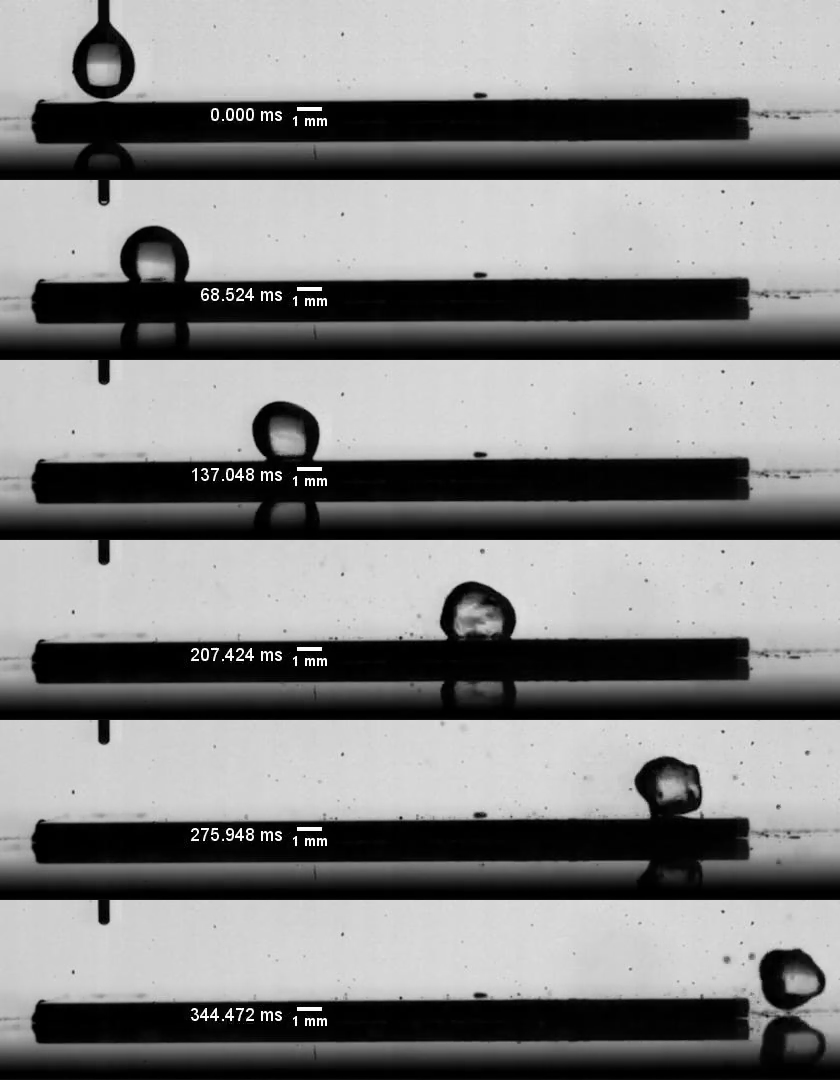
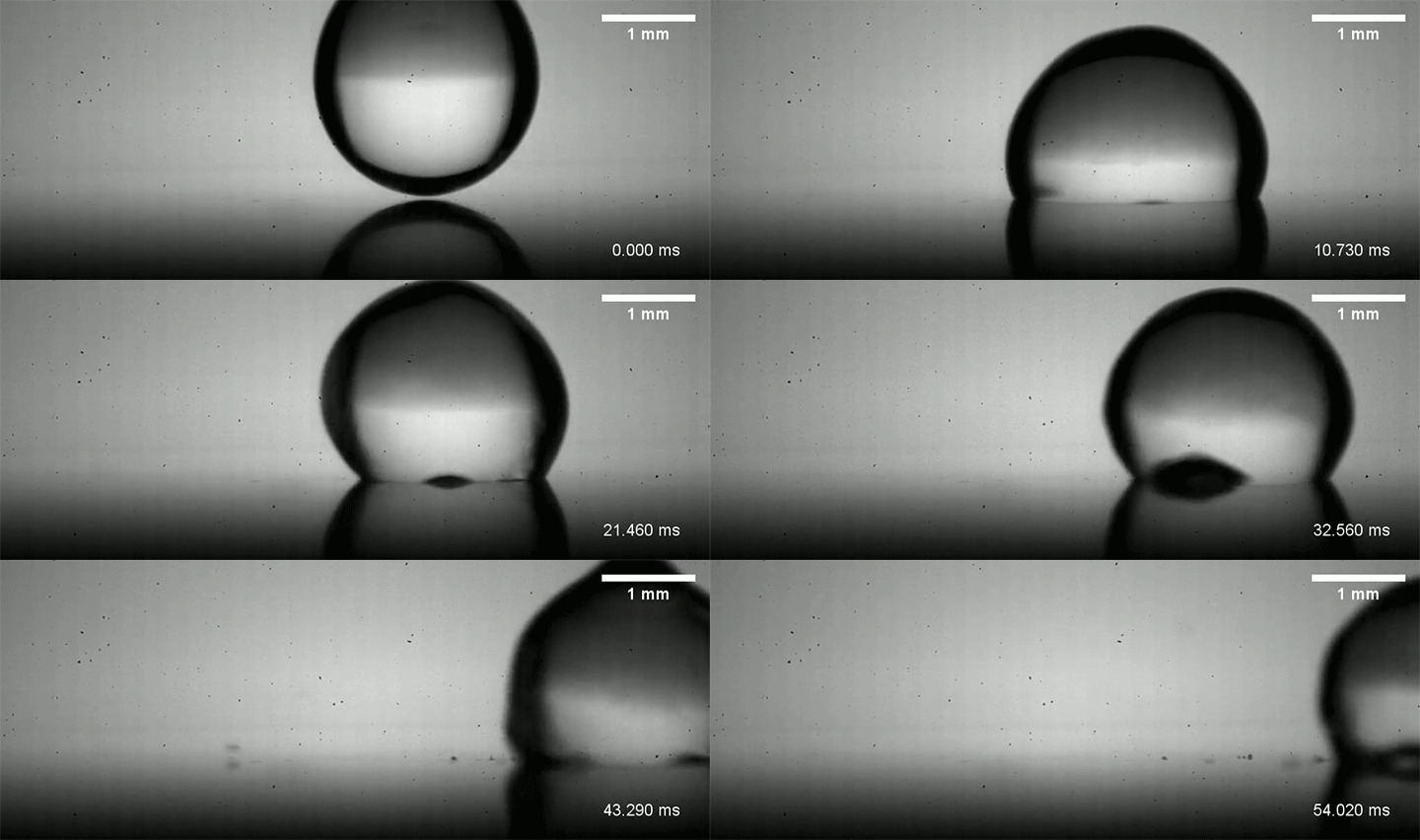
Robust, self-cleaning surfaces are a holy grail for many engineers, but they’re tough to achieve. One necessary ingredient for a self-cleaning surface is the ability to shed water, which is why superhydrophobic coatings and surface treatments are popular. Here, researchers prompt their droplets to move at speeds up to 16 cm/s by dropping them onto a thin layer of heated oil.
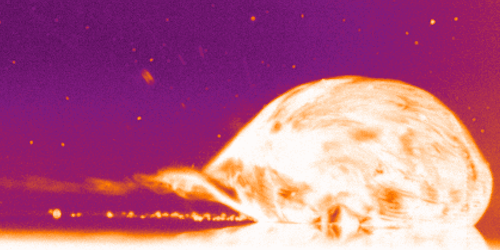
Longtime readers will no doubt be reminded of self-propelling Leidenfrost drops, but this situation is not quite the same. In general, the oil layer suppresses the Leidenfrost effect. Instead, the oil heats the drop, evaporating its vapor. A bubble of vapor will nucleate at a random location in the droplet and eject itself, pushing the drop in the opposite direction. Because of the disruption caused by that ejection, new bubbles will preferentially form at the same spot, providing an ongoing supply of vapor that keeps the drop sliding in the same direction. It’s like a miniature rocket zooming along the oil film! (Image and research credit: V. Leon and K. Varanasi; via APS Physics)