Tag: droplet impact

  • Oil-on-Water Impact

    Oil-on-Water Impact

    Although many people have studied droplet impacts over the years, there’s been remarkably little work done with oil-on-water impacts. One of the things that makes this situation different is that the oil and water are completely immiscible, which means we can see aspects of the impact process that are invisible with, say, water-on-water impacts.

    The animation above shows an underwater view of the oil droplet’s impact. The energy of the initial impact creates an expanding crater and an unstable crown splash. That crown splash contains both water and oil. After it ejects some droplets, the rim stabilizes, but we can still see small perturbations along its edge as it starts to retract. In the water, high surface tension damps out these perturbations. Not so for the oil! As the crater retracts, the small disturbances along the rim get stretched into mushroom-shaped fingers that point inward toward the impact site. Because the index of refraction is different between oil and water, we can see the fingers clearly near the end of the animation. (Image and research credit: U. Jain et al.; submitted by Utkarsh J.)

  • How Rain Can Spread Pathogens

    How Rain Can Spread Pathogens

    Rainfall can help spread pathogens from an infected plant to healthy ones. This transfer can happen both through droplets and by dry-dispersal of pathogen spores (top). When a raindrop hits a leaf, its initial spread triggers a vortex ring of air that can lift thousands of dry spores into a swirling trajectory (bottom). That boost in height carries spores beyond the slower wind speeds of the plant’s boundary layer and into faster air streams that disperse it toward healthy plants. (Image and research credit: S. Kim et al.)

  • Water Impacts

    Water Impacts

    In the clean and simplified world of the laboratory, a droplet’s impact on water is symmetric. From a central point of impact, it sends out a ring of ripples, or even a crown splash, if it has enough momentum. But the real world is rarely so simple.

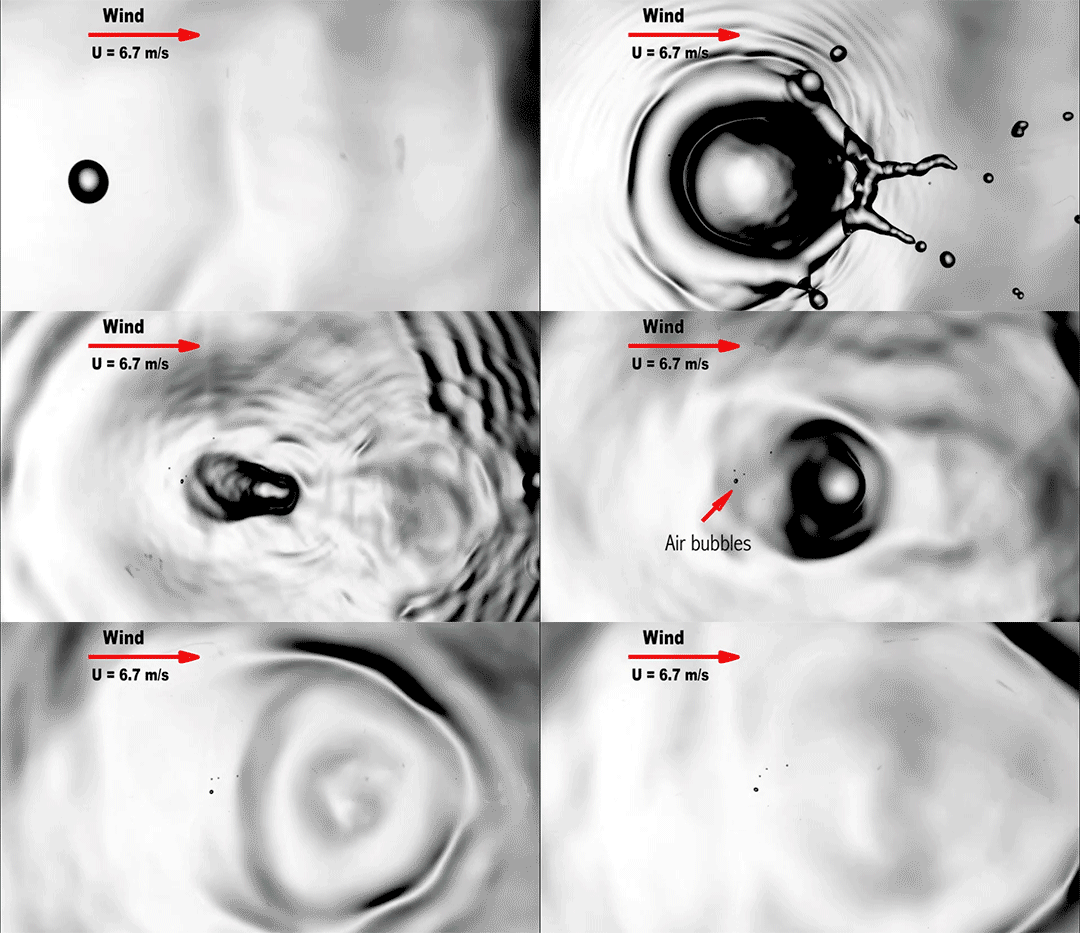
    Here we see how droplets impact when the wind is blowing against them. The drops fall at an angle, creating an oblique cavity. Rings of ripples spread from the impact, but the ligaments of a splash crown form only on the leeward side. As the wind speed increases, so does the violence of the impact, eventually beginning to trap tiny pockets of air beneath the surface. Those miniature bubbles can spray droplets and aerosols into the air when they finally pop. (Image and video credit: A. Wang et al.)

  • Featured Video Play Icon

    Freezing Drop Impact

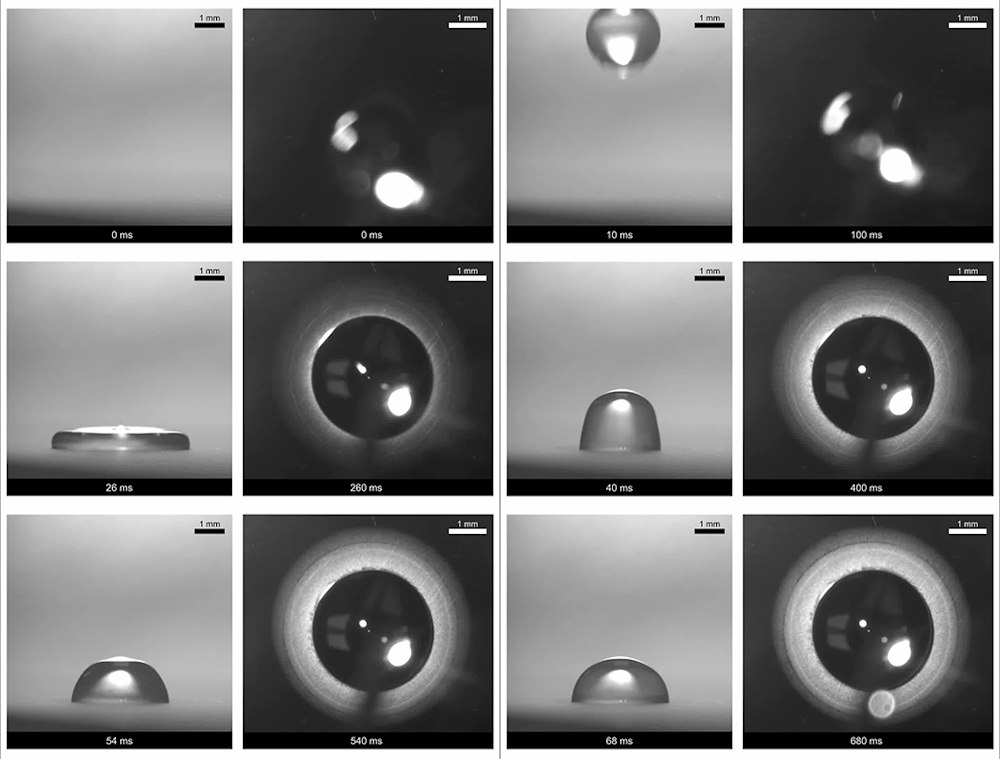
    At the altitudes where aircraft fly, it’s often cold enough for water drops to freeze in seconds or less. Once attached to a wing, such frozen drops disrupt the flow, reducing lift and increasing drag. To help understand how such droplets freeze, scientists study droplet impact on cold surfaces. Starting at room temperature (counter-clockwise from upper left), a drop will spread on the surface, then retract. When the temperature is colder, parts of the droplet freeze before retraction completes, leaving a thin sheet with a thicker center. At even colder temperatures, the droplet’s rim destabilizes and freezing occurs before the droplet has time to retract fully. And at the coldest temperatures, the droplet breaks apart into a frozen splash. (Image and video credits: V. Thievenaz et al.)

  • Putting a Spin on Splashes

    Putting a Spin on Splashes

    Researchers put a spin on splashing droplets with selective wetting. When a drop impacts on a water-repellent, superhydrophobic surface, it will spread circularly, then pull back together and rebound off the surface. That’s because the surface coating resists actually touching – or being wetted by – the water. But just as there are surface coatings that resist water, there are those that attract it.

    Above, researchers have coated a surface so that it’s mostly superhydrophobic, but it also has narrow pinwheel-like arms that are hydrophilic. As the drop impacts, it spreads across the surface and then retracts. But where the hydrophilic arms are, the drop lingers. This creates the four lobes we see on the droplet, and the asymmetric retraction gives the drop angular momentum. As it leaves the surface, the spin continues. In some configurations, the researchers could make the drop spin at more than 7300 rpm. (Image and research credit: H. Li et al; via Science; submitted by Kam-Yung Soh)

  • Breaking Up Drops

    Breaking Up Drops

    Lots of applications – from rocket engines to ink jet printing – require breaking large droplets into smaller ones, so there are many methods to do this. Some techniques rely on fluid instabilities, others use ultrasonic vibration. But one of the most effective methods may also be the simplest: placing a mesh between large drops and their target.

    That’s the idea at the heart of this new study, which uses a wire mesh to break large droplets into a spray of finer ones 1000 times smaller. The target application is agricultural spraying, and the researchers argue that their method would allow farmers to treat their crops effectively with fewer chemicals and less run-off. Drops impacting the mesh form a narrow cone over the plant, and the smaller, slower droplets are better at sticking to the plant instead of bouncing away. They’re also less likely to injure crops, since they don’t disturb the leaves the way larger drops do. (Image and research credit: D. Soto et al.; via MIT News; submitted by Omar M.)

  • A Viscous Splash

    A Viscous Splash

    The splash of a drop may be commonplace, but it is still a mesmerizing and fertile phenomenon. When it comes to splashing, scientists are still learning how to predict the outcome. Here a drop of silicon oil impacts a film of silicon oil with an even higher viscosity. The momentum of that impact creates a crater and a splash curtain that rises and expands from the initial point of impact. Because the film viscosity is higher than the drop’s, the evolution of the corona slows down. Eventually, surface tension and gravity start pulling the splash curtain back down as the crater collapses. Meanwhile at the top of the splash, capillary forces pull fluid into the rim, which becomes unstable and grows cusps that eventually eject a cloud of smaller droplets. (Image and research credit: H. Kittel et al., source)

  • Rim Break-Up

    Rim Break-Up

    Splashing drops often expand into a liquid sheet and spray droplets from an unstable rim. Although this behavior is key to many natural and industrial processes, including disease transmission and printing, the physics of the rim formation and breakup has been difficult to unravel. But a new paper offers some exciting insight into this unsteady process. 

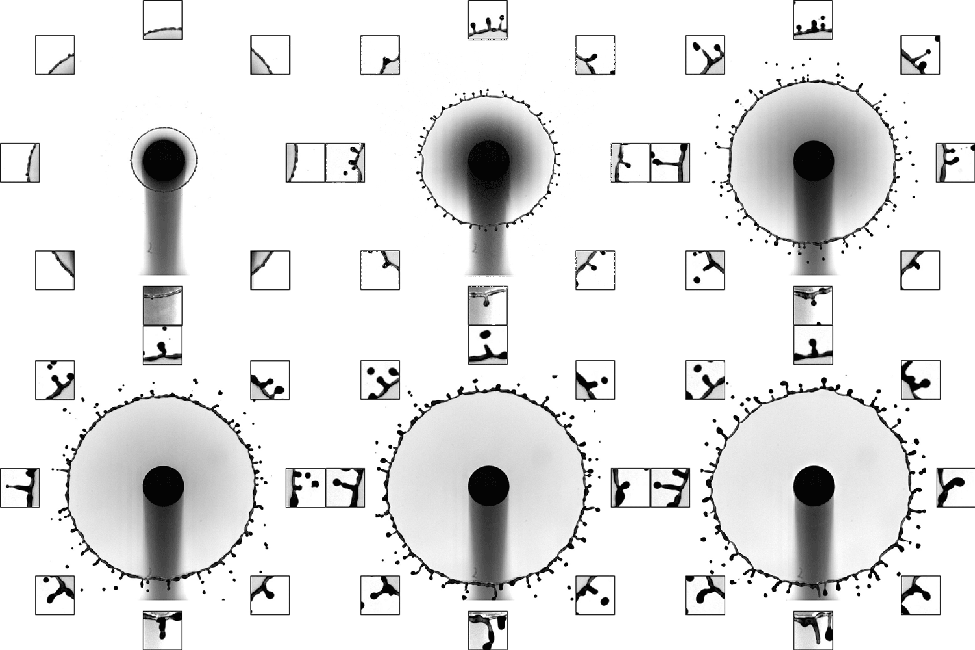
    The researchers found that if they carefully tracked the instantaneous, local acceleration and thickness of the rim, it always maintained a perfect balance between acceleration-induced forces and surface tension. That means that even though different points on the rim appear very different, there’s a universality to how they behave. They found that this rule held over a remarkably large range of situations, including across fluids of different viscosities and splashes on various surfaces. (Image and research credit: Y. Wang et al.; via MIT News; submitted by Kam-Yung Soh)

  • Wrapping Droplets

    Wrapping Droplets

    Future efforts for targeted drug delivery may require encapsulating droplets before transporting them to their final location. One method for encapsulation is wrapping a drop in a thin, solid sheet. Previously, we saw that drops can wrap themselves with a little outside assistance, but here the drops achieve that same feat on their own, using the energy of droplet impact to wrap liquids. 

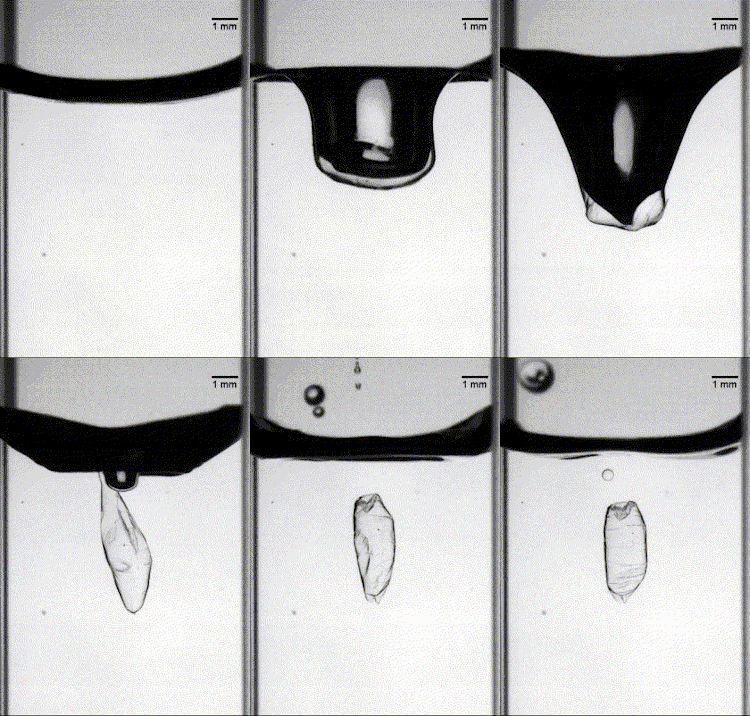
    Here’s how it works: float a thin sheet on a bath of a liquid like water, then let an oil drop fall into the bath. Its impact deforms the air-water interface and, with a sufficiently energetic impact, causes the oil droplet to pinch off. The flexible sheet wraps around the droplet, and the encapsulated droplet sinks due to gravity. The shape of the final drop depends on the sheet’s initial geometry. The researchers have successfully used circular, triangular, and cross-shaped sheets to wrap droplets. Check out the original paper or the video below for more. (Image and research credit: D. Kumar et al.; video credit: Science)

  • Water Atop Oil

    Water Atop Oil

    At first glance, this image looks much like the impact of any drop on a pool of the same liquid, but that’s not what you’re seeing. This is the impact of a water droplet on a thin film of oil, and the immiscibility of those two fluids has important effects on the collision. When the water drop impacts, it spreads and forms a compound crown that rises out of the fluid. Eventually, that momentum runs out and the crown falls into the liquid.

    Water’s intermolecular forces are strong enough to pull the remains of the droplet back in on itself. As that fluid collides at the center, it gets forced up into a central jet with enough energy to eject a droplet or two at its tip. Even though this looks like a Worthington jet, it’s not. Worthington jets form after the collapse of a cavity in the impacted liquid – in other words, they form on pools, not on films. Despite the visual similarity, this central jet is formed entirely differently! (Image and research credit: Z. Che and O. Matar, source; submitted by O. Matar)