Tag: droplet impact

  • Featured Video Play Icon

    The World in a Droplet

    Capturing refracted images in a droplet is a popular pastime among high-speed photographers, and in this solo Slow Mo Guy outing, we get to see that process in video. Physically, the subject is a simple drop of water, which on impact with a pool, rebounds into a Worthington jet and ejects one or more droplets from its tip. Despite hundreds of years of study, it’s still a joy to watch, especially at 12,000 frames per second.

    It’s also not the easiest image to capture, and one thing I rather enjoy about this video is how it gives you a sense of the trial and error involved in capturing just the right view. Even without having to worry about the timing issues, there is a lot of fiddling with lenses, focus, lights, and positioning — something familiar not just to photographers and videographers but to many researchers as well! (Image and video credit: The Slow Mo Guys)

  • Featured Video Play Icon

    Bouncing Off Defects

    The splash of a drop impacting a surface depends on many factors — among them droplet speed and size, air pressure, and surface characteristics. In this award-winning video from the 2019 Gallery of Fluid Motion, we see how the geometry of a superhydrophobic surface can alter a splash.

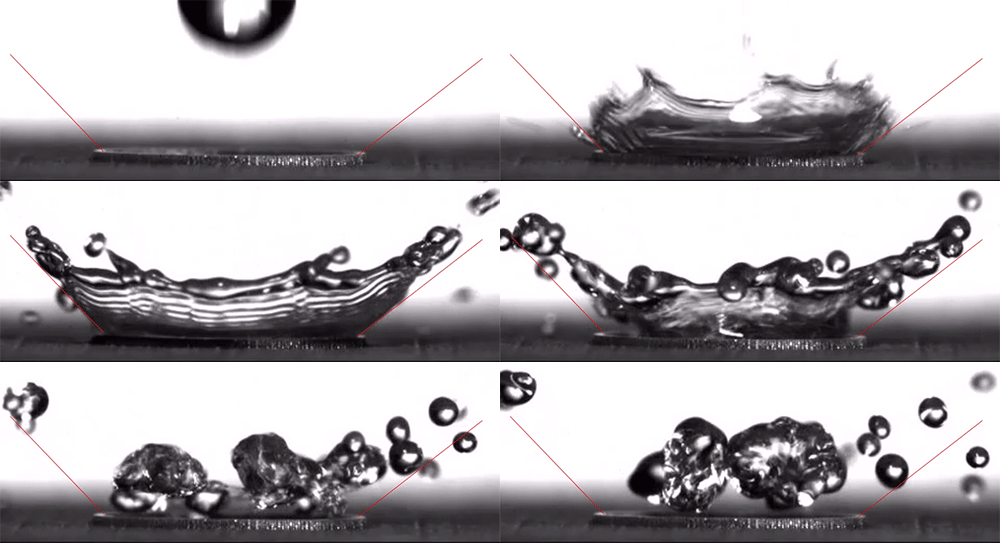
    When a drop falls on a protruding superhydrophobic surface, like the apex of a cone, it can be pierced from the inside, completely changing how the droplet rebounds and breaks up. The variations the video walks us through are all relatively simple, but resulting splashes may surprise you nevertheless. (Image and video credit: The Lutetium Project)

  • Featured Video Play Icon

    “Viscoelasticity Gives You Wings!”

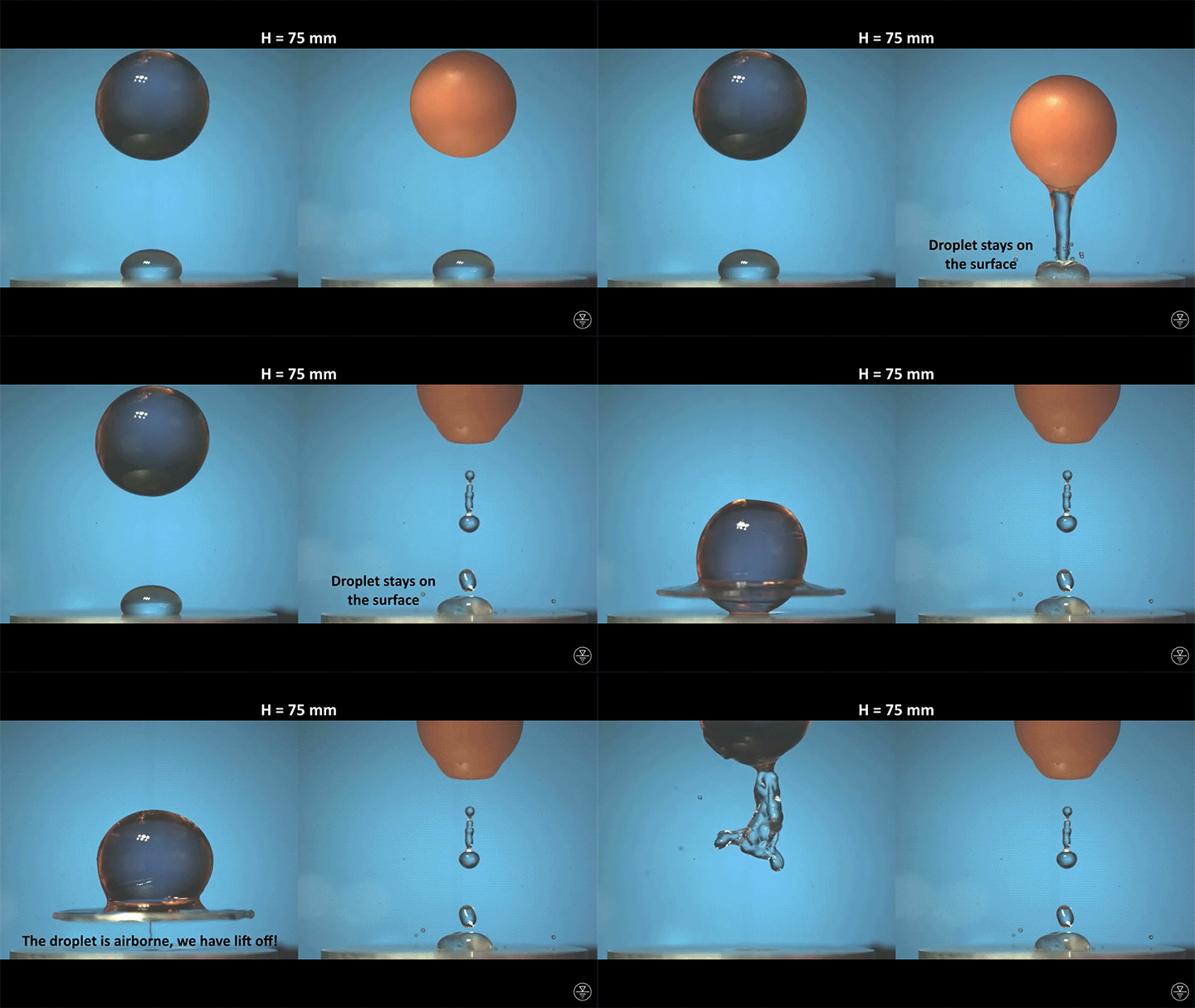
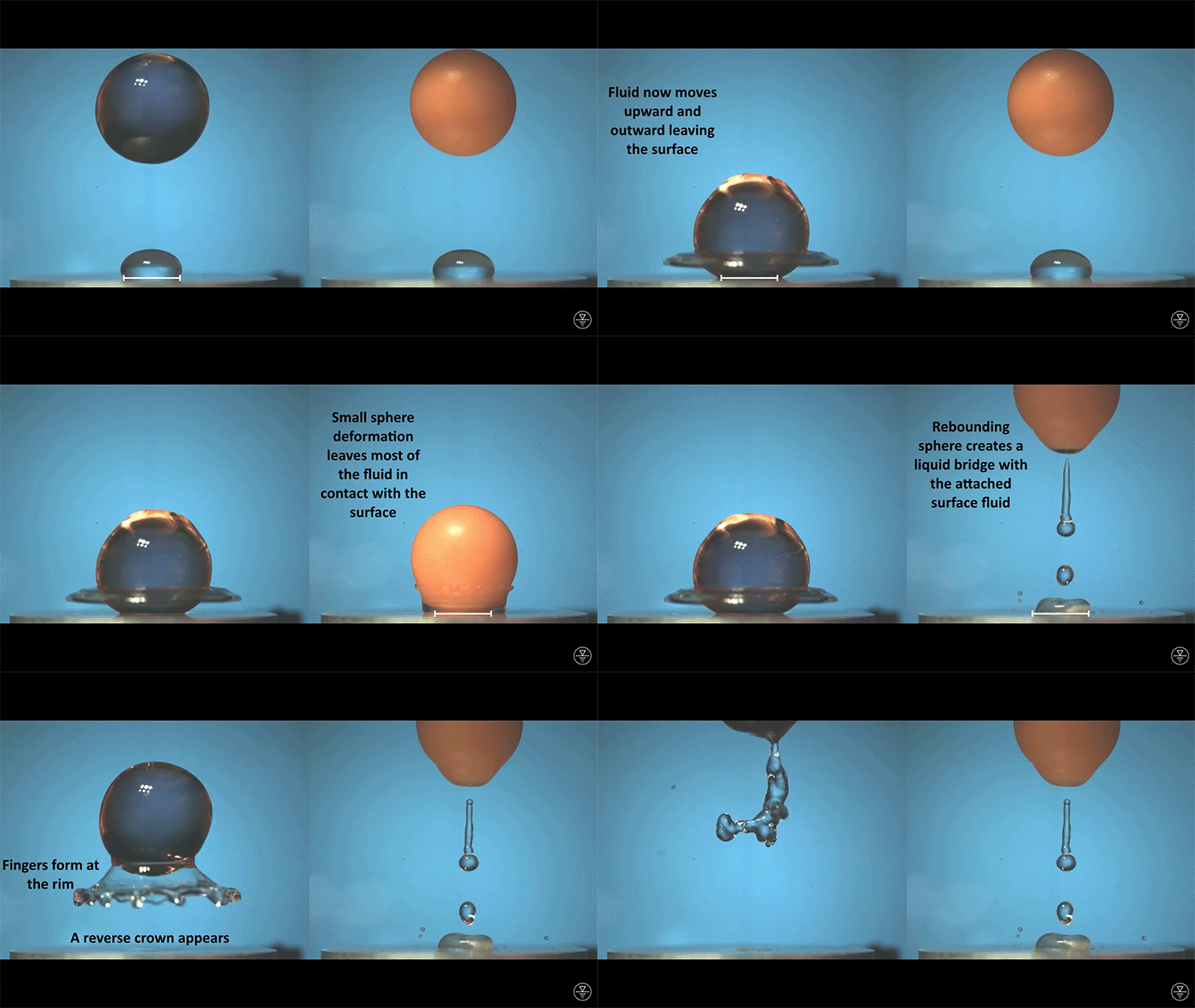
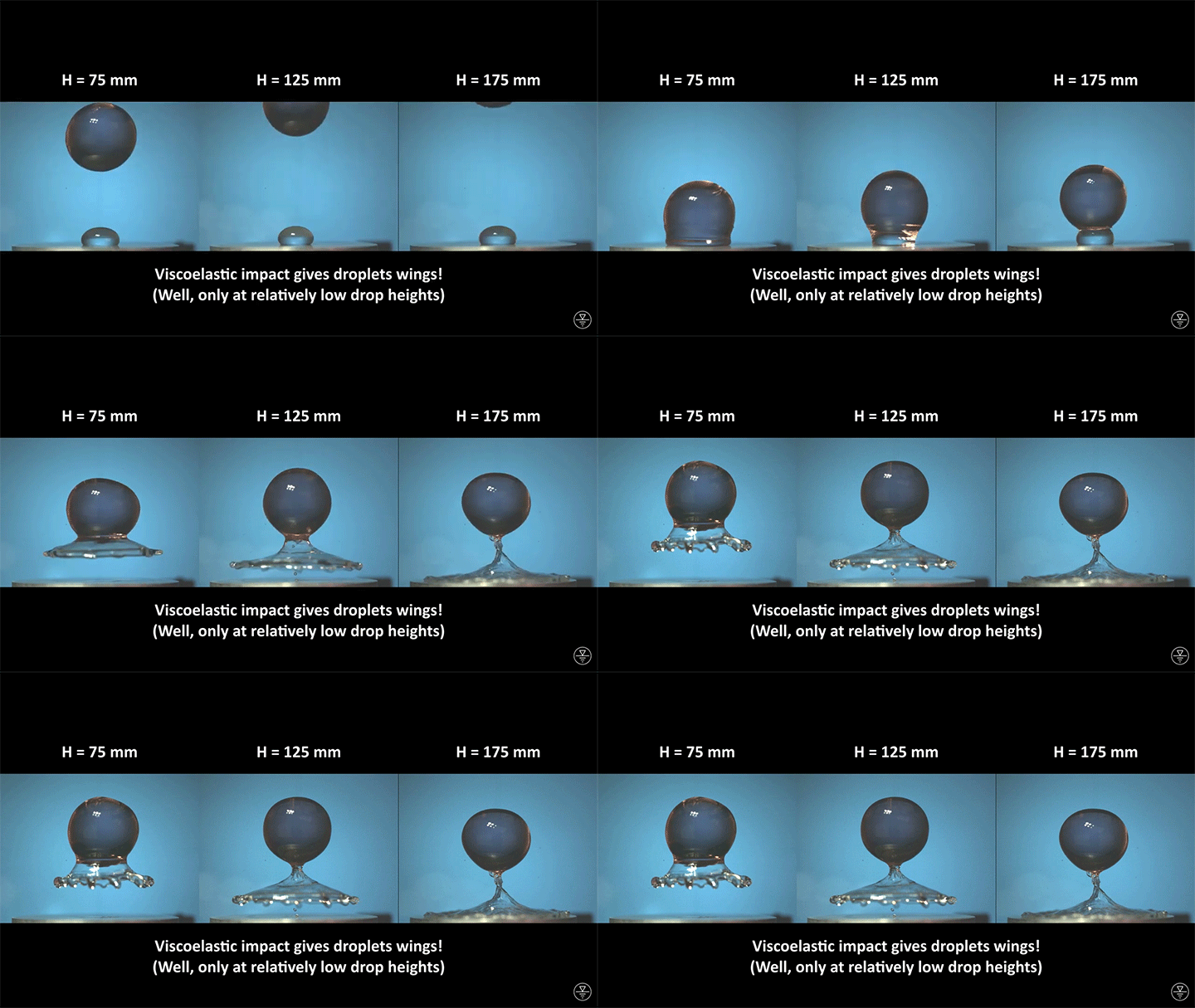
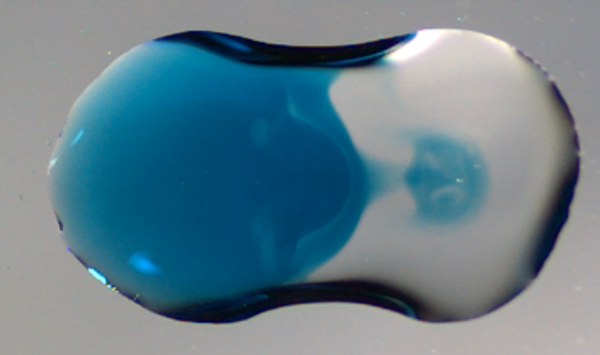
    What happens when you drop a hydrogel bead on a water droplet? Because of the hydrogel’s viscoelasticity and its hydrophilic nature, the rebounding bead carries the droplet with it. As seen in the video above, when the impact energy is small enough, the droplet forms a reverse crown during lift-off, kind of like giving the hydrogel bead a skirt. The key feature for lift-off is the bead’s deformation on impact. Because the hydrogel widens at its base, it is sometimes able to push the entire droplet off its initial footprint and detach it from the surface. (Image, research, and video credit: R. Rabbi et al.)

  • Falling Drops and Forming Stalagmites

    Falling Drops and Forming Stalagmites

    The vast stalactites and stalagmites found in caves take millennia to form. Mineral-rich water seeps down the icicle-like stalactites and then drips onto stalagmites below, each drop depositing a little more calcite onto the growing rock. By observing this dripping action first-hand, researchers found that most falling drops create a splash that’s much smaller than the width of the stalagmite they fall onto. So how do stalagmites end up so wide?

    It turns out that there’s a large variance in where drops hit the stalagmite. There’s no wind in these caves to push the droplets, so researchers concluded the drop’s trajectory depends on the vortices it sheds as it falls. A drop that falls from a short height will have a vertical trajectory. But once the drop is falling tens of meters, it can end up as many as several centimeters to the side of where it would fall in a vacuum. This scatter-shot variation in drop impacts is what enables stalagmites to grow so wide. (Image and research credit: J. Parmentier et al., source; via NYTimes; submitted by Kam-Yung Soh)

  • Making Drops Stick

    Making Drops Stick

    As you may have noticed when washing vegetables, many plants have superhydrophobic leaves. Water just beads up on their surface and slides right off. This is a useful feature for plants that want to direct that water toward their roots, but it’s a frustration in agriculture, where that superhydrophobicity means extra spraying of pesticides in order to get enough to stick to the plant.

    But that may not be the case for much longer. Researchers have found that adding a little polymer to water droplets (right) can suppress their ability to rebound (left) from superhydrophobic surfaces. Above a critical concentration, the high shear rate of the droplet as it tries to detach activates the viscoelastic properties of the polymer. That viscoelasticity suppresses the rebound, keeping the droplet attached. That’s good news for everyone, since it means less spraying is needed to protect crops. (Image and research credit: P. Dhar et al.)

  • Featured Video Play Icon

    Drops That Dig

    On extremely hot surfaces, droplets will skitter on a layer of their own vapor, thanks to the Leidenfrost effect. This keeps the liquid insulated from contact with the hot surface. But what if the surface isn’t solid?

    That situation is what we see above. Instead of soaking into a granular material like a room temperature droplet (left), a drop falling onto a very hot bed of grains digs a hole! As with a typical drop on a super hot surface, the heat vaporizes part of the droplet. As the vapor escapes, it carries sand with it, allowing the boiling drop to burrow its way into the material. As the temperature difference between the sand and droplet changes, the digging slows. Eventually, the drop comes to a rest and boils away. (Video and image credit: J. Zou et al.)

  • Splashes on Hairy Surfaces

    Splashes on Hairy Surfaces

    The question of whether a droplet will splash is a complicated one, even for smooth surfaces, but researchers are also interested in what happens to hairy surfaces when droplets strike. By varying the droplet viscosity and speed, along with the spacing of the hairs, researchers sketched out the variety of impacts one can get. 

    What happens during impact depends largely on how the kinetic energy of the droplet compares to the dissipation caused by interaction with the hairs. When the two balance, the droplet gets captured, like in the upper right image. If the hairy dissipation wins, you get a drop that stays mostly on the surface of the hairs. And if the kinetic energy outweighs the dissipation, you end up with a star-shaped splash that spreads between the hairs. (Image and research credit: A. Nasto et al.)

  • Featured Video Play Icon

    Pouring a Liquid Mirror

    In this video, the Slow Mo Guys play with liquid gallium, giving us a chance to see how molten metals behave (outside of, say, the Terminator movies). Near its melting point, gallium is about six times denser than water, with a viscosity three times higher, and a surface tension about ten times greater. So how do those properties affect its behavior?

    You may be surprised that when watching the gallium vibrate on a speaker or get poured into a pan, it doesn’t look all that different from water. Yes, it’s highly reflective, but, on the whole it doesn’t look radically different from a distance. We can use the Reynolds number to quantify what’s going on here. It’s a dimensionless number that compares the fluid’s inertial force to the viscous force. Imagine we have two versions of an experiment, one where we pour gallium at a given speed and one pouring at the same volume and speed but with water. If we compared the Reynolds numbers of the water and the gallium, they only differ by a factor of two. Overall, that’s not very much. That’s why the two pours look similar.

    The story is different, though, if we look at individual drops of gallium and water, like when the first few drops of our pour hit the surface. Check out the gallium drops below. They’re conical on either end! This looks very different from what we expect with water droplets. You might think that’s because the metal is more viscous, but if we compare a water drop with a gallium drop of the same characteristic size and impact speed, we find a different story. For this, we’ll use the Ohnesorge number, which compares the viscous forces to a combination of inertia and surface tension. In this case, we find that the gallium drop’s Ohnesorge number is almost an order of magnitude smaller than the water droplet’s. That means that viscosity isn’t a major factor for our gallium drop. Both surface tension and inertia are more important.

    But if the surface tension is so high, then why aren’t the droplets spherical? Mostly because they don’t have time to form spheres before they hit. Their shape suggests that they’ve only just broken into droplets, which makes sense if the pour is fast and the surface tension is strong. (Video and image credit: The Slow Mo Guys)

  • Avoiding Droplet Contact

    Avoiding Droplet Contact

    Cold rain splashing on airplane wings can freeze in instants. To prevent that, researchers look for ways to minimize the time and area of contact a drop has. Hydrophobic coatings and textures can do some of the work, but they are easily damaged and don’t always work well when it comes to freezing.

    The new technique shown here uses ring-shaped “waterbowls” to help deflect drops. As the drop impacts and spreads, the walls of the ring texture force the lamella up and off the surface. This reduces both the time and area of contact and, under the right circumstances, cuts the heat transfer between the fluid and surface in half. The technique is useful for more than just preventing freezing, though; it would also be helpful for waterproofing breathable fabrics, where shedding moisture quickly without clogging pores is key to keeping the wearer dry. (Image and research credit: H. Girard et al.; via MIT News and Gizmodo)

  • Condensing Halos

    Condensing Halos

    Drops that impact a very hot surface will surf on their own vapor, and ones that hit a very cold surface will freeze almost immediately. But what happens when the temperature differences aren’t so extreme? Scientists explored this (above) by dropping room-temperature water droplets onto a cool surface – one warmer than the freezing point but cooler than the dew point at which water condenses. 

    They found that impacting drops formed a triple halo of condensate (right).  The first and brightest ring forms at the radius of the drop’s maximum extent during impact. The second band forms from water vapor that leaves the droplet at impact. As that vapor cools, it condenses into a second band. The final, dimmest band forms as the droplet stabilizes and cools. It’s the result of water vapor near the droplet continuing to cool and condense. (Image and research credit: Y. Zhao et al.; via Nature News; submitted by Kam-Yung Soh)