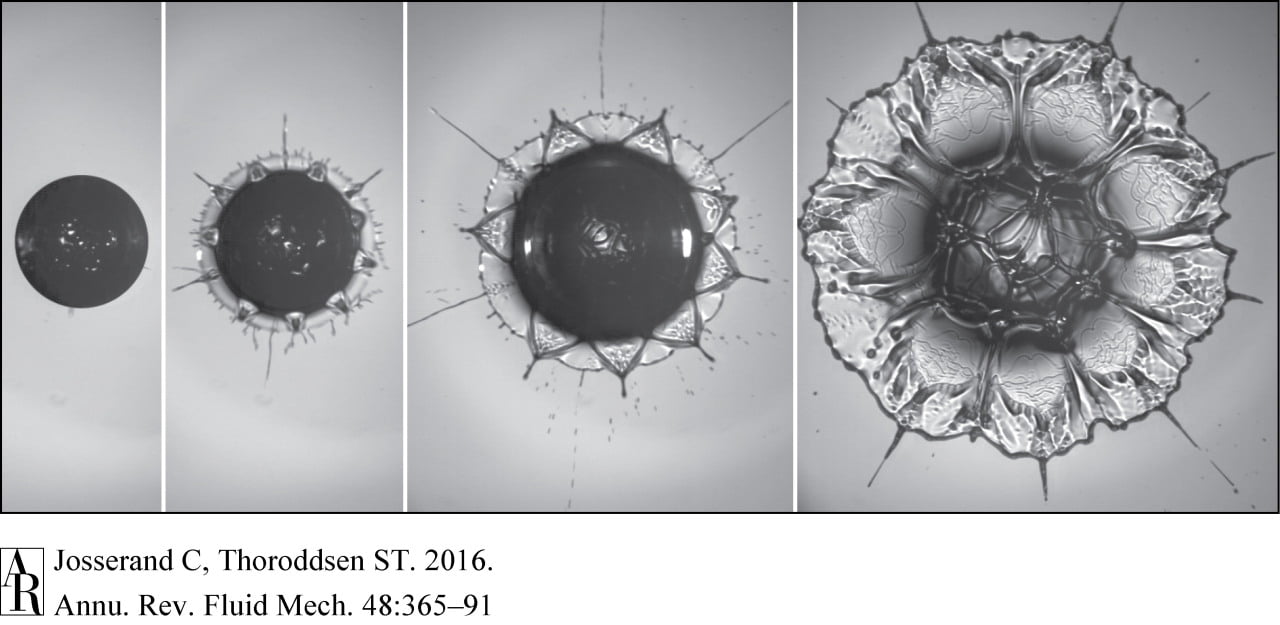
Shoot a sphere through a drop with sufficient speed, and you’ll see something like the composite photo above. Going from right to left, the projectile is initially coated in liquid and stretches the fluid behind it as it continues flying. This forms a thin sheet of fluid called a lamella with a thicker, uneven rim at its far end. The lamella continues stretching until the projectile breaks through and detaches. Now the lamella starts rebounding back on itself as surface tension struggles to keep the fluid together. A new rim forms on the front, and both the front and back rims thicken as the lamella collapses. Along the rims thicker portions start forming droplets – like spikes on a crown – as the surface-tension-driven Plateau-Rayleigh instability starts breaking the structure down. The untenable sheet of fluid will break up into a cloud of smaller, satellite droplets when it can hold together no longer. (Image credit: V. Sechenyh et al., video)
Tag: droplet impact

A Particle-Filled Splash
A drop of water that impacts a flat post will form a liquid sheet that eventually breaks apart into droplets when surface tension can no longer hold the water together against the power of momentum flinging the water outward. But what happens if that initial drop of water is filled with particles? Initially, the particle-laden drop’s impact is similar to the water’s – it strikes the post and expands radially in a sheet that is uniformly filled with particles. But then the particles begin to cluster due to capillary attraction, which causes particles at a fluid interface to clump up. You’ve seen the same effect in a bowl of Cheerios, when the floating O’s start to group up in little rafts. The clumping creates holes in the sheet which rapidly expand until the liquid breaks apart into many particle-filled droplets. To see more great high-speed footage and comparisons, check out the full video. (Image credit and submission: A. Sauret et al., source)

Emulsion Impact
Emulsions – mixtures of two immiscible fluids – are quite common; the oil and vinegar combination used in many salad dressings is one. The image sequence above shows the first 800 microseconds of the impact of a similarly emulsified droplet. The outer drop, seen on the left, consists of a water/glycerin mixture, and inside the drop are 20 smaller perfluorohexane droplets. These smaller droplets are denser and tend to settle toward the bottom of the outer drop. When the compound droplet hits a solid surface, it spreads in a spectacular starburst pattern that depends on the number and location of interior droplets. You can see a similar impact in motion here. (Image credit: J. Zhang and E. Li; source: C. Josserand and S. Thoroddsen)

Wrinkling Fluids

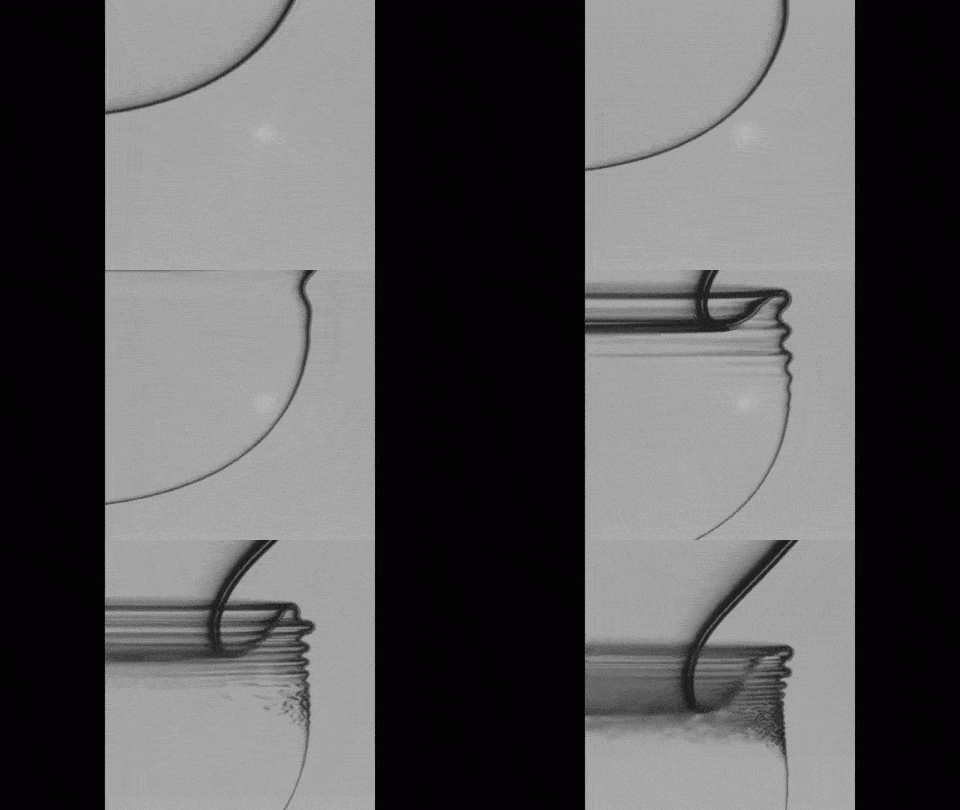
What you see here is a viscous drop falling into a less viscous fluid. Shear forces between the drop and the surrounding fluid cause the drop to quickly deform into a shape like an upside-down mushroom as it descends. The cap forms a vortex ring that curls the viscous fluid back on itself. As it does, that motion compresses the viscous sheet, causing it to wrinkle, as seen in the close-up in the bottom animation. Check out the full video here. (Image credit: E. Q. Li et al., source)

Controlling Droplet Bounce
Water repellent, or hydrophobic, surfaces are common in nature, including lotus leaves, many insects, and even some geckos. These hydrophobic surfaces typically gain their water-repelling ability from extremely tiny nanoscale structures in the form of tiny hairs or specially textured surfaces. But, while the nanoscale structures impart superhydrophobicity, researchers have found that larger macroscale structures can improve water-repellent characteristics by reducing a drop’s time of contact with the surface. A smaller contact time means less chance of contamination on self-cleaning surfaces. It’s also helpful in preventing water from freezing on contact to cold surfaces – valuable, for example, in protecting airplane wings’ leading edges from icing over. This combination of nanoscale and macroscale, water-repelling structures can be found in nature, too, such as on the wings of butterflies, which must quickly shed water in order to fly. (Image credits: K. Hounsell et al.; A. Gauthier et al., source video)

Raindrops in Puddles

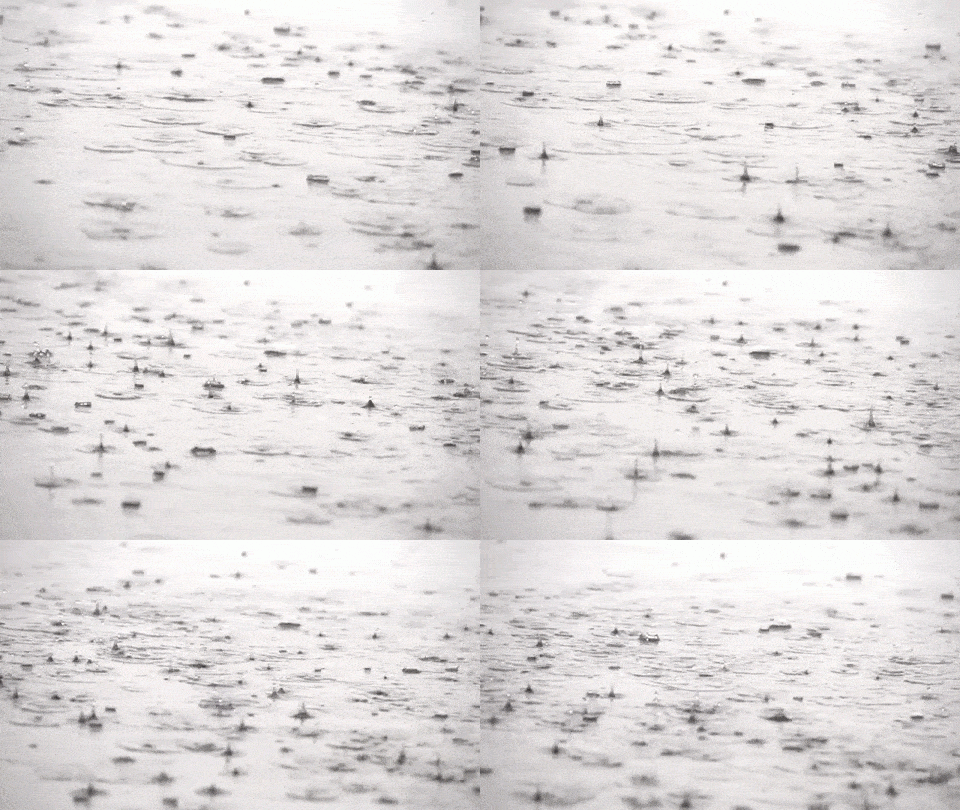
Watching rain drops hit a puddle or lake is remarkably fascinating. Each drop creates a little cavity in the water surface when it impacts. Large, energetic drops will create a crown-shaped splash, like the ones in the upper animation. When the cavity below the surface collapses, the water rebounds into a pillar known as a Worthington jet. Look carefully and you’ll see some of those jets are energetic enough to produce a little satellite droplet that falls back and coalesces. Altogether it’s a beautifully complex process to watch happen over and over again. (Image credit: K. Weiner, source)
——————
Help us do some science! I’ve teamed up with researcher Paige Brown Jarreau to create a survey of FYFD readers. By participating, you’ll be helping me improve FYFD and contributing to novel academic research on the readers of science blogs. It should only take 10-15 minutes to complete. You can find the survey here.

Rain-spread Pathogens
Like humans, plants can spread pathogens to one another. Although scientists had observed correlations between rainfall and the spread of diseases among plants, this study is one of the first to look at the fluid dynamics of leaf and rainfall interaction. When a raindrop hits a leaf, it doesn’t simply splash as it would against an immobile surface. The impact of the drop deforms the leaf, and the plant’s rebound significantly affects the trajectory and size of the resulting droplets. Depending on factors like the leaf’s stiffness, a large drop, carrying many pathogens, may rebound and splatter onto a neighboring leaf. Other leaves tend to catapult out many smaller droplets, which may fly farther afield but carry fewer pathogens. For more, check out the press release or the original research paper. (Video credit: Massachusetts Institute of Technology; research credit: Bourouiba Research Group)

Coalescence Cascade
The simple coalescence of a drop with a pool is more complicated than the human eye can capture. Fortunately, we have high-speed cameras. Here a droplet coalesces by what is known as the coalescence cascade. Because it has been dropped with very little momentum, the droplet will initially bounce, then seem to settle like a bead on the surface. A tiny film of air separates the drop and the pool at this point. When that air drains away, the drop contacts the pool and part–but not all!–of it coalesces. Surface tension snaps the remainder into a smaller droplet which follows the same pattern: bounce, settle, drain, partially coalesce. This continues until the remaining droplet is so small that it can be coalesced completely. (Image credit: Laboratory of Porous Media and Thermophysical Properties, source video)

Drops on a Porous Surface
The splashing of a drop upon impact is a remarkably complicated phenomenon. Perhaps surprisingly, the air around the impacting drop plays a major role in determining which drops splash and which don’t. Lowering the air pressure, for example, stops a drop from splashing. The layer of air that gets trapped beneath the spreading edge of a drop during impact seems to be responsible for splashing. As seen in the video above, drops that impact on a leaky surface, where air can escape, do not splash. By varying where leakage is possible on the surface, the researchers can localize where trapping the air matters most. There’s a critical radius during the drop’s spread where, without leakage, air will be trapped and cause the drop to splash. (Video credit: Y. Liu et al.)

Asteroid Impact
I often receive questions about how fluids react to extremely hard and fast impacts. Some people wonder if there’s a regime where a fluid like water will react like a solid. In reality, nature works the opposite way. Striking a solid hard enough and fast enough makes it behave like a fluid. The video above shows a simulated impact of a 500-km asteroid in the Pacific Ocean. (Be sure to watch with captions on.) The impact rips 10 km off the crust of the Earth and sends a hypersonic shock wave of destruction around the entire Earth. There’s a strong resemblance in the asteroid impact to droplet impacts and splashes. Much of this has to do with the energy of impact. The asteroid’s kinetic (and, indeed, potential) energy prior to impact is enormous, and conservation of energy means that energy has to go somewhere. It’s that energy that vaporizes the oceans and fluidizes part of the Earth’s surface. That kinetic energy rips the orderly structure of solids apart and turns it effectively into a granular fluid. (Video credit: Discovery Channel; via J. Hertzberg)