Tag: droplet impact

  • Featured Video Play Icon

    Hollow Drops

    When a partially-air-filled drop hits a surface, it splashes and rebounds in a complex fashion. This video breaks down the physics of the process. Upon impact, a lamella spreads, eventually becoming wavy and unstable along its rim. At the same time, a counterjet forms, growing until it pierces the remaining bubble of the drop. The jet continues to stretch upward due to its momentum, pinching off and forming wobbly satellite drops that finally fall back to the surface. (Image and video credit: D. Naidu and S. Dash)

  • Dripping Impact

    Dripping Impact

    How does water drip, drip, dripping onto stones erode a crater? Water is so much more deformable that it seems impossible for it to wear harder materials away, even over thousands of impacts. To investigate this, a team of researchers developed a new measurement technique: high-speed stress microscopy. In the process, they found that water owes its incredible erosive power to three factors: 1) The drop’s impact creates surface shock waves along the material, which helps increase erosive power; 2) After the shock wave passes, a decompression wave in the material helps loosen surface matter; and 3) The spreading drop sends a non-uniform wave of stress across the material that simultaneously presses and scrubs at the surface. Together, these factors enable simple, repetitive droplet impacts to wear away at hard surfaces. (Image credit: cottonbro; research credit: T. Sun et al.; via Cosmos; submitted by Kam-Yung Soh)

  • Splashing on Spheres

    Splashing on Spheres

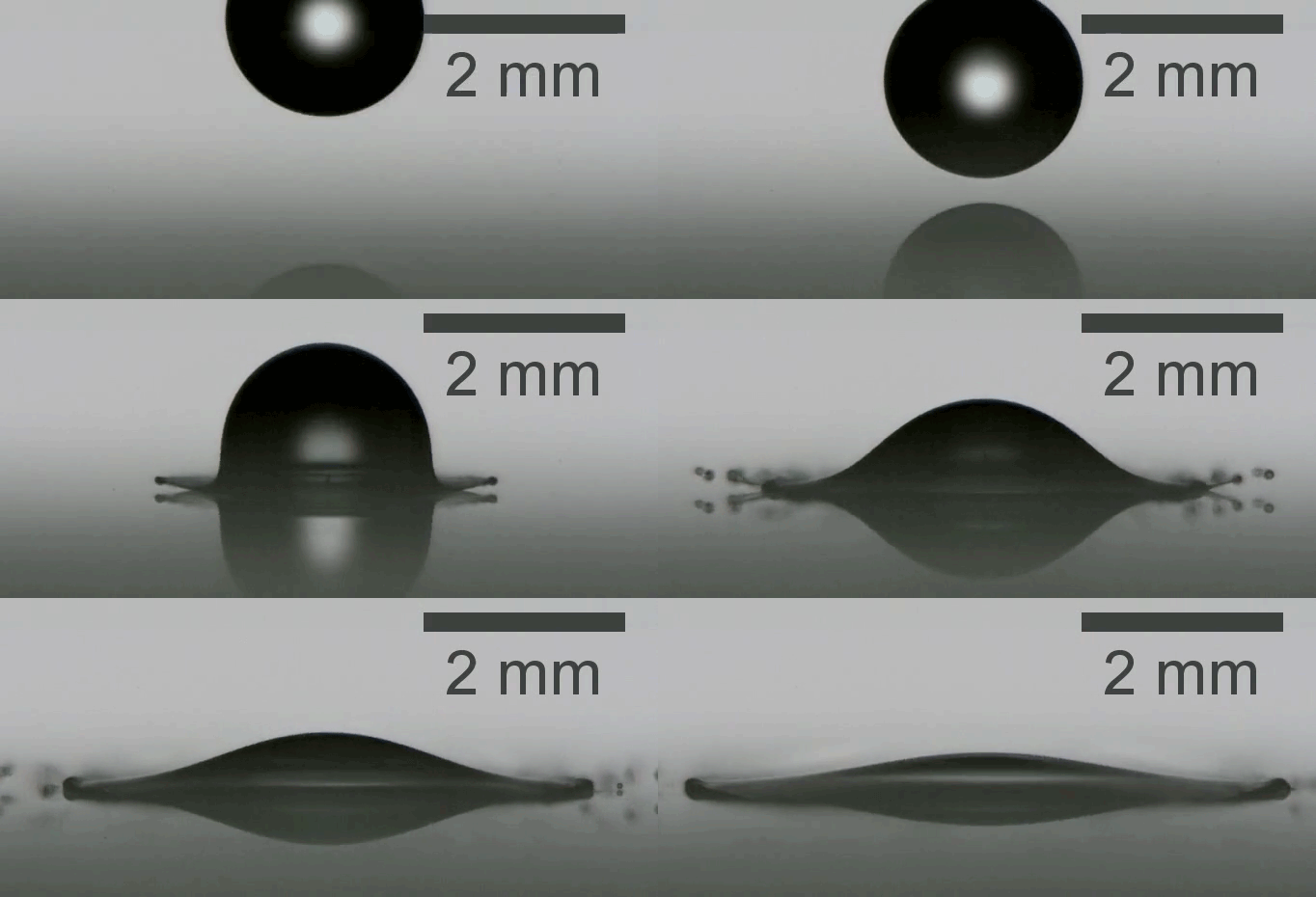
    The splash of a droplet is a surprisingly complex phenomenon, depending not only on the droplet’s characteristics but also the surrounding air pressure, the roughness and temperature of the impact surface, and the surface’s curvature. In this study, researchers investigated the effects of surface curvature on splashing, finding that it’s harder for a drop to splash on spheres of smaller radius than ones with a larger radius of curvature.

    In Image 1, the falling droplet coats the 2-mm sphere with no sign of splashing. But as the radius gets larger (Images 2 and 3), splashing becomes more and more pronounced. They found that the splash suppression is due to a modification of the lift force on the leading edge of the lamella, the thin liquid layer created as the drop impacts and spread. (Image, research, and submission credit: T. Sykes et al.; also available here)

  • Stopping The Drop

    Stopping The Drop

    When a droplet falls on a mesh surface, some of the liquid can burst through the holes (top row). But subsequent drops have a harder time penetrating the prewetted mesh. After a few drops have impacted (rows 2-3), the wetted mesh can completely suppress penetration (rows 4-5). The authors found that the taller drops sitting atop the mesh were better at stopping penetration from an incoming drop. (Image and research credit: L. Xu et al.)

  • Wet Masks Block Droplets Better

    Wet Masks Block Droplets Better

    As wearing face masks for long periods has become more typical, you may have wondered whether a soggy mask offers less protection. All masks — cloth, surgical, and N-95s — get moist from their wearer’s breath. A recent study indicates this isn’t a cause for alarm, though.

    Researchers looked at how relatively high-speed droplets (like those from a cough or sneeze) impact dry and wet masks. These high-speed droplets can break into smaller droplets upon impact with a mask layer. The more layers a mask has, the fewer droplets make it through. But even for single-layer masks*, a moistened mask layer lets fewer droplets through. So you don’t have to worry if it’s a little humid in there. Your mask is still working! (Image credit: top – V. Davidova, other – S. Bagchi et al.; research credit: S. Bagchi et al.; via APS Physics)

    * To be clear, you should be wearing masks that are more than a single layer thick. Personally, I’m still only going into indoor public spaces in an N-95 at this point.

    Droplet penetration through a mask. Top row: dry, single layer mask. Middle row: wet, single layer mask. Bottom row: wet, triple layer mask.
    Droplet penetration through a mask. Top row: dry, single layer mask. Middle row: wet, single layer mask. Bottom row: wet, triple layer mask. When wet, masks permit fewer droplets through.

  • Microjets and Needle-Free Injection

    Microjets and Needle-Free Injection

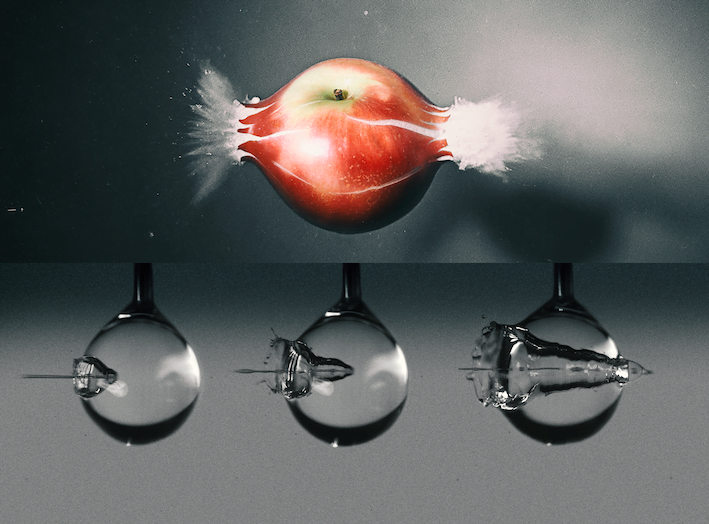
    Some people don’t mind needles, and others absolutely detest them. But to replace needles with needle-free injections, we have to understand how high-speed microjets pass through skin. Given skin’s opacity, that’s tough, so researchers are instead using droplets as a model. If we can understand the dynamics of a microjet passing through different kinds of droplets, getting jets of medicine into arms becomes easier.

    Researchers found that jets passed completely through a droplet if they impacted above a critical velocity. For Newtonian droplets, the jet creates a cavity and shoots straight through because the inertia of the impact outweighs the countering force of surface tension. But with viscoelastic drops, the jet goes through, slows down, and gets sucked back into the droplet. In this case, the combination of surface tension and viscoelasticity can, eventually, overpower the jet’s inertia. (Image, research, and submission credit: M. Quetzeri-Santiago et al.)

  • Decelerating Jets

    Decelerating Jets

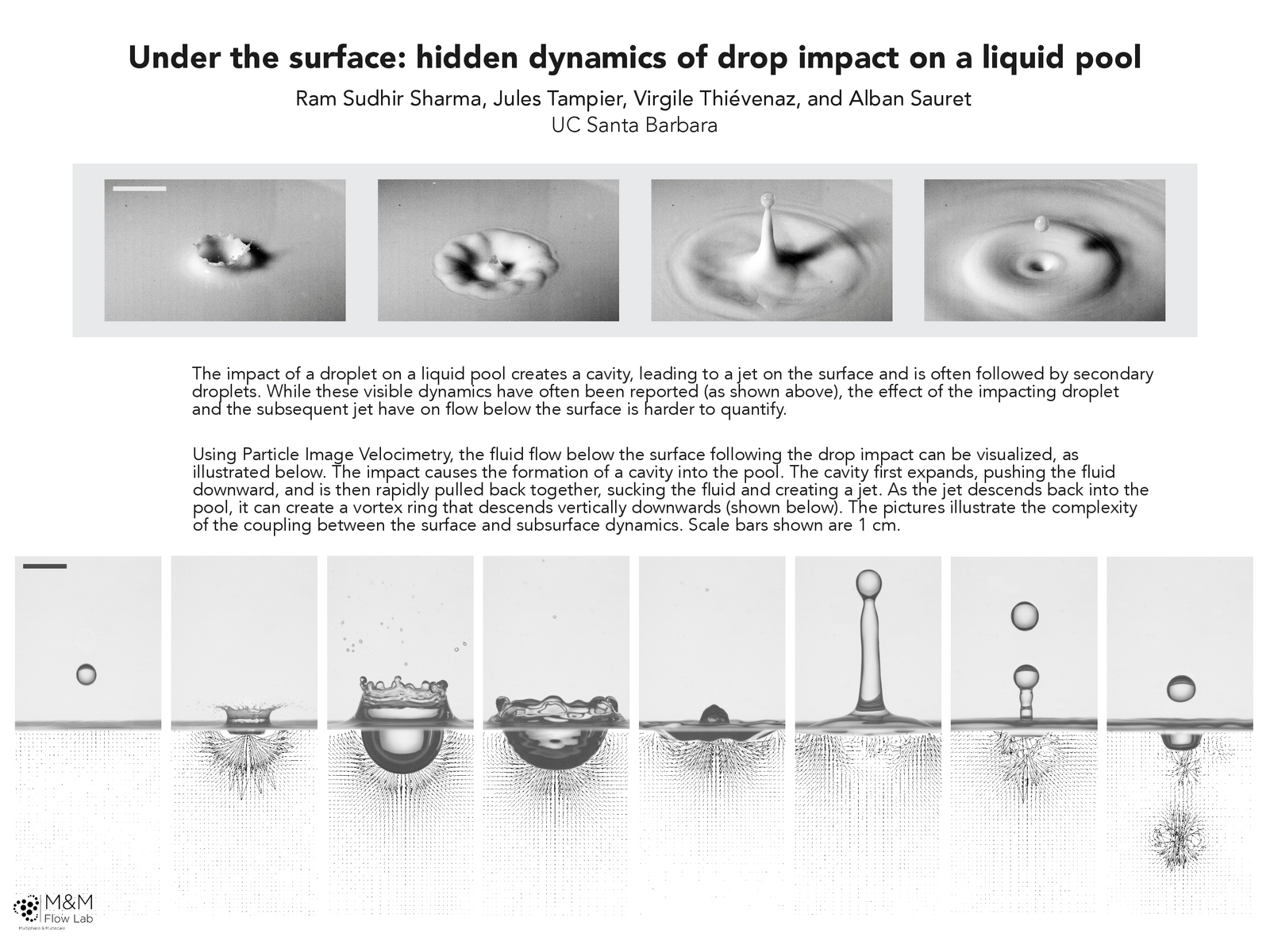
    For more than a century, scientists have been fascinated by the jet that forms after a drop impacts a liquid. In this study, researchers tracked fluorescent particles in the fluid to understand the velocity and acceleration of flow inside the jet. They found that, within the first 10ms after the jet appears, it decelerates at up to 20 times the gravitational acceleration. That’s much too fast for gravity to cause, pointing instead to the critical importance of surface tension in dictating the behavior of these fast-moving jets. (Image and research credit: C. van Rijn et al.; via APS Physics; submitted by Kam-Yung Soh)

  • Freezing Splats

    Freezing Splats

    In fluid physics, there’s often a tug of war between different effects. For droplets falling onto a surface colder than their freezing point, the hydrodynamics of impact, sudden heat transfer, and solidification processes all compete to determine how quickly and in what form droplets freeze.

    The images above form a series based on changing the height from which the droplet falls. Each image is divided into two synchronized parts. On the left, we see a visible light, top-down view of the freezing droplet; on the right, we see an infrared view of freezing. As the height of impact increases, the shape of the frozen drop becomes more elaborate, moving from a flat splat with a small conical tip all the way to one with a concentric double-ring in its center. (Image and research credit: M. Hu et al.)

  • Featured Video Play Icon

    Viscoplastic Drop Impact

    There are many materials that don’t behave exactly as a fluid or a solid, instead displaying characteristics of both. In this video, we see drops of hair gel falling into water. The gel is viscoplastic – showing some of the viscous behavior of a fluid and some of the plastic behavior (the inability to change back to its initial shape) of a solid.

    On impact, the gel deforms due to the forces on it, but the final shape does not depend solely on the amount of force; instead, it’s the rate at which the forces are applied that determines the final shape. By tuning the impact speed and the gel stiffness, it’s possible to make many final capsule shapes, something that could be useful in applications like drug manufacturing. (Image and video credit: M. Jalaal et al.)

  • The Best of FYFD 2020

    The Best of FYFD 2020

    2020 was certainly a strange year, and I confess that I mostly want to congratulate all of us for making it through and then look forward to a better, happier, healthier 2021. But for tradition and posterity’s sake, here were your top FYFD posts of 2020:

    1. Juvenile catfish collectively convect for protection
    2. Gliding birds get extra lift from their tails
    3. How well do masks work?
    4. Droplets dig into hot powder
    5. Updating undergraduate heat transfer
    6. Branching light in soap bubbles
    7. Boiling water using ice water
    8. Concentric patterns on freezing and thawing ice
    9. Bouncing off superhydrophobic defects
    10. To beat surface tension, tadpoles blow bubbles

    There’s a good mix of topics here! A little bit of biophysics, some research, some phenomena, and some good, old-fashioned fluid dynamics.

    If you enjoy FYFD, please remember that it’s primarily reader-supported. You can help support the site by becoming a patronmaking a one-time donationbuying some merch, or simply by sharing on social media. Happy New Year!

    (Image credits: catfish – Abyss Dive Center, owl – J. Usherwood et al., masks – It’s Okay to Be Smart, droplet – C. Kalelkar and H. Sai, boundary layer – J. Lienhard, bubble – A. Patsyk et al., boiling – S. Mould, ice – D. Spitzer, defects – The Lutetium Project, tadpoles – K. Schwenk and J. Phillips)