Temperatures in the Arctic are rising faster than elsewhere, triggering more and more melting. Photographer Scott Portelli captured a melting ice shelf protruding into the ocean in this aerial image. Across the top of the frozen landscape, streams and rivers cut through the ice, leading to waterfalls that flood the nearby ocean with freshwater. This meltwater will do more than raise ocean levels; it changes temperature and salinity in these regions, disrupting the convection that keeps our planet healthy. (Image credit: S. Portelli/OPOTY; via Colossal)
Tag: convection

Why Icy Giants Have Strange Magnetic Fields
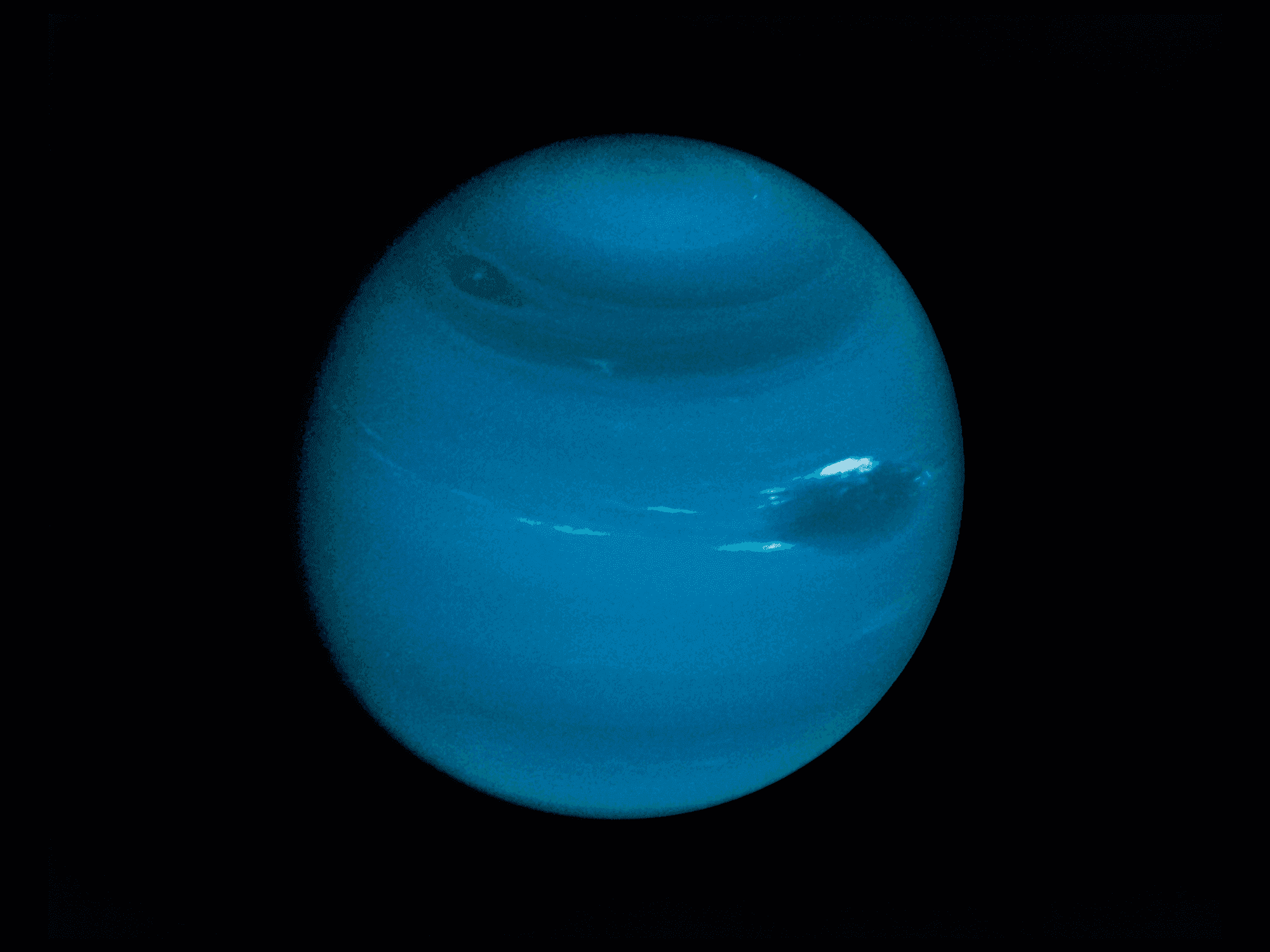
When Voyager 2 visited Uranus and Neptune, scientists were puzzled by the icy giants’ disorderly magnetic fields. Contrary to expectations, neither planet had a well-defined north and south magnetic pole, indicating that the planets’ thick, icy interiors must not convect the way Earth’s mantle does. Years later, other researchers suggested that the icy giants’ magnetic fields could come from a single thin, convecting layer in the planet, but how that would look remained unclear. Now a scientist thinks he has an answer.
When simulating a mixture of water, methane, and ammonia under icy giant temperature and pressure conditions, he saw the chemicals split themselves into two layers — a water-hydrogen mix capable of convection and a hydrocarbon-rich, stagnant lower layer. Such phase separation, he argues, matches both the icy giants’ gravitational fields and their odd magnetic fields. To test whether the model holds up, we’ll need another spacecraft — one equipped with a Doppler imager — to visit Uranus and/or Neptune to measure the predicted layers firsthand. (Image credit: NASA; research credit: B. Militzer; via Physics World)
Fediverse Reactions
-

How Cooling Towers Work


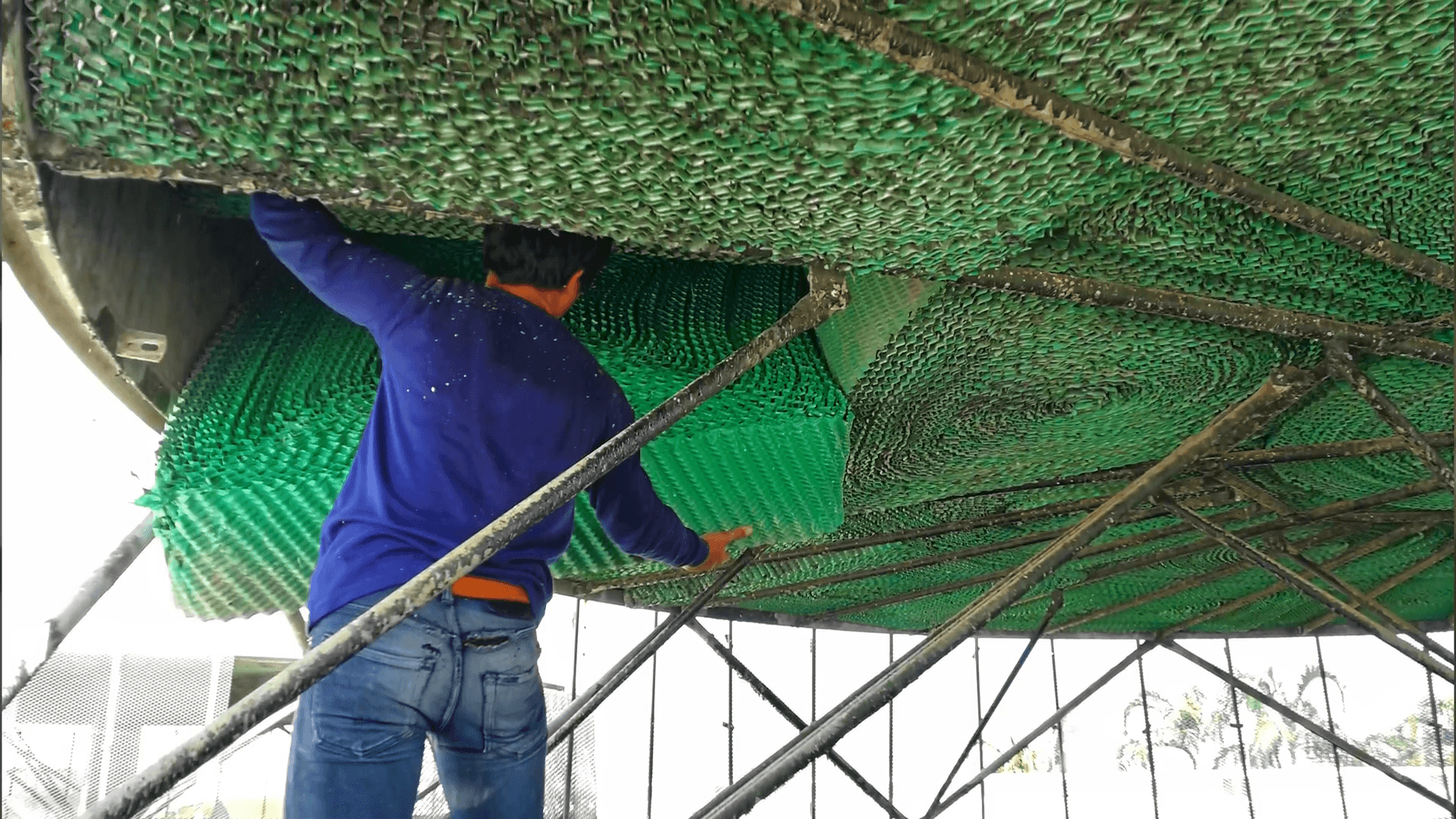

Power plants (and other industrial settings) often need to cool water to control plant temperatures. This usually requires cooling towers like the iconic curved towers seen at nuclear power plants. Towers like these use little to no moving parts — instead relying cleverly on heat transfer, buoyancy, and thermodynamics — to move and cool massive amounts of water. Grady breaks them down in terms of operation, structural engineering, and fluid/thermal dynamics in this Practical Engineering video. Grady’s videos are always great, but I especially love how this one tackles a highly visible piece of infrastructure from multiple engineering perspectives. (Video and image credit: Practical Engineering)
Fediverse Reactions
-
Convection in Blue
Convection cells like these are all around us — in the clouds, on the Sun, and in our pans — but we rarely get to watch them in action. Convection results from densities differing in different areas of a fluid. Under gravity’s influence, having a dense fluid over a lighter one is unstable; the dense fluid will always sink and the lighter one will rise. When that motion has to take place across a large surface area, we often end up with cells like the ones seen here.

Convection cells in an alcohol-paint mixture. What drives the density differences in the fluid? That depends. Often there’s a temperature difference that drives warmer fluid to rise and cool fluid to sink. But that’s not always the source of convection. Evaporating a volatile chemical — like alcohol — out of a mixture can also create the density differences needed for convection. That may be the source of the convection we see here in a mixture of paint and alcohol. (Video and image credit: W. Zhu; via Nikon Small World in Motion)

When Fires Make Rain
The intense heat from wildfires fuels updrafts, lifting smoke and vapor into the atmosphere. As the plume rises, water vapor cools and condenses around particles (including ash particles) to form cloud droplets. Eventually, that creates the billowing clouds we see atop the smoke. These pyrocumulus clouds, like this one over California’s Line fire in early September 2024, can develop further into full thunderstorms, known in this case as pyrocumulonimbus. The storm from this cloud included rain, strong winds, lightning, and hail. Unfortunately, storms like these can generate thousands of lightning strikes, feeding into the wildfire rather than countering it. (Image credit: L. Dauphin; via NASA Earth Observatory)

Underground Convection Thaws Permafrost Faster
In recent years, Arctic permafrost has thawed at a surprisingly fast pace. Much of that is, of course, due to the rapid warming caused by climate change. But some of that phenomenon lives underground, where water’s unusual properties cause convection in gaps between rocks, sediment, and soil.
Water is densest not as ice but as water. This is why ice cubes float in your glass. Water’s densest form is actually a liquid at 4 degrees Celsius. For water-logged Arctic soils, this means that the densest layer is not at the frozen depth but at a higher, shallower depth. This places a dense liquid-infused layer over a lighter one, a recipe for unstable convection.

Illustration of underground convection and permafrost thaw. On the left: temperature and density of the water in Arctic soil varies with depth. The temperature gets colder the deeper you go, but because water is densest at 4 degrees Celsius, the density is greatest at a shallower depth than the freezing interface. As a result of this unstable configuration (dense water over less dense water), convection can occur (right). In a recent numerical simulation, researchers found that this underground convection caused permafrost to thaw much more quickly than it would due to heat conduction alone. In fact, the effects appeared in as little as one month, so in a single summer, this convection could have a big effect on the thaw depth. (Image credit: top – Florence D., figure – M. Magnani et al.; research credit: M. Magnani et al.)

Origins of Salt Polygons
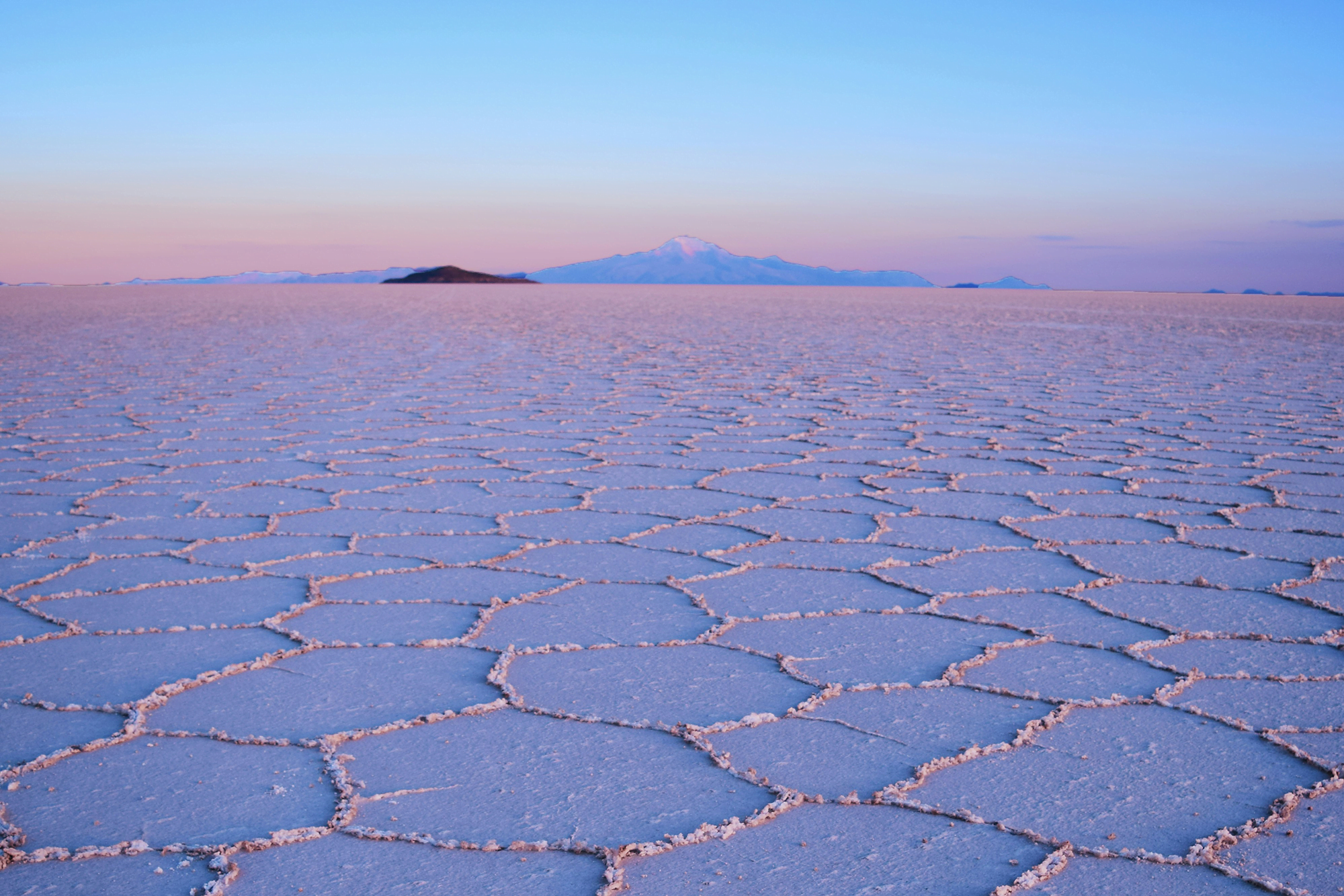
Around the world, dry salt lakes are crisscrossed by thousands of meter-wide salt polygons. Although they resemble crack patterns, these structures are actually the result of convection occurring in the salty groundwater beneath the soil. I have covered the physics previously, but this new article by several of the researchers gives a behind-the-scenes glimpse of the investigation itself and how they uncovered the true explanation. (Image credit: S. Liu, see also: Physics Today)

Measuring Ocean Upwelling
Large-scale ocean circulation is critical to our planet’s health and climate. In this process, seawater near the poles cools and sinks into the deep ocean, carrying dissolved carbon and nutrients with it. Later, that cold water gets pushed back up to the surface elsewhere, where it warms, and the cycle repeats. Although the theory behind this circulation has been around for decades, it’s been difficult to observe the rise, or upwelling, of water from the depths. But a recent study used a fluorescent, non-toxic dye to measure upwelling directly.
Researchers deployed 200 liters of dye just above the floor of a marine canyon near Ireland, then monitored the dye’s movement for several days at a depth of 2200. They found that turbulence along the slope of the canyon drove upwelling at speeds of about 100 meters per day, much faster than global rates. The authors suggest that this kind of topographically-enhanced upwelling could be a major factor in setting overall ocean circulation. (Image credit: visualization – NASA, ship – S. Nguyen; research credit: B. Wynne-Cattanach et al.; via Physics World)

Warming Temperatures Increase Turbulence
After multiple high-profile injuries caused by atmospheric turbulence, you might be wondering whether airplane rides are getting rougher. Unfortunately, the answer is yes, at least for clear-air (i.e., non-storm-related) turbulence in the North Atlantic region. It seems that climate change, as predicted, is increasing the bumpiness of our atmosphere. There are a couple of mechanisms at play here.
The first is that warming temperatures fuel thunderstorms. When ground-level temperatures and water temperatures are warmer, that provides more warm, moist air rising up and feeding atmospheric convection. Especially in the summertime, that translates into stronger, more frequent thunderstorms; even with flights avoiding the storms themselves, there’s greater turbulence surrounding them.
The second mechanism relates to wind, specifically in the mid-latitudes. In general, a temperature difference between two regions causes stronger winds. (Think about the windy conditions that accompany an incoming cold front.) At the mid-latitudes, the difference between cold polar regions and warmer equatorial ones creates a strong wind, known as the jet stream. Now, as temperature gradients increase at cruising altitudes, the jet stream gets stronger, which means bigger changes in wind speed with altitude. And its those wind speed differences at different heights that drive turbulence.
So, yes, we’re likely to see more turbulent flights now and in the future. But, fortunately, there’s a simple way to avoid injuries from that bumpiness: buckle up! If you keep your seat belt fastened while you’re seated, you can avoid getting tossed around by unexpected G-forces. (Image credit: G. Ruballo; see also Gizmodo)
The Solar Corona in Stunning Detail


The ESA’s Solar Orbiter captured this beautifully detailed video of our sun‘s corona last September. The Solar Orbiter took this footage from about 43 million kilometers away, a third of the distance between the sun and the Earth. Scattered across the visible surface are fluffy, lace-like features known as coronal moss. Along the curving horizon, gas spires called spicules stretch up to heights of 10,000 kilometers. The video also highlights a “small” eruption of plasma that is nevertheless larger than the entire Earth. We can even see evidence of coronal rain, denser and darker clumps of plasma that gravity pulls back toward the sun. (Video and image credit: ESA; via Colossal)