Tag: climate change

  • The Microscopic Ocean

    The Microscopic Ocean

    When you’re the size of plankton, water may as well be molasses. Viscosity rules at these scales, and swimming plankton leave distinctive wakes that are slow to dissipate. Fish that feed on plankton use these trails to find their prey. But this microscopic world is changing as the ocean warms.

    At higher temperatures, water is less viscous, and plankton wakes don’t last as long. To make matters worse for hungry fish, warmer waters have led to an explosion in a species of faster plankton, capable of moving hundreds of body lengths a second. This species is far more difficult to catch, which may explain some of the collapses we’re observing in populations of fish like cod and haddock. (Video and image credit: BBC Earth Lab)

  • Urban Centers During Hurricanes

    Urban Centers During Hurricanes

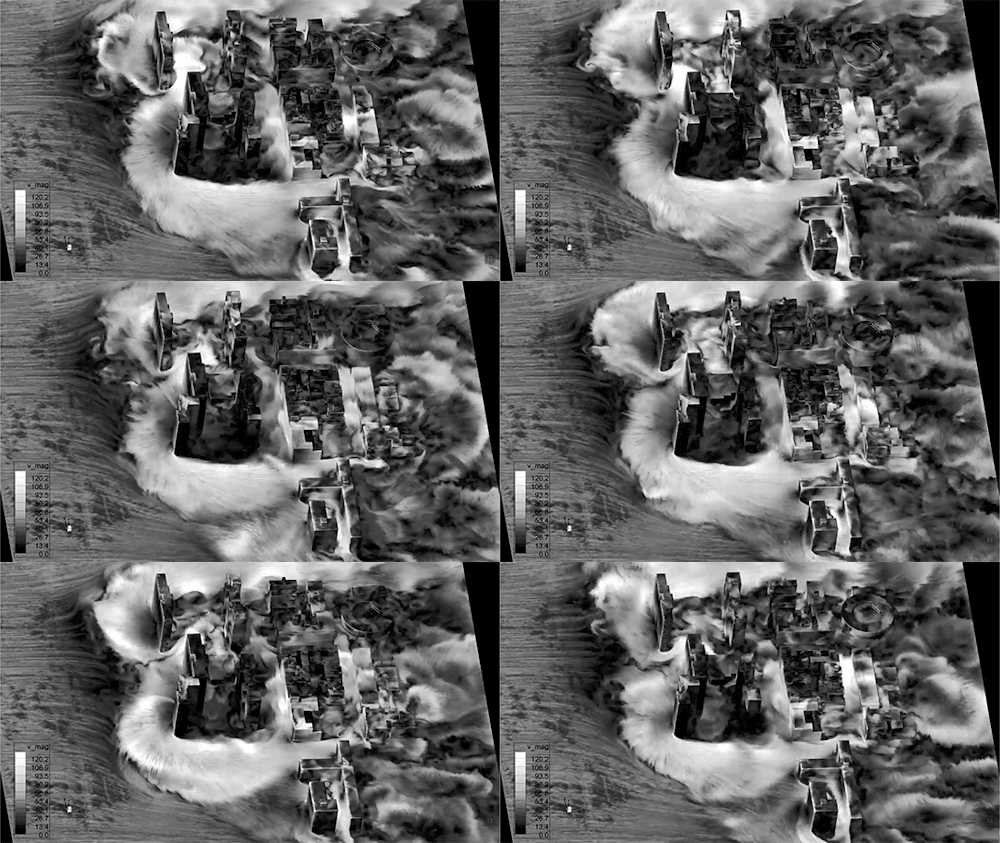
    As the climate warms, many urban centers are facing stronger and more frequent storms. Some, like New York City, are using numerical simulations to better understand the interactions of their complicated urban geometries with hurricane force winds. 

    Above you see a simulation showing predicted wind speeds in a Lower Eastside neighborhood. The incoming wind speed (from the left) is roughly 60 m/s (~134 mph), but the speeds around and between buildings are as much as 2 times higher than that. That means that, even if a storm is Category 3 or 4, there will be areas of a neighborhood that receive sustained winds well beyond the range of a Category 5 hurricane. Urban planners need this sort of data both for devising building requirements and for understanding what storm conditions warrant mandatory evacuations for residents. (Video and image credit: X. Jiang et al.)

  • Ice Bridges

    Ice Bridges

    During winter, Canada’s Arctic Archipelago, home of the Northwest Passage, generally fills with sea ice. These ice bridges form in the long and narrow straits between islands. A new paper models ice bridge formation and break-up, showing that ice bridges can only form when ice floating in the strait is sufficiently thick and compact. To form a bridge, wind must first push the ice together and then frictional forces between individual pieces of ice must be large enough to resist wind or water driving them apart. As temperatures drop, the individual ice chunks can then freeze together into solid sheets until summer returns.

    The existence of a critical thickness and density of the ice field for ice bridge formation has important implications for climate change. As Arctic temperatures warm for longer periods, these waters may no longer generate ice of sufficient thickness and quantity for ice bridges to form. Since ice bridges serve as important oases for marine mammals and sea birds and help isolate Arctic sea ice from warmer waters, their loss will have a profound impact on both Arctic ecology and global climate. (Image credit: NASA Earth Observatory; research credit: B. Rallabandi et al.; via Physics Buzz)

  • Featured Video Play Icon

    Simulating the Earth

    Computational fluid dynamics and supercomputing are increasingly powerful tools for tracking and understanding the complex dynamics of our planet. The videos above and below are NASA visualizations of carbon dioxide in Earth’s atmosphere over the course of a full year. They are constructed by taking real-world measurements of atmospheric conditions and carbon emissions and feeding them into a computational model that simulates the physics of our planet’s oceans and atmosphere. The result is a visualization of where and how carbon dioxide moves around our planet.

    There are distinctive patterns that emerge in a visualization like this. Because the Northern Hemisphere contains more landmass and more countries emitting carbon, it contains the highest concentrations of carbon dioxide, but winds move those emissions far from their source. As seasons change and plants begin photosynthesizing in the Northern Hemisphere, concentrations of carbon dioxide decrease as plants take it up. When the seasons change again, that carbon is re-released.

    These visualizations underscore the fact that these carbon emissions impact everyone on our planet–nature does not recognize political borders–and so we share a joint responsibility in whatever actions we take. (Video credit: NASA Goddard; h/t to Chris for the second vid)

  • Featured Video Play Icon

    Fluids Round-Up

    Time for another fluids round-up! Here’s some of the best fluid dynamics from around the web:

    – Band Ok Go filmed their latest music video in microgravity, complete with floating, splattering fluids. Here they describe how they did it. Rhett Allain also provides a write-up on the physics.

    – Scientists are trying to measure the impact of airliners’ contrails on climate change. (pdf; via @KyungMSong)

    – Researchers observing the strange moving hills on Pluto suspect they may, in fact, be icebergs.

    – The best angle for skipping a rock is 20-degrees. Related: elastic spheres skip well even at higher angles. (via @JenLucPiquant)

    – Fluid dynamics and acoustics have some fascinating overlaps. Be sure to check out “The World Through Sound” series at Acoustics Today, written by Andrew “Pi” Pyzdek, who also writes one of my favorite science blogs.

    – Over at the Toast, Mallory Ortberg explores the poetry of the Beaufort wind scale.

    Could dark matter be a superfluid? (via @JenLucPiquant)

    – Understanding the physics of the perfect pancake is helping doctors treat glaucoma. (submitted by Maria-Isabel)

    – Van Gogh’s “Starry Night” shows swirling skies, but just how turbulent are they? (submitted by @NathanMechEng)

    – The physics (and fluid dynamics!) of throwing a football – what’s the best angle for a maximum distance throw? (submitted by @rjallain)

    (Video credit: Ok Go)

    Thanks to our Patreon patrons who help support FYFD!

  • Featured Video Play Icon

    Earth’s Aerosols

    The motions of Earth’s atmosphere move more than just air and moisture. As seen in this animation built from NASA satellite data, the atmosphere also transports large amounts of small solid particles, or aerosols, such as dust. Each year the wind carries millions of tons of Saharan dust across the Atlantic, depositing much of it in the Amazon basin. This provides much needed nutrients like phosphorus to plants and animals in the Amazon; check out this video from the Brain Scoop to see what happens in areas that don’t receive these nutrients. Dust is only one of many sources for atmospheric aerosols, though. Sea salt, volcanic eruptions, and pollution are others. All of these aerosols serve as potential nucleation sites for raindrops or snowflakes, and their transport all around the globe by atmospheric winds means that seemingly local effects–like a regional drought or increased pollution in developing countries–can have global effects. (Video credit: NASA Goddard; submitted by entropy-perturbation)

  • Featured Video Play Icon

    Melting Ice Sheets From Below

    A new study of ice sheets in West Antarctica has made major news this week with the announcement that the ice melt in this region is unstoppable and may raise sea levels by more than 1.2 meters. Part of what makes the ice sheet so unstable is the local topography, shown schematically in the animation above. The land on which the glacier sits lies well below sea level, and the grounding line marks where the ice, sea, and land meet. Part of the glacier projects outward as a sheet, with seawater between it and the land; this is not unusual, but it can encourage melting if the water under the ice sheet is warmer. A major problem for this region, though, is that the slope of the underlying land tilts downward. This means that, as warmer water begins circulating under the ice sheet, it causes the grounding line to retreat and expose a greater volume for warm water to fill beneath the ice. More warm water melts more ice and the process continues unabated. (Video credit: NASA/JPL; h/t to jtotheizzoe, jshoer)

  • Frozen Methane Bubbles

    Frozen Methane Bubbles

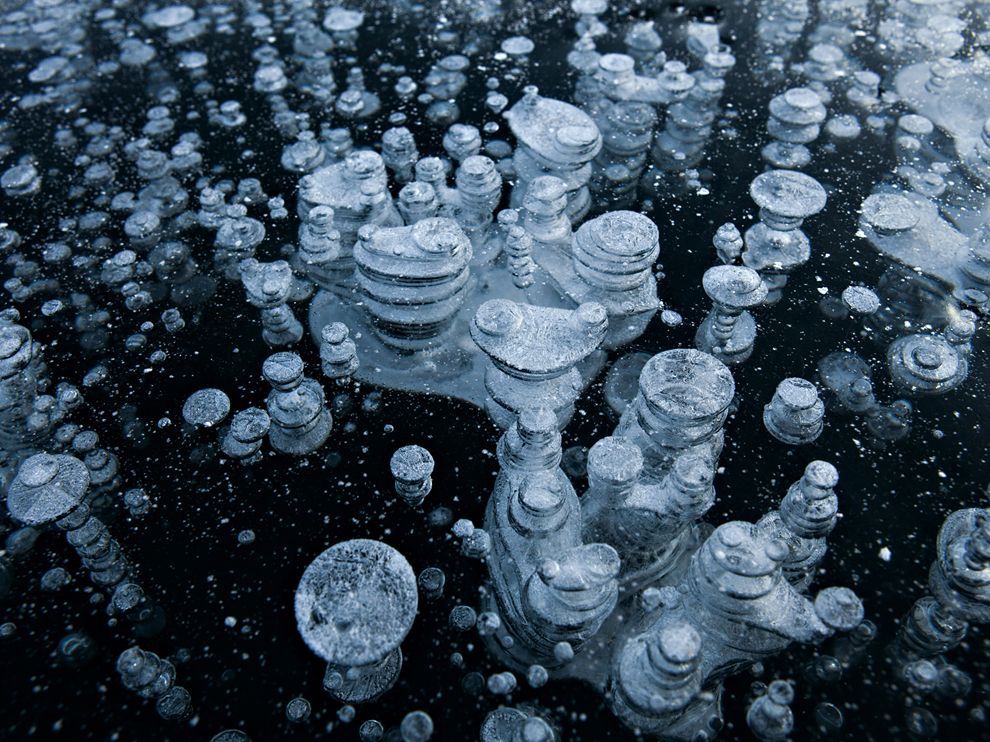
    As the Arctic warms, methane that was previously trapped by permafrost rises from the muddy bottom of lakes to escape into the atmosphere. Here the first clear ice of the fall has trapped the rising methane bubbles, allowing scientists an opportunity to estimate the amount of methane being released. When spring arrives and the lakes melt, the methane will rise again. (Photo credit: M. Thiessen/National Geographic)

  • Featured Video Play Icon

    Jellyfish Flow

    Florescent dye reveals the flow pattern of ocean water around a swimming jellyfish. Some researchers posit that fluid drift associated with the swimming of marine animals may be as substantial a factor in ocean mixing as turbulence caused by the wind and tides. If true, modeling of climate change–past, present, and future–would need to take into account the biology of the ocean as well! #