Tag: capillary waves

  • Making Waves in Cold Atoms

    Making Waves in Cold Atoms

    If you take a glass of water and tap on the side of it, you’ll generate waves on the water’s surface. The form of the waves depends on surface tension and gravity, and viscosity governs how quickly the waves fade away. In a recent experiment, researchers performed an equivalent tap for a container of ultra-cold atoms, and the results they found were odd indeed.

    The researchers used lithium-6 atoms chilled so close to absolute zero that they could form a superfluid. The “glass” they were contained in consisted of intersecting laser beams, and the “tap” came from toggling the intensity of one of the lasers. This created rippling waves through the atoms that the group could observe.

    Measuring at various temperatures, the group found that the waves in the atoms always decayed the way one expects for a classical fluid like water. Even when the atoms transitioned into a superfluid, the wave decay did not change. Since superfluids are considered to have zero viscosity, you’d expect their waves to decay more slowly, but it turns out, that’s not the case! (Image credit: F. Mittermeier; research credit: M. Zwierlein et al., see also; via Physics; submitted by Kam-Yung Soh)
  • A Star Drop

    A Star Drop

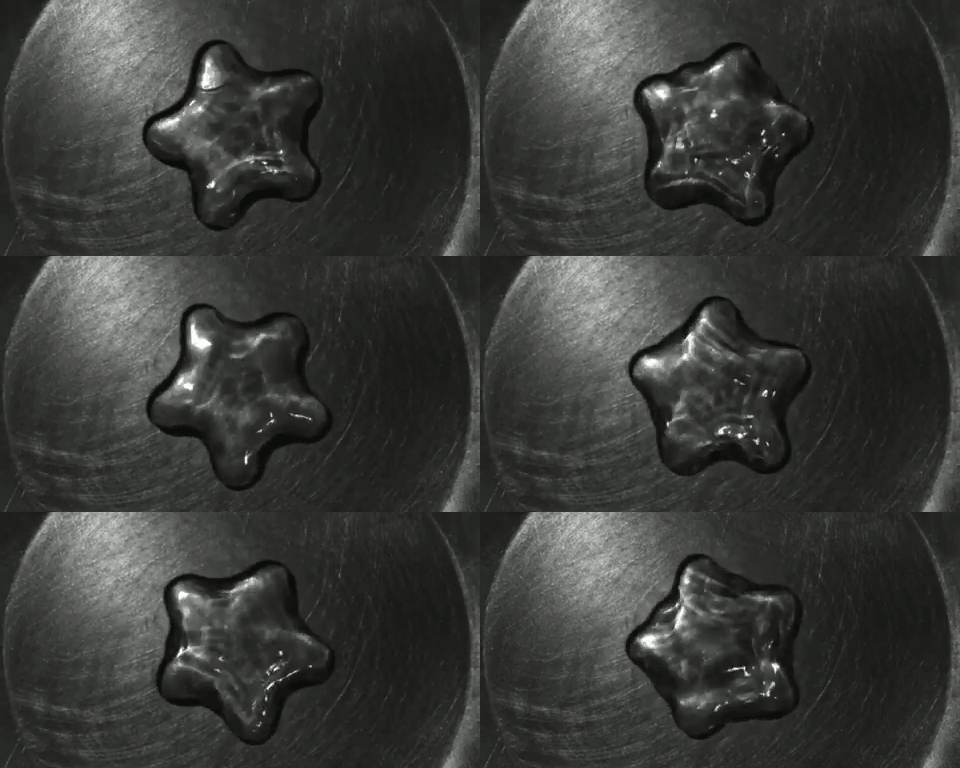
    There are many ways to make a droplet oscillate in a star-shape – like vibrating its surface or using acoustic waves to excite it – but these methods involve externally forcing the droplet’s oscillation. Leidenfrost drops – liquids levitating on a film of their own vapor caused by the extremely hot surface below – turn themselves into stars. It all starts with the constant evaporation driven by the heat below. This creates a thin, fast-moving layer of vapor flowing beneath the drop. That vapor shears the drop, causing capillary waves – essentially ripples – that travel through the drop in a characteristic way. Those ripples in turn cause pressure oscillations in the vapor layer, alternately squeezing and releasing it. Feedback from the vapor layer then drives the droplet into star-shaped oscillations. Under the right conditions, water drops can form stars with as many as 13 points! (Image and research credit: X. Ma and J. Burton, source)

  • A Drip’s Vortex

    A Drip’s Vortex

    Drip food coloring into water and you can often see a torus-shaped vortex ring after the drop’s impact. That vortex rings form during droplet impact has been well known for over a century, but only recently have we begun to understand the process that leads to that vortex ring. Part of the challenge is that the vortex formation is very small and very fast, but recent work with x-ray imaging has allowed experimentalists to finally capture this event.

    When a drop impacts a pool, surface tension draws some of the pool liquid up the sides of the drop. At the same time, the impact causes ripple-like capillary waves down the sides of the drop. This causes pool liquid to penetrate sharply into the drop, triggering the spirals that mark the forming vortex ring. When drops impact with even higher momentum, multiple vortex spirals can form, as seen on the lower right image. The authors observed as many as four rings during an impact. For more, check out the (open access) article.  (Image and research credit: J. Lee et al., source)

  • Water Skiing Beetles

    Water Skiing Beetles

    Waterlily beetles employ an unusual method of getting around: they skim across the water surface. The beetles are mostly covered in tiny hairs that help make their body hydrophobic (water-repellent) – a common adaptation for insects that spend their time sitting on the water’s surface – but the beetles also have hydrophilic claws on their legs that help anchor them to the water’s surface. When they need to move quickly, the beetles lean upright and start flapping their wings, creating thrust that helps push them along the interface. Between water’s viscosity and drag from the waves the insect generates, it has to expend a lot of energy for this method of travel – more than these insects do flying in air – but researchers suspect that staying at the surface could remain beneficial for the beetles because it’s easier to locate their floating food sources this way. (Image credit: H. Mukundarajan et al., source; via New Scientist)

  • Swirling Pollen

    Swirling Pollen

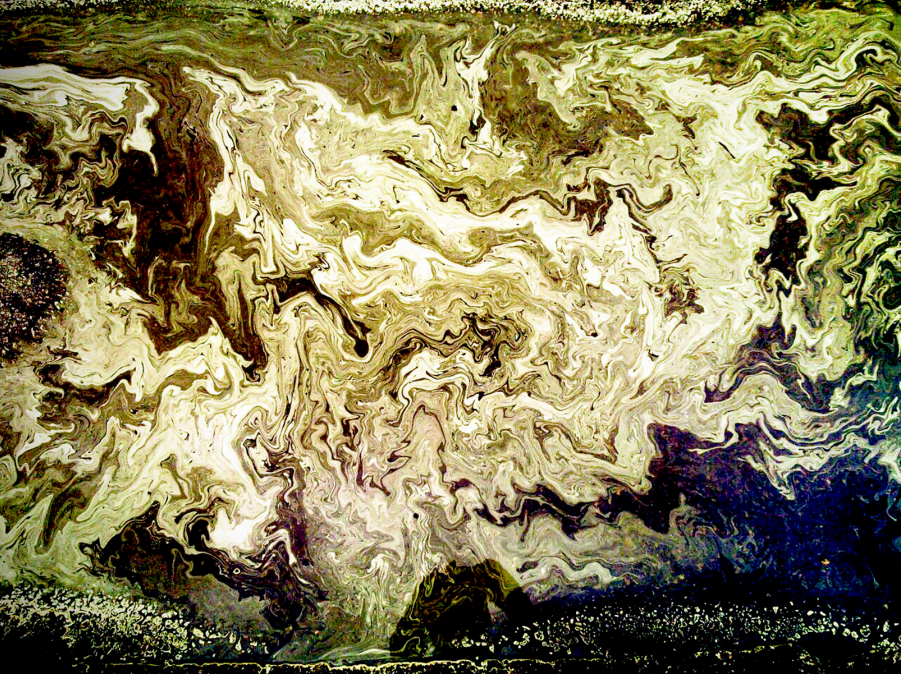
    This photo captures the chaotic mixing present in a simple puddle. Pine pollen strewn across the puddle’s surface acts as tracer particles, revealing some of the motion of the underlying water. As wind blows across the puddle, it moves the water through the formation of ripples and by shearing the surface. That deformation on the top of the puddle will cause further motion beneath the surface. With time and changing wind direction, the resulting pattern of flow can be very complex! (Photo credit: K. Jensen, original)

  • Reversing Time

    Reversing Time

    Waves contain lots of information. They are also time invariant, which means that they will behave the same regardless of whether time moves forward or backward. This isn’t a property we observe often in life since time just moves forward for us. But a new experiment has demonstrated a method of wave control that can, in a sense, roll back the clock.

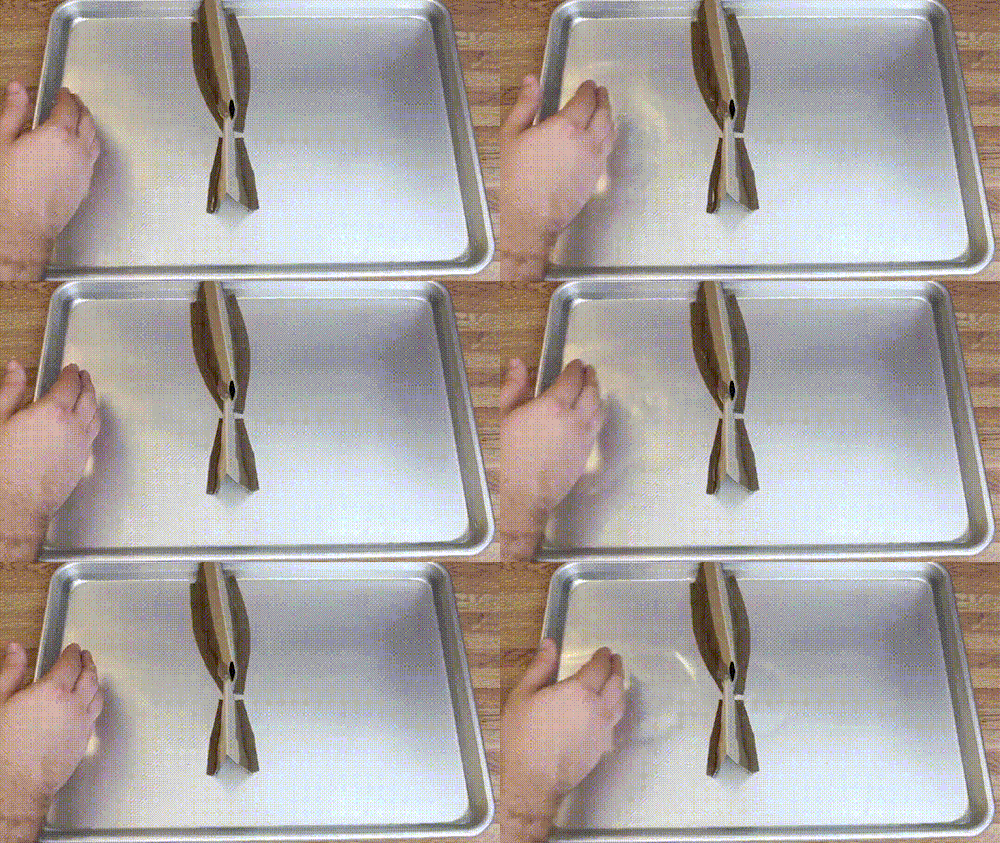
    To do this, the scientists created a instantaneous time mirror, or ITM. When they create a disturbance on the surface of a pool of water, it sends out capillary waves in the form of ripples. A short time later, they accelerate the pool sharply downward. This universal disturbance is their instantaneous time mirror, which generates backward-propagating ripples. Those new backward-propagating waves travel back toward the source and refocus into the shape of the initial disturbance. This works for both a simple point disturbance (top image) and for a more complicated geometry like a smiley face (bottom image). (Image credit: V. Bacot et al., source; submitted by @g_durey)

    ETA: To be clear, this experiment does not refute causality. It’s more like saying that the information for the initial conditions is still carried on in the later state and that you can do something to extract that information.

  • Featured Video Play Icon

    Diffraction

    Wave phenomena can sometimes be a little difficult to wrap one’s head around. In this video, Mike from The Point Studios explains wave diffraction and why opening a window can help you spy on the conversation next door. Diffraction occurs when waves encounter an obstacle. If that obstacle is a slit in a wall, the slit becomes a point source, radiating waves outward spherically. The video focuses on acoustics, but diffraction matters in more than just sound – it’s key to water ripples, light and other electromagnetic waves, and, according to quantum theory, the fundamental building blocks of matter.   (Video credit: The Point Studios)

  • Featured Video Play Icon

    Water-Based Tractor Beam

    Researchers in Australia have demonstrated a “tractor beam” capable of manipulating floating objects from a distance using surface waves on water. And, unlike some research, you can try to replicate this result right in the comfort of your own bathtub! When a wave generator oscillates up and down, it creates surface waves that move objects and particles on the water’s surface. When the wave amplitudes are small, the outgoing wave fronts tend to be planar, as in part (a) of the figure above. These planar waves push surface flow away from the wave generator in a central outward jet, and new fluid is entrained from the sides to replace it. This creates the kind of flowfield shown in the streaklines of part (b).

    Increasing the amplitude of the surface waves drastically changes the surface flow’s behavior. Larger wave amplitudes are more susceptible to instabilities due to the nonlinear nature of the surface waves. This means that the planar wave fronts seen in part (a) break down into a three-dimensional wavefield, like the one shown in part (c). Near the wave-maker, the surface waves now behave chaotically. This pulsating motion ejects surface flow parallel to the wave-maker, which in turn draws fluid and any floating object toward the wave-maker. The corresponding surface flowfield is shown in part (d). The researchers are refining the process, but they hope the physics will one day be useful in applications oil spill clean-up. (Video credit: Australia National University; image and research credit: H. Punzmann et al. 1, 2; via phys.org; submitted by Tracy M)

  • Rebounding

    Rebounding

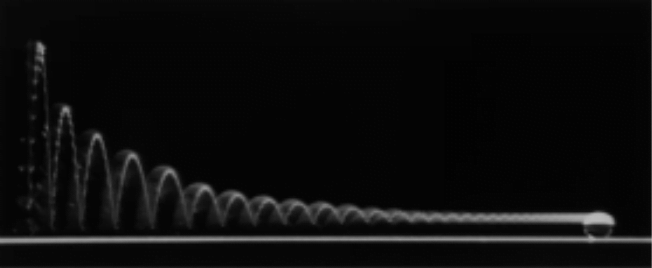
    A water droplet can rebound completely without spreading from a superhydrophobic surface. The photo above is a long exposure image showing the trajectory of such a droplet as it bounces. In the initial bounces, the droplet leaves the surface fully, following a parabolic path with each rebound. The droplet’s kinetic energy is sapped with each rebound by surface deformation and vibration, making each bounce smaller than the last. Viscosity damps the drop’s vibrations, and the droplet eventually comes to rest after twenty or so rebounds. (Image credit: D. Richard and D. Quere)

  • Featured Video Play Icon

    Coalescence

    The coalescence of two liquid droplets takes less than the blink of an eye, but it is the result of an intricate interplay between surface tension, viscosity, and inertia. The high-speed video above was filmed at 16000 frames per second, yet the initial coalescence of the silicone oil drops is still nearly instantaneous. At the very instant the drops meet, an infinitesimally small neck is formed between the droplets. Mathematically speaking, the pressure and curvature of the droplets diverge as a result of this tiny contact area. This is an example of a singularity. Surface tension rapidly expands the neck, sending capillary waves rippling along the drops as they become one. (Video credit: S. Nagel et al.; research credit: J. Paulsen)