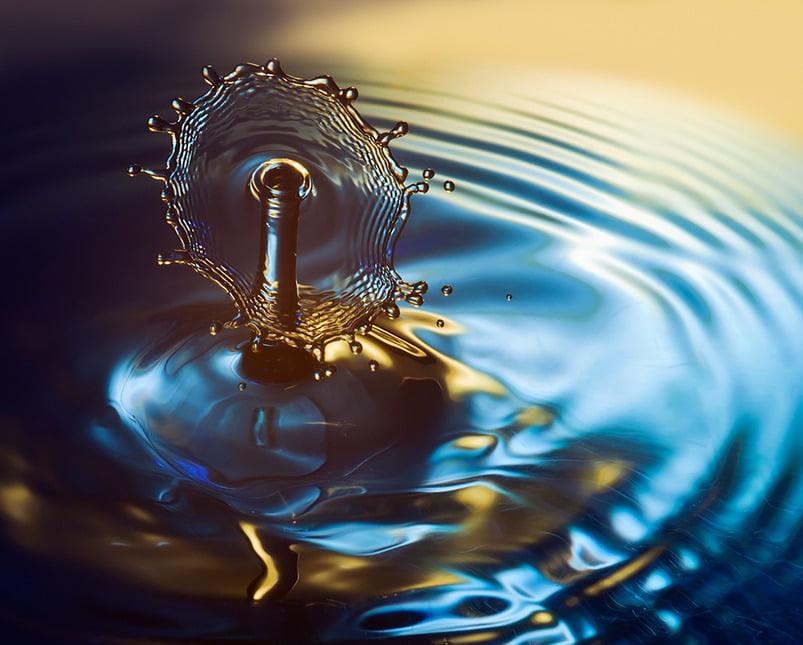
When a water drop strikes a pool, it can form a cavity in the free surface that will rebound into a jet. If a well-timed second drop hits that jet at the height of its rebound, the impact creates an umbrella-like sheet like the one seen here. The thin liquid sheet expands outward from the point of impact, its rim thickening and ejecting tiny filaments and droplets as surface tension causes a Plateau-Rayleigh-type instability. Tiny capillary waves–ripples–gather near the rim, an echo of the impact between the jet and the second drop. All of this occurs in less than the blink of an eye, but with high-speed video and perfectly-timed photography, we can capture the beauty of these everyday phenomena. (Photo credit: H. Westum)
Tag: capillary waves

Bouncing in Lockstep
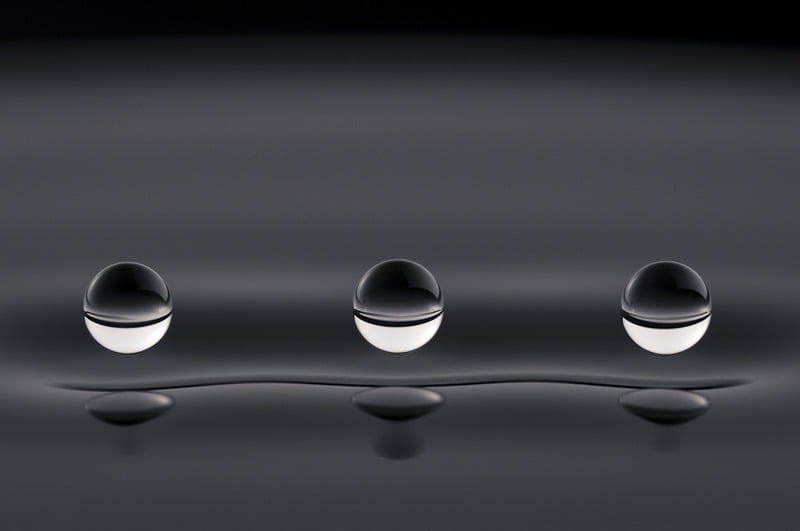
Droplets of silicone oil bounce on a pool of the same thanks to the vibration provided by a loudspeaker. Each droplet’s bounce causes ripples in the pool and the interference between these ripples fixes the droplets in lockstep with one another. As long as the vibration continues to feed the thin layer of air that separates the droplets from the pool during each bounce and no impurities break the surface tension at the interface, the droplets will bounce indefinitely on their liquid trampoline. Such systems can be used to observe quantum-mechanical behavior like wave-particle duality on a macro-scale. (Photo credit: A. Labuda and J. Belina)

Reader Question: Non-Coalescing Droplets
Reader ancientavian asks:
I’ve often noticed that, when water splashes (especially as with raindrops or other forms of spray), often it appears that small droplets of water skitter off on top of the larger surface before rejoining the main body. Is this an actual phenomenon, or an optical illusion? What causes it?
That’s a great observation, and it’s a real-world example of some of the physics we’ve talked about before. When a drop hits a pool, it rebounds in a little pillar called a Worthington jet and often ejects a smaller droplet. This droplet, thanks to its lower inertia, can bounce off the surface. If we slow things way down and look closely at that drop, we’ll see that it can even sit briefly on the surface before all the air beneath it drains away and it coalesces with the pool below. But that kind of coalescence cascade typically happens in microseconds, far too fast for the human eye.
But it is possible outside the lab to find instances where this effect lasts long enough for the eye to catch. Take a look at this video. Here Destin of Smarter Every Day captures some great footage of water droplets skittering across a pool. They last long enough to be visible to the naked eye. What’s happening here is the same as the situation we described before, except that the water surface is essentially vibrating! The impacts of all the multitude of droplets create ripples that undulate the water’s surface continuously. As a result, air gets injected beneath the droplets and they skate along above the surface for longer than they would if the water were still. (Video credit: SuperSloMoVideos)
Droplet Bounce
This high-speed video shows the remarkable resilience of a water droplet upon impact against as a solid surface. The droplet deforms into a pancake-shape, with its center depressing almost flat before rebounding upward. The rest of the drop follows, splitting into several droplets as capillary waves dance across its surface. When one satellite drop almost escapes, the main droplet just barely comes in contact with it, the coalescence enough to tip surface tension into pulling them together instead of breaking them apart. (Video credit: K. Suh/ChemistryWorldUK)

Droplet Impact Visualized
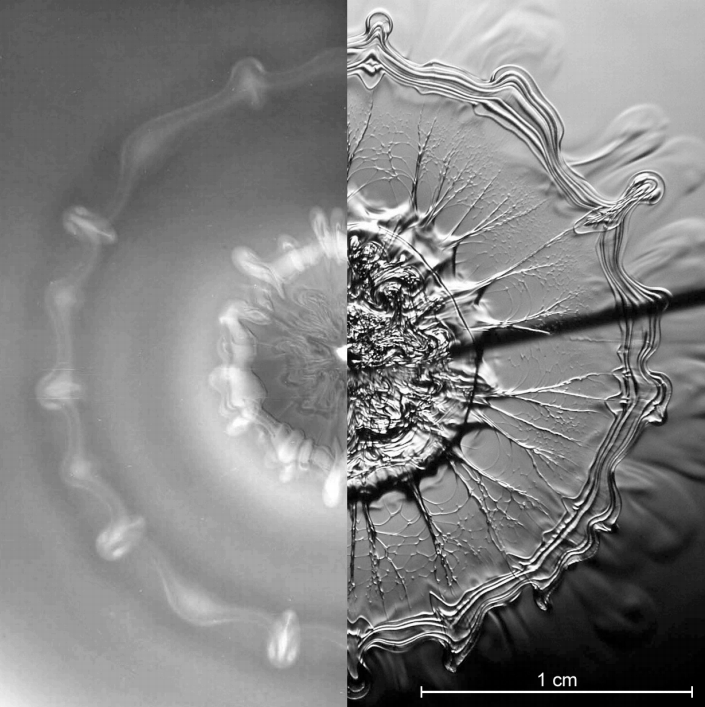
When a drop falls from a moderate height into a shallow pool, its impact creates a complicated pattern. The photo above is a composite image showing a top-down view 100 ms after such an impact. On the left side, the flow is visualized using dye whereas the right shows a schlieren photograph, in which contrast indicates variations in density. Both methods show the same general structure – an inner vortex ring generated at the edge of the impact crater and formed mostly of drop fluid and an outer vortex ring, consisting primarily of pool fluid, formed by the spreading wave. Both regions show signs of instability and breakdown. (Photo credit: A. Wilkens et al.)

Ripples
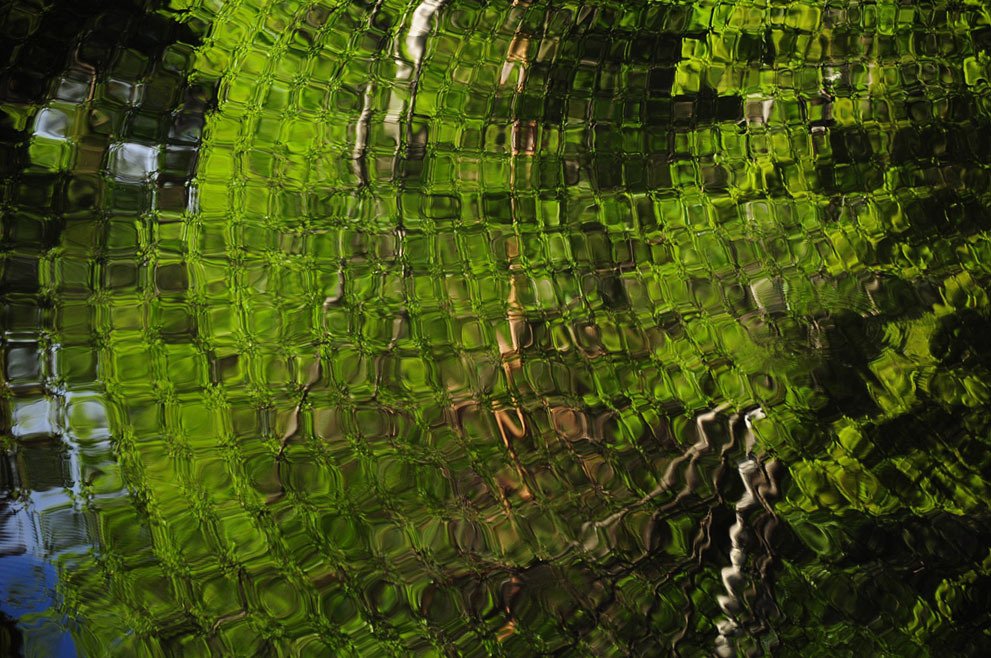
Capillary waves–ripples–interfere with one another after the photographer throws objects into a narrow point in a small lake. The reflections of these waves off the lake’s boundaries and against one another creates a mosaic-like geometric effect on the liquid surface. (Photo credit: Jorgen Tharaldsen/National Geographic Photo Contest)
Bouncing Off
A water droplet falling onto a superhydrophobic surface will rebound and bounce without wetting the surface. Capillary and internal waves reflect in the drop until it comes to rest at a high contact angle, formed at the boundary where the liquid, solid, and air meet. Such surfaces can have interesting interactions with water, as when two droplets coalesce on a surface and then begin bouncing or when superhydrophobic objects are dropped into a bath. (Video credit: Gangopadhyay Group, University of Missouri)
Didgeridoo Soap Bubble
This high-speed video shows a soap bubble being blown via didgeridoo, a wind instrument developed by the Indigenous Australians. The oscillations of the capillary waves on the surface of the bubble vary with the frequency of note being played. High frequency notes excite small wavelengths, whereas lower notes create large wavelength oscillations. For more fun, check out what you can do with didgeridoos in space. (submitted by Christopher B)
Astro Puffs
Microgravity continues to be a fascinating playground for observing surface tension effects on the macroscale without pesky gravity getting in the way. Here astronaut Don Pettit has created a sphere of water, which he then strikes with a jet of air from a syringe. Initially, the momentum from the jet of air creates a sharp cavity in the water, which rebounds into a jet of water that ejects one or more satellite drops. Surface waves and inertial waves (inside the water sphere) reflect back and forth until the fluid comes to rest as a sphere once more. Note how similar the behavior is to the pinch-off of a water column. Both effects are dominated by surface tension, but on Earth we can only see this behavior with extremely small droplets and high-speed cameras! (Video credit: Don Pettit, Science Off the Sphere)
Breaking Water with Sound
Previously we saw how vibration could atomize a water droplet, breaking it into a spray of finer droplets. Here astronaut Don Pettit shows us what the process looks like in microgravity using some speakers and large water droplets. At low frequencies the water displays large wavelength capillary waves and vertical vibrations. Higher frequencies–like the earthbound experiment on much smaller droplets–cause fine droplets to eject from the main drop when surface tension can no longer overcome their kinetic energy. (submitted by aggieastronaut, jshoer and Jason C)
(Source: /)