Tag: biology

  • Flow in the Heart

    Flow in the Heart

    Few flows are more integral to our well-being than blood flow through the heart. Over the course of our lives, our hearts develop from a few cells pushing viscous blood through tiny arteries to the muscular center of a vast circulatory network, capable of powering us through incredible physical feats. What’s most astonishing about all this is that the heart goes through all these changes and adaptations without ever pausing. 

    Peering into the heart to see it in action is difficult, but researchers today are combining imaging techniques like CT and MRI with computational fluid dynamics to build patient-specific heart models. Not only does this help us understand hearts in general; it’s paving the way toward predicting how a specific treatment may affect a patient. Imagine, for example, being able to simulate and compare different models of an artificial heart valve to see which will work best for a particular patient. We’re not to the point of doing so yet, but it’s a very real possibility in the future. 

    To see some examples of predicted and measured heart flows, check out this video by J. Lantz. In the meantime, happy Valentine’s Day! (Image credits: Linköping University Cardiovascular Magnetic Resonance Group, video source; via Another Fine Mesh)

  • Swallowing Physics

    Swallowing Physics

    Swallowing – whether of food, beverage, or medication – is an important process for humans, but it’s one many struggle with, especially as they age. To help study the physics behind swallowing, one research group has built an artificial mouth and throat model, shown in the bottom row of images. The model uses rollers to imitate the wave-like motion of swallowing. 

    In our mouths, chewed food typically combines with saliva to form a soft ball we can move from our tongue and down our throat with a series of reflex actions. How easily we swallow something depends on its flow properties, our saliva, shape, and more. 

    In their early studies of model swallowing, researchers have focused on what it takes to swallow pills (suspended in liquid). What they found is probably consistent with your own experience: smaller pills are easier to swallow than large ones, and elongated pills are easier to swallow than round ones of the same volume. That seems to be a function of elongated pills’ smaller cross-section when aligned with flow going down the throat. As the research continues, scientists hope to explore what can be done to make food easier to swallow for those who struggle with it. (Image credits: meal – D. Shevtsova; model – M. Marconati; via APS Physics; submitted by Kam-Yung Soh)

  • Collective Motion: Nematodes

    Collective Motion: Nematodes

    We often imagine that collective motion creates an advantage – that the schooling fish and flocks of birds gain something from this behavior – but that’s not always the case. Above, you see nematodes moving through a thin liquid layer. Random collisions occasionally bring the nematodes into contact, and once that happens, surface tension holds them together with a force that exceeds what their muscles can supply. Essentially, they move together for the same reason that Cheerios clump together in your cereal bowl. But despite being stuck alongside one another, there’s no change in how the nematode moves. It sees neither an advantage nor a disadvantage from being attached to its neighbor. (Image and research credit: S. Gart et al., source)

    This post completes our series on collective motion. Check out the previous posts about honeybee waveshow crowds are like sand, the fluid properties of worms, and why a lack of randomness makes predicting group behaviors hard.


  • Collective Motion: Waving Bees

    Collective Motion: Waving Bees

    Giant honeybees live in huge open nests. To protect themselves, they’ve developed a mesmerizing wave-like defense known as shimmering. When shimmering, the bees in a hive, beginning from a distinct spot, will flip over to expose their abdomens. Taken together, this creates large-scale patterns like those seen above.

    Scientists have connected the behavior to the presence of wasps that prey on the bees. It seems that shimmering helps to repel the wasps without putting individual bees in danger. If shimmering doesn’t ward off the wasps, the bees can also use their flight muscles to heat the area around the intruder to a wasp-lethal temperature – or, individuals bees can sacrifice themselves by stinging the wasp. (Image credit: Beekeeping International, source; research credit: G. Kastberger et al.; via Gizmodo)

    This post is part of our series on collective motion. Check out our previous posts about how crowds are like sand, the fluid properties of worms, and why a lack of randomness makes predicting group behaviors hard.

  • Collective Motion: Worms

    Collective Motion: Worms

    Although most animals are more solid than fluid, what happens when you put many of them together can be strikingly fluidic. Above you see the black aquatic worm, Lumbriculus variegatus, which must keep moist to stay alive. An individual worm will die within an hour of being removed from the water, but, in a group, the worms can survive far longer. They do so, in part, by acting like a viscoelastic fluid, a material with both solid (elastic) and fluid (viscous) properties.

    In small groups, the worms squirm tightly together to minimize their collective surface area and prevent themselves from drying out. But in larger groups, the worm blobs begin sending out feelers, searching for more advantageous circumstances. In the top image, you can see this causes three of the blobs to ultimately merge into an even bigger one. The worm collective can also “liquify”, allowing the blob to change shape and tackle obstacles like flowing through a pipe. (Image and research credit: Y. Ozkan-Aydin et al.; via Science)

    This is the second post in our series on collective motion. Check out the first post here.

  • Water Anoles Breathe Underwater

    Water Anoles Breathe Underwater

    Meet the water anole, a small lizard native to the tropics of Central America. While studying these anoles, researchers discovered that they could flee underwater and remain submerged for 16 minutes or more at a time. Curious to see how the lizard manages this feat, they filmed them underwater, discovering that the anole seems to exhale a small bubble that sticks on its face and then re-inhale it.

    How exactly this built-in “scuba gear” works is still under investigation, but here’s my guess. Fresh oxygen can diffuse from water into a bubble; some insects use this to breathe underwater. The natural, random motion of molecules tends to cause chemicals to move from areas of high concentration to those of low concentration. But this molecular diffusion is extremely slow. That tiny bubble you see isn’t around long enough for any significant molecular diffusion of fresh oxygen. But what if the surface of the bubble is actually much larger?

    Notice the silvery shininess we see on the anole. That’s because most of the lizard isn’t actually wet. The anole is superhydrophobic, so its skin has trapped a thin layer of air that appears to extend over a large part of its body. I think perhaps the anole has fresh oxygen diffusing into the air layer across most of its skin, and the large bubble it inhales and exhales serves as a sort of pump to help draw that fresh oxygen through the air layer and into its body. That could help explain how the anole can stay submerged for so long.

    As researchers continue to investigate this little aquanaut, it will be interesting to discover just what its secrets are! (Image and video credit: L. Swierk; via Gizmodo)

  • Finding New Shapes in Foam

    Finding New Shapes in Foam

    In the summer of 2018, a group of researchers announced they’d discovered a new geometrical shape, the scutoid. They found the scutoid, a sort of twisted prism, in the shape of epithelial cells packed between curved surfaces. Having heard of this new geometry, a different group of physicists wondered if they could find scutoids elsewhere, specifically, in the cells of a foam. As shown in the picture above, they did.

    To visualize a scutoid, first image a prism. Take two polygons with an equal number of sides and connect them. But if you imagine packing such prisms between two curved surfaces, you’ll quickly see that it won’t work. They just don’t fit together. Instead, one face may adopt, say, six sides, while the other takes on five. To join those two end faces, one of the sides will have to have a Y-shaped junction and a triangular face. This is a scutoid.

    You can see two such shapes in the image above. In the left bubble, the far side forms a pentagon, while the near face is a hexagon. On the right, the bubble has six faces in the background and eight in the foreground. And between them, you can just see the triangular face that connects the two scutoids.

    It’s not only exciting to find scutoids in a new, non-biological medium; it suggests a physical mechanism behind their formation. Foams are a well-known example of energy minimization. The fact that scutoids are found in a curved foam suggests that the shape itself is connected to energy minimization, something that could help us understand how biological scutoids grow and form. (Image and research credit: A. Mughal et al.; via Physics World; submitted by Kam-Yung Soh)

  • Sniffing Underwater

    Sniffing Underwater

    Star-nosed moles – tiny mammals native to the northeastern United States – have an underwater superpower: sniffing. To seek prey underwater, the moles blow bubbles and suck them back into their nostrils in about a tenth of a second. Their eponymous noses seem to be key to this, as seen in newly published research. Researchers built model star noses from plastic (lower right) to explore how well different shapes could hold the bubble in place, a necessary ingredient for the mole to sniff them back up. 

    With a perfectly flat plate, any small tilt makes the bubble slide toward the edge and float away. Star-shaped ones, on the other hand, can hold a bubble even up to a 7-degree tilt angle, a 40% improvement. The spacing of the gaps is also important. If they’re too wide, buoyancy can pull the bubble up through them. But if they’re too narrow for the bubble to deform upward through them, they make poor anchors. 

    Understanding the mechanics of underwater sniffing is good for more than just appreciating this funny-looking mammal, though. The researchers hope their findings will help develop underwater chemical sensors that use bubble sniffing instead of exposing their components directly to sea water, which would significantly extend their usable life. For more, check out the paper and my interview with the lead author in the video below. (Image credits: top and lower left – K. Catania; lower right – A. Lee; research credit: A. Lee and D. Hu; video credit: N. Sharp and T. Crawford)

  • Inside a Heart

    Inside a Heart

    You may not give it much thought, but there is important fluid dynamics happening inside you every moment of every day, especially inside your heart. Of the four chambers of the heart, the left ventricle has the thickest walls, reflecting its important task: pumping oxygenated blood throughout the body. In a healthy heart (top of poster; click here for the full-size version), a vortex ring and trailing jet fill the ventricle when the mitral valve opens. Then the ventricle contracts and pumps blood out the aortic valve and into the rest of the body.

    But for individuals with a leaking aortic valve (bottom of poster), things look different. Blood leaks back through the aortic valve at the same time that the mitral valve opens to allow freshly oxygenated blood back in. The two inflows disrupt mixing in the chamber, and, instead of pumping fully-oxygenated blood into the body, the left ventricle has to struggle to pump a less-oxygenated mixture into the body. (Image credit: G. Di Labbio et al.)

    ETA: (Research paper: G. Di Labbio et al., arXiv)

  • Fighting a Viscous World

    Fighting a Viscous World

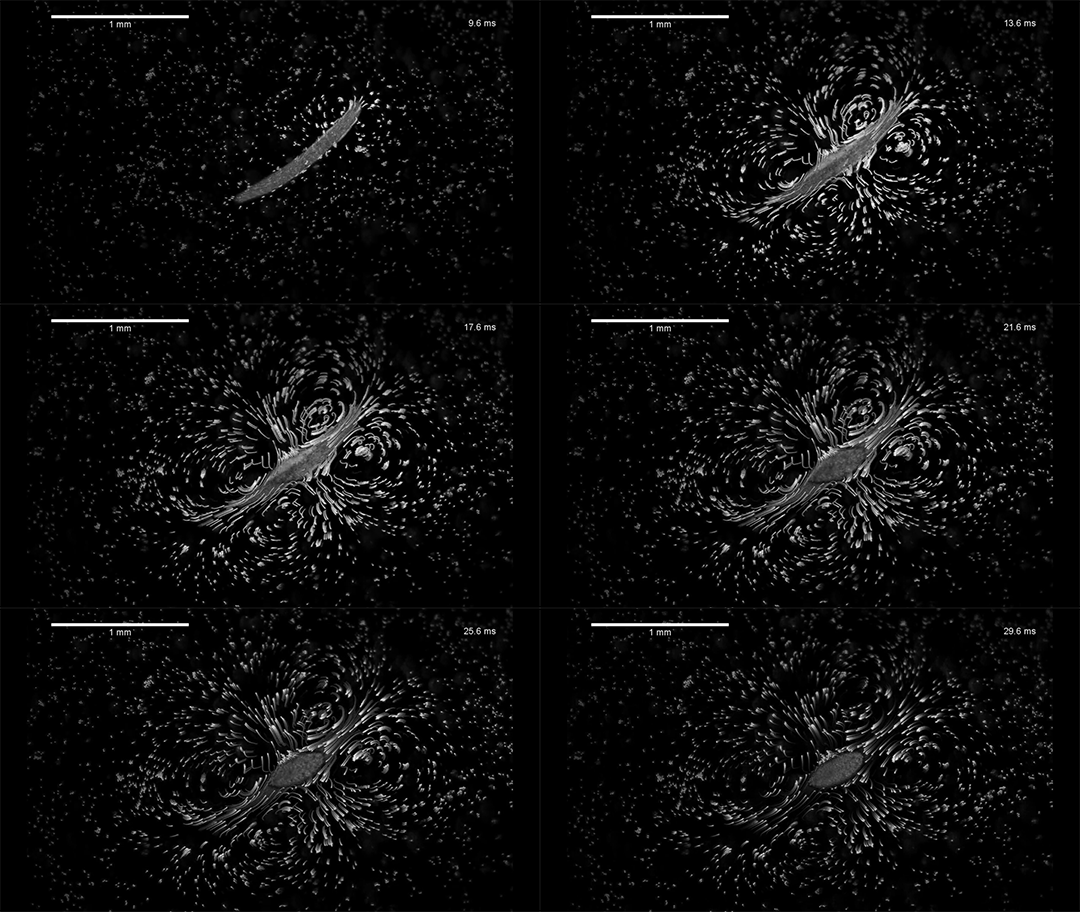
    Vaucheria is a genus of yellow-green algae (think pond scum), and some species within this genus reproduce asexually by releasing zoospores. Once mature, the zoospore has to squeeze out of a narrow, hollow filament in order to escape into the surrounding fluid (top). To do so, it uses tiny hair-like flagella on its surface. Despite the minuscule size of these micron-length flagella, they generate some major flows around the zoospore (middle and bottom). Even several body lengths away, the flow field shows significant vorticity. All this active entrainment of fluid from the surroundings helps the zoospore escape its confinement and swim away to start a new plant. (Image and research credit: J. Urzay et al., source)