Tag: biology

  • Plant Week: Bladderworts

    Plant Week: Bladderworts

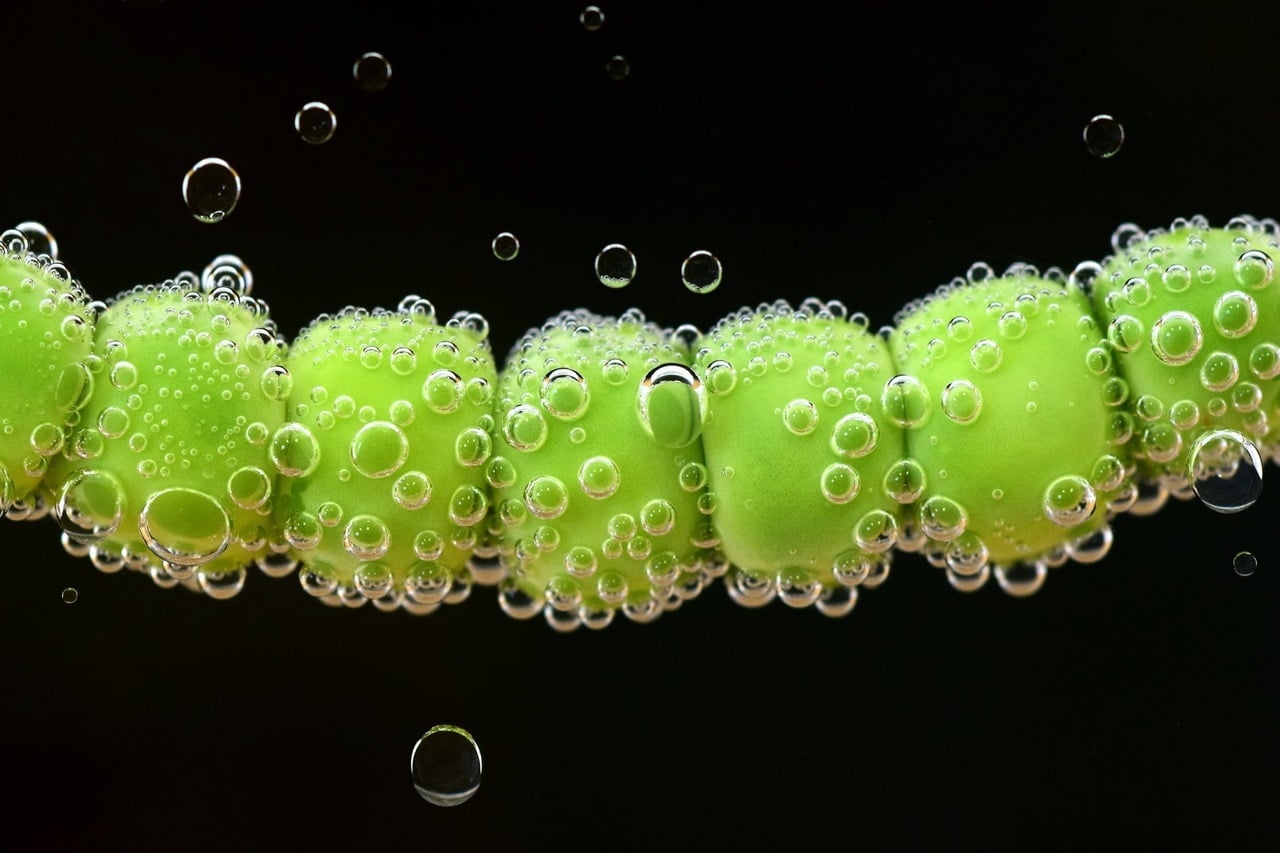
    Carnivorous plants live in nutrient-poor environments, where clever techniques are necessary to keep their prey from getting away. The aquatic bladderwort family nabs their prey through ultra-fast suction. This starts with a slow phase (top) in which water is pumped out of the trap. Because the internal pressure is lower than the external hydrostatic pressure, this compresses the walls of the trap, and it leaves the trap’s door narrowly balanced on the edge of stability. A slight perturbation to the trigger hairs around the door will cause it to buckle. 

    That’s when things get fast. As the door buckles and the trap expands to its original volume, water gets sucked in, pulling whatever prey was nearby with it. The door reseals as the pressure inside and outside the trap equalizes, and, in only a couple milliseconds total, the bladderwort has its snack. It secretes digestive enzymes to break down what it’s caught, and over many hours, it pumps out the trap to reset it. (Image and research credit: O. Vincent et al.; submitted by David B.)

    All this week, FYFD is celebrating Plant Week. Check out our previous post on how dandelion seeds fly tens of kilometers.

  • Featured Video Play Icon

    Plant Week: Dandelions in Flight

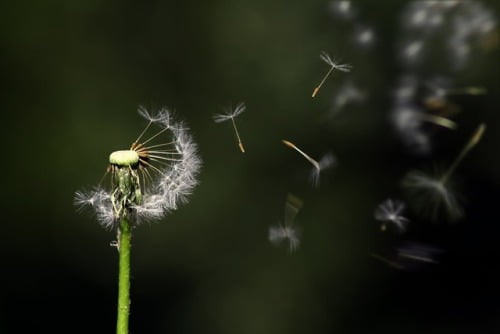
    To kick off Plant Week here on FYFD, we’re taking a closer look at that ubiquitous flower: the dandelion. Love ‘em or hate ‘em, these little guys manage to get just about everywhere, thanks in part to their amazing ability to stay windborne for up to 150 km! To do that, the dandelion uses a bristly umbrella of tiny filaments, known as a pappus, that can generate more than four times the drag per area of a solid disk. Its porosity – all that empty space between the filaments – is also key to its stability; it helps create and stabilize a separated vortex ring that the seed uses to stay aloft. Check out the full video below! (Image and video credit: N. Sharp)

  • Plant Week: Introduction

    Plant Week: Introduction

    Spring has sprung! The trees have leaves, the flowers are in bloom, and snow is (almost) a distant memory.* And here at FYFD, we’re getting ready to kick off a full week of celebrating the intersection of fluid dynamics and plants.

    To get you into the mood, here’s a look at some previous plant-filled posts:

    How trees use negative pressure to hydrate
    The catapulting seeds of the hairyflower wild petunia
    Seeds that self-dig
    How desert moss drinks from the air
    The swimming of zoospores

    Stay tuned all next week for lots more plant physics!

    *Confession: it’s still snowing at my house as I type this. But the trees do have leaves and there are flowers blooming. Poor things. – Nicole

    (Original image: Pixabay)

  • Digging Sandpits

    Digging Sandpits

    Antlion larvae dig sandpits to catch their prey, and, according to a new study, they rely on the physics of granular materials to do so. The antlion digs in a spiral pattern (bottom), beginning from the outside and working its way inward. As it digs, it ejects larger grains and triggers avalanches that cause large grains to fall inward. This leaves the walls of the final pit lined with small grains, which have a shallower angle of repose and will slip out from under any prey that wander in. The subsequent avalanche will carry the victim to the antlion lying in wait at the center of the pit. (Image credits: antlion larva – J. Numer; antlion digging – N. Franks et al.; research credit: N. Franks et al.; submitted by Kam-Yung Soh)

  • Communication Between Microswimmers

    Communication Between Microswimmers

    The elongated cells of Spirostomum ambiguum swim using hair-like cilia, but when threatened, the cells contract violently, sending out long-range hydrodynamic waves, like those visualized above. Along with these waves, the cells release toxins aimed at whatever predator threatens them. In a colony, these waves act like a communication beacon. The swirl of a previous cell’s reaction tugs on its neighbors. As they contract, the message–and the toxins–spread. If the colony density is high enough, the hydrodynamic trigger waves will propagate through the entire colony, releasing enough toxins to disable even large predators. (Image and video credit: A. Mathijssen et al.)

  • Featured Video Play Icon

    Sniffing

    In many ways, smell is a strange sense. The very act of sniffing – pulling air and odor molecules into our noses – changes what remains behind in a way that sight and sound do not. Humans aren’t great sniffers, but dogs have an exquisite sense of smell, and in this video, Deep Look describes how and why that is. From special scent organs to their experimental protocols, dogs are well-adapted to reading the world by smell. (Image and video credit: Deep Look)

  • Catching Prey

    Catching Prey

    The skinny, freshwater alligator gar can grow to more than 2 meters in length, giving it a distinct resemblance to its namesake. But this fish’s history traces back more than a hundred million years to the Early Cretaceous. And a new (pre-printed) study, combining live observations and numerical models built from CT-scans, is shedding new light on how the gar and its prehistoric ancestors feed.

    The gar uses a lateral strike (top) to come at its prey from the side. But hydrodynamically speaking, that’s a tough way to catch dinner. As soon as the gar’s snout accelerates toward its prey, it pushes a bow wave ahead of it, like an early warning signal. To counter that disadvantage, the gar has a complex bone structure in its skull (bottom) that helps it generate suction. Note how the gar’s jaw and throat open sequentially from front to back. Each expansion sucks in water, and by timing them just right, the gar produces suction throughout its entire attack. The bow wave warning does its prey no good if both are already getting sucked into the gar’s mouth! (Image and research credit: J. Lemberg et al., bioRxiv pre-print; via Science; submitted by Kam-Yung Soh)

  • How the Hagfish Deploys Its Slime

    How the Hagfish Deploys Its Slime

    Hagfish – an eel-like species – are known for their prodigious slime production, which helps them escape predators (and, in some cases, seriously muck up highways). Part of the hagfish’s slime consists of ~10 cm fibers that the creature deploys in tiny skeins (bottom) only a hundred microns across. To form the viscoelastic slime that thwarts its predators, those skeins of fiber have to unravel and do so in only tenths of a second. A new study shows that viscous drag plays a major role in that unraveling. 

    Most fish use a suction method to catch prey. In the hagfish’s case, that does the predator more harm than good because the very flow it creates to try and catch the hagfish pulls the slime skein apart and helps the slime expand 10,000 times in volume, creating a mess that chokes the gills of the attacking fish. (Image credit: top – L. Böni et al.; bottom – G. Choudhary et al., source; research credit: G. Choudhary et al.; via Ars Technica; submitted by Kam Yung Soh)

  • Bats in Ground Effect

    Bats in Ground Effect

    As pilots can tell you, flying near the ground (or an open expanse of water) gives one an aerodynamic boost. Essentially, the surface acts like a mirror, reflecting and dissipating the wingtip vortices that create downwash. That reduces the power necessary to fly, as long as you’re flying within about a wingspan of the surface.

    Theoretically, flapping fliers like bats and birds should also benefit from this ground effect, but measurements have been hard to come by. A new study using bats trained to fly in a wind tunnel provides some of the first detailed measurements of ground effect for flapping animals. The researchers found a 29% reduction in the power necessary for flight when in ground effect compared to being out of it! That’s twice the savings predicted by modeling, meaning we still have a ways to go to accurately capture the physics of flapping flight under these circumstances.

    Such a substantial savings also strengthens arguments for flight developing from the ground up. Using ground effect, surface-dwelling animals could have evolved flight gradually, taking advantage of the energy savings offered by sticking close to the surface. (Image and research credit: L. Johansson et al.; submitted by Marc A.)

  • Featured Video Play Icon

    The Sharpshooter Insect

    The sharpshooter is a small, sap-sucking insect capable of consuming more than 300 times its body weight in fluid each day. To sustain that level of intake, the insect also has to have a robust mechanism for expelling excess fluid, and that particular talent has earned the insect the nickname of the “pissing fly”. Together a group of sharpshooters can expel enough fluid to imitate rain (top).

    Individually, the insects form a droplet on hydrophobic hairs near their anus. Once the droplet is large enough, those hairs bend like a spring, and the droplet gets catapulted off the insect with an acceleration greater than 20g. That makes it among the fastest reactions in the natural world – more than twenty times the acceleration of a cheetah. Understanding this mechanism is valuable for engineers building robotics as well as for finding ways to counter the agricultural menace the sharpshooters present when it comes to spreading diseases among infected crops. (Image and video credit: E. Challita et al.; via WashPo; submitted by Marc A.)