Tag: biology

  • Featured Video Play Icon

    Why Animals Shake Themselves Dry

    For many animals, letting themselves air-dry is not an option. They would become hypothermic before their wet fur dried completely. This is why dogs and many other furry mammals shake themselves dry. It’s a remarkably efficient process, too, removing the majority of water from fur in a matter of seconds.

    The key is to shake at a frequency such that the centrifugal force of the shake overcomes surface tension’s ability to keep the water attached to fur. The looseness of a dog’s skin (compared to humans!) is a bonus for them; the extra translation as they shake increases the centrifugal force, allowing them to shed more water more quickly. (Image and video credit: BBC Earth; research credit: A. Dickerson et al.)

  • Replacing Injections With Pills

    Replacing Injections With Pills

    In medicine, many medications contain molecules too large to be easily absorbed through the intestinal wall, so these so-called biologics — like the insulin administered to diabetics — are injected into the body. Researchers are studying ways that such injections could eventually be replaced with pills, but there are plenty of challenges involved.

    Some substances, known as transient permeability enhancers, allow the intestines to absorb larger molecules, but they work for only tens of minutes, which means researchers must understand how and when to administer them relative to the medication they help patients absorb. To do so, researchers are building computational fluid dynamics models of the human digestive system so that they can better understand how and when different kinds of pills break down in the body. (Image credit: Macro Room, source; via CU Engineering; submitted by Jenny B.)

  • To Beat Surface Tension, Tadpoles Make Bubbles

    To Beat Surface Tension, Tadpoles Make Bubbles

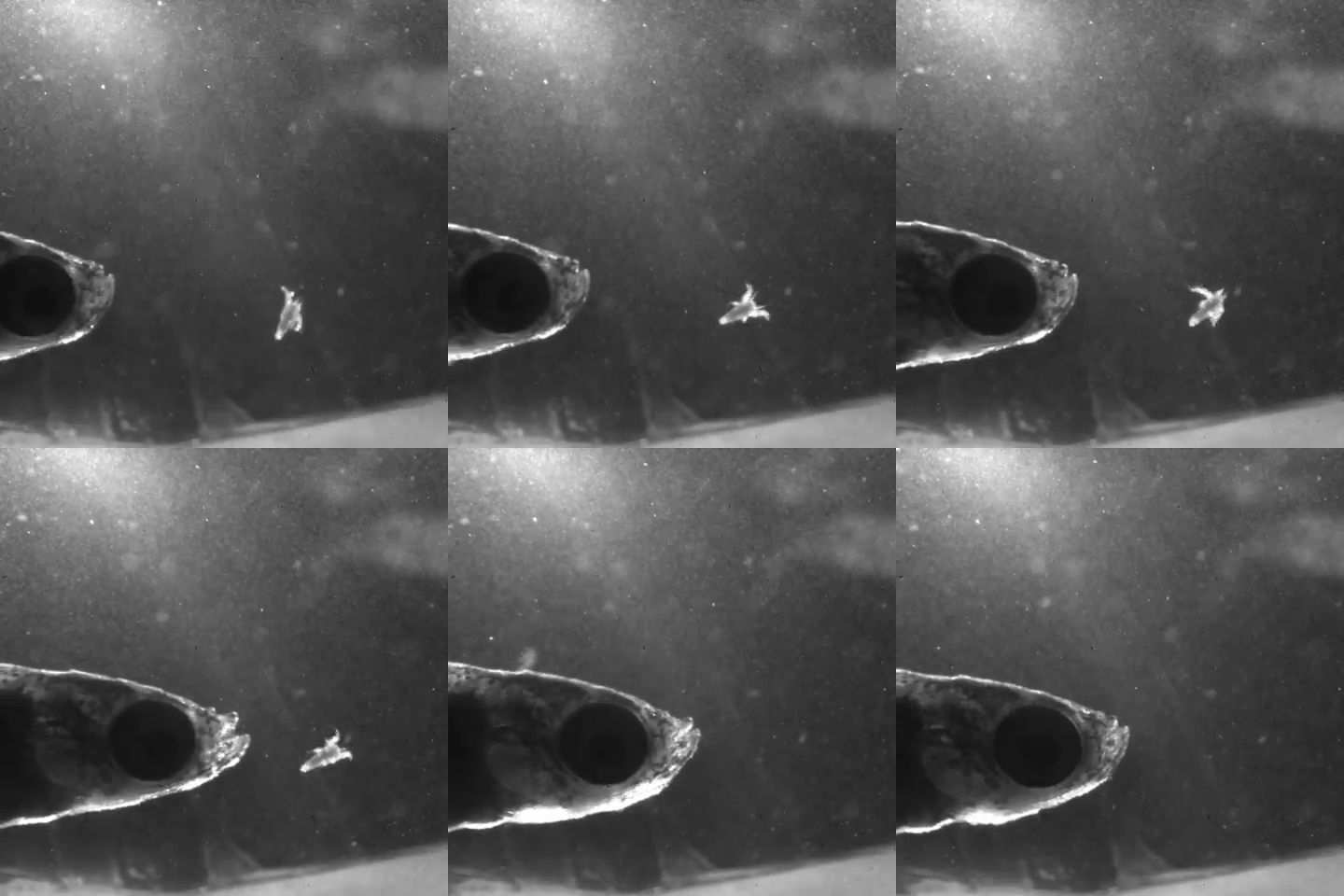
    For tiny creatures, surface tension is a formidable barrier. Newborn tadpoles are much too small and weak to breach the air-water surface in order to breathe. Researchers found that, instead, the 3 millimeter creatures place their mouths against the surface, expand their mouth to generate suction, and swallow a bubble consisting largely of fresh air.

    When they’re especially small, some of these species are essentially transparent (Image 1), allowing researchers to see the bubble directly. But even as the tadpoles aged (Images 2 and 3) and grew strong enough to breach the surface, they observed many instances in which the tadpoles continued this bubble-sucking method to breathe. (Image and research credit: K. Schwenk and J. Phillips; via Cosmos; submitted by Kam-Yung Soh)

  • Wild Gray Seals Clap Back

    Wild Gray Seals Clap Back

    Here’s a paper that cries out for fluid dynamical/acoustical follow-up: wild gray seals have been observed signaling underwater by clapping their forefins. As you can hear in the video, the sound is quite loud and carries well underwater. The biologists who observed the behavior postulate that it’s used by males during breeding season to ward one another off and to signal strength to nearby females.

    Although many species (including humans) slap against the water surface to generate noise, we don’t know of other species producing such a loud clap entirely underwater. The clap resembles the motions used by seals for propulsion, though the results are obviously quite different. I know plenty of researchers already looking into seal propulsion — here’s your future work! (Image and video credit: B. Burville; research credit: D. Hocking et al.; via Gizmodo)

  • Holding Fast in the Flow

    Holding Fast in the Flow

    Many tiny creatures in the natural world face living in fast flows. The larvae of the net-winged midge, for example, forage their way through fast-flowing Alpine springs with speeds of 3 m/s or more. You or I would find standing in such water a challenge, but these larvae are unbothered, thanks to the clever suction-cup-like appendages that help anchor them to rough rocks.

    The larvae generate their strong attachment with an outer rim flexible enough to conform to uneven surfaces. When they activate the central piston of the suction cup, this creates a seal strong enough to withstand forces up to 600 times the larvae’s body weight. But holding on to one spot forever is hardly useful, so the larvae also have a V-shaped notch in the cup controlled by dedicated muscles. When activated, this quickly breaks the seal, allowing the larvae to relocate. (Image and research credit: V. Kang et al.; via The Engineer; submitted by Marc A.)

  • Morphing Wings Using Real Feathers

    Morphing Wings Using Real Feathers

    Although humanity has long been inspired by bird flight, most of our flying machines are nothing like birds. Engineers have struggled to recreate the ease with which birds are able to morph their wings’ characteristics as they change from one shape to another. Now researchers have built a biohybrid robot, PigeonBot, that uses actual pigeon feathers as part of its morphing design.

    Many species of birds, including pigeons, have Velcro-like hooks in the microstructure of their feathers. These hooks help the flight feathers stick to one another and create a continuous wing surface that air cannot easily slip through, even as the wing drastically changes shape. By using actual feathers, PigeonBot shares this advantage.

    PigeonBot also has a somewhat minimalist design in its articulation, using only a wrist and finger joint in each wing to control shape. The feathers are connected through an elastic ligament, which — along with their microstructure — allows them to smoothly change shape under aerodynamic loads. The end result is a remarkably capable and agile biorobot researchers can use to better understand how birds control their flight. (Image and research credit: L. Matloff et al. and E. Chang et al.; via NPR and Gizmodo)

  • Featured Video Play Icon

    Rattlesnakes Sip Rain From Their Scales

    Getting enough water in arid climates can be tough, but Western diamondback rattlesnakes have a secret weapon: their scales. During rain, sleet, and even snow, these rattlesnakes venture out of their dens to catch precipitation on their flattened backs, which they then sip off their scales.

    Researchers found that impacting water droplets tend to bead up on rattlesnake scales, forming spherical drops that the snake can then drink. Compared to other desert-dwelling snakes, Western diamondbacks have a far more complicated microstructure to their scales, with labyrinthine microchannels that provide a sticky, hydrophobic surface for impacting drops. (Video and image credit: ACS; research credit: A. Phadnis et al.; via The Kid Should See This)

  • The Best of FYFD 2019

    The Best of FYFD 2019

    2019 was an even busier year than last year! I spent nearly two whole months traveling for business, gave 13 invited talks and workshops, and produced three FYFD videos. I also published more than 250 blog posts and migrated all 2400+ of them to a new site. And, according to you, here are the top 10 FYFD posts of the year:

    1. The perfect conditions make birdsong visible
    2. Pigeons are impressive fliers
    3. The water anole’s clever method of breathing underwater
    4. 100 years ago, Boston was flooded with molasses
    5. The BZ reaction is some of nature’s most beautiful chemistry
    6. The labyrinthine dance of ferrofluid
    7. 360-degree splashes
    8. The extraordinary flight of dandelion seeds
    9. Dye shows what happens beneath a wave
    10. Bees do the wave to frighten off predators

    Nature makes a strong showing in this year’s top posts with five biophysics topics. FYFD videos also had a good year: both my Boston Molasses Flood video and dandelion flight video made the top 10!

    If you’d like to see more great posts like these, please remember that FYFD is primarily supported by readers like you. You can help support the site by becoming a patronmaking a one-time donation, or buying some merch. Happy New Year!

    (Image credits: birdsong – K. Swoboda; pigeon take-off – BBC Earth; water anole – L. Swierk; Boston molasses flood – Boston Public Library; BZ reaction – Beauty of Science; ferrofluid – M. Zahn and C. Lorenz; splashes – Macro Room; dandelion – N. Sharp; dyed wave – S. Morris; bees – Beekeeping International)

  • Surfing Honeybees

    Surfing Honeybees

    Honeybees have superpowers when it comes to their aerodynamics and impressive pollen-carrying, but their talents don’t end in the air. A new study confirms that honeybees can surf. Wet bees cannot fly–their wings are too heavy for them to get aloft when wet–but falling into a pond isn’t the end for a foraging honeybee.

    Instead, the bee flaps its wings, using them like hydrofoils to lift and push the water. This action generates enough thrust to propel the bee three body lengths per second. It’s a workout the bee can only maintain for a few minutes at a time, but researchers estimate honeybees could cover 5-10 meters in that time. Once ashore, the bee spends a few minutes drying itself, and then flies away no worse for the wear. (Image and research credit: C. Roh and M. Gharib; via NYTimes; submitted by Kam-Yung Soh)

  • Seeing Past the Surface

    Seeing Past the Surface

    Satellite imagery has revolutionized remote sensing and our ability to observe the world around us. But peering past the surface of water has always been next to impossible. We might be able to see the extent of a coral reef from a photo, but thanks to the interplay of light and water, the details are too blurry to identify what species we’re looking at.

    To solve this issue, researchers decided to work backwards, taking everything we understand about the physics of light – refraction, reflections, and so on – and using it to remove the distortions. The result is NASA’s FluidCam, an instrument capable of of taking a video of shallow waters less than 10 m deep, processing it, and producing images with sub-centimeter accuracy showing what lies beneath. Tests in American Samoa revealed details fine enough that scientists were able to identify multiple coral species as well as many of the species of fish inhabiting the reef. 

    With coral reefs changing quickly, this technology may be invaluable for monitoring coral health without actively disrupting these delicate systems. (Image credit: N. Usry; research credit: V. Chirayath and A. Li; via OceanBites; submitted by Kam-Yung Soh