Tag: biology

  • The Challenges of Being Small

    The Challenges of Being Small

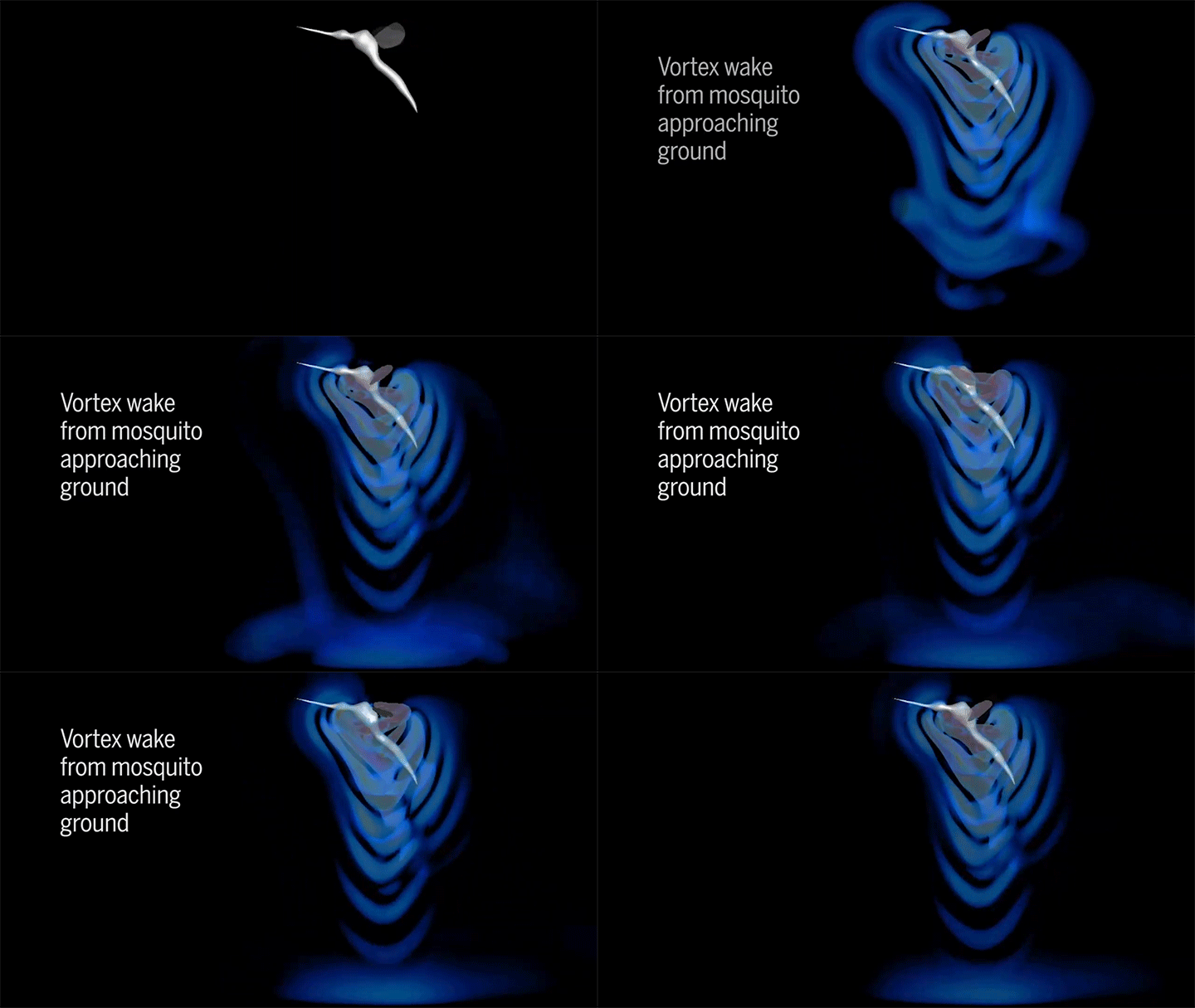
    For juvenile fish, feeding is a challenge. Their small size — often less than 5 mm in length — makes hydrodynamically capturing prey much harder because of viscosity’s relatively larger effect on them. But size may not be the only factor in determining their success, as a new study shows.

    Researchers studied feeding behaviors of two, equally-sized species’ larvae: zebrafish and guppies. The biggest difference between these two species is their developmental time prior to beginning to hunt on their own. Guppies develop five times longer than zebrafish larvae before they start feeding.

    Both fish have the same hydrodynamic limitations to overcome. If you look closely at the first image, you’ll see fluid being pushed ahead of the fish as it swims. The researchers refer to this as a bow wave, and it effectively announces to any prey that the fish is approaching. To sneak up on prey, the fish has to be able to generate enough suction force to pull its food in from beyond the bow wave’s reach. The experiments showed that guppies were able to do this reliably, while zebrafish could not. The subsequent difference in their feeding success was stark: the guppies’ success rate was almost five times that of the zebrafish! (Image and research credit: T. Dial and G. Lauder, source; via G. Lauder)
  • Shake It!

    Shake It!

    Vibrate a pool of water, and you’ll get Faraday waves, ripple-like excitations that form their own distinctive pattern compared to the driving vibration. But you don’t have to vibrate a pure liquid to see Faraday waves. A recent study observed them in vibrated earthworms!

    Odd as this may sound, the results make sense. When anesthetized (as they were in the experiments), earthworms are essentially a liquid wrapped in an elastic membrane, which is not so different from a droplet held together by surface tension.

    But why vibrate earthworms in the first place? It turns out earthworms are a good model organism for studies of vertebrate neural systems, so observing how vibrations propagate through them can provide insight into how our own nervous systems transmit information. (Image, research, and submission credit: I. Maksymov and A. Pototsky)

  • Featured Video Play Icon

    How Animals Stay Dry in the Rain

    Getting wet can be a problem for many animals. A wet insect could quickly become too heavy to fly, and a wet bird can struggle to stay warm. But these animals have a secret weapon: tiny, multi-scale roughness on their wings, scales, and feathers that helps them shed water. Watch the latest FYFD video to learn how! (Image and video credit: N. Sharp; research credit: S. Kim et al.)

  • Mossy Vortex Rings

    Mossy Vortex Rings

    Many plants have evolved an ability to move remarkably quickly. Often, this capability is driven by water. Here we see the moss Sphagnumaffine, which disperses its spores explosively. The process is triggered by the spore capsule gradually drying out; its shape changes from round to cylindrical, pressurizing the capsule. Once the internal pressure is high enough to overcome the strength of the capsule’s upper membrane, the capsule bursts, sending a plume of spores aloft. The sudden release of spore-laden air forms a vortex ring, which lifts the spores higher far more efficiently than they would be otherwise. (Image credit: capsule dry-out – J. Edwards et al., spore dispersal – J. Edwards et al. 2010; research credit: J. Edwards et al.)

  • New Signs of Turbulence in Blood Flow

    New Signs of Turbulence in Blood Flow

    Our bodies are filled with a network of blood vessels responsible for keeping our cells oxygenated and carrying away waste products. In many ways, our blood vessels are tiny pipes, but there’s a crucial difference in the flow they carry: it’s pulsatile. Because the flow is driven by our hearts, rather than a continuous pump, every heartbeat creates a distinct cycle of acceleration and deceleration in the flow. And new research has found that this cycle, when combined with curvature or flow restrictions like plaque build-up, can create turbulence in unexpected places.

    Specifically, the researchers found that decelerating pipe flows can develop a helical instability that breaks down into turbulence, even in vessels where purely laminar flow would be expected. In the animations above, you can see the flow slow, develop swirls and then break into turbulence. The flow becomes laminar again as it accelerates, but during that brief bout of turbulence there’s much higher forces on the walls of a blood vessel. Over time, that extra force could contribute to inflammation or even hardening of the arteries. (Image and research credit: D. Xu et al.; via phys.org)

  • Featured Video Play Icon

    How COVID-19 Affects the Lungs

    One of the best known COVID-19 symptoms of this pandemic is difficulty breathing, and while you’ve likely heard a lot about ventilators used to help patients get oxygen, you may not know much about the processes that cause the breathing problems. This video from Deep Look provides a solid overview of the infection route and how lung damage occurs during infection. Perhaps unsurprisingly — this is FYFD, after all — fluid dynamics plays a major role in this process, both under normal conditions and when air sacs in the lungs get damaged by the body’s immune system responding to the virus. (Image and video credit: Deep Look)

  • Featured Video Play Icon

    Singing in the MRI

    We rarely consider just how complex the process is when we speak or sing. Sound waves produced in our larynx are shifted and amplified by the geometry of our throats, mouths, sinus cavities, tongues, and lips. This video provides a glimpse of that hidden complexity through a trained vocalist singing inside an MRI machine. He sings the same aria in four distinctly different vocal styles, and it’s incredible to watch all the changes his tongue, lips, and soft palette go through to produce those different sounds. (Image and video credit: T. Ross; via Flow Vis)

  • Bristling Sharkskin Fights Separation

    Bristling Sharkskin Fights Separation

    The speedy shortfin mako shark has a secret weapon to fight drag: bristling denticles that line its fins and tail. Denticles are tiny, anvil-shaped enamel scales on the mako’s skin. In the photo above, each one is about 100 microns across. Under normal conditions, with flow moving over the shark from nose to tail, the denticles lie flat, providing no interference.

    But when sudden changes in flow near the shark’s skin cause water to begin moving in the opposite direction, the denticles flare up. Their rise interferes with the reversed flow, trapping it in small eddies beneath each denticle. Since that flow reversal is a precursor to the flow separating from the shark’s body, the bristling effectively cuts off flow separation before it can begin. The result is much less separation and much lower drag. Once the flow stops trying to move upstream, the denticles settle back into their original place. (Image credit: mako shark – jidanchaomian, denticles – J. Oeffner and G. Lauder, illustration – A. Lang, bristling – A. Lang et al.; research credit: A. Lang and A. Lang et al.; submitted by Kam-Yung Soh)

  • Steering as a Boxfish

    Steering as a Boxfish

    Coral reefs are full of odd-looking denizens, but one of the funniest-looking ones must be the boxfish. This family of fish lives up to its name; their bodies feature an angular, bony carapace that helps protect them. But you don’t have to be a fluid dynamicist to wonder how in the world they swim with that kind of shape.

    There’s actually disagreement in scientific circles as to whether the basic shape of a boxfish is stabilizing or destabilizing, in other words, whether the fish’s body shape will try to automatically turn or roll when flow moves past. A new study focuses instead on the role the fish’s tail fin serves. Through experiments (on a fish model) and simulations, the researchers showed that boxfish rely on their tail fins both as rudders and course-stabilizers.

    Living around coral reefs means that boxfish need to be highly maneuverable, and this research indicates that the fish’s body shape, combined with the stabilizing power of its tail, are key to its ability to quickly and easily turn in any direction. (Image credits: boxfish – D. Seddon, simulation – P. Boute et al.; research credit: P. Boute et al.; via NYTimes; submitted by Kam-Yung Soh)

  • COVID-19 and Outdoor Exercise

    COVID-19 and Outdoor Exercise

    By now you’ve probably come across some blog posts and news articles about a new pre-print study looking at the aerodynamics of running and the potential exposure to exhaled droplets. And you may also have seen articles questioning the accuracy and validity of such simulations. I’ve had several readers submit questions about this, so I dug into both the research and the criticisms, and here are my thoughts:

    Is this study scientifically valid?

    I’ve seen a number of complaints that since this paper hasn’t been peer-reviewed, we shouldn’t trust anything about it. That seems like an unreasonable overreaction to me considering how many studies receive press attention prior to their actual peer-reviewed publication. This is not a random CFD simulation produced by someone who just downloaded a copy of ANSYS Fluent. This work comes from a well-established group of engineers specializing in sports aerodynamics, and long-time readers will no doubt recognize some of their previous publications. Over the past decade, Blocken and his colleagues have become well-known for detailed experimental and simulation work that indicates larger aerodynamic effects in slipstreams than what we generally recognize.

    In this paper, they lay out previous (biological) studies related to SARS and droplet exhalation; they use those papers and several wind tunnel studies to validate computational models of droplet evaporation and runner aerodynamics; and then they use those inputs to simulate how a cloud of exhaled droplets from one runner affects someone running alongside, behind, or in a staggered position relative to the first runner.

    In other words, their work includes all the components one would expect of a scientific study, and it makes scientifically justifiable assumptions with regard to its methods. (That’s not, mind you, to say that no one can disagree with some of those choices, but that’s true of plenty of peer-reviewed work as well.) All in all, yes, this is a scientifically valid study, even if it has not yet undergone formal peer-review*.

    Can simulations actually tell us anything about virus transmission?

    One complaint I’ve seen from both biologists and engineers is that simulations like these don’t actually capture the full physics and biology involved in virus transmission. While I agree with that general sentiment, I would point out two important facts:

    1) Blocken et al. acknowledge that this is not a virology study and confine their scientific results to looking at what happens physically to droplets when two people are moving relative to one another. Whether those droplets can transmit disease or not is a question left to biological researchers.

    2) Most medical and biological research also does not account for the physics of droplet transmission and transport. For the past century, this research has focused almost exclusively on droplet sizes, with the assumption that large droplets fall quickly and small droplets persist a little longer. To my knowledge, some of the only work done on the actual physics of the turbulent cloud produced by coughing or sneezing comes from Lydia Bourouiba’s lab at MIT. And, to me, one of the fundamental conclusions from her work is that droplets (especially small ones) can persist a lot longer and farther than previously assumed. Can those droplets facilitate transmission of COVID-19? The general consensus I’ve seen expressed by medical experts is no, but, to my knowledge, that is based on opinion and assumption, not on an actual scientific study.

    The bottom line

    In my opinion, there’s a big disconnect right now between the medical/biological community and the engineering community. To truly capture the physics and biology of COVID-19 transmission requires the expertise and cooperation of both. Right now both sides are making potentially dangerous assertions.

    Honestly, based on what I know about aerodynamics, I am personally skeptical as to whether 6 ft of physical separation is truly enough; whether it is or not seems to depend on how transmissible the novel coronavirus is through small droplets, which, again, to my knowledge, is unestablished.

    Should we leave more distance than 6ft between us when exercising outdoors? Absolutely. Aerodynamically, it makes perfect sense that following in someone’s slipstream would put you inside their droplet cloud, which needs time and space to disperse. Personally, I’ve sidestepped the question entirely by doing all my cycling indoors while quarantined.

    tl;dr: There are a lot of open questions right now about COVID-19 transmission and what qualifies as safe distancing, but it’s smarter to err on the side of more distancing. Don’t hang close to others when running or cycling outdoors.

    (Image and research credit: B. Blocken et al.; submitted by Corky W. and Wendy H.)

    *I will add that, with my training, I have and do occasionally peer-review studies such as this one, and I read the full paper with the same sort of critical eye I would turn to a paper I was asked to review.