Turbulent flows are complicated to simulate because of their many scales. The largest eddies in a flow, where energy is generated, can be of the order of meters, while the smallest scales, where energy is dissipated, are of the order of fractions of a millimeter. In Direct Numerical Simulation (DNS), the exact equations governing the flow are solved at all of those scales for every time step–requiring hundreds or thousands of computational hours on supercomputers to solve even a small domain’s worth of flow, as on the airplane wing in the video. Large Eddy Simulation (LES) is another technique that is less computationally expensive; it calculates the larger scales exactly and models the smaller ones. The video shows just how complicated the flow field can look. The red-orange curls seen in much of the flow are hairpin vortices, named for their shape, and commonly found in turbulent boundary layers.
Tag: airplanes

Feathering on SpaceShipTwo
Virgin Galactic and Scaled Composites recently performed their first feathered flight with SpaceShipTwo, which is on track to be the first commercial spaceship. Feathering is a re-entry technique devised by Scaled Composites founder Burt Rutan:
Once out of the atmosphere the entire tail structure of the spaceship can be rotated upwards to about 65º. The feathered configuration allows an automatic control of attitude with the fuselage parallel to the horizon. This creates very high drag as the spacecraft descends through the upper regions of the atmosphere. The feather configuration is also highly stable, effectively giving the pilot a hands-free re-entry capability, something that has not been possible on spacecraft before, without resorting to computer controlled fly-by-wire systems. The combination of high drag and low weight (due to the very light materials used to construct the vehicle) mean that the skin temperature during re-entry stays very low compared to previous manned spacecraft and thermal protection systems such as heat shields or tiles are not needed. During a full sub-orbital spaceflight, at around 70,000ft following re-entry, the feather lowers to its original configuration and the spaceship becomes a glider for the flight back to the spaceport runway. #
Though it works well for decelerating from sub-orbital speeds, feathering is sadly not useful for orbiting spacecraft due to the much higher kinetic energies that have to be dissipated.

Airplane Vortex Wake
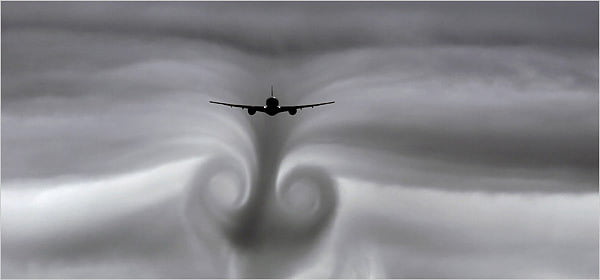
The wingtip vortices in the wake of a commercial airliner distort the clouds as the plane descends. Wingtip vortices form as a result of high pressure air from the underside of the wing accelerating around the wingtips to reach the low pressure on top of the wing. They can be hazardous to other (lighter) aircraft. They also contribute to downwash that decreases the effective lift of a wing. Geese use the same mechanism to their advantage when flying in a V-formation, and some snakes use it to glide.

The Ekranoplan
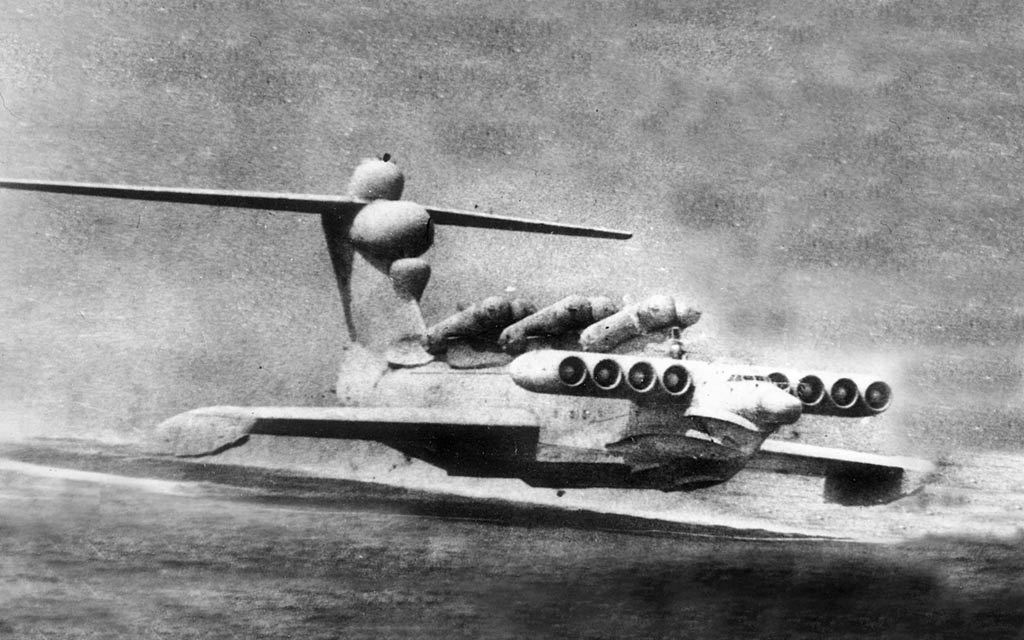
The ekranoplan, the monster of the Caspian Sea, was a Soviet-era aircraft nearly 74 meters in length and weighing 380,000 kgs fully loaded. (In contrast, the C-17 is 53 m long and weighs 265,350 kg fully loaded.) This enormous craft relied on ground effect to stay aloft, where it was capable of 297 knots. Flying close to the ground or water increases the possible lift on wings through a “cushioning effect” that increases pressure on the lower wing surface and by disrupting the formation of wingtip vortices which typically reduce lift through downwash.

Laminar Flow Control
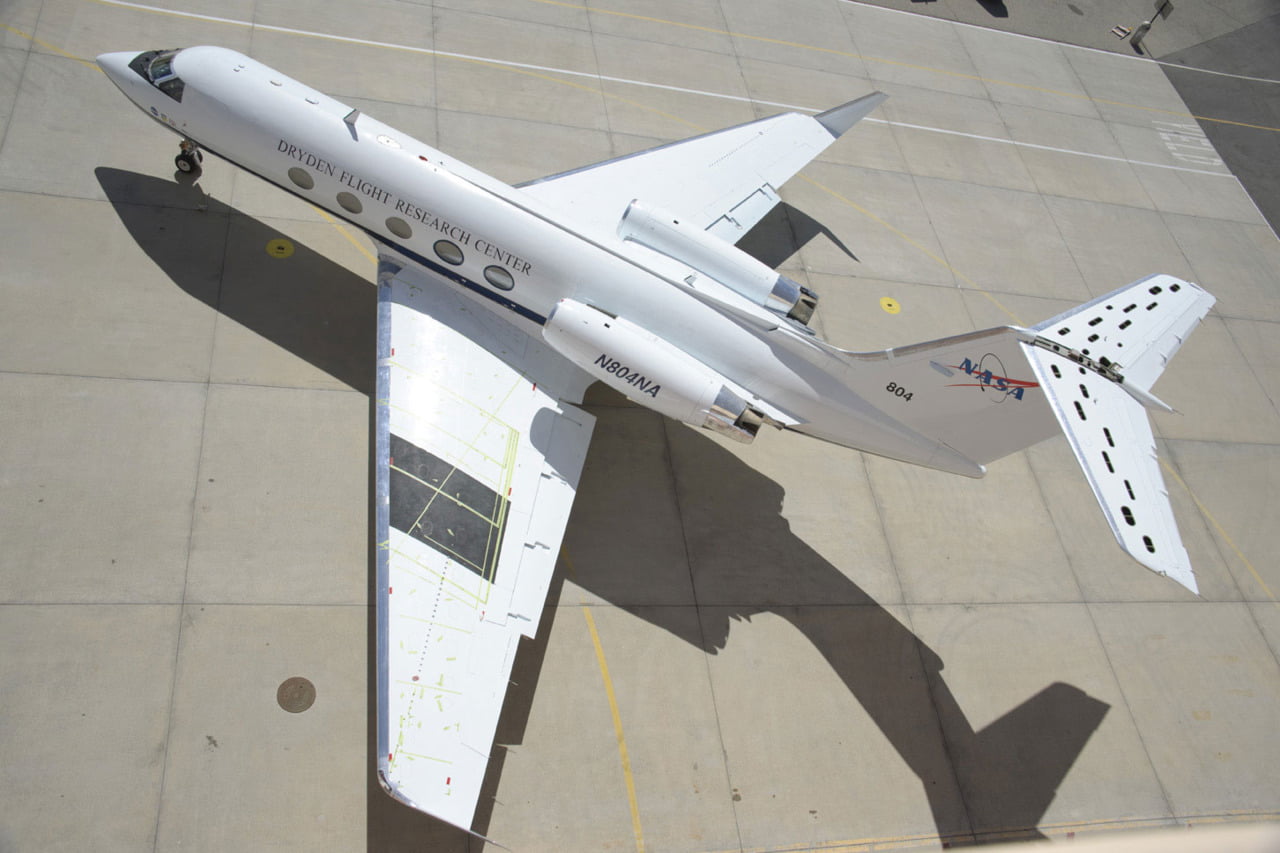
On Wednesday, March 30, 2011 at 3:00 EDT NASA engineers are holding an online chat about a current project to achieve laminar flow control on business jet-class airplanes. Keeping flow over an airplane’s wings laminar could decrease the total drag on an airplane by as much as 15%. In particular, this project involves placing tiny hockey-puck-shaped discrete roughness elements (DREs) along the front of the wing. These DREs are positioned such that they perturb the mean-flow over the wing at a higher frequency than the naturally most unstable frequency; as a result, flow actually remains laminar over a greater extent of the wing than would normally be the case. For more on the technical ideas, see this NASA blog post or feel free to ask questions in the comments. #
Full disclosure: This project is being conducted in joint with professors with whom I work, and the subject matter is related to my own research.
Computational Vortex Rings
Computational fluid dynamics (CFD) sometimes gets a bad rep as “colorful fluid dynamics”, but as computers get faster and faster, more complicated and physically accurate simulations are possible. Shown here are simulations of vortex rings and wingtip vortices in stunningly gorgeous detail. Understanding the evolution of these vortices from a fundamental level helps fluid mechanicians design better methods of controlling them. As mentioned in the video, wingtip vortices are a particularly hazardous everyday example; the time it takes for one plane’s wingtip vortices to disperse determines how quickly the next airplane can take-off or land on that same runway. Being able to break down these vortices faster would allow more frequent use of existing facilities.

Smoke Visualization on an F-16
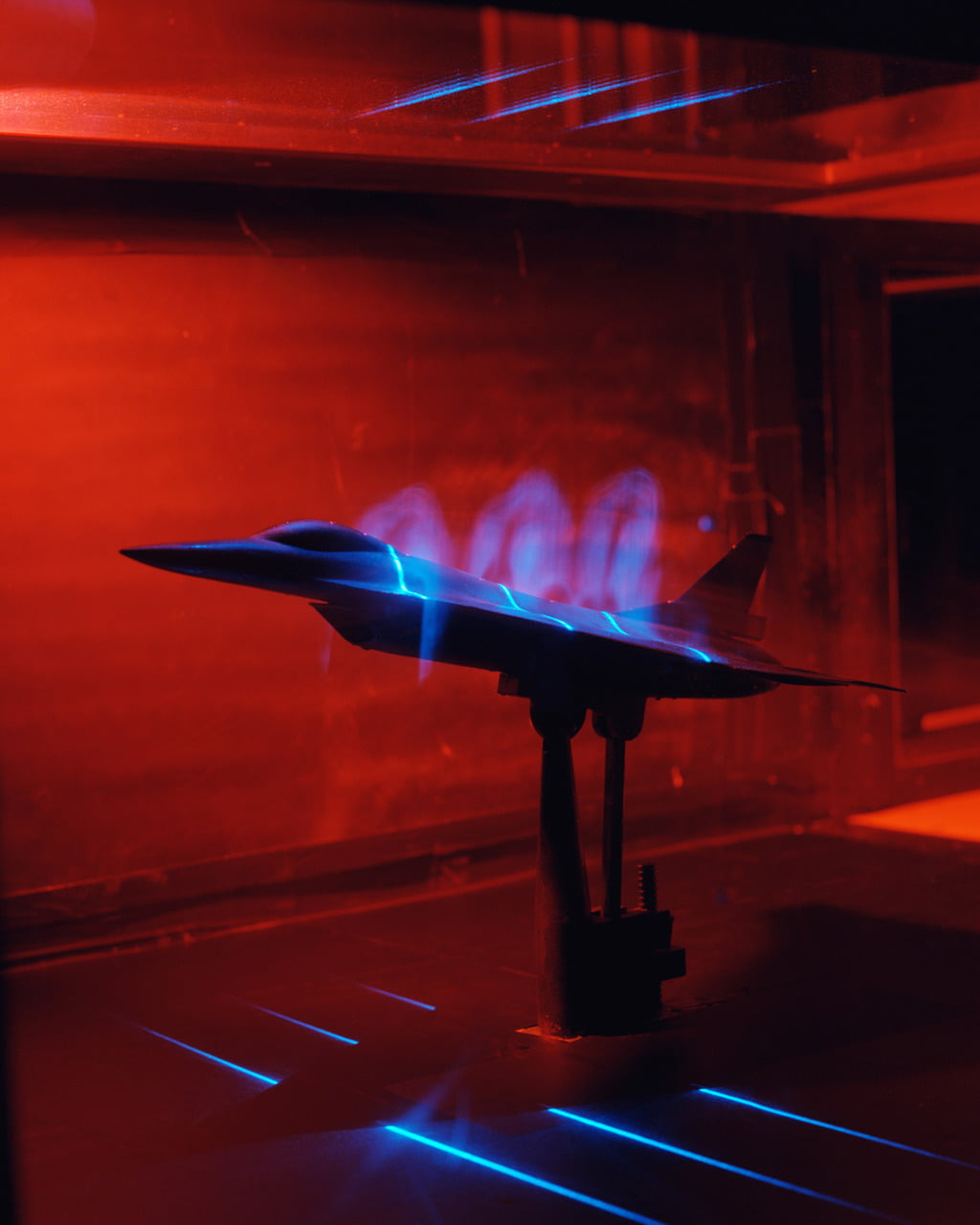
Flow around an F-16XL Scamp model is visualized using smoke illuminated by laser sheets. Lasers are common equipment in fluids laboratories; they’re useful for flow visualization and for many velocimetry techniques.

Wind Tunnel Testing
This photo shows a prototype of the X-48C blended wing body aircraft being tested in NASA Langley’s 12-Foot Low-Speed Tunnel. Blended wing bodies have many advantages over conventional tube-and-wing designs: the entire surface of the craft can generate lift; the usable cargo/passenger area of the craft is increased; and, structurally, the craft is easier to manufacture. Flight tests of a remote-controlled version of the craft have also taken place.
Air Force Gears Up For Hypersonic Missile Test
Air Force Gears Up For Hypersonic Missile Test
The U.S. Air Force has announced another test of the X-51 Waverider coming up on March 22nd. This will be the latest in only a handful of tests of a new supersonic combustion ramjet engine, also known as a scramjet. The test should involve flying at Mach 6 for about four minutes. Hopefully we’ll have see some exciting results from that test flight in a week or so.