Wingtip vortices mark the path of Discovery as she makes her final landing. Though not always visible, these vortices are generated by any lifting body planform and can be a major source of induced drag on the craft. Here the vortices are visible because the low pressure in the core of the vortex caused a local temperature drop below the dew point, thus causing condensation. Such vortices persist for significant lengths of time in the wake of aircraft; they are a major source of wake turbulence, which limits how frequently aircraft can take-off or land on a single runway. (Photo by Jen Scheer)
Tag: airplanes

Wright Brothers’ Wind Tunnel
A large part of the Wright Brothers’ ultimate success in creating the first powered heavier-than-air craft came as a result of work done in their homemade wind tunnel, shown above. In the aftermath of the failure of their 1901 Glider, the brothers decided that the lift and drag data they had used from Otto Lilienthal must be inaccurate. They built this wind tunnel and its force balances to measure lift and drag on two hundred different airfoils themselves and were rewarded with far more successful flights with their 1902 Glider, which led directly to the Wright Flyer in the following year. #

Hole-Punch Clouds
These hole-punch clouds seen over Myrtle Beach, SC were probably caused by three aircraft flying in military formation. When airplanes pass through supercooled water vapor, the acceleration of air over the wing causes a pressure drop that can flash-freeze the water vapor, resulting in a localized snow shower. See National Geographic for more. #

Frosting on Superhydrophobic Surfaces
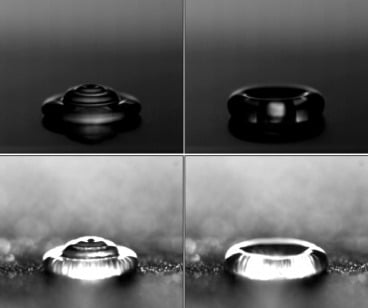
Icing on airplane wings can be disastrous for lift and control, and thus how ice initially forms on a wing is an active area of research. New work shows that superhydrophobic (water-fearing) surfaces may actually promote ice buildup. Superhydrophobic surfaces are prone to frosting–collecting ice that forms directly from a vaporous state–and that fine layer of frost is conducive to further ice buildup from a liquid state. The photo above shows a water droplet striking a dry superhydrophobic surface (top) and a frosted superhydrophobic surface (bottom). (via Gizmodo) #

Airplanes Creating Snow
Scientists now think that that airplanes may be responsible for increasing local snowfall by flash-freezing supercooled water vapor in clouds. Water droplets can persist in the atmosphere to temperatures of -42 degrees Celsius. But when an airplane’s wing passes through moist air, the acceleration of the air passing over the wing causes a pressure decrease that can drop the temperature by as much as 19 C, causing the water droplets to form ice crystals immediately. (The particulate matter in the aircraft exhaust probably also aids this process.) The same behavior can also create holes in clouds and cause ice to form on the wings. # (Related behavior: vapor cones)
Photo credit: lhoon

xkcd and Lift
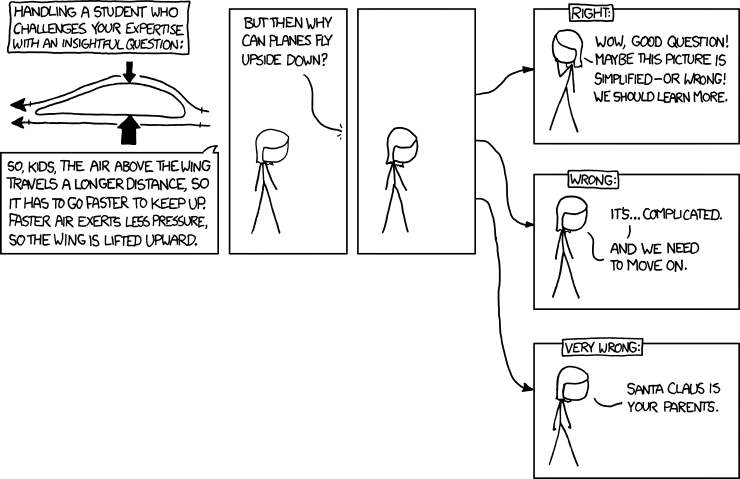
xkcd identifies a very common misconception about how airfoils work! (via Vinnchan and jasonas14) #

Jet-Based Control
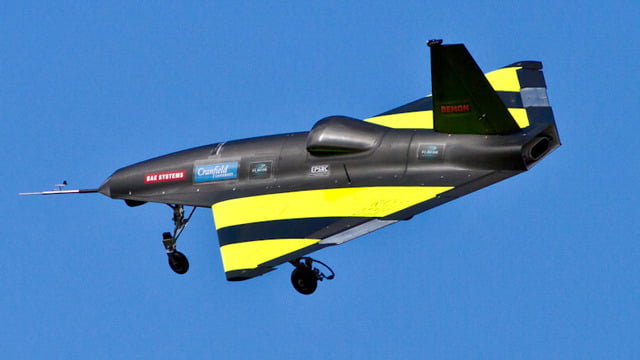
Researchers have flown the first aircraft designed to maneuver without conventional control surfaces like ailerons and flaps. Instead of changing the wing geometry to alter the lift on different parts of the craft, the UAV uses strategically placed jets of air along the wing to control its flight. The plane can also alter the direction of its thrust, not by turning the nozzle as is conventionally done, but by modifying the thrust vector by directing and firing a secondary jet into the exhaust. #

Supersonic
Moving supersonically–faster than the local speed of sound–can cause some awesome effects. Among these are vapor cones (a.k.a. Prandlt-Glauert singularities), shock waves, and, of course, the sonic boom.
How Wings Create Lift
One of the topics in fluid dynamics almost everyone has come across is the explanation of how airplanes produce lift. Using Bernoulli’s principle–which relates velocity and pressure–and a picture of an airfoil, your average science text will say that a bit of air going over the top of the airfoil has to travel farther than a bit of air going under the airfoil, and that, therefore, the air over the top travels faster than the air under the airfoil.
Unfortunately, this is misleading and, depending on the wording, outright wrong! The hidden assumption in this explanation is that air that goes over the top and air that goes under the bottom have to reach the trailing edge of the airfoil at the same time. But why would that be? (As one of my profs once said, “There is nothing in physics that says there is Conservation-Of-Who-You-Were-Sitting-Next-To-When-You-Started.”)
Take a look at the video above. It shows an airfoil in a wind tunnel using smoke visualization to show how the air moves. Around the 0:25 mark, the video slows to show a pulse of smoke traveling over the airfoil. What happens at the trailing edge? The smoke going over the top of the airfoil is well past the trailing edge by the time the smoke going under the airfoil reaches the trailing edge!
It’s true that air goes faster over the top of the airfoil than the bottom and that this causes a lower pressure on top of the airfoil (as Bernoulli tells us it should) and that this causes an upward force on the airfoil. But which causes which is something of a chicken-and-egg problem.
A more straightforward way, in my opinion, of explaining lift on an airplane is by thinking about Newton’s 3rd law: for every action, there is an equal and opposite reaction. Take a look at the air’s movement around the airfoil as the angle of attack is increased around 1:00 on the video. Just in front of the airfoil, the air is moving upward. Just after the airfoil, the air is pointed downward. A force from the airfoil has pushed the air down and changed its direction. By Newton’s 3rd law, this means that the air has pushed the airfoil up by the same amount. Voila! Lift!
Wingtip Vortices in Flight
This NASA Langley Research Center test shows real-time flow visualization of the wingtip vortices off a C-5A Galaxy aircraft.