Tag: airplanes

  • Icing on Airplane Wings

    Icing on Airplane Wings

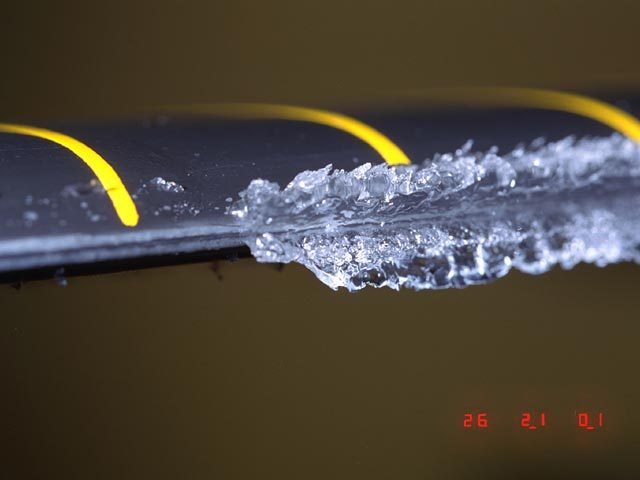
    Icing on airplane wings remains little understood and a major hazard. These photos show examples of ice formation along the leading edge of a swept wing. If an aircraft flies through a cloud of supercooled water droplets, the droplets will freeze shortly after impact with the aircraft’s wings. As ice continues to build up in strange shapes, the aerodynamic profile of the wing changes, which can lead to disastrous effects as the stall and control characteristics of the wing shift. (Photo credit: NASA Glenn Research Center)

  • Micro Air Vehicle Flow Viz

    Micro Air Vehicle Flow Viz

    A smoke wire shows the deformation of streamlines around a swept-winged micro air vehicle (MAV). These crafts typically feature wingspans smaller than one foot and, thus, never develop the type of flow fields associated with larger fixed-wing airplanes. This complicates theoretical predictions of lift and drag for MAVs as well as making them difficult to control. MAVs have numerous commercial and military applications, including search and rescue operations. (Photo credit: Tom Omer)

  • Featured Video Play Icon

    Examples of Flutter

    Aeroelasticity is the study of the interaction of structural and aerodynamic forces on an object, and its most famous example is flutter, which occurs when the aerodynamic forces on an object couple with its natural structural frequencies in such a way that a violent self-excited oscillation builds. What does that mean? Take a look at the video above. This compilation shows examples of flutter on wind tunnel models, road signs, airplanes, and the Tacoma Narrows Bridge–one of the most famous examples of all time. When air moves over and around an object, like a stop sign, it exerts forces that cause the structure to twist or vibrate. Those vibrations then alter the airflow around the object, which changes the aerodynamic forces on the object.  If the motion of the object increases the aerodynamic forces which then increase the oscillation, then a potentially destructive flutter cycle has been created. Flutter is very difficult to simulate computationally, so tests are usually performed experimentally to ensure that any vibrations in the system will damp out rather than grow to the point of structural failure like many of the examples in the film.

  • Featured Video Play Icon

    Vortices on an Airliner

    Wingtip vortices form on airplanes due to the finite length of their wings. In general, lift on the wings results from low-pressure, high-velocity air moving over the top of the wing and high-pressure, low-velocity air moving below the wing. Near the wingtips, the high-pressure air is able to slip around the edge to the top of the wing, generating a vortex that then trails behind the airplane. The same thing is occurring in the video above, except the edges of the wing’s control surfaces are serving as the tip of the wing. Similar vortices also exist at the wingtips, but they are not made visible by condensation as the aileron vortices are.

  • Flow Over Swept Wings

    Flow Over Swept Wings

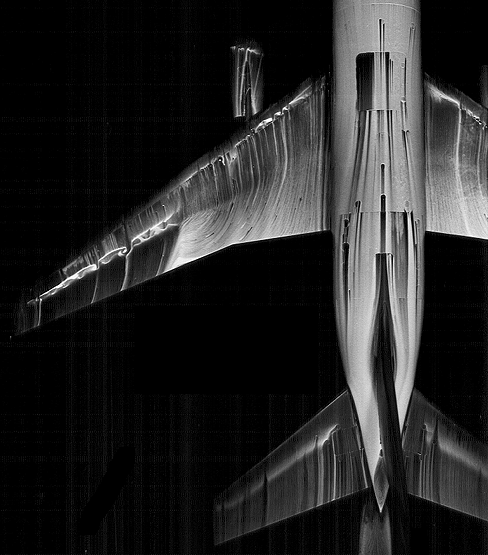
    Flow over a swept wing behaves very differently than a straight fixed wing or an airfoil. Instead of flowing straight along the chord of the wing in a two-dimensional fashion, air is also directed along the wing, parallel to the leading edge. The above oil flow visualization on a swept wing airplane model shows this curvature of streamlines.  As a result of this three-dimensional flow behavior, boundary layers on swept wings are subject to the crossflow instability, which manifests as co-rotating vortices aligned to within a few degrees of the streamlines. Triggering this boundary layer instability can lead to turbulence and higher drag for the aircraft.

  • Featured Video Play Icon

    Circulation Around an Airfoil

    As a followup to yesterday’s question about ways to explain lift on an airfoil, here’s a video that explains where the circulation around the airfoil comes from and why the velocity over the top of the wing is greater than the velocity around the bottom. Kelvin’s theorem says that the circulation within a material contour remains constant for all time for an inviscid fluid. Before the airplane moves, the circulation around the wing is zero because nothing is moving. As shown in the video, as soon as the plane moves forward, a starting vortex is shed off the airfoil. As the plane flies, our material contour must still contain the starting position and thus the starting vortex. However, in order to keep the overall circulation in the contour zero, the airfoil carries a vortex that rotates counter to the starting vortex. This is the mechanism that accelerates the air over the top of the wing and slows the air around the bottom. Now we can apply Bernoulli’s principle and say that the faster moving air over the top of the airfoil has a lower pressure than the slower moving air along the bottom, thus generating an upward force on the airfoil. (submitted by jessecaps)

  • Reader Question: How Airfoils Produce Lift

    doughboy3-deactivated20120305 asks:

    I’m a Undergrad Aeronautical Engineering student. I’m curious as to your opinion as to how airfoils produce lift. I know the usual theory told in this situation. However my aerodynamics professor says that there are many things going on during the flow around an airfoil. I’m hoping to get a better idea of the different mechanisms responsible for lift.

    There’s a common misconception of Bernoulli’s principle that’s often used to explain how an airfoil creates lift (which I assume is the “usual theory” to which you refer), and while there are many correct (or, perhaps, more correct) ways of explaining lift on an airfoil, I think the only opinions involved are as to which explanation is best. After all, opinions don’t keep a plane in the air, physics does!

    I tackled the air-travels-farther-over-the-top misconception and presented one of my preferred ways of looking at the situation in a previous post; in short, the airfoil’s shape causes a downward deflection of the flow, which, by Newton’s 3rd law, indicates that the air has exerted an upward force on the airfoil. There’s a similar useful video from Cambridge on the topic here.

    Another explanation I have heard used concerns circulation and its ability to produce lift (see the Kutta-Joukowski theorem for the math). In this case, it’s almost easier to think about lift on a cylinder instead of lift on a more complicated shape like an airfoil.  If you spin a cylinder, you’ll find that the circulation around that object results in a force perpendicular to the flow direction. This is called the Magnus effect and, in addition to explaining why soccer balls sometimes curve strangely when kicked, has been used to steer rotor ships. One of my undergrad aero professors used to do a demonstration where he’d wrap a string around a long cardboard cylinder and demonstrate how, by pulling the string, the cylinder’s spinning produced lift, making the cylinder fly up off the lectern and attack the unsuspecting students.

    An airfoil doesn’t spin, but its shape produces the same type of circulation in the flow field.  Without delving into the mathematics, it’s actually possible through conformal mapping and the Joukowski transform to show that the potential flow field around a spinning cylinder is identical to that around a simple airfoil shape! Although that mathematical technique is not all that useful in a world where we can calculate the inviscid flow around complicated airfoils exactly, it’s still pretty stunning that we can analytically solve potential flow around (and thus estimate lift for) a host of airfoil shapes on the back of an envelope.

    In short, your aerodynamics professor is right in saying that there are many things going on during the flow around an airfoil. If you get a roomful of aerodynamicists together and ask them to explain how airfoils generate lift, you would be faced with a lively discussion with about as many competing explanations as there are participants. As you learn more in your classes, you’ll gain a better intuitive feel for how it works and you’ll learn more of the nuances, which will help you understand why there is no one simple-to-understand explanation that we use!**

    ** Lest I confuse someone into thinking that aerodynamicists don’t know how airfoils produce lift, let me add that the argument here is over how best to explain the production of lift, not over how the lift is produced. We have the equations to describe the flow and we can solve them. We know that lift is there and why. We simply like to argue over how to explain it to people without all the math.

  • Wingtip Vortices in Ground Effect

    [original media no longer available]

    If you’ve ever watched airplane contrails fade, you’ve probably observed the Crow instability, which causes the trailing wingtip vortices of the plane to interact and distort. The same effect is explored in the video above with the addition of ground effect. The first clip shows a pair of counter-rotating vortices from the side, showing a periodic pattern of thickening and thinning along the vortices. The second clip shows cross-sectional slices of the vortices at a thin and a thick point.

  • Featured Video Play Icon

    Aeroelastic Flutter

    Flutter is a rather innocuous term for a potentially dangerous phenomenon that can occur for any flexible structure in a moving flow. Aeroelastic flutter occurs when aerodynamic forces and a structure’s natural modes of vibration get coupled: the surrounding flow causes the object to vibrate, which alters the nature of the aerodynamic forces on the object, which, in turn, feeds into the object’s vibration. In some cases, damping will contain the motion to a limit cycle, but under other conditions, flutter results in an uncontrollable self-exciting oscillation that persists until destruction, as in the famous Tacoma Narrows Bridge collapse.

  • Aircraft Contrails

    [original media no longer available]

    Under the right atmospheric conditions, condensation can form, even at low speeds, as moist air is accelerated over airplane wings. This acceleration causes a local drop in pressure and temperature, which can cause water vapor in the air to condense. The condensation can sometimes get pulled into the wingtip vortices shed off of the wings, tail, and ailerons of an aircraft, as in the video above, making the aerodynamics of the airplane visible to the naked eye.