Tag: aerodynamics

  • Sochi 2014: Speedskating Redux

    Sochi 2014: Speedskating Redux

    Since we wrote about the US team’s speedskating suits last week, they have become the subject of major controversy. After six events, the US team had not placed higher than seventh despite strong World Cup results during the autumn. The Wall Street Journal reported that three people familiar with the team suggested a design flaw:

    Vents on back of the suit, designed to allow heat to escape, are also allowing air to enter and create drag that keeps skaters from staying in the low position they need to achieve maximum speed, these people said. One skater said team members felt they were fighting the suit to maintain correct form. #

    To address this, some members had seamstresses sew fabric over the vent. The upper left image shows the original suit and the one on the right shows a team member in a modified suit. The change made no apparent impact on the skaters’ finish. The US team has no gone so far as to get a special dispensation to switch back to their older suits but still the podium eluded skaters in Saturday’s events. 

    Now, to be clear, I have not seen any data on the development of Under Armour’s suits beyond the public coverage, and I have no connections to any of the parties involved. However, given the extensive nature of the wind tunnel development that went into these suits, I would be exceptionally surprised if there was a design flaw capable of slowing skaters down by nearly 1 second over 1000 meters. It would require a major flaw in the testing design and methodology to overlook such a substantial drag effect.

    At the same time, there are other factors that may be affecting the US team adversely. Sochi’s races are taking place at low altitudes, where the air is denser and drag is greater. This does affect all competitors, but it is worth noting that many of the US speedskaters train at altitude in Salt Lake City and that the entire team had their training camp at high altitude in Italy prior to Sochi.  Another factor is the ice conditions. Salt Lake has what is considered fast ice that permits longer glides between each step, whereas Sochi has soft ice, which requires a faster tempo and does not glide as easily. (Image credits: Under Armour, Getty Images, P. Semansky/AP)
  • Sochi 2014: Luge

    Sochi 2014: Luge

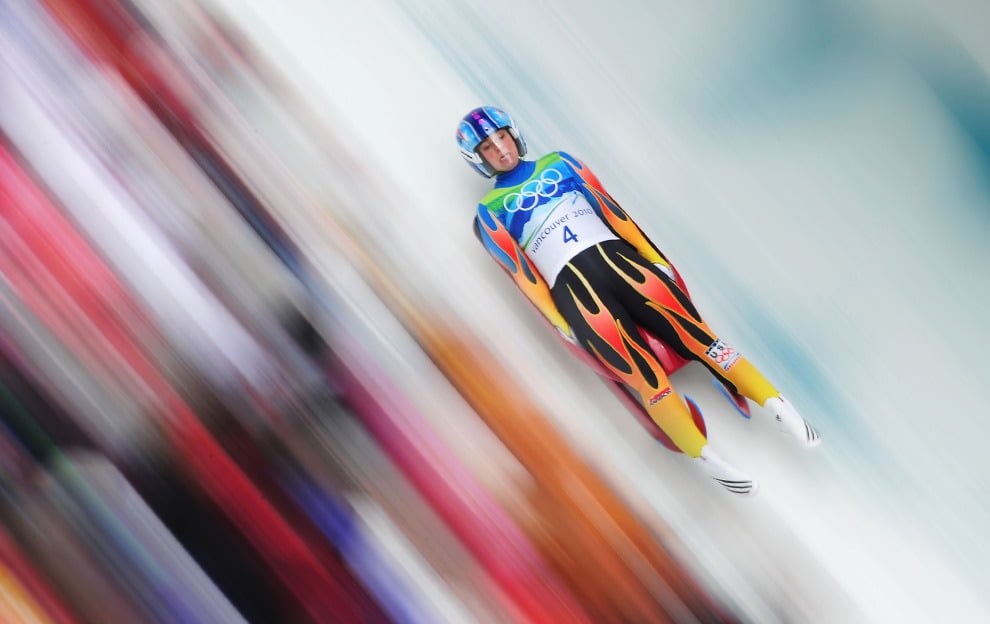
    Like athletes in many of the gravity sports in the Winter Olympics, lugers want to be as aerodynamic as possible to minimize their drag. Once a luger has started sliding, only gravity can increase their speed – every other force, from friction to drag, pulls away valuable time. Luge sleds are built on sharp runners and athletes slide feet-first in a position much more streamlined than the head-first position of skeleton. Both contribute to the much higher speeds in luge – up to 140 kph (87 mph). Luge is also the only sliding sport measured down to thousandths of a second, so every gram of drag* makes a difference. Lugers keep their heads pulled back and wear full helmets to keep the air flow consistent and attached as much as possible. It is also typical for them to spend time in the wind tunnel, testing their sled’s aerodynamics, adjusting their position, and even testing their suits. (Photo credit: S. Botterill)

    * For those wondering, yes, drag is a force and a gram is a unit of mass, not force. However, it is not unusual when testing athletes in wind tunnels to compare drag between configurations in terms of grams.

    FYFD is celebrating the Games with a series on fluid dynamics in the Winter Olympics. Stay tuned for more!

  • The Physics of a Flying-V

    The Physics of a Flying-V

    New research using free-flying northern bald ibises shows that during group flights the birds’ positioning and flapping maximize aerodynamic efficiency. In flight, a bird’s wings generate wingtip vortices, just as a fixed-wing aircraft does. These vortices stretch in the bird’s wake, creating upwash in some regions and downwash in others as the bird flaps. According to theory, to maximize efficiency a trailing bird should exploit upwash and avoid downwash by flying at a 45-degree angle to its leading neighbor and matching its flapping frequency. The researchers found that, on average, this was the formation and timing the flock assumed. In situations where the birds were flying one behind the next in a straight line, the birds tended to offset their flapping by half a cycle relative to the bird ahead of them–another efficient configuration according to theory. Researchers don’t yet know how the birds track and match their neighbors; perhaps, like cyclists in a peloton, they learn by experience how to position themselves for efficiency. For more information, see the researchers’ video and paper. (Photo credit: M. Unsold; research credit: S. Portugal; via Ars Technica; submitted by M. Piedallu van Wyk)

  • Featured Video Play Icon

    Simulating a Curveball

    Spinning an object in motion through a fluid produces a lift force perpendicular to the spin axis. Known as the Magnus effect, this physics is behind the non-intuitive behavior of football’s corner kick, volleyball’s spike, golf’s slice, and baseball’s curveball. The simulation above shows a curveball during flight, with pressure distributions across the ball’s surface shown with colors. Red corresponds to high pressure and blue to low pressure. Because the ball is spinning forward, pressure forces are unequal between the top and bottom of the ball, with the bottom part of the baseball experiencing lower pressure. As with a wing in flight, this pressure difference between surfaces creates a force – for the curveball, downward. (Video credit: Tetra Research)

  • Fluids Round-up – 25 May 2013

    Fluids Round-up – 25 May 2013

    Sometimes I come across cool links and stories about fluid dynamics that don’t quite fit into a typical FYFD post, but I’d like to start sharing those semi-regularly with round-up posts. Here’s some fun stuff I’ve seen lately:

    And, yes, that last Specialized video chat includes an FYFD shout-out about 49 minutes in. 🙂

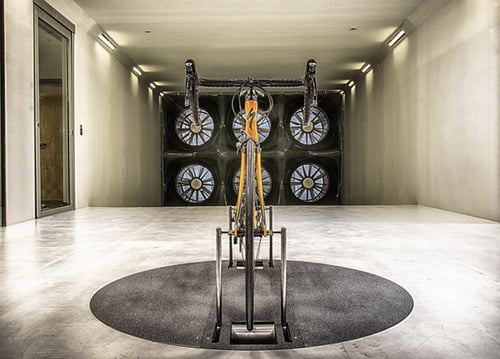
    (Photo credit: Specialized)

  • Featured Video Play Icon

    Diving Peregrines

    Few animals can compete with a peregrine falcon for pure speed. There is evidence that, when diving, the falcon can reach speeds upward of 200 mph (320 kph). That the birds can achieve this by pulling their wings back into a low-drag profile is impressive, but the control they exert to do so is even more astounding. The placement and acuity of a falcon’s eyes would require tilting its head roughly 40 degrees if diving straight down on its prey. Such asymmetry increases their drag by more than 50% and creates a torque that yaws the bird. Instead, as seen in the video above, the falcon keeps its head straight and flies in a spiral-like dive, allowing it to maintain sight contact with its target and maximizing its speed despite the extended dive. (Video credit: BBC; research credit: V. A. Tucker)

  • Featured Video Play Icon

    Flapping Flags

    Sometimes structural forces and aerodynamic forces combine to produce instabilities. One of the most common and familiar examples of this, a flag flapping in the breeze, remains extremely complex to analyze and describe. The flexibility of the flag, and its small but finite resistance to bending, combine with the variability of air flow around the flag to create a fascinating dance of effects. This same aeroelastic flutter can create disastrous results for structures and aircraft. For more on the flapping flag, see Argentina and Mahadevan (2004). (Video credit: S. Morris)

  • Featured Video Play Icon

    Magnus Force

    Physics students are often taught to ignore the effects of air on a projectile, but such effects are not always negligible. This video features several great examples of the Magnus effect, which occurs when a spinning object moves through a fluid. The Magnus force acts perpendicular to the spin axis and is generated by pressure imbalances in the fluid near the object’s surface. On one side of the spinning object, fluid is dragged with the spin, staying attached to the object for longer than if it weren’t spinning.  On the other side, however, the fluid is quickly stopped by the spin acting in the direction opposite to the fluid motion. The pressure will be higher on the side where the fluid stagnates and lower on the side where the flow stays attached, thereby generating a force acting from high-to-low, just like with lift on an airfoil. Sports players use this effect all the time: pitchers throw curveballs, volleyball and tennis players use topspin to drive a ball downward past the net, and golfers use backspin to keep a golf ball flying farther. (Video credit: Veritasium)

  • Using Flow Viz for Optimization

    Using Flow Viz for Optimization

    Flow visualization is a powerful design tool for engineers. When Google was interested in determining optimal configurations for their heliostat array, they turned to NASA Ames’ water tunnel facility to test upstream barriers to deflect flow off the heliostats.   In each photo, flow is from left to right and fluorescent dye is used to mark streamlines and reveal qualitative flow detail. Upstream of the obstacles, the streamlines are coherent and laminar, but after deflection, the flow breaks down into turbulence. In this case, such turbulence is desirable because it lowers the local fluid velocity and thus the aerodynamic loads experienced by each heliostat, potentially allowing for a savings in fabrication. For more, see Google’s report on the project. (Photo credits: google.org)

  • London 2012: Discus Physics

    London 2012: Discus Physics

    Like the javelin, the discus throw is an athletic event dating back to the ancient Olympics.  Competitors are limited to a 2.5 m circle from which they throw, leading to the sometimes elaborate forms used by athletes to generate a large velocity and angular momentum upon release. The flight of the discus is significantly dependent on aerodynamics, as the discus flies at an angle of attack. Spin helps stabilize its flight both dynamically and by creating a turbulent boundary layer along the surface which helps prevent separation and stall. Unlike many other events, a headwind is actually advantageous in the discus throw because it increases the relative velocity between the airflow and the discus, thereby increasing lift. The headwind also increases the drag force on the discus, but research shows the benefits of the increased lift outweigh the effects of increased drag, so much so that a discus flies further in air than it would in a vacuum. (Photo credits: P Kopczynski, Wiki Commons, EPA/K Okten)

    FYFD is celebrating the Olympics by featuring the fluid dynamics of sports. Check out our previous posts, including why corner kicks swerve, what makes a pool fast, how an arrow flies, and how divers avoid splash.