Track cycling is a sport where speed is everything. As much as 90% of the resistance a rider has to overcome is aerodynamic drag. To minimize drag, riders wear form-fitting one-piece skinsuits and wear special, streamlined helmets. They have aerodynamic bikes (unique left-side-drive ones, if you’re the Team USA women) and ride with their arms close together and thrust in front of them to minimize the frontal area they expose.
Even the tactics of racing rely heavily on aerodynamics. In events like team pursuit cyclists stay extremely close to the wheel of the rider ahead of them in order to remain in that rider’s slipstream and experience less drag. When switching off the position of lead rider, cyclists use the curvature of the track to help them move to the back of the paceline quickly to minimize the time spent outside of their teammate’s draft. (Image credits: GettyImages via the Guardian and the IOC, source)
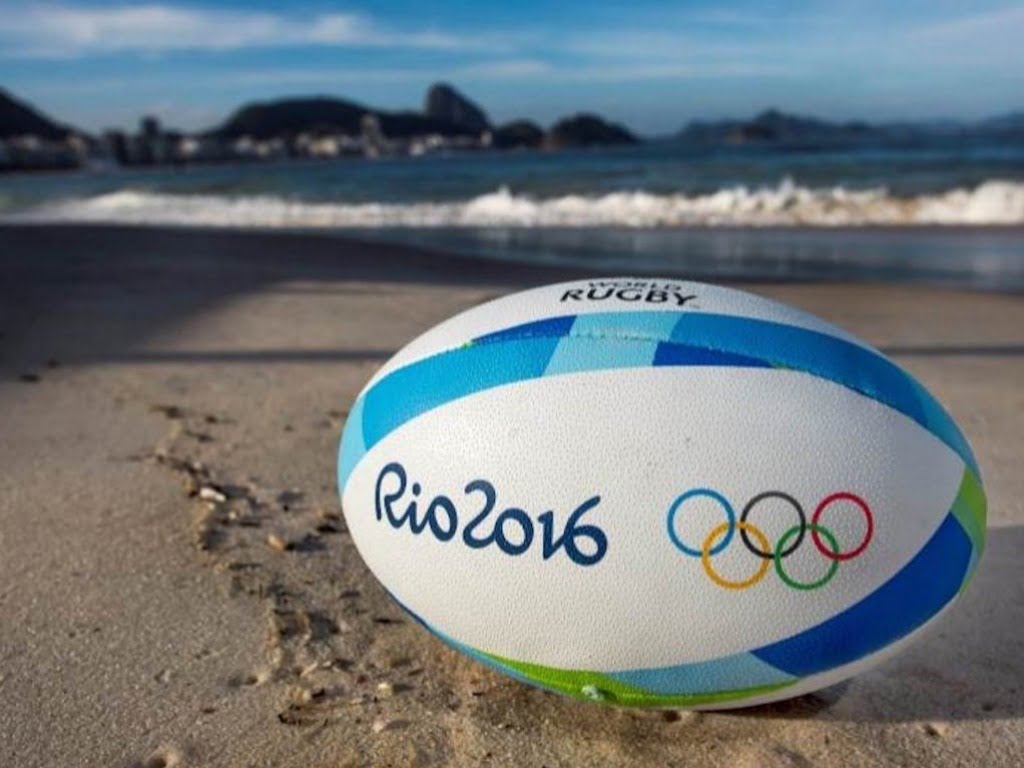
The sport of rugby returns to the Olympics in Rio this year. Rugby’s ball is somewhat similar in size and shape to an American football, but it is a little wider and more rounded. Aerodynamically, this means that the rugby ball has more drag, but it is also more stable in flight, allowing players to pass and kick accurately, with or without a spiral.
As seen in the flow visualizations above, air travels up and around the ball before separating on the far side. The more the ball is tilted, the larger this separated region is and the greater the drag. At the same time, though, that tilt provides lift on the ball. The ideal orientation is the one with the largest ratio of lift force and drag force. For a rugby ball, this occurs at about 40 degrees.(Image credits: Planet Rugby; A. Vance et al.)
Today marks the official start of the 2016 Summer Olympics in Rio. Here at FYFD we’ll be celebrating by taking a look at how fluid dynamics affects Olympic sports. You can check out our previous series on the London Olympics here. Since this weekend features the men’s and women’s cycling road races, we’ll get started with cycling!
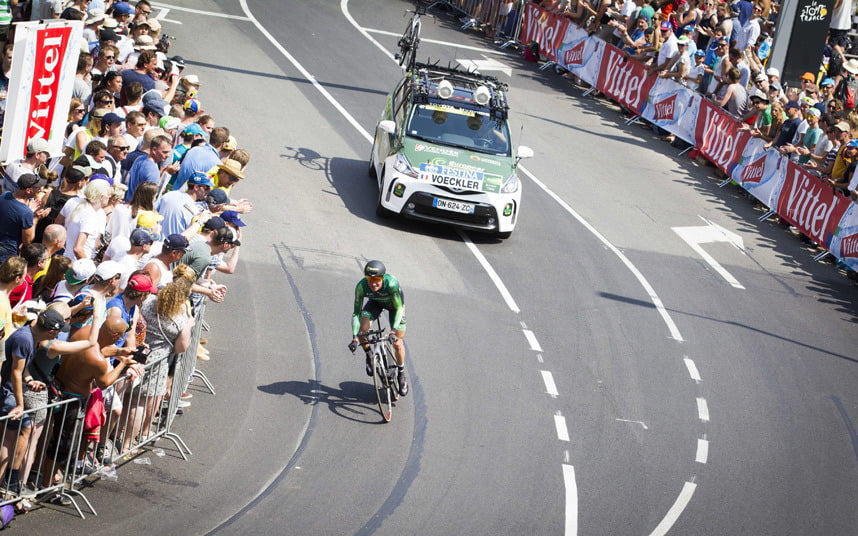
In road cycling, equipment and race strategy are all built around aerodynamic efficiency. It’s understood that following a car or motorbike gives a cyclist an unfair advantage, and officials can be quick to punish infractions. What the rules don’t account for, though, is the advantage a cyclist gets when they’re followed by a motorbike (or car). These vehicles are significantly larger than a cyclist, and when they are trailing a cyclist, they have a significant upstream effect. Essentially the higher pressure traveling ahead of the motorbike will counter the low pressure region immediately behind the cyclist. The result is that the cyclist, despite being in front, experiences less drag than they would if the motorbike weren’t there.
The difference isn’t tiny either: if a motorbike follows a rider at a distance of 0.5 m for just 1 km, the rider saves more than 2 seconds. When events can be won or lost by fractions of a second, those gains are significant. (Image credits: DCMS; B. Blocken et al., GettyImages, Reuters; research credit: B. Blocken et al.; submitted by Marc A.)
A new study has found that budgerigars (also commonly known as parakeets or budgies) fly at only two distinct speeds. The researchers flew the birds in a tapered tunnel to see how they navigated in response to widening or narrowing paths. What they found, regardless of the flight direction in the tunnel, is that the birds fly at approximately 9.5 m/s in areas wider than 2.5 times their wingspan and drop suddenly to a speed about half that when in narrower areas. The higher speed falls within the bird’s most energy-efficient range, suggesting that the birds may prefer flying at this condition. Insects like bumblebees also change speeds when entering cluttered environments, but the insects do so gradually, not suddenly like the budgerigars. The reason for this difference is not yet known, but it could relate to how the animals sense their environment or to differences in their flight efficiency when varying speed. (Image credit: J. Bendon; research credit: I. Schiffner and M. Srinivasan; submitted by Marc A.; h/t to Irmgard B.)
We play with fluid dynamics all the time, though we don’t always think of it as such. Here are a few ways it shows up in the ways we play:
Aerodynamics This is the study of air moving past an object. Whether you’re throwing a paper plane, flying a kite, or riding a bike, aerodynamics has an impact on what you’re doing.
Lift
Skipping a rock won’t work unless its impact generates some lift, but we see lift in lots of other places, too, from birds and planes to racecars and sailboats.
Magnus Effect
The Magnus effect relates to lift forces on a spinning object. It can affect the way a frisbee flies, but we see it a lot in ball-related sports, too. The flight of golf balls, volleyballs, baseballs, and soccer balls can all be significantly impacted by the Magnus effect. Check out these videos for a primer on the Magnus effect and the reverse Magnus effect.
Bubbles
Everybody loves playing with bubbles. But they may have more of a impact than you realize, whether it’s in making the foam on your latte, enhancing the aroma of your champagne, or making your joints pop.
Tune in all week for more examples of fluid dynamics in daily life. (Image credit: S. Reckinger et al., source)
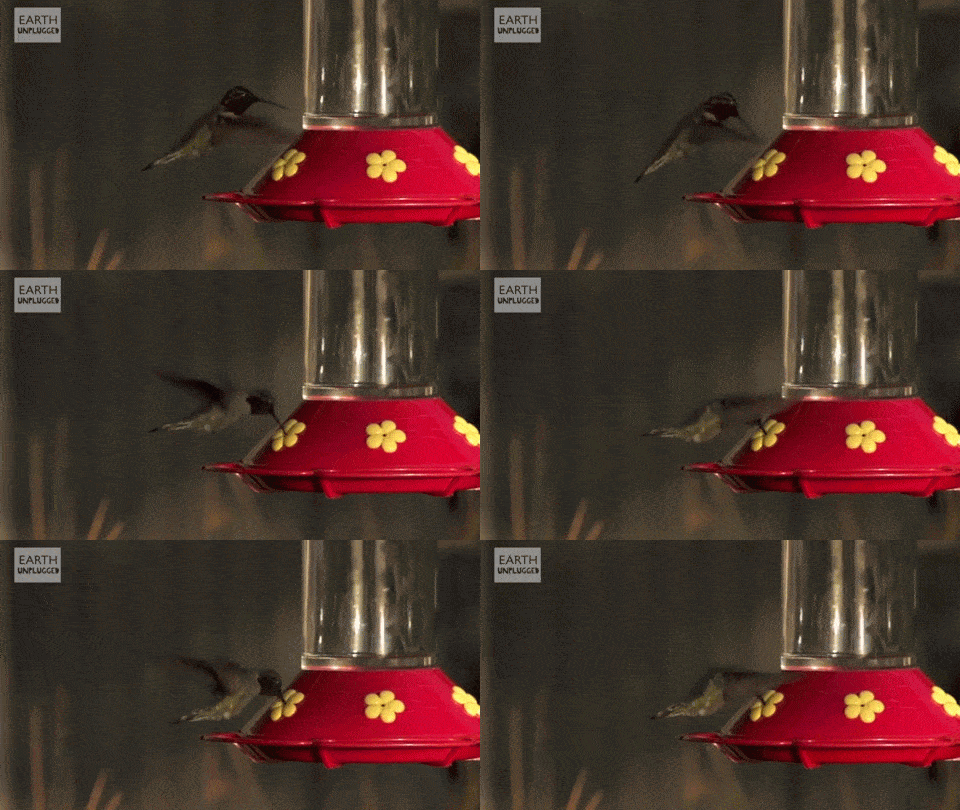
Hummingbirds are incredible flyers, especially when it comes to hovering. To hover stationary and stable enough to feed, the hummingbird’s flapping pattern not only has to generate enough lift, or vertical force, to counteract their weight, but the bird must balance any forward or backward forces generated during flapping.
As you can see in the animations above, when hovering the hummingbird’s wings move forward and back rather than up and down. When slowed down even further, the figure-8 motion of the wings becomes apparent. This careful motion is key to the hover; it allows the bird to generate about 70% of its lift on the downstroke when the wings move forward and creates the remainder of the lift needed on the upstroke. For much more high-speed footage of hummingbirds, check out the full BBC Earth Unplugged video, but be warned: you may experience a cuteness overdose! (Image credit: BBC Earth Unplugged, source)
This year’s Tour de France opened with an individual time trial stage in which riders competed solo against the clock. But, according to numerical simulations, some riders may get an unfair aerodynamic advantage in the race if they have a following car. The top image shows the pressure fields around a rider with a car following 5 meters behind versus 10 meters behind. The size of the car means that it displaces air well in advance of its arrival. By following a rider closely, that car’s high pressure region can help fill in a cyclist’s wake, thereby reducing the drag the rider experiences. For a short time trial like the 13.8 km race that kicked off this year’s tour, a rider whose car follows at 5 meter could save 6 seconds over one whose car followed at the regulation 10 meter distance. (As it happens, the stage was decided by a 5 second margin.) Since not all riders get a team follow car, it’s especially important to ensure that those who do aren’t receiving an additional advantage. For more about cycling aerodynamics, check out our previous cycling posts and Tour de France series. (Image credit: TU Eindhoven, EPA/J. Jumelet; via phys.org; submitted by @NathanMechEng)
so, how is lift actually generated? i’ve been going through Anderson’s Introduction to Flight (6th Ed.) and while it offers the derivation of various equations very thoroughly, it barely touches on why lift is generated, or how camber contributes to the increase of C(L)
This is a really good question to ask. There are a lot of different explanations for lift out there (and some of the common ones are incorrect). The main thing to know is that a difference in pressure across the wing–low pressure over the top and higher pressure below–creates the net upward force we call lift. It’s when you ask why there’s a pressure difference across the wing that explanations tend to start diverging. To be clear, aerodynamicists don’t disagree about what produces lift – we just tend to argue about which physical explanation (as opposed to just doing the math) makes the most sense. So here are a couple of options:
Newton’s third law states that for every action there is an equal and opposite reaction. If you look at flow over an airfoil, air approaching the airfoil is angled upward, and the air leaving the aifoil is angled downward. In order to change the direction of the air’s flow, the airfoil must have exerted a downward force on the air. By Newton’s third law, this means the air also exerted an upward force–lift–on the airfoil.
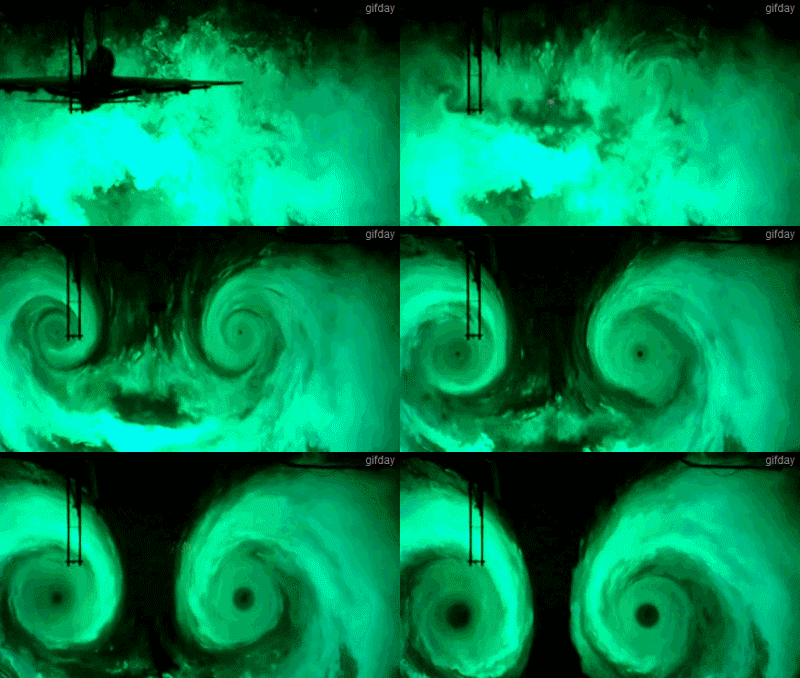
The downward force a wing exerts on the air becomes especially obvious when you actually watch the air after a plane passes:
This one can be harder to understand. Circulation is a quantity related to vorticity, and it has to do with how the direction of velocity changes around a closed curve. Circulation creates lift (which I discuss in some more detail here.) How does an airfoil create circulation, though? When an airfoil starts at rest, there is no vorticity and no circulation. As you see in the video above, as soon as the airfoil moves, it generates a starting vortex. In order for the total circulation to remain zero, this means that the airfoil must carry with it a second, oppositely rotating vortex. For an airfoil moving right to left, that carried vortex will spin clockwise, imparting a larger velocity to air flowing over the top of the wing and slowing down the air that moves under the wing. From Bernoulli’s principle, we know that faster moving air has a lower pressure, so this explains why the air pressure is lower over the top of the wing.
Asymmetric Flow and Bernoulli’s Principle
There are two basic types of airfoils – symmetric ones (like the one in the first picture above) and asymmetric, or cambered, airfoils (like the one in the image immediately above this). Symmetric airfoils only generate lift when at an angle of attack. Otherwise, the flow around them is symmetric and there’s no pressure difference and no lift. Cambered airfoils, by virtue of their asymmetry, can generate lift at zero angle of attack. Their variations in curvature cause air flowing around them to experience different forces, which in turn causes differing pressures along the top and the bottom of the airfoil surface. A fluid particle that travels over the upper surface encounters a large radius of curvature, which strongly accelerates the fluid and creates fast, low-pressure flow. Air moving across the bottom surface experiences a lesser curvature, does not accelerate as much, and, therefore, remains slower and at a higher pressure compared to the upper surface.
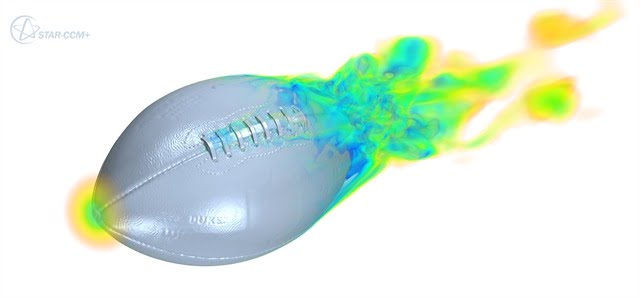
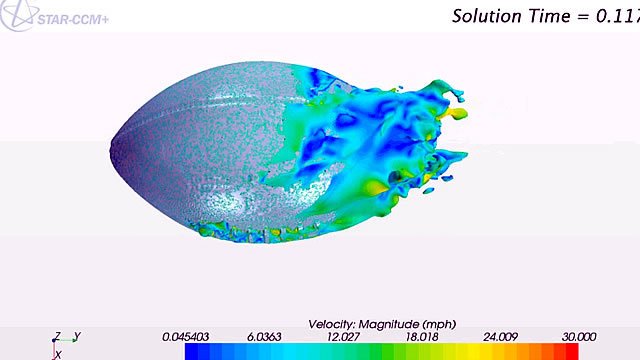
Like many sports balls, the American football’s shape and construction make a big difference in its aerodynamics. Unlike the international football (soccer ball), which undergoes significant redesigns every few years thanks to the World Cup, the American football has been largely unchanged for decades. The images above come from a computational fluid dynamics (CFD) simulation of a spiraling football in flight. Although the surface is lightly dimpled, the largest impact on aerodynamics comes from the laces and the air valve (just visible in the upper right image). Both of these features protrude into the flow and add energy and turbulence to the boundary layer. By doing so, they help keep flow attached along the football longer, which helps it fly farther and more predictably. For more, check out the video of the CFD simulation. (Image credits: CD-adapco; via engineering.com)
Skydivers and freefall acrobats utilize vertical wind tunnels as ground training facilities. Low-speed acrobatics, like gymnastics, relies on inertial forces and angular momentum for flips and attitude changes. But at freefall speeds, aerodynamic forces are much larger, and an acrobat’s orientation relative to the flow has a big effect on his stability and maneuverability. Simple movements of an arm or leg can significantly alter one’s aerodynamics, allowing the acrobats to choreograph controlled and synchronized motion. (Video credit: Red Bull)
Author’s note – After much consideration, I’ve decided to move FYFD to a MWF posting schedule for the time being. Working full-time has its limitations, and I believe the less frequent posting schedule will allow me to dedicate more time to generating new content like FYFD videos. This was a tough decision, but I hope it will help FYFD grow in the long-term. – Nicole