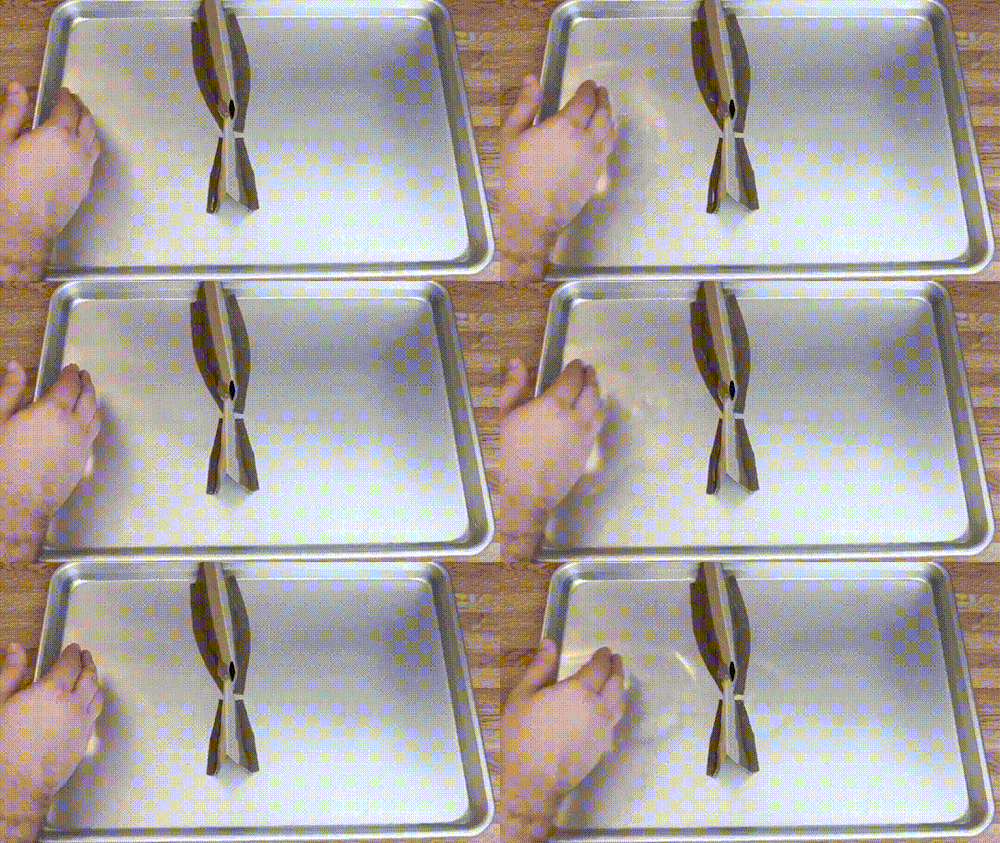
Wave phenomena can sometimes be a little difficult to wrap one’s head around. In this video, Mike from The Point Studios explains wave diffraction and why opening a window can help you spy on the conversation next door. Diffraction occurs when waves encounter an obstacle. If that obstacle is a slit in a wall, the slit becomes a point source, radiating waves outward spherically. The video focuses on acoustics, but diffraction matters in more than just sound – it’s key to water ripples, light and other electromagnetic waves, and, according to quantum theory, the fundamental building blocks of matter. (Video credit: The Point Studios)
As nocturnal hunters, owls are aerodynamically optimized for stealthy flying. This clip from BBC Earth demonstrates just how quiet a barn owl is in flight compared to a pigeon or a peregrine falcon. The owl’s large wingspan relative to its body size gives it enough lift that it does not have to flap often, allowing it to glide instead, but this is far from its only stealthy adaptation. Owl feathers feature a serrated leading edge that helps break flow over the wing into smaller, quieter vortices. Their fringe-like trailing edge breaks flow up even further and acts to damp noise from airflow. The downy feathers of the owl’s body also help muffle any noise from the bird’s movement, allowing the barn owl to fly almost silently. (Video credit: BBC Earth; via Gizmodo)
Time for another look at some of the best fluids content out there. It’s the fluids round-up – with a special focus this week on oceans!
– Ryan Pernofski spent two years filming the ocean in slow motion with his iPhone to make the short film “Slowmocean” seen above. It’s a gorgeous ode to the beauty of breaking waves.
– Oceans with higher salinity than Earth’s could drive global circulation that would make exoplanets more hospitable to life.
– Wind and waves make harsh, erosive environments. This photo essay from SFGate shows how greatly the sands of Pacifica shift over time. (submitted by Richard)
– Ever listened to an orchestra made from ice? You should! Learn about Tim Linhart, who builds and maintains ice instruments. (submitted by ashketchumm)
– MIT has demonstrated a new 3D-printing technique that allows for printing liquid and solid parts simultaneously, allowing would-be creators to rapid-prototype hydraulically-driven robotics.
Birds do not always vocalize in order to make their songs. The male African broadbill, shown in the top video above, makes a very distinctive brreeeet in its flight displays, but as newly published research shows, the sound comes from its wings, not its voice. During the display, the broadbill spreads its primary feathers and sound is produced on the downstroke, when wingtip speeds reach about 16 m/s. By filming a broadbill wing with a high-speed camera in a wind tunnel at comparable air speeds, researchers could localize the sound production to the 6th and 7th primary feathers.
In the second video above, you can see these feathers twisting and fluttering in the breeze. This is an example of aeroelastic flutter, a phenomenon in which aerodynamic and structural forces couple to induce oscillations. The same phenomenon famously caused the collapse of the Tacoma Narrows Bridge in 1940. In the birds, however, the flutter is non-destructive and the vibration produces audible sound which the other feathers modulate into the calls we hear. Broadbills aren’t the only birds to use this trick; some species of hummingbirds use flutter in their tail feathers during mating displays. (Video, image, and research credits: C. Clark et al.; additional videos here)
You may be familiar with the glass harp, the instrument created by rubbing the rim of a partially-filled wine glass. But did you know that you can create the same effect by immersing an empty glass in water? In this video, Dan Quinn explains the physics behind both types of glass harps and why the pitch changes as you add or remove water. Vibration is the driving factor (as with most sound), and the key to the shifting pitches has to do with the change in mass of the material being vibrated. For more great physics, also be sure to check out Quinn’s previous video on tears of wine. (Video credit: D. Quinn)
Amorous alligators call to mates with a behavior known as water dancing. Their audible bellows are accompanied by infrasonic sound–vibrations below the 20 Hz limit of human hearing. These vibrations from their lungs excite Faraday waves in the water near the alligator’s back and make the surface explode in a dance of jets and atomized droplets. I’ve seensimilarresultsin otherinstancesof vibration, but this may be the only example of this I’ve seen in the wild. Researchers studying the phenomenon noted that the frequency of sound the alligators emit corresponds to a wavelength equal to the spacing of the raised scales, or scutes, on the alligators’ backs. They hypothesize that the shape of the scutes helps males create the display. (Image credit: N. Marven, source; research credit: P. Moriarty and R. Holt; h/t to io9)
——————
Don’t forget about our FYFD survey! I’ve teamed up with researcher Paige Brown Jarreau to create a survey of FYFD readers. By participating, you’ll be helping me improve FYFD and contributing to novel academic research on the readers of science blogs. It should only take 10-15 minutes to complete. You can find the survey here. Please take a few minutes to participate and share!
Sound and acoustics often intersect with fluid dynamics. Most of the sounds we experience are pressure waves traveling through air. In this video, Joe of It’s Okay To Be Smart takes a closer look at sound: what it is; how we measure it; and just how loud a sound can get. For air at sea level, the loudest possible sound is 194 dB. Add any more energy and it distorts the pressure wave from what we recognize as sound into what’s known as a shock wave. (Video credit: It’s Okay To Be Smart/PBS Digital Studios)
Engineering students from George Mason University have built a fire extinguisher that uses sound to put out flames. Since sound waves are mechanical pressure waves, they can move the air surrounding a burning material. Through trial and error the students found the high-frequency sound had little effect, but at frequencies between 30-60 Hz the sound waves could jostle enough oxygen away from the flame to extinguish the fire. They’re hoping the solution is scalable and can be applied to larger fires. For other wild ideas for chemical-less fire extinguishers, check out how researchers put out fires with explosions. (Video credit: George Mason University; submitted by @isanaht)
The familiar popping behavior of popcorn is the combination of several events. When heated, unpopped kernels act like pressure vessels, managing to contain their boiling water content until a critical temperature of 180 degrees Celsius. At this temperature, nearly all kernels fracture. Popcorn’s jump doesn’t come from the fracture, though. Most of its acrobatics occur when a leg of starch branches out of the popping kernel. The starch acts somewhat like a muscle – after being compressed against the ground, it springs back, propelling the corn upward. Finally, by synchronizing high-speed video and audio recordings of popping corn, researchers determined that the pop in popcorn is not caused by fracture or rebound but instead is the result of the release of water vapor. (Image credit: TAMU NAL, source; research credit: E. Virot and A. Ponomarenko; submitted by Chad W.)