Acoustic levitation traps particles using specially shaped sound waves, but, thus far, it’s only been useful for small particles. One common method of trapping forms the sound waves into a vortex-like shape. Particles in one of these acoustic vortices will spin rapidly, become unstable, and get ejected from the vortex if they’re larger than about half the wavelength of sound used. Recently, though, researchers have stabilized much larger particles by trapping them between two acoustic vortices with opposite spins. The researchers alternate between the two vortices so that each can counteract the other in order to hold the particle in the center of the trap. The new technique has enabled them to trap particles up to 4 times larger than those in previous experiments. (Image and research credit: A. Marzo et al., source; via Science)
Tag: acoustics

Pigeon Flutter
Birds are well-known for their vocalizations, but this isn’t their only way to produce noise. A new study on crested pigeons finds that the birds’ wings produce distinctive high and low notes during take-off. A low note takes place during each upstroke, and a high note is heard during the downstroke. A major source of the noise is the highly modified P8 feather. When airflow over the feather is fast enough, it sets off twisting and torsion in the feather through aeroelastic flutter. It’s this vibration that causes the noise. By playing back the notes at different speeds, researchers found that the crested pigeons use the notes’ timing as an alarm. When the cycle of high and low repeats in quick succession, they respond by taking off to escape the perceived danger.
Other bird species are also known to use aeroelastic flutter to make noise. Check out these hummingbirds, which use flutter in their mating displays. (Video credit: Science; research credit: T. Murray et al.)

Rocket Launch Systems


If you’ve ever watched a rocket launch, you’ve probably noticed the billowing clouds around the launch pad during lift-off. What you’re seeing is not actually the rocket’s exhaust but the result of a launch pad and vehicle protection system known in NASA parlance as the Sound Suppression Water System. Exhaust gases from a rocket typically exit at a pressure higher than the ambient atmosphere, which generates shock waves and lots of turbulent mixing between the exhaust and the air. Put differently, launch ignition is incredibly loud, loud enough to cause structural damage to the launchpad and, via reflection, the vehicle and its contents.
To mitigate this problem, launch operators use a massive water injection system that pours about 3.5 times as much water as rocket propellant per second. This significantly reduces the noise levels on the launchpad and vehicle and also helps protect the infrastructure from heat damage. The exact physical processes involved – details of the interaction of acoustic noise and turbulence with water droplets – are still murky because this problem is incredibly difficult to study experimentally or in simulation. But, at these high water flow rates, there’s enough water to significantly affect the temperature and size of the rocket’s jet exhaust. Effectively, energy that would have gone into gas motion and acoustic vibration is instead expended on moving and heating water droplets. In the case of the Space Shuttle, this reduced noise levels in the payload bay to 142 dB – about as loud as standing on the deck of an aircraft carrier. (Image credits: NASA, 1, 2; research credit: M. Kandula; original question from Megan H.)
Songs in Soap
There are many beautiful ways to visualize sound and music – Chris Stanford’s fantastic “Cymatics” music video comes to mind – but this is one I haven’t seen. This visualization uses a soap film on the end of an open tube with music playing from the other end. You can see the set-up here. The result is a fascinating interplay of acoustics, fluid dynamics, and optics. As sound travels through the tube, certain frequencies resonant, vibrating the soap film with a standing wave pattern (3:20). At the same time, interference between light waves reflecting off the front and back of the soap film create vibrant colors that show the film’s thickness and flow.
When the frequency and amplitude are just right, the sound excites counter-rotating vortex pairs in the film (0:05), mixing areas of different thicknesses. With just a single note, the vortex pairs appear and disappear, but with the music, their disappearance comes from the changing tones. Watching the patterns shift as the film drains and the black areas grow is pretty fascinating, but one of the coolest behaviors is how the acoustic interactions are actually able to replenish the draining film (2:15). Because the tube was dipped in soap solution, some fluid is still inside the tube, lining the walls. With the right acoustic forcing, that fresh fluid actually gets driven into the soap film, thickening it.
There are several more videos with different songs here – “Carmen Bizet” is particularly neat – as well as a short article summarizing the relevant physics for those who are interested. (Video and research credit: C. Gaulon et al.; more videos here)

Reader Question: Resonating Bottles
Reader shoebill-san asks:
why does it make that weird sound when i blow over a bottle? i did a science experiment in college where we looked at the resonance in a beaker at different water levels, is it like that? related?
Blowing across the top of a bottle creates what’s called Helmholtz resonance, where air inside the neck of the bottle actually vibrates up and down, like you see in the animation above. The stream of air from your mouth creates low pressure just outside the bottle, pulling some of the air out. That air will tend to overshoot, ultimately causing pressure in the bottle neck to drop lower. That vacuum will pull air back into the bottle, at which point the low pressure your blowing supplies pulls it back out, and so on. The actual sound you hear comes from those puffs of moving air. In reality, they move too fast to see; the animation comes from a high-speed video, and I highly recommend watching the full vid.
From your description, I’m not 100% sure what the experiment you did in college was, but I’m guessing it was some variation of the glass harp, where you rub a partially-filled glass and get an eerie sound that varies depending on how much water is in the glass. Like the bottle example above, that’s an example of resonance, but the two are different. In the bottle, it’s the air that’s resonating. For the glass harp, it’s the glass walls themselves that are resonating. The liquid inside just changes the pitch by slowing down the speed at which the glass’s walls vibrate. For a full and fantastic explanation of how that works, check out this video by Dan Quinn. (Image credit: N. Moore, source)
When Walls Chirp
If you’ve ever clapped near a wall with a corrugated surface, you may have noticed some strange echoes. Surfaces like these can cause a chirping sound to observers. The reason, as Nick Moore explains in the video above, is that the original sound reflects off the corrugations at different times and travels back to the observer such that the first reflections to arrive are closely spaced (and thus higher pitched) while the later reflections are spread further out. This creates a chirp that starts at a high pitch and then falls to lower ones. Have you ever come across structures that do this? (Video credit: N. Moore)

Inside Singing
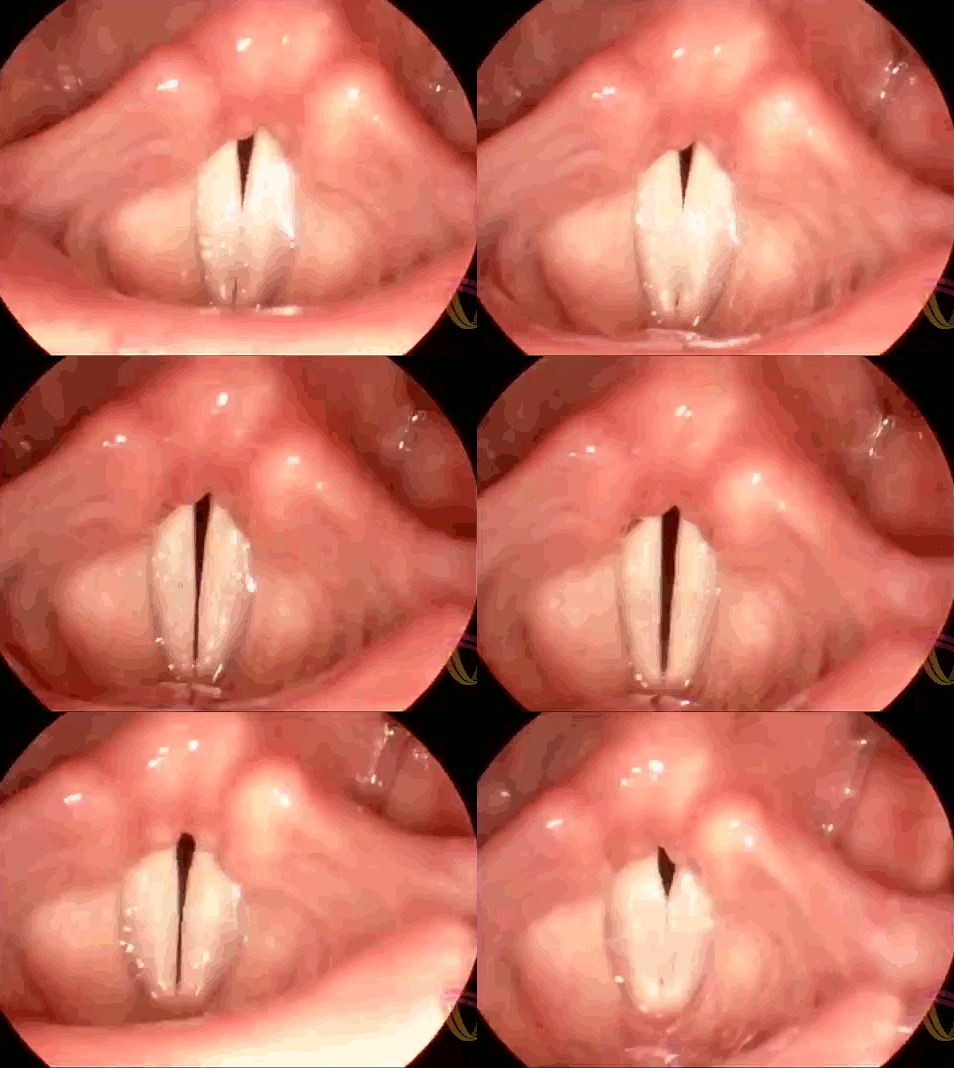
These are the vocal folds of a woman singing. Human speech (and song) results from interactions between elastic muscles and aerodynamics. As we exhale, the vocal folds are initially pushed apart, then the flow of air moving past creates low pressure (via the Bernoulli effect) that helps pull the folds together. As the folds close, high pressure again forms to force them open. This sets a cycle of oscillation or vibration that produces sound. To change the pitch of the sounds we create, we can lengthen or shorten the vocal folds or change their tension. In this respect, they behave somewhat similarly to the strings of a musical instrument. If you’d like to admire more vocal folds in action, check out this endoscopic video for four singers performing together. (Image credit: LinguaHealth, source)
Ionic Sound
So, as we learned previously, sound can actually travel through space. But the recordings our spacecraft send us from other planets or from the edge of the Solar System aren’t really that kind of sound. Acoustic waves require a medium; they travel when particles bump into one another, which, given the sparseness of space, means that only very low frequency sounds can travel. But space has a lot of ions and plasmas – charged particles like electrons and protons – and those particles can interact without physically contacting one another. Instead their motion causes a changing magnetic field that affects nearby particles, which in turn affect more particles (and so on). This transmits what’s called ionic sound. Check out the video above to hear some awesome examples of the ionic sounds of our solar system! (Video credit: The Point Studios)
Hearing in Space
Everyone knows that, in space, no one can hear you scream. Sound is a wave that requires a medium to travel through, and if space is empty, there’s no medium to carry that sound. Except, as Mike from The Point Studios explains, empty is a relative term. Space is full of dust and gas and plasma, just not as full of that matter as we’re used to. Thus, the question of whether sound can travel through space turns into a matter of scale. If the scale–the wavelength–of a sound is much larger than the distance between molecules, then the sound can propagate. So there CAN be sound in space – it just has to have a very long wavelength and, thus, a very low frequency. Check out the video for the full story! (Video credit: The Point Studios)

Where Jupiter’s Heat Comes From
Exactly what goes on in Jupiter’s atmosphere has confounded scientists for decades. Its upper atmosphere – essentially the only part we can observe – is hundreds of degrees warmer than solar heating can account for. Although it has bright auroras at its poles, that energy is trapped at high altitudes by the same rotational effects that create Jupiter’s stunning bands.
Observations of Jupiter’s Great Red Spot, a storm that’s lasted for hundreds of years, may provide clues as to where all the extra heat is coming from. Spectral mapping shows that the area over the Spot is over 1000K warmer than the rest of the upper atmosphere. Because of its isolated location, the best explanation for the Great Red Spot’s extra heat comes from below: scientists suspect that the raging storm is generating so much turbulence and such a deafening roar that these gravity and acoustic waves propagate upward and heat the atmosphere above. If so, a similar coupling mechanism to the clouds below may account for the widespread warmth in Jupiter’s upper atmosphere. (Image credit: NASA; research credit: J. O’Donoghue et al.)