Peacocks are known for their colorful mating displays, but it turns out there’s more to them than meets the eye. To help them gain a penhen’s attention, peacocks will sometimes rattle their train-feathers. The sound this makes is mostly below the range of human hearing, but the rustle creates subtle vortices in the air that cause the feathers atop a peahen’s head to vibrate. Playing back the sound at peahens from typical train-rattling distances also gets the females’ attention. Researchers found the playback makes peahens’ crests vibrate at a resonant frequency, suggesting that these feathers are for more than display; they’re used for communication as well! (Image and research credit: S. A. Kane et al.; video credit: Science)
Tag: acoustics

Ricequakes

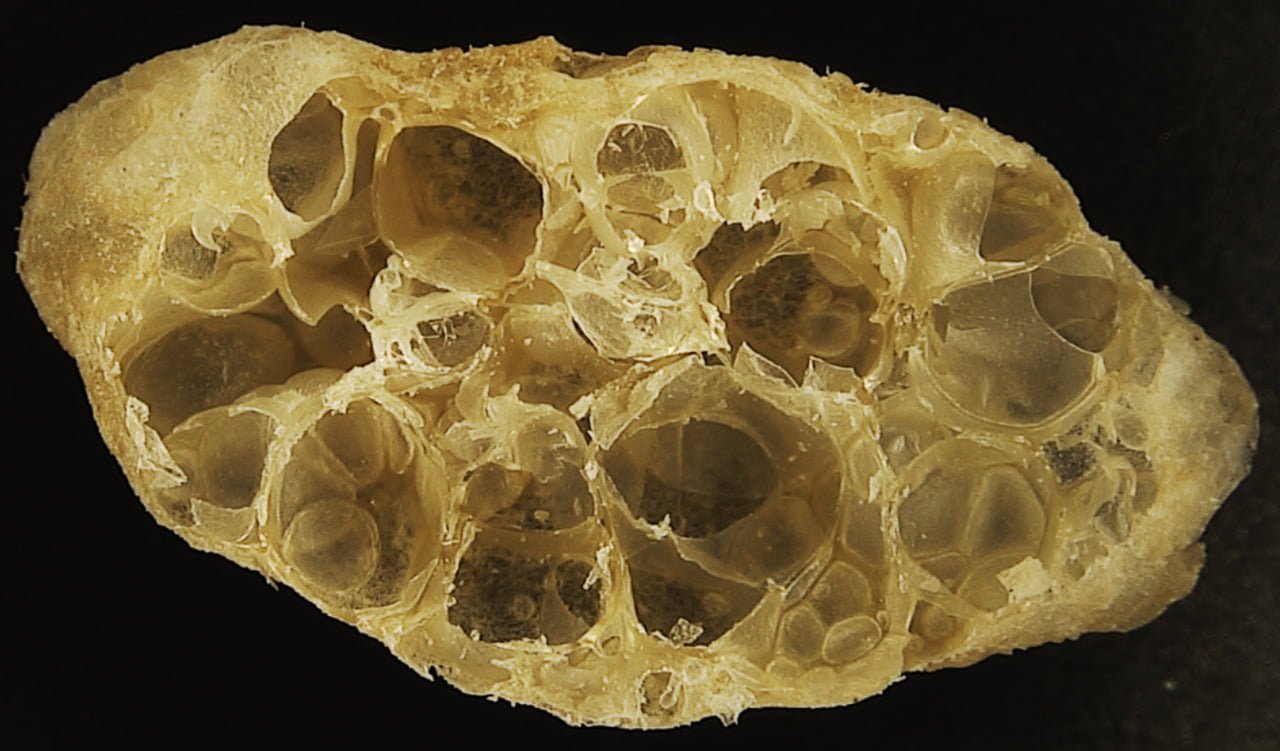
Rockfill dams, sinkholes, ice shelves, and other geological features often consist of brittle, porous materials that are partially submerged. Over time, pressure and chemical reactions with the fluid around them can cause these structures to collapse, but it can take many, many years.
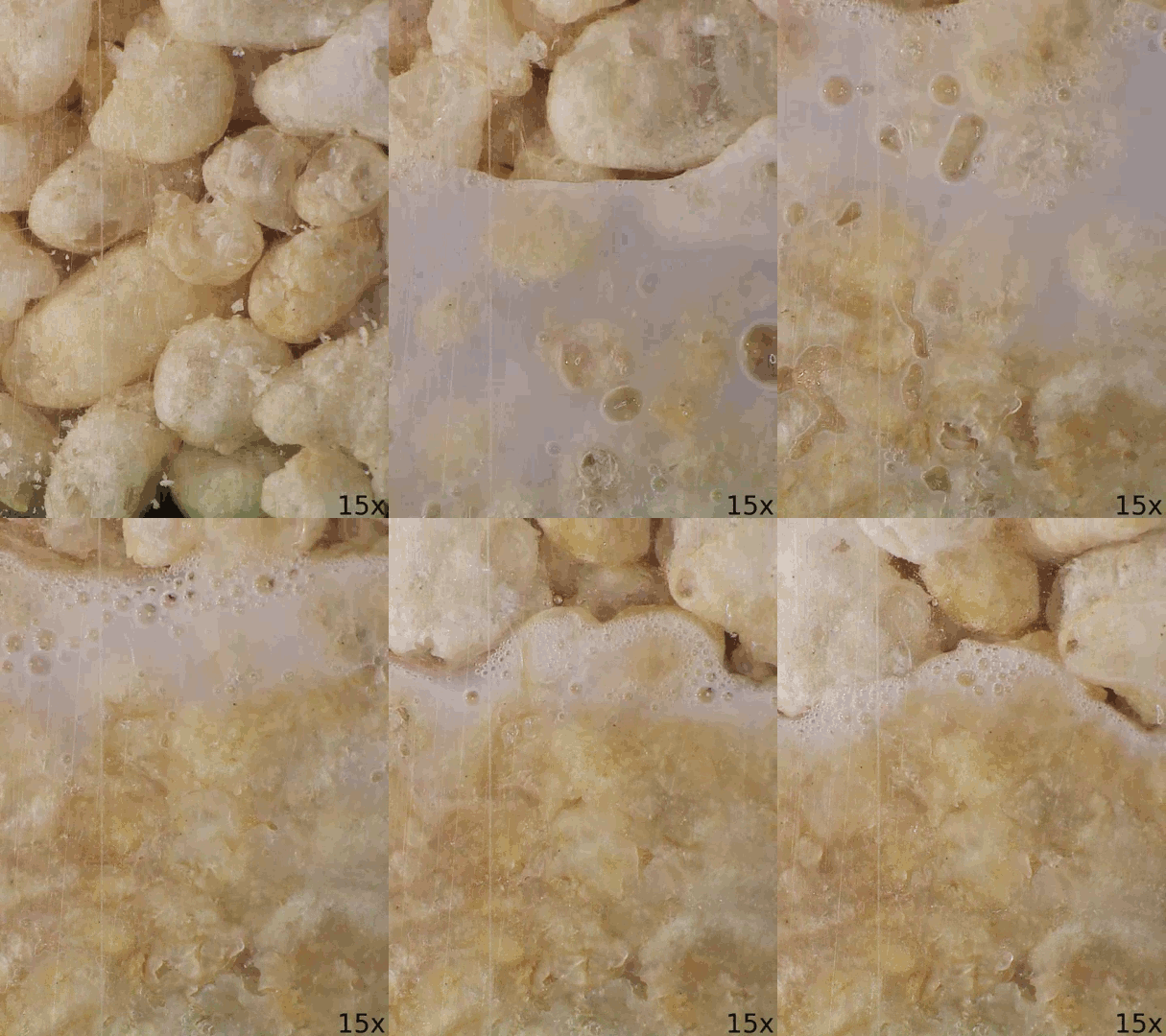
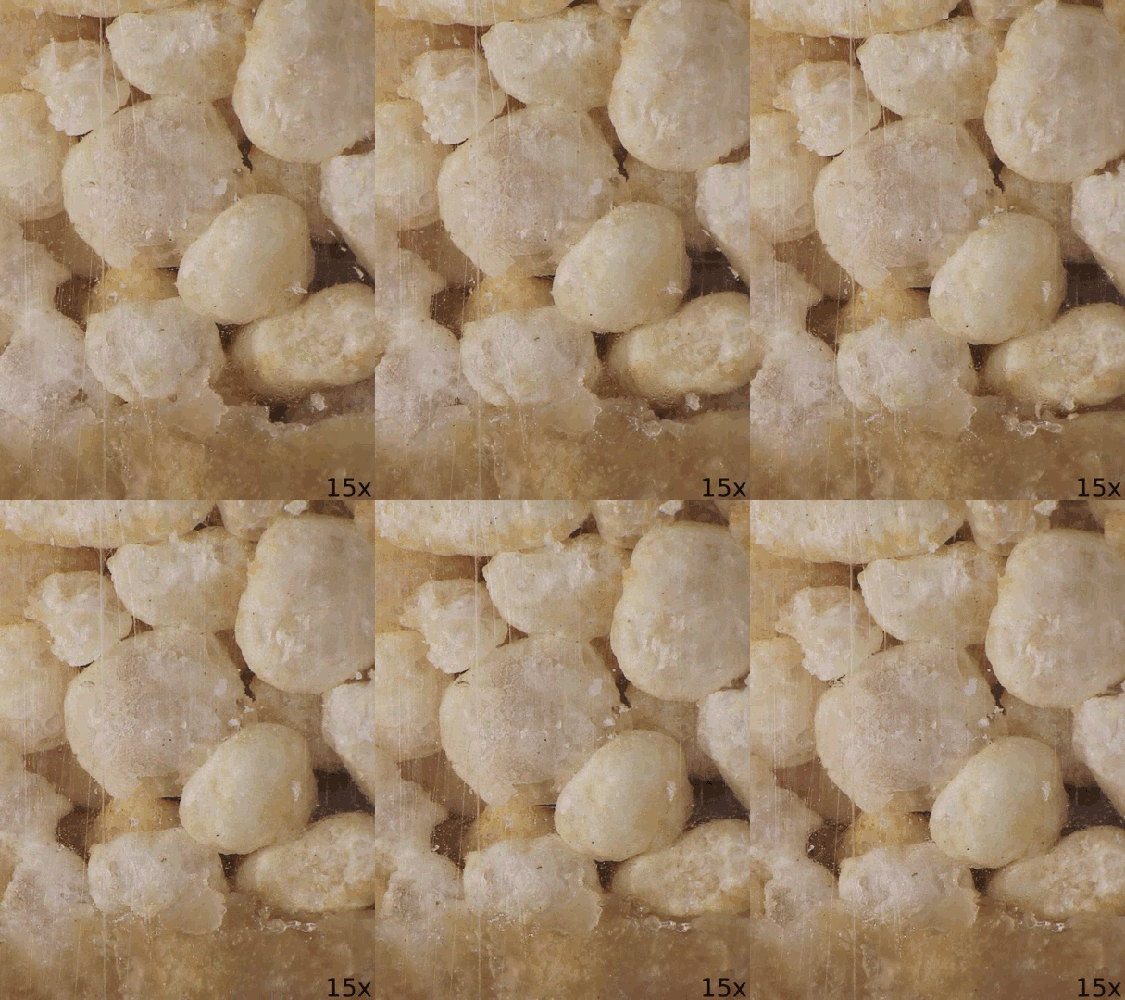
To study the physics behind this, researchers have turned to a new model: puffed rice cereal. Like their counterparts in nature, puffed rice grains contain micropores that slowly soften and get crushed after being wetted. Researchers filled their test container with puffed rice and put it under pressure to give the whole stack a constant stress. Then they injected milk in the bottom section of the container. After an immediate collapse in the wet material (lower left), the remaining grains collapsed slowly in a series of “ricequakes”.
As the micropores compacted, the cereal let out audible cracks that corresponded with the motion of a crushing wavefront (lower right). The time between ricequakes increased linearly and depended on pore size. The relationship was so consistent, researchers found, that they could predict how long the puffed rice stack had been wet simply by listening to the time between crackles! Experiments like these offer scientists an exciting chance to understand geological physics that would otherwise take up to millions of years to observe. (Image and research credit: I. Einav and F. Guillard; via Physics World; submitted by Kam-Yung Soh)

Boiling with Sound
Ultrasonic vibrations can boil nanoscale liquid layers, according to a new simulation-based study. Above you see a layer of water initially about 2 nm thick. When the surface it’s on vibrates at frequencies in the 100 GHz range – about a billion times faster than a hummingbird flaps – it superheats the thin layer of water. In this case, the film undergoes nucleate boiling, forming the same kinds of bubbles you see when boiling a pot of water. When the water layer gets too thin to support nucleate boiling, it stops boiling but evaporation continues. The transition occurs when van der Waals forces become significant. The technique only works with ultrathin layers of a liquid, but the authors envision broad application possibilities in industry as well as in micro- and nano-scale fluid systems. (Image and research credit, and submission: R. Pillai et al.)

Levitating with Sound
Sound can manipulate fluids in fascinating ways, from levitation to vibration. Here researchers use sound to levitate and manipulate droplets and turn them into bubbles. Increasing the acoustic pressure on the levitating droplet flattens it, then slowly causes the drop to buckle. When the buckled film encloses a critical volume, the sound waves resonate inside it. That causes a big jump in acoustic pressure, which makes the drop snap closed into a bubble. (Image and research credit: D. Zang et al.; via Science News; submitted by Kam-Yung Soh)

Flying Beetles, Stinging Nettles, and Jellyfish


In the latest JFM/FYFD video, we tackle some of the less pleasant aspects of summer weather: stopping invasive insects, understanding how plants dispense poison, and looking at the physics behind jellyfish stings. And if you’ve missed any of our previous videos, we’ve got you covered. (Image and video credit: T. Crawford and N. Sharp)

Using Sound to Print
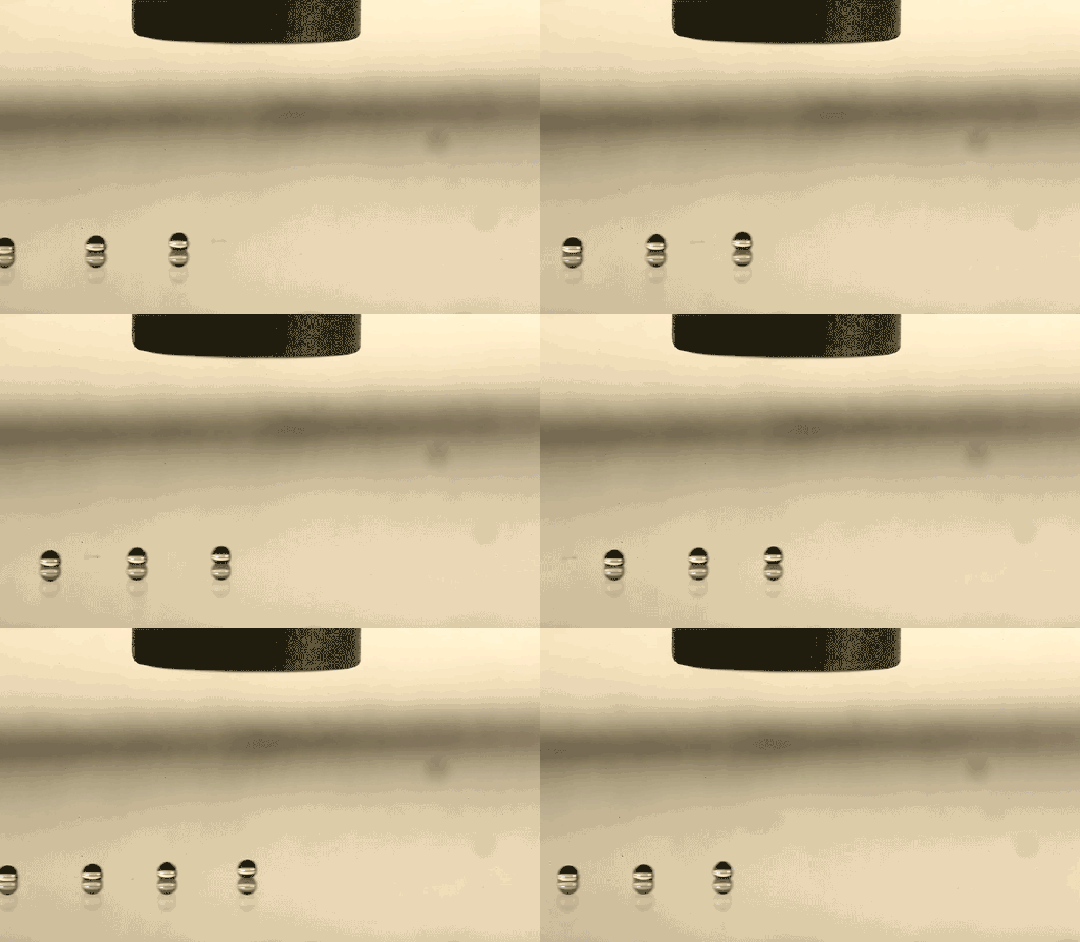
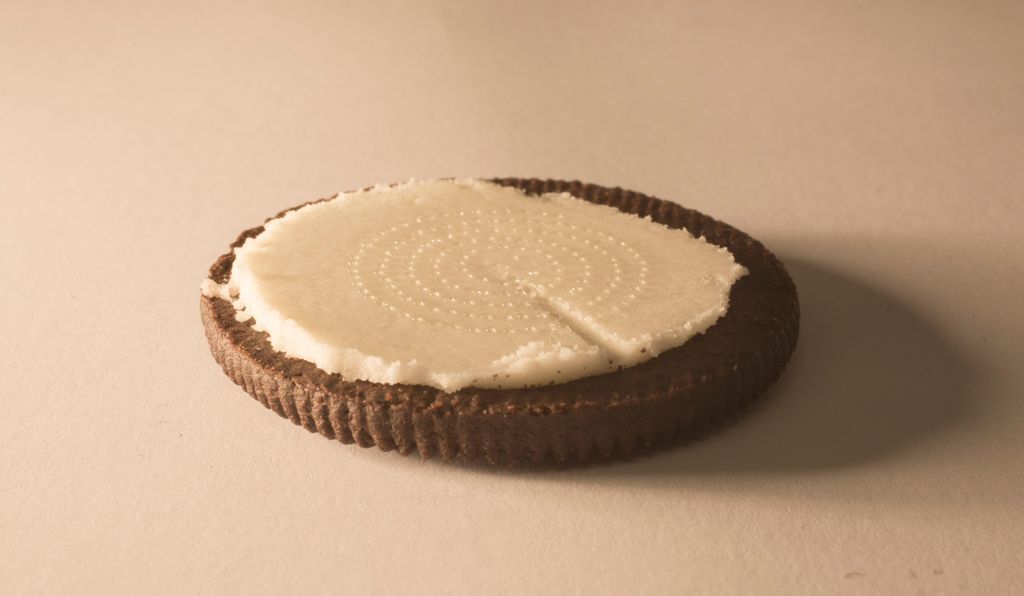
Inkjet printing and other methods for directing and depositing tiny droplets rely on the force of gravity to overcome the internal forces that hold a liquid together. But that requires using a liquid with finely tuned surface tension and viscosity properties. If your fluid is too viscous, gravity simply cannot provide consistent, small droplets. So researchers are turning instead to sound waves.
Using an acoustic resonator, scientists are able to generate forces up to 100 times stronger than gravity, allowing them to precisely and repeatably form and deposit micro- and nano-sized droplets of a variety of liquids. In the images above, they’re printing tiny drops of honey, some of which they’ve placed on an Oreo cookie for scale. The researchers hope the technique will be especially useful in pharmaceutical manufacturing, where it could precisely dispense even highly viscous and non-Newtonian fluids. (Image and research credit: D. Foresti et al.; via Smithsonian Mag; submitted by Kam-Yung Soh)
The Mystery of Carnegie Hall’s Sound
For nearly a century, the acoustics of Carnegie Hall were touted as among the very best in the world. But after a much-needed renovation in 1986, musicians and critics felt the magic of the old sound had been lost. In this video, Gizmodo explores the mystery of what changed. Was it a hole in the ceiling? The curtains that had been removed?
Eventually, a second renovation – this time for warping of the stage floor – revealed the likely culprit. Concrete had been installed to reinforce the stage in the first renovation, and this changed the stage’s resonance. Previously, instruments like the bass had caused the wooden floor to vibrate, which amplified their sound. The concrete damped that vibration, cutting out a key ingredient in Carnegie’s acoustics. When the second renovation restored the all-wooden stage, suddenly the venerable concert hall had its sound back. (Video credit: Gizmodo)

The Sound of Bubbles
When you enjoy the sound of a babbling stream on a hike, what you’re actually hearing is bubbling. Air bubbles caught in the water resonate at a frequency that depends on their size. In fact, you can use a hydrophone – basically an underwater microphone – to listen to these bubbles and learn about them. Researchers recently did exactly that with glasses of sparkling wine. By listening to the bubbles and applying a simple physical model, the researchers could characterize differences in two brands of sparkling wine, including just how bubbly they were and what size their typical bubbles are. They hope eventually to develop acoustic techniques that can monitor quality control for sparkling wines and other carbonated beverages. (Image credit: J. Kääriäinen; research credit: K. Spratt et al.; submitted by Kam-Yung Soh)
When Sound Makes You Vertiginous
For some people, a musical tone is enough to induce vertigo and feelings of being drunk. These individuals often have a small hole or defect in the bone that surrounds the canals of the inner ear. Normally, the fluid inside these canals reacts when we rotate our heads, triggering a counterrotation of our eyes that helps stabilize the image on our retinas. But when there’s a defect in the bone surrounding the canal, certain acoustic tones may pump that fluid directly. The patient’s eyes then try to correct for a rotation that’s not occurring, thereby inducing dizziness and vertigo. (Image credit: M. Moiner; research credit: M. Iversen et al.; submitted by Marc A.)

The Dangerous Clatter of Dishes
Have you ever noticed how loud dishes are when you’re handling them? Under the right (or, perhaps more accurately, wrong) circumstances, the clatter of ceramics like porcelain can be dangerously loud, as engineer Phil Metzger discovered when repairing his toilet. At one point the lid to his tank slipped from his hands and fell about 20 centimeters to strike the edge of the toilet. The lid did not break, but Metzger stumbled away stunned from the loud noise. He immediately noticed that his hearing was distorted – he described his own voice as sounding “like talking through a kazoo”. Upon further experiment, he found that the distortion occurred at specific, regularly-spaced frequencies. Like any engineer, therefore, he turned to physics to analyze the accident.
Since the lid didn’t break, he knew that the energy from the lid’s fall went into two places: the sound he heard and a small amount of dissipated heat. Using the speed of sound in a ceramic and the dimensions of the lid, he was able to calculate the frequency of sound produced by the impact, and with a little more work, he could estimate that the sound, as transmitted to his nearby ear, had been about 138 dB. Permanent damage from brief sounds can occur at 140 dB, so this was well inside the danger zone. The pressure from sounds this loud is enough to severely bend the tiny hairs in your cochlea that are responsible for sensing these vibrations. Luckily for Metzger, his hearing did recover after a few days, but it’s a good reminder to be careful. Sometimes everyday physics can be surprisingly dangerous! (”Research” credit: P. Metzger; image credit: comedynose/Flickr; via Motherboard via J. Ouellette)