Conventional wind tunnels are great, but some aerodynamic testing requires facilities of a different nature. The video above is from the WindEEE dome, a hexagonal chamber with sixty fans on one wall, eight directional fans on the other five walls, and six fans in the upper chamber. Each is individually computer controlled, allowing the researchers to create straight flows as well as complex vortical ones. The video shows their tornado flow, which stands 5 m tall and swirls at 30 m/s. They can also move the tornado around the chamber at 2 m/s. This capability enables a kind of scale-model analysis of tornadoes and their impact that’s not possible in most facilities. You can read more about the dome at New Scientist or the WindEEE website. (Video credit: New Scientist/WindEEE; submitted by entropy-perturbation)
Search results for: “wind tunnel”

Testing a Supersonic Car
How do you test a supersonic car like the Bloodhound SSC in a wind tunnel? With free-flying objects like airplanes, wind tunnel testing is relatively straightforward. Mounting a stationary model in a supersonic flow gives an equivalent flow-field to that object flying through still air at supersonic speeds. The same does not hold true for the supersonic car, though, because you need to account for the effect of the ground on airflow. One option is to build a moving wall in the wind tunnel. For low-speed applications, this is feasible but incredibly complicated and very expensive. For supersonic speeds, it’s impossible. You could achieve the same moving-wall effect at supersonic speeds with a rocket sled, but that is also expensive and difficult to fit in most experimental facilities. The simplest solution is the one you see above – build two models and mount them belly-to-belly. Reflecting the models makes the plane of symmetry a stagnation plane, which, fluid dynamically speaking, acts like an imaginary ground plane relative to the model. For more on the project and the technique, check out this article. (Photo credit: B. Evans; via ThinkFLIP; submitted by G. Doig)

Brazuca
Since 2006, Adidas has unveiled a new football design for each FIFA World Cup. This year’s ball, the Brazuca, is the first 6-panel ball and features glued panels instead of stitched ones. It also has a grippy surface covered in tiny nubs. Wind tunnel tests indicate the Brazuca experiences less drag than other recent low-panel-number footballs as well as less drag than a conventional 32-panel ball. Its stability and trajectory in flight are also more similar to a conventional ball than other recent World Cup balls, particularly the infamous Jabulani of the 2010 World Cup. The Brazuca’s similar flight performance relative to a conventional ball is likely due to its rough surface. Like the many stitched seams of a conventional football, the nubs on the Brazuca help trip flow around the ball to turbulence, much like dimples on a golf ball. Because the roughness is uniformly distributed, this transition is likely to happen simultaneously on all sides of the ball. Contrast this with a smooth, 8-panel football like the Jabulani; with fewer seams to trip flow on the ball, transition is uneven, causing a pressure imbalance across the ball that makes it change its trajectory. For more, be sure to check out the Brazuca articles at National Geographic and Popular Mechanics, as well as the original research article. (Photo credit: D. Karmann; research credit: S. Hong and T. Asai)

Tiny Fliers
There’s an apocryphal story claiming that, aerodynamically speaking, honeybees should not be able to fly. Obviously, they can, but it’s true that a small, flapping creature and a large, fixed-wing aircraft will not generate lift exactly the same way. NYU professor Leif Ristroph has a lot of projects exploring flapping flight on smaller scales, as seen in this video. His oscillatory fliers and rotating flapping flight simulator have both been featured previously. Part of the beauty of these projects is their size; in a field that’s historically required giant wind tunnels and room-length wave tanks, Ristroph’s work provides insight into long-standing problems using apparatuses that fit on a countertop. (Video credit: Cool Hunting/L. Ristroph et al.)

Reader Question: Lagrangian Vs. Eulerian
Reader isotropicposts writes:
Hi, I’m taking a fluids class and I’m not sure I understand the whole lagrangian-eulerian measurements of velocity and acceleration. Could you explain this?
This is a really great question because the Eulerian versus Lagrangian distinction is not obvious when you first learn about it. If you think about a fluid flowing, there are two sensible reference frames from which we might observe. The first is the reference frame in which we are still and the fluid rushes by. This is the Eulerian frame. It’s what you get if you stand next to a wind tunnel and watch flow pass. It’s also how many practical measurements are made. The photo above shows a Pitot tube on a stationary mount in a wind tunnel. With the air flow on, the probe measures conditions at a single stationary point while lots of different fluid particles go past.
The other way to observe fluid motion is to follow a particular bit of fluid around and see how it evolves. This is the Lagrangian method. While this is reasonably easy to achieve in calculations and simulations, it can be harder to accomplish experimentally. To make these kinds of measurements, researchers will do things like mount a camera system to a track that runs alongside a wind tunnel at the mean speed of the flow. The resulting video will show the evolution of a specific region of flow as it moves through time and space. The video below has a nice example of this type of measurement in a wave tank. The camera runs alongside the the wave as it travels, making it possible to observe how the wave breaks.
In the end, both reference frames contain the same physics (Einstein would not have it any other way), but sometimes one is more useful than the other in a given situation. For me, it’s easiest to think of the Eulerian frame as a laboratory-fixed frame, whereas the Lagrangian frame is one that rides alongside the fluid. I hope that helps! (Photo credit: N. Sharp; video credit: R. Liu et al.)

Sochi 2014: Bobsledding
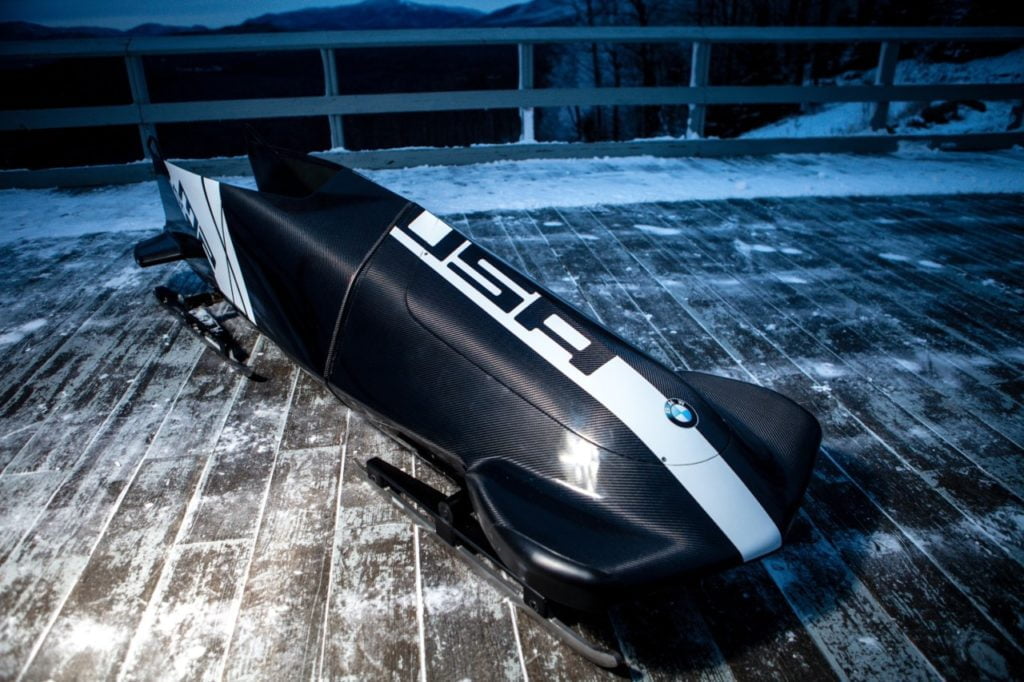


Today bobsledding is an sport rife with modern technology and design techniques. In recent years, companies better known for their expertise in automobiles and Formula 1 racing have become players with BMW designing American sleds, McLaren making the UK sleds, and Ferrari providing for the Italian team. Like many winter gravity sports, contenders can be separated by as little as hundredths of a second. This makes aerodynamics a serious concern, but the variability of the sled’s position and orientation over a run makes realistically simulating the aerodynamics, either in a wind tunnel or computationally, extremely difficult. Additionally, the sport’s governing body restricts a sled’s dimensions, weight, shape, and other details; for example, bobsleds are not allowed to use vortex generators that would help maintain attached flow and reduce drag. Instead, designers try to shave drag elsewhere, in the shaping of the sled’s nose or by tweaking the back end of the sled to reduce the drag-inducing wake. Even the shape of the driver’s helmet is aerodynamically significant. (Image credits: Exa Corp, Getty Images, BMW)
FYFD is celebrating #Sochi2014 by looking at fluid dynamics in winter sports. Check out our previous posts on how skiers glide, the US speedskating suit controversy, and why ice is slippery.

Sochi 2014: Downhill Skiing
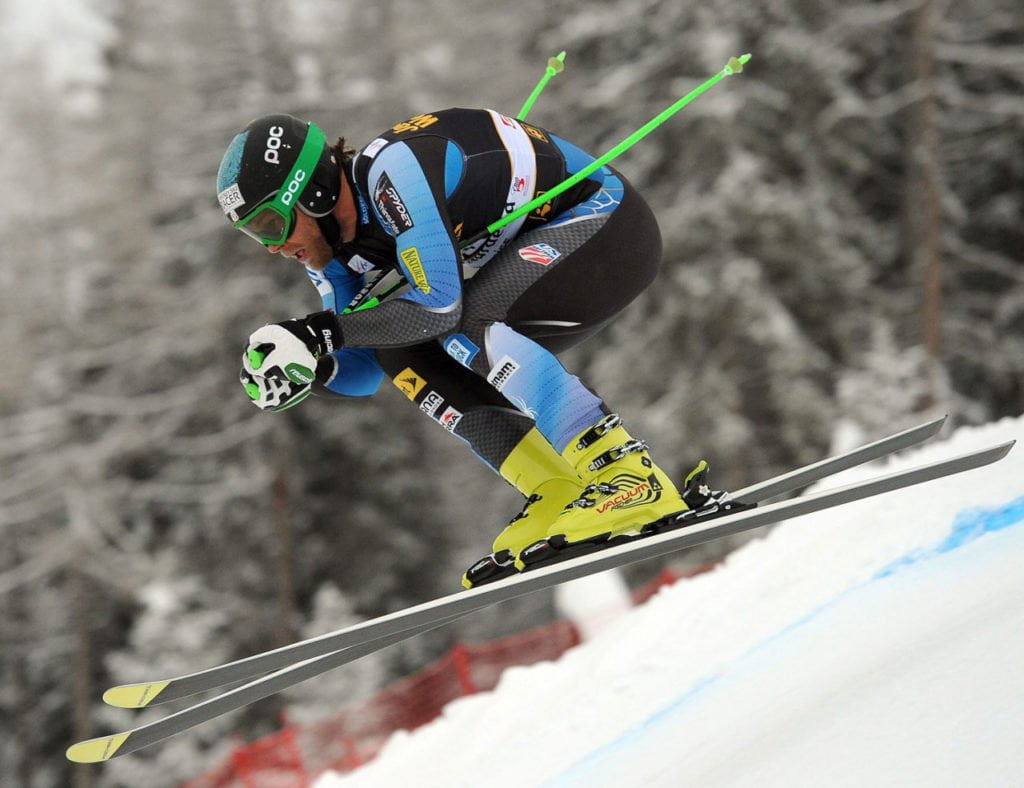
Like the athletes who compete on ice, skiers rely on a film of liquid beneath their skis to provide the low friction necessary to glide. The moisture results from the friction of the ski’s base and edges cutting into the snow, and, depending on the conditions of the snow, different surface treatments are recommended for the skis to help control and direct this lubricating film. Similarly, skiers uses various waxes on their skis to lower surface tension and provide additional lubrication. Fluid dynamics can also play a role in tactics for various ski-based events. In endurance events like cross-country skiing, drafting behind other skiers can help an athlete avoid drag and save energy. When drafting, cross-country skiers have lower heart rates. Drag and aerodynamics can also play a significant roles in alpine skiing, especially in speed events like the downhill or super G. In these events solo skiers reach speeds of 125 kph, where drag is a major factor in slowing their descent. Between turns smart skiers will tuck, decreasing their frontal area and reducing drag’s effects. Athletes use wind tunnel testing to dial in their tuck position for maximum effect, and, like speedskaters, skiers may also wear special aerodynamic suits. (Photo credits: F. Cofferini/AFP/Getty Images, C. Onerati; h/t to @YvesDubief)

Sochi 2014: Speedskating Redux

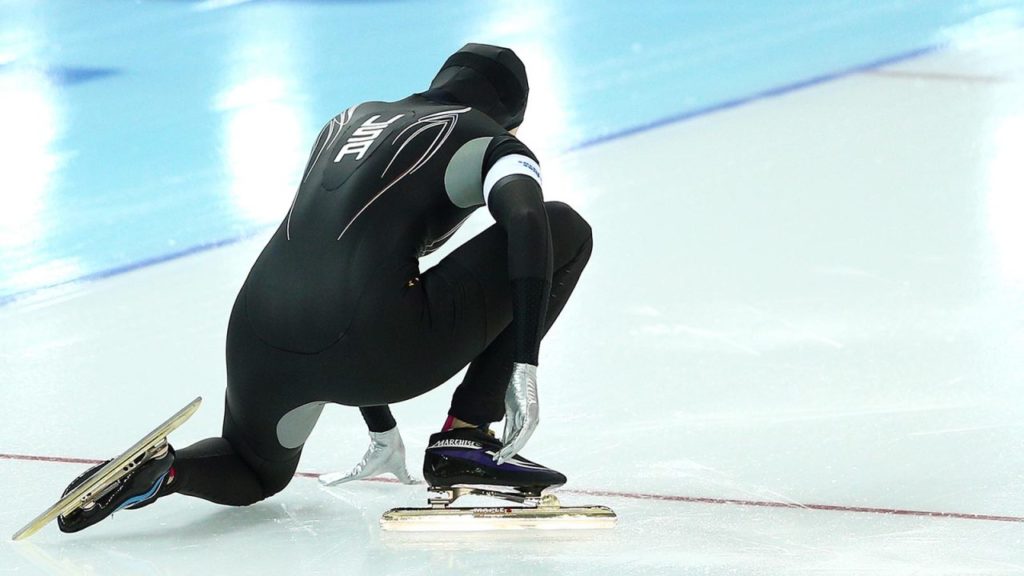


Since we wrote about the US team’s speedskating suits last week, they have become the subject of major controversy. After six events, the US team had not placed higher than seventh despite strong World Cup results during the autumn. The Wall Street Journal reported that three people familiar with the team suggested a design flaw:
Vents on back of the suit, designed to allow heat to escape, are also allowing air to enter and create drag that keeps skaters from staying in the low position they need to achieve maximum speed, these people said. One skater said team members felt they were fighting the suit to maintain correct form. #
To address this, some members had seamstresses sew fabric over the vent. The upper left image shows the original suit and the one on the right shows a team member in a modified suit. The change made no apparent impact on the skaters’ finish. The US team has no gone so far as to get a special dispensation to switch back to their older suits but still the podium eluded skaters in Saturday’s events.
Now, to be clear, I have not seen any data on the development of Under Armour’s suits beyond the public coverage, and I have no connections to any of the parties involved. However, given the extensive nature of the wind tunnel development that went into these suits, I would be exceptionally surprised if there was a design flaw capable of slowing skaters down by nearly 1 second over 1000 meters. It would require a major flaw in the testing design and methodology to overlook such a substantial drag effect.
At the same time, there are other factors that may be affecting the US team adversely. Sochi’s races are taking place at low altitudes, where the air is denser and drag is greater. This does affect all competitors, but it is worth noting that many of the US speedskaters train at altitude in Salt Lake City and that the entire team had their training camp at high altitude in Italy prior to Sochi. Another factor is the ice conditions. Salt Lake has what is considered fast ice that permits longer glides between each step, whereas Sochi has soft ice, which requires a faster tempo and does not glide as easily. (Image credits: Under Armour, Getty Images, P. Semansky/AP)

Sochi 2014: Ski Jump
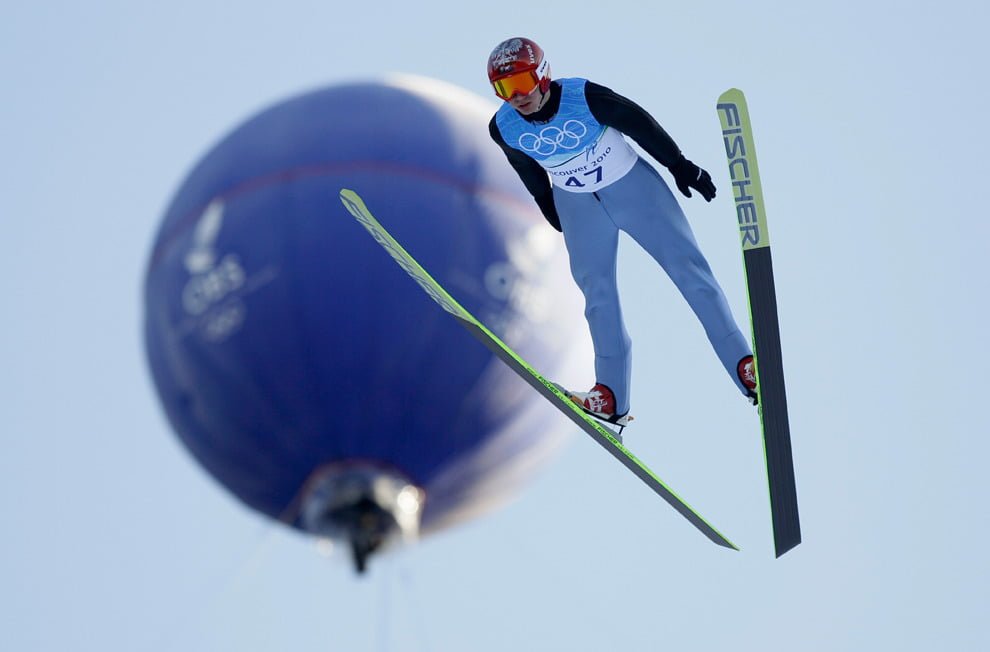
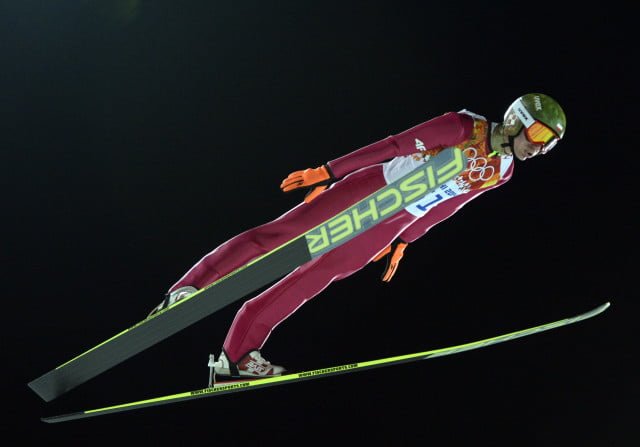
Great ski jumpers are masters of aerodynamics. There are four main parts to a jump: the in-run, take-off, flight, and landing. An athlete’s aerodynamics are most vital in the in-run and, naturally, the flight. During the in-run, the athlete is trying to gain as much speed as possible, so she tucks down and pulls her arms behind her back to streamline her body and keep her frontal area as small as possible. This limits her drag so that she can maximize her speed at take-off. Once in the air, though, the jumpers act like gliders. In flight, there are three forces acting on the the jumper: gravity, lift, and drag. Gravity pulls the jumper down, and drag tends to push her backwards up the hill, but lift, by counteracting gravity, helps keep jumpers aloft for a greater distance. To maximize lift, a jumper angles her skis outward in a V and holds her arms out from her sides. This configuration turns the jumper’s body and skis into a wing. The best jumpers will tweak their positions with training jumps and wind tunnel time to maximize their lift while minimizing their drag in flight and on the in-run. Technique is critical in ski jumping, but conditions play a significant role as well. Tomorrow’s post will discuss why and how judges account for changing conditions. (Photo credits: L. Baron/Bongarts/Getty Images; D. Lovetsky/AP; E. Bolte/USA Today)
FYFD is celebrating the Games with a look at fluid dynamics in the Winter Olympics. Check out our previous posts on the aerodynamics of speed skating, why ice is slippery and how lugers slide so fast.
Sochi 2014: Luge
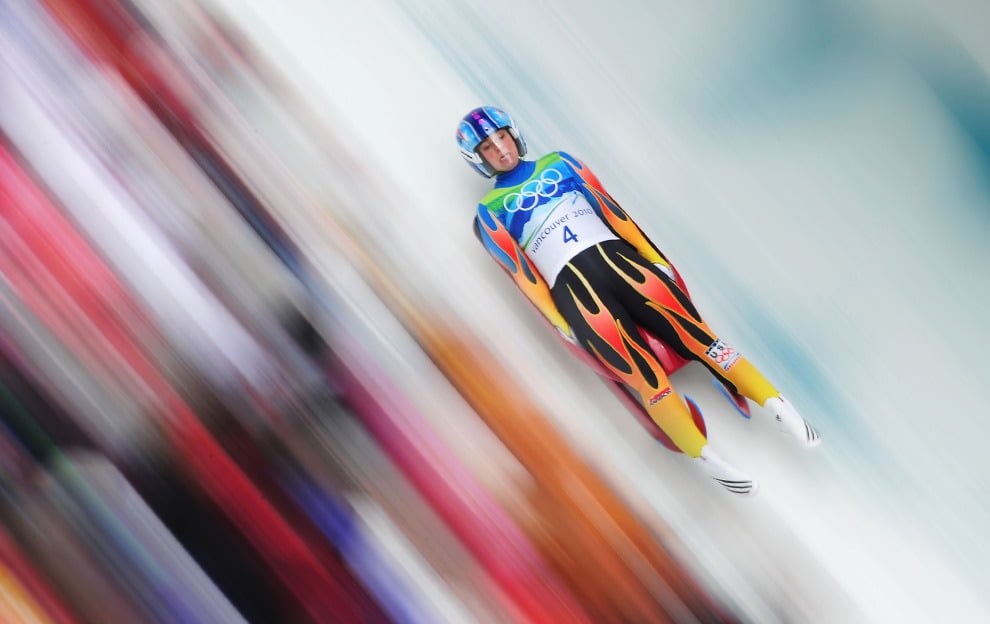
Like athletes in many of the gravity sports in the Winter Olympics, lugers want to be as aerodynamic as possible to minimize their drag. Once a luger has started sliding, only gravity can increase their speed – every other force, from friction to drag, pulls away valuable time. Luge sleds are built on sharp runners and athletes slide feet-first in a position much more streamlined than the head-first position of skeleton. Both contribute to the much higher speeds in luge – up to 140 kph (87 mph). Luge is also the only sliding sport measured down to thousandths of a second, so every gram of drag* makes a difference. Lugers keep their heads pulled back and wear full helmets to keep the air flow consistent and attached as much as possible. It is also typical for them to spend time in the wind tunnel, testing their sled’s aerodynamics, adjusting their position, and even testing their suits. (Photo credit: S. Botterill)
* For those wondering, yes, drag is a force and a gram is a unit of mass, not force. However, it is not unusual when testing athletes in wind tunnels to compare drag between configurations in terms of grams.
FYFD is celebrating the Games with a series on fluid dynamics in the Winter Olympics. Stay tuned for more!