
Waterlily beetles employ an unusual method of getting around: they skim across the water surface. The beetles are mostly covered in tiny hairs that help make their body hydrophobic (water-repellent) – a common adaptation for insects that spend their time sitting on the water’s surface – but the beetles also have hydrophilic claws on their legs that help anchor them to the water’s surface. When they need to move quickly, the beetles lean upright and start flapping their wings, creating thrust that helps push them along the interface. Between water’s viscosity and drag from the waves the insect generates, it has to expend a lot of energy for this method of travel – more than these insects do flying in air – but researchers suspect that staying at the surface could remain beneficial for the beetles because it’s easier to locate their floating food sources this way. (Image credit: H. Mukundarajan et al., source; via New Scientist)
Search results for: “waves”

Breaking Wave
This animation shows a cinemagraph of a breaking wave photographed by Ray Collins. The motion was inferred and digitally added by a second artist, Jersey Maria. The result is hypnotic, as if we are traveling beside the wave and watching it tear apart ever so slowly. The wave seems to be poised on a tipping point, only breaking up along its back edge, when instinct tells us it will keep steepening and tipping forward until its top curl crashes down in a wave of white foam. Surf photography like Collins’ work shows us an alternative perspective on waves, their power frozen into a single instant. Reanimated, it feels like we’re seeing the wave in hyper-slow-motion, watching every tiny movement of water before everything crashes down. Even if it’s not physically realistic, it is an awesome view. (Image credit: R. Collins / J. Maria, source, original; via Iwan A.)

Acrylic and Oil


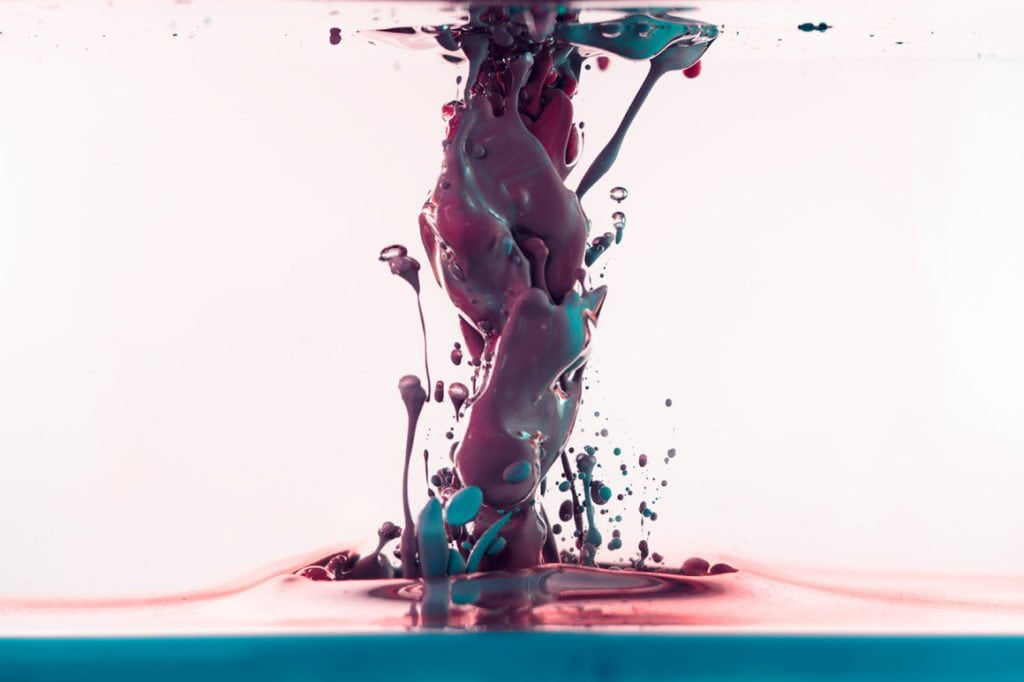

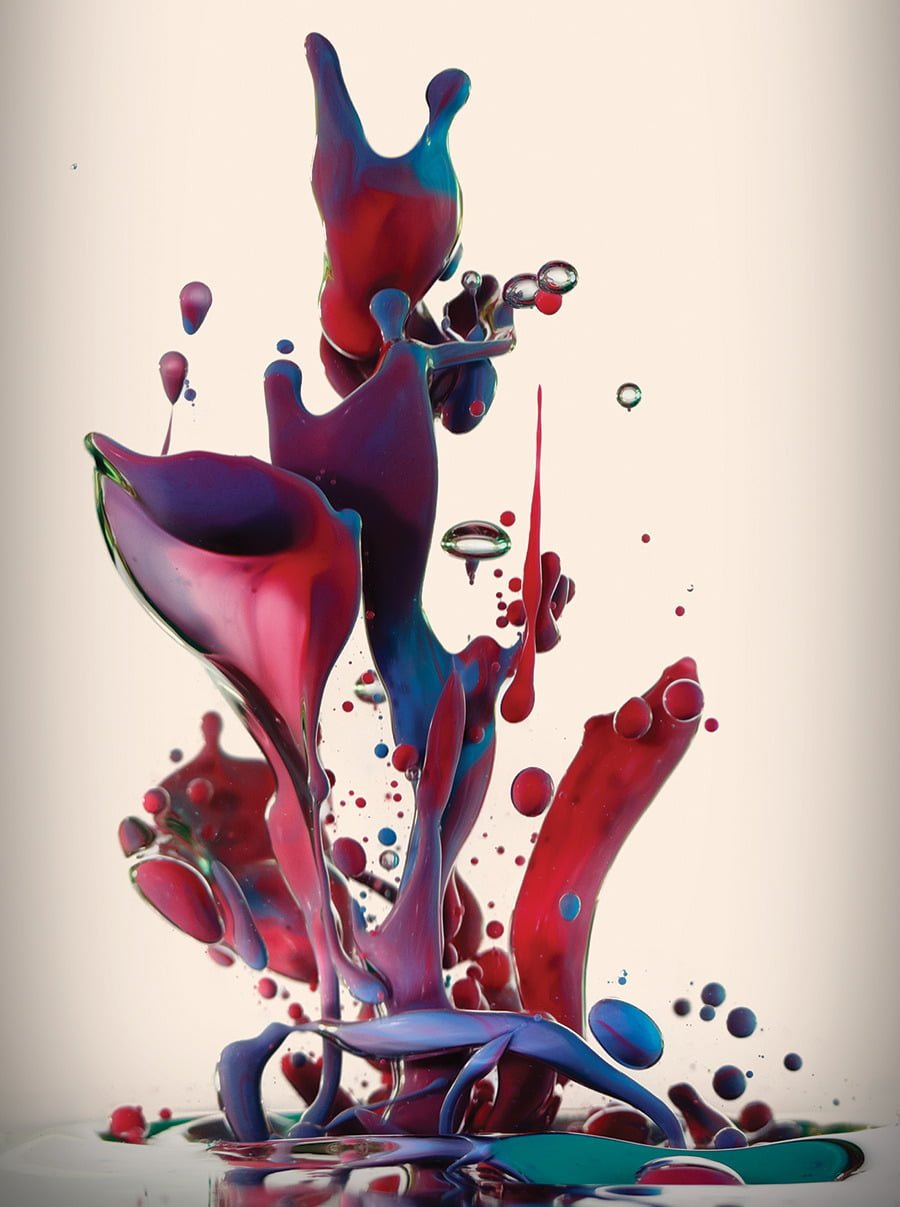
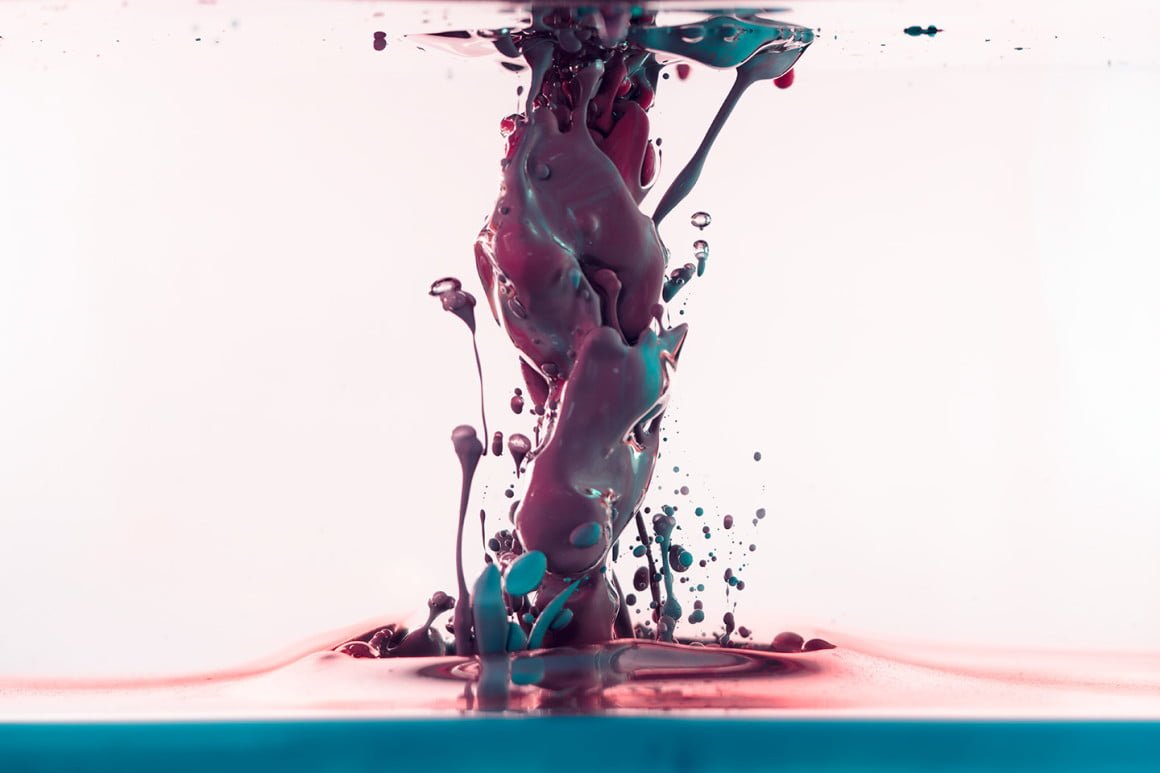
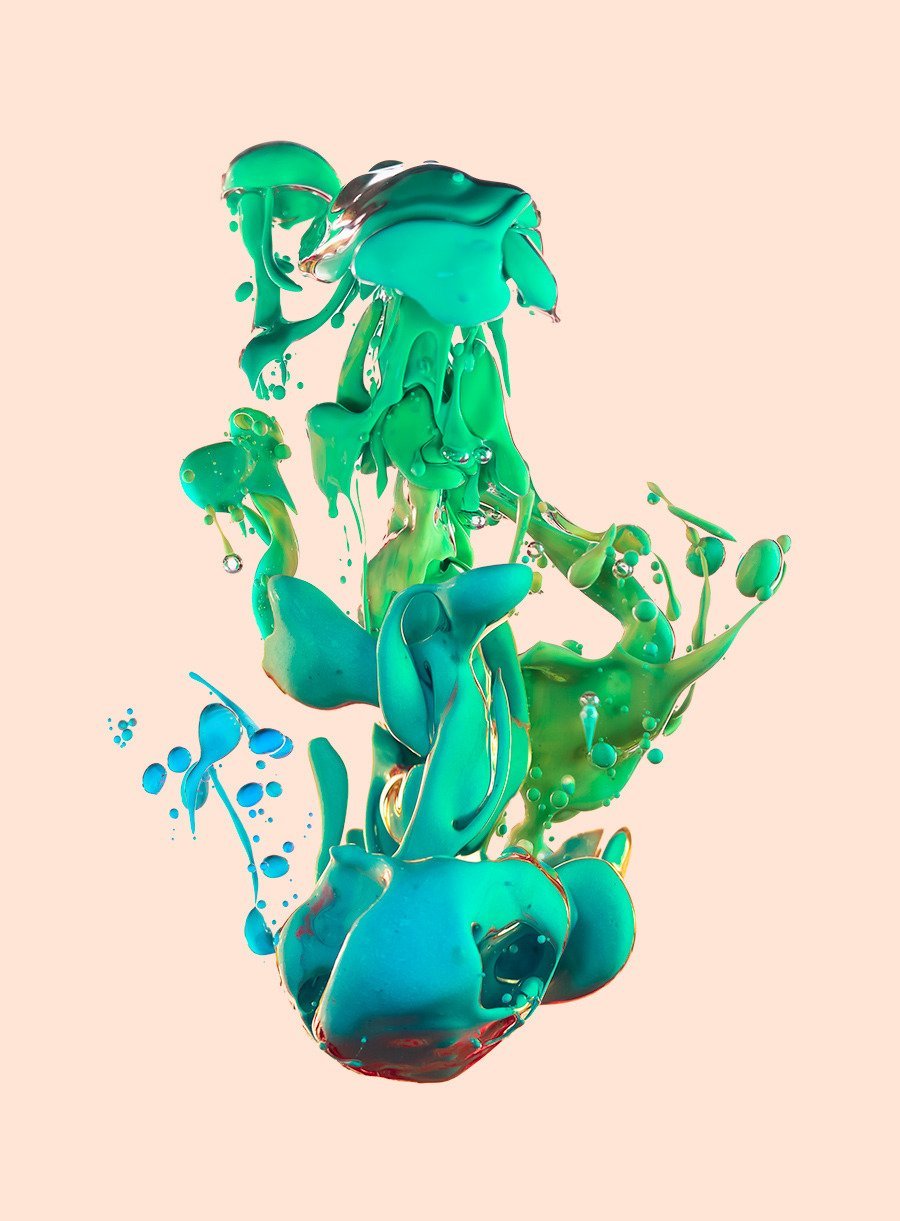
Photographer Alberto Seveso is well-known for ink in water art, some of which FYFD has featured previously (1, 2, 3). More recently, he’s been experimenting with alternative methods, dropping fluids like acrylic paint into sunflower oil. The effect is quite different but no less beautiful. Because the paint and oil are immiscible, the boundaries between the two fluids are much more clearly defined and highlighted in an iridescent sheen. Instead of appearing like billowing waves of silk, the paint forms abstract and alien shapes driven by gravity, inertia, and density differences. For many more great examples, check out Seveso’s website. (Photo credit: A. Seveso)

The Kamifusen

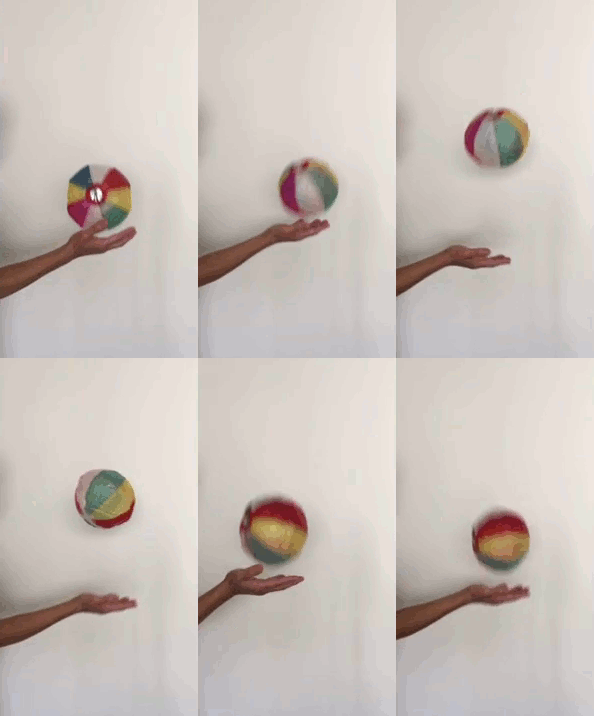



The kamifusen is a traditional Japanese toy made of colorful paper. It resembles a beach ball, but unlike that toy, the kamifusen has an open hole at one end. Given that hole, one might expect the toy to deflate when struck, but the opposite is true – a deflated kamifusen inflates itself when bounced. The key to this counter-intuitive behavior comes from a combination of fluid dynamics and solid mechanics.
When the kamifusen bounces off a player’s hand, it is compressed, which increases pressure inside the toy and forces some air out. Elastic waves rebound through the ball’s paper walls, much like seismic waves traveling outward from an earthquake. Those waves re-expand the toy’s walls, dropping the interior pressure and pulling air in from the outside. Although the pressure spike from impact is larger, its duration is short compared to the low pressure generated by the subsequent elastic waves. As a result, more air flows into the toy than is knocked out, and so the kamifusen inflates. For more, check out this explanation at Physics Today. (Image and research credit: I. Fukumori, source; submitted by E. van Andel)

Bottle Rocket Shock Diamonds
Mach diamonds or shock diamonds can often be seen in the exhaust of rocket engines. Here they’re shown in high-speed video of a bottle rocket’s launch. The rocket’s exhaust exits at a pressure that is higher than the surrounding atmosphere, which causes the exhaust to bulge outward and forms two expansion fans, seen in pink, to lower the pressure. The pressure actually drops too low, however, causing shock waves, seen in turquoise, to form in order to raise the exhaust’s pressure. This back-and-forth between shock waves and expansion fans continues, forming the diamond shapes we see. Each subsequent set gets weaker as the exhaust closes in on the right pressure, and ultimately the series of diamonds fades into turbulence. (Image credit: P. Peterson and P. Taylor, source)

Shocks on a Wing
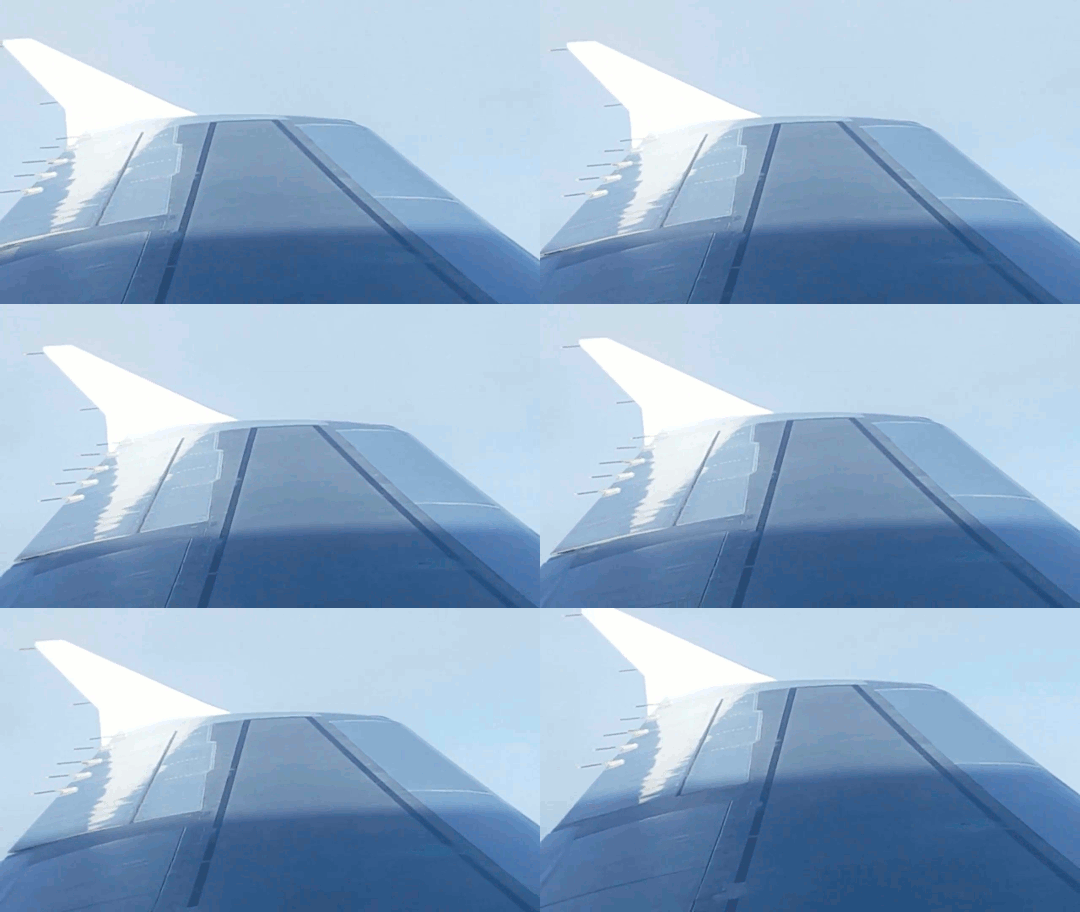
Commercial airliners fly in what is known as the transonic regime at Mach numbers between 0.8 and 1.0. While the airplane itself never exceeds the speed of sound, that doesn’t mean that there aren’t localized regions where air flows over the airplane at speeds above Mach 1. In fact, it’s actually possible sometimes to see shock waves on the top of airliner’s wings with nothing more than your eyes. The animations above show shock waves sitting about 50-60% of the way down the wing’s chord on a Boeing 737 (top) and Airbus A-320 (bottom). The shock wave looks like an unsteady visual aberration sitting a little ways forward of the wing’s control surfaces.
The wings themselves are shaped so that these little shock waves are relatively stationary and remain upstream of the flaps pilots use for control. Otherwise, the sharp pressure change across a shock wave sitting over a control surface could make moving that surface difficult. This was one of the challenges pilots first trying to break the sound barrier faced. (Image credits: R. Corman, source; agermannamedhans, source)
Breaking the Wave Speed Limit
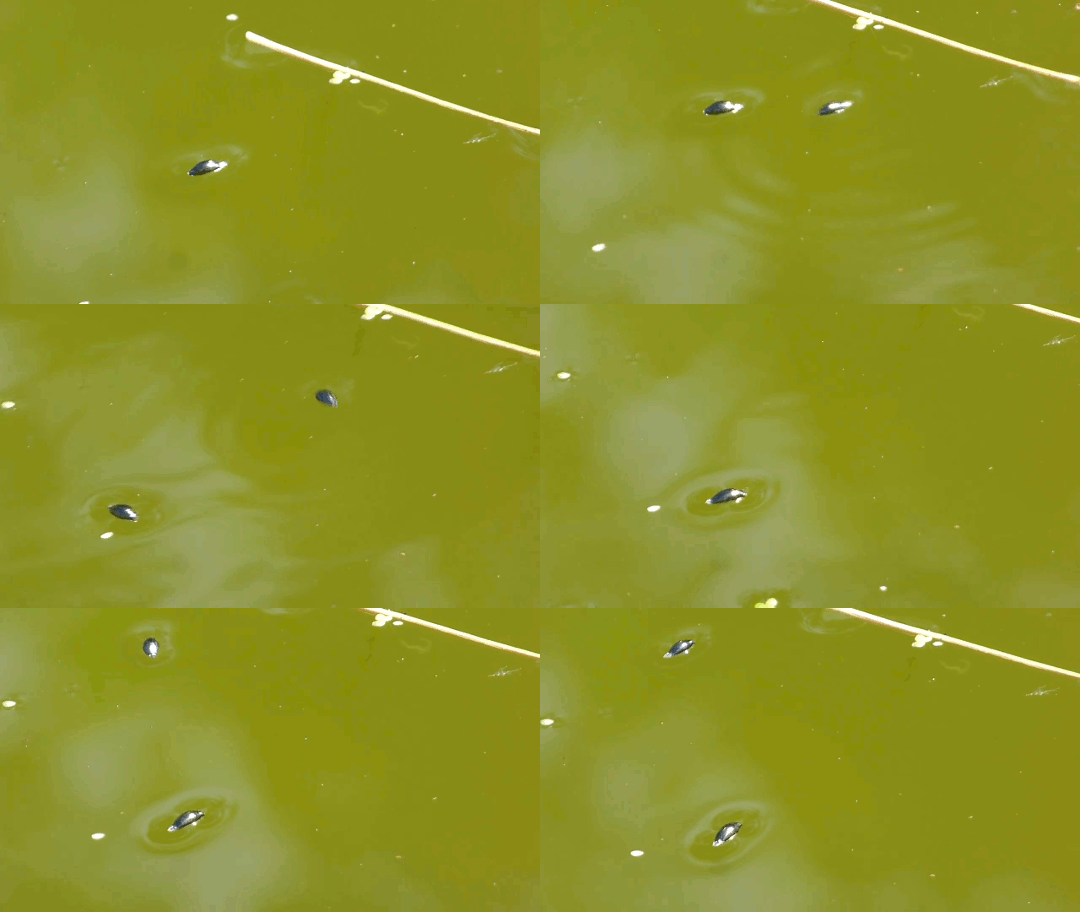
Whirligig beetles are small surface swimming insects. As they race across the water surface, they create both visible and unnoticeable waves on the water. These waves are the result of both surface tension and gravity. Typically, it’s the wavelength of the gravity waves that limit a swimmer or boat’s speed. When the wavelength of the gravity waves a swimmer creates meets the size of the swimmer, the waves generated ahead of the swimmer start to reinforce the waves forming at the back of the swimmer. This traps the swimmer (or boat) in a trough between its bow and stern waves and limits the max speed of the swimmer since overcoming this critical hull speed requires excessive amounts of power.
The tiny whirligig beetle overcomes this natural speed limit cleverly. It is smaller than the shortest possible gravity wave in water. Thus, it can never be trapped between its bow and stern waves! This allows the tiny swimmer to zip across the water’s surface at speeds above 0.5 m/s. That’s over 30 beetle body lengths per second! (Image credit: H. L. Drake, source; research credit: V. Tucker; submitted by Marc A.)
Wrinkling Winds
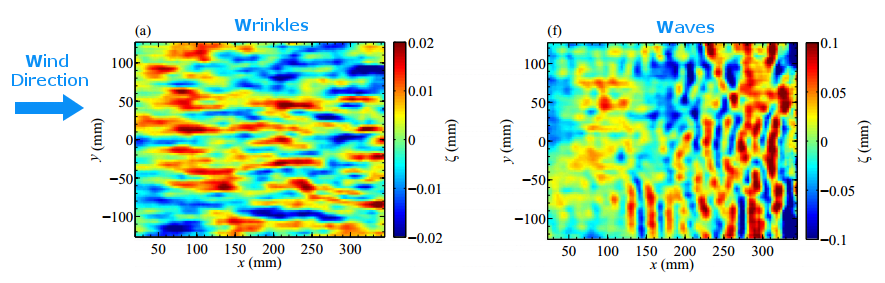
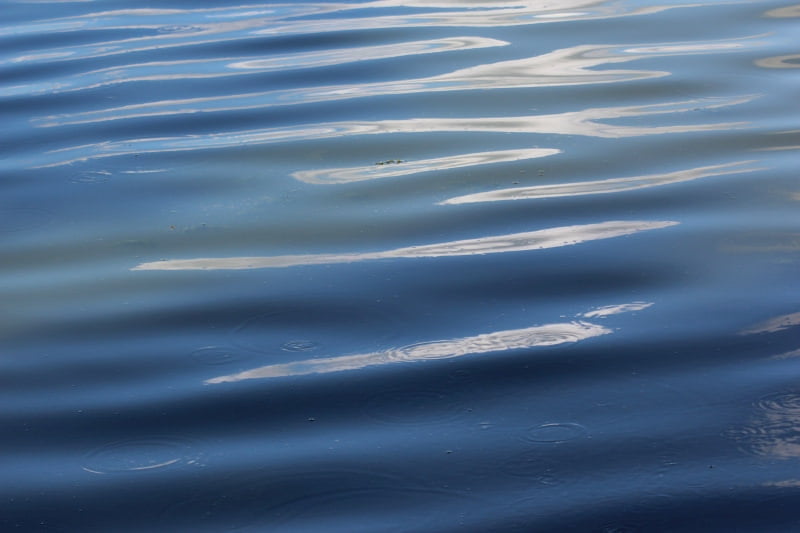
If you’ve ever sat out on a lake and just watched the water’s surface, you’ve probably noticed how complex and variable it looks. There may be waves that rock your kayak but there are smaller variations, too, like little ripples or even tiny wrinkles that appear on the surface. Much of this activity comes from wind blowing across the water. When the wind exceeds a critical speed, waves form. They generally travel in lines that are aligned perpendicular to the wind (lower right). But what happens when the wind is below the critical speed?
A recent study looked at just this question. By blowing air across the surface of different liquids and observing variations in the surface height as small as 2 micrometers, the researchers were able to measure tiny wrinkles on the water’s surface (lower left) when the wind speed was small. The size and shape of the wrinkles actually corresponds to structures in the turbulent air flow over the water! For fluids like water, there’s a smooth transition from wrinkles to waves as the wind speed increases, so both may be visible at the same time. For higher viscosity fluids, the switch from one to the other is more abrupt. (Image credits: water – M. Soveran; figure – A. Paquier et al. w/ annotations added in blue; research credit: A. Paquier et al.)

Breaking Soon


Australian photographer Warren Keelan captures spectacular photos of waves just before and during the moment they break. Fluid dynamics is defined by motion – specifically the motion of substances that do not hold a single form – but one thing I love about wave photography is how crisp and solid water appears when frozen in time. In a way, it feels like a reminder that, even though we classify matter into different states, ultimately those states have a lot in common. (Image credit: W. Keelan; via Colossal)

Four Seasons
The team behind Beauty of Science decided to explore the four seasons in this video combining macro footage of crystal growth, chemical reactions, and fluid dynamics. It’s always a fun game with videos like this to try and guess exactly what makes the mesmerizing patterns we see. Are those blue streaming waves in Spring caused by alcohol shifting the surface tension in a mixture? Are the dots of color welling up in Autumn a lighter fluid bursting up from underneath a denser one? As fun as the visuals are, though, what really made this video stand out for me was its excellent use of “The Blue Danube” to tie everything together. Check it out and don’t forget the audio! (Video credit: Beauty of Science; via Gizmodo)


