Search results for: “waves”

  • Wrinkling Winds

    Wrinkling Winds

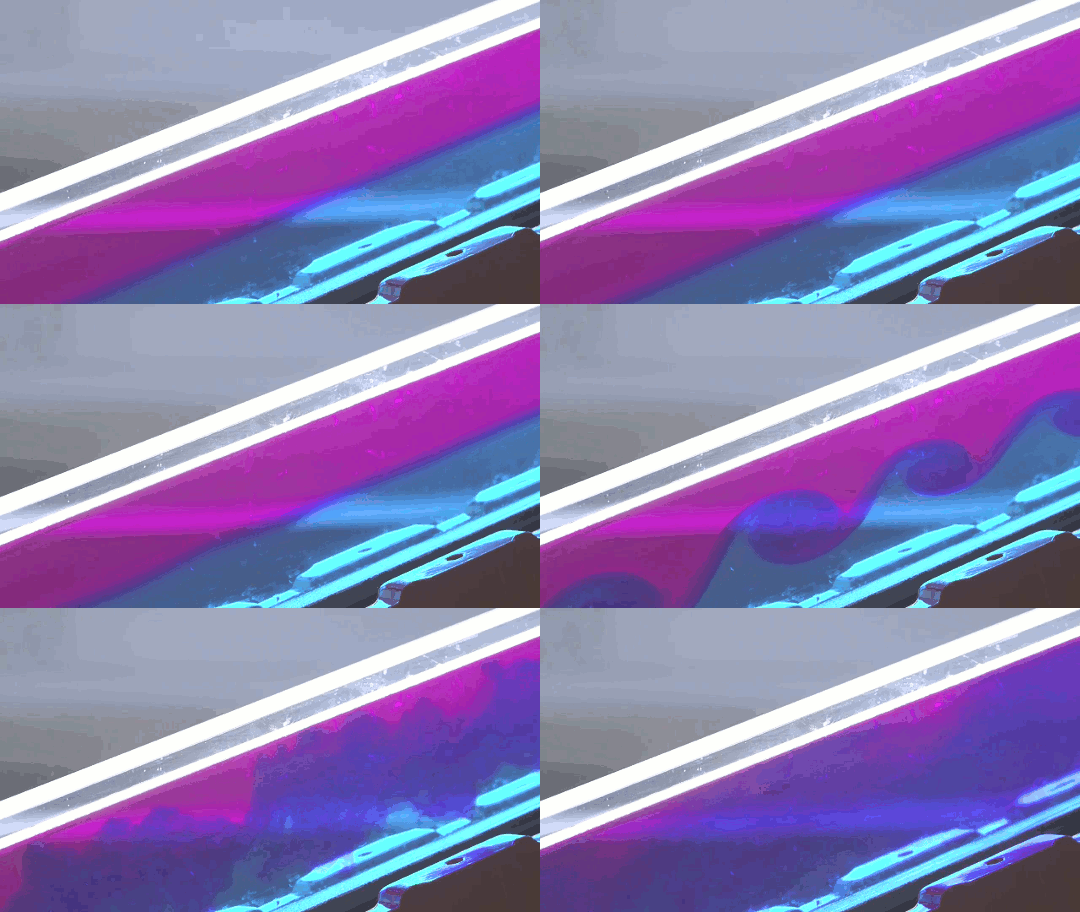
    If you’ve ever sat out on a lake and just watched the water’s surface, you’ve probably noticed how complex and variable it looks. There may be waves that rock your kayak but there are smaller variations, too, like little ripples or even tiny wrinkles that appear on the surface. Much of this activity comes from wind blowing across the water. When the wind exceeds a critical speed, waves form. They generally travel in lines that are aligned perpendicular to the wind (lower right). But what happens when the wind is below the critical speed?

    A recent study looked at just this question. By blowing air across the surface of different liquids and observing variations in the surface height as small as 2 micrometers, the researchers were able to measure tiny wrinkles on the water’s surface (lower left) when the wind speed was small. The size and shape of the wrinkles actually corresponds to structures in the turbulent air flow over the water! For fluids like water, there’s a smooth transition from wrinkles to waves as the wind speed increases, so both may be visible at the same time. For higher viscosity fluids, the switch from one to the other is more abrupt. (Image credits: water – M. Soveran; figure – A. Paquier et al. w/ annotations added in blue; research credit: A. Paquier et al.)

  • Breaking Soon

    Breaking Soon

    Australian photographer Warren Keelan captures spectacular photos of waves just before and during the moment they break. Fluid dynamics is defined by motion – specifically the motion of substances that do not hold a single form – but one thing I love about wave photography is how crisp and solid water appears when frozen in time. In a way, it feels like a reminder that, even though we classify matter into different states, ultimately those states have a lot in common. (Image credit: W. Keelan; via Colossal)

  • Featured Video Play Icon

    Four Seasons

    The team behind Beauty of Science decided to explore the four seasons in this video combining macro footage of crystal growth, chemical reactions, and fluid dynamics. It’s always a fun game with videos like this to try and guess exactly what makes the mesmerizing patterns we see. Are those blue streaming waves in Spring caused by alcohol shifting the surface tension in a mixture? Are the dots of color welling up in Autumn a lighter fluid bursting up from underneath a denser one? As fun as the visuals are, though, what really made this video stand out for me was its excellent use of “The Blue Danube” to tie everything together. Check it out and don’t forget the audio! (Video credit: Beauty of Science; via Gizmodo)

  • Featured Video Play Icon

    “Pulse”

    Photographer Mike Olbinski returns with another incredible storm-chasing timelapse video, this time all in black-and-white. To me, that choice helps “Pulse” emphasize the ominous majesty of these supercells and tornadoes by highlighting the textures that make up the clouds. Watching clouds in timelapse, they seem to materialize from nowhere as moisture drawn up from the land cools and condenses. Sped up, suddenly the convective rotation and the roiling turbulence inside clouds is perfectly clear. I especially love the sequence beginning at 2:25, where a distant black line slowly transforms into an incredible landscape marked with successive waves of rolling, turbulent clouds. Watch this one on a large screen at a high resolution, if you can. You won’t regret it! (Video credit: M. Olbinski)

  • Crowns On Impact

    Crowns On Impact

    Dropping a partially-filled test tube of water against a table makes the meniscus at the air-water interface invert into a jet of liquid. In some cases, the impact is strong enough to generate splashing crowns of water around the base of the jet. These crowns come in two forms – one with many splashes layered upon one another and the other with only a few splashes and a faster jet. 

    The many-layered splash crowns come from the pressure wave that reflects back and forth from the bottom of the tube to the surface and back. This pressure wave moves at the speed of sound and vibrates the water surface, creating the many splashes. The same reflected pressure wave occurs in the second type of splash crown, but it gets disrupted by cavitation bubbles that form in the water (visible in the lower left image). Instead the splash crowns form from the shock waves generated when the cavitation bubbles collapse. (Image credits: A. Kiyama et al.)

  • Creating Moana’s Ocean

    Creating Moana’s Ocean

    Hopefully by now you’ve had an opportunity to see Disney’s film Moana. Fluid dynamics play a central role in the movie, and Disney’s animators faced the challenge of hundreds of shots requiring special effects to animate water, lava, waves, and wind. Science Friday has a great segment interviewing a couple of Moana’s animators, in which they discuss the process of turning the ocean itself into a character. 

    Because the physics of fluids is so complex, scientists and animators differ in the way they approach simulations. Scientists usually try to capture a full physical representation of a flow, simulating every detail to the smallest scale and time step. Animators, on the other hand, are interested in capturing a realistic feel for a flow. For an animator, the simulation should be exactly as complex as necessary to make the water move in a way a person believes it should. With Moana, animators had the extra challenge of melding the ocean character’s actions with appropriate water physics–think bubbles, drops, and splashes. The results are impressive and exceptionally fun. (Image credits: Disney/Science Friday; via Jesse C.)

  • Featured Video Play Icon

    Paint Spilling Physics

    There is a remarkable amount of physics contained in art. In this video, scientists from The Splash Lab explore some of the physics involved in pouring paint atop a rectangular post. The spreading paint transforms its shape repeatedly, and, at the corners of the post, it preserves a tiny history of all the colors poured. Paint sliding down the sides shifts from a thin sheet to a thicker jet that deposits color in waves. For tall posts, the distance the paint falls is long enough for instabilities to set in, producing a paint puddle that’s riddled with curves and waves between each color of paint. It’s a lovely reminder of the complexity inherent even within a simple action. (Video credit: R. Hurd et al.)

  • The Sound of a Balloon Popping

    The Sound of a Balloon Popping

    The pop of an overfilled balloon is enough to make anyone jump, but you’ve probably never seen it like this. The photo above uses an optical technique known as schlieren photography that reveals changes in density of a transparent gas like air. The shredded rubber of the balloon is still visible in black, and around the balloon there’s an expanding spherical shock wave. It’s the sudden release of energy when the balloon ruptures and the gas inside begins to expand that causes the shock wave. Notice, though, that the gas from the balloon is still clearly visible and balloon-shaped–much like a water balloon that’s just popped. From that clear delineation, I would say that this balloon was filled with a different gas than air–otherwise the density shouldn’t be different enough to make the interior gas distinguishable.  (Image credit: G. Settles)

  • Inside Cavitation

    Inside Cavitation

    Cavitation bubbles live a short and violent life. It begins when a low-pressure void forms in a fluid–for example, when a liquid is accelerated so that the pressure drops below the vapor pressure, which can happen at the tips of a boat’s propeller or when striking a bottle. The bubbles that form expand and then collapse rapidly as the higher pressure of the liquid surrounding them squeezes them down. That collapse of the bubble is so violent that it heats the fluid inside the bubble to temperatures hotter than the surface of the sun, generating both a flash of light and a shock wave. It’s these shock waves that cause much of the damage associated with cavitation in engineering, but they can be used for good as well. Shock wave lithotripsy uses cavitation-induced shock waves to break down kidney stones. (Image credit: O. Supponen et al., source)

  • Swirling Pollen

    Swirling Pollen

    This photo captures the chaotic mixing present in a simple puddle. Pine pollen strewn across the puddle’s surface acts as tracer particles, revealing some of the motion of the underlying water. As wind blows across the puddle, it moves the water through the formation of ripples and by shearing the surface. That deformation on the top of the puddle will cause further motion beneath the surface. With time and changing wind direction, the resulting pattern of flow can be very complex! (Photo credit: K. Jensen, original)