
Schlieren photography allows visualization of density gradients, such as the sharp ones created by shock waves off this T-38 aircraft flying at Mach 1.1 around 13,000 ft. Although shock waves are relatively weak at this low supersonic Mach number, they persist, as seen in the image, at significant distances from the craft. The sonic boom associated with the passage of such a vehicle overhead is due to the pressure change across a shock wave. The higher the altitude of the supersonic craft, the less intense its shock wave, and thus sonic boom, will be by the time it reaches ground level. (Photo credit: NASA)
Search results for: “waves”
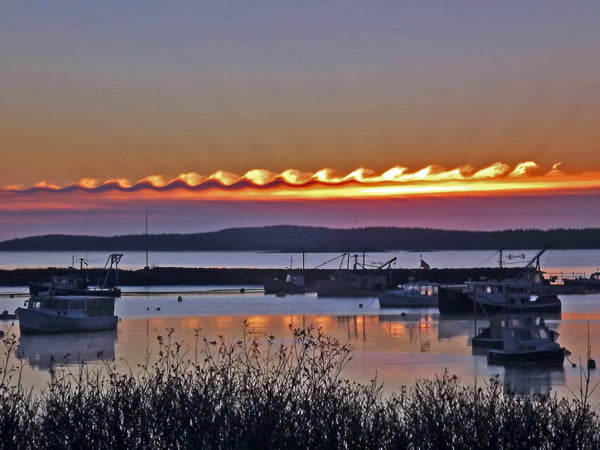
Ocean Waves in the Sky
These wave-like Kelvin-Helmholtz clouds can form due to shear between different layers of air in the atmosphere. When one region of air has a higher velocity than the other, their interface forms a shear layer, which can break down in this wavy pattern. In this case, the lower layer of air was moist enough to form condensation and clouds, making the pattern visible to the naked eye. (Photo credit: Gene Hart; via Flow Visualization)

Fluorescing Shock Waves
Wind tunnel testing plays a major role in the planning of many space missions. Here a model of the Mars Sample Return Orbiter is tested at Mach 10 to determine the heat shield’s response to aerobraking off Mars’ atmosphere. The colors are the result of electron beam fluorescence, in which an electron gun is used to ionize molecules in the flow, which causes them to emit photons (light). The technique can be used for flow visualization–as in the case of the shock waves shown here–or to measure flow characteristics like density, temperature, and velocity. (Photo credit: Thierry Pot/DAFE/ONERA)

Supersonic Bubble Shock Waves
Supercomputing has been an enormous boon to fluid dynamics over the past few decades. Many problems, like the interaction between a supersonic shock wave and a bubble, are too complicated for analytical solutions and difficult to measure experimentally. Numerical simulation of the problem, combined with visualization of key variables, adds invaluable understanding. Here a shock wave strikes a helium bubble at Mach 3, and the subsequent interactions in terms of density and vorticity are shown. This situation is relevant to a number of applications, such as supersonic combustion and shockwave lithotripsy–a medical technique in which kidney stones are broken up inside the body using shock waves. After impact, an air jet forms and penetrates the center of the structure while the outer regions mix and form a persistent vortex ring. (Video credit: B. Hejazialhosseini et al.; via Physics Buzz)

How Are Sea Waves Created?
There are many different kinds of sea waves, some of which have fluid dynamical origins and some of which don’t. For example, tsunamis are caused by the sudden displacement of the ocean floor caused by earthquakes and the tides are caused by the pull of the moon on Earth’s oceans. But many of the waves we are accustomed to seeing are caused by the wind moving across open water, whether in the ocean, in a lake or a sea, or even a river or pond. When the wind blows across the free surface of the water, the difference in velocity between the two fluids causes shearing and the development of surface waves as a result of the Kelvin-Helmholtz instability. (Incidentally, this is why other examples of the K-H instability look so much like ocean waves.)
These wind-generated waves can take several forms. Ripples–or capillary waves–remain visible only as long as the wind is blowing. But under steady conditions, or after the wind has affected a large enough area, waves can form that will persist at the surface even if the wind stops blowing. At that point, even though the wind generated the waves, it is gravity that allows them to persist. This is the source of most of the waves we see on large bodies of water. (Photo credit: Travis Weins)

Seeing Shock Waves
In this still image from a video of a 2008 demonstration of a U.S. Navy railgun, the shock waves in front of the projectile are momentarily visible. When travelling faster than the speed of sound in air, information (in the form of pressure waves) is unable to travel ahead of the projectile, meaning that the air cannot deform around the object as it does at low speeds. Instead, a front known as a shock wave forms on or in front of the object, depending on its speed and shape. Across this shock wave, thermodynamic properties of the gas are discontinuous; the pressure, temperature, and density of the air rise drastically, but the air is also deformed so that it passes around the object. (See also: bullet from a gun.)

How Shock Waves Form


Most people are familiar with the Doppler effect–in which the frequency of a wave changes depending on the motion of the observer relative to the wave source–from the shifting pitch of sirens as they pass. But the effect is important for pressure waves in addition to acoustic waves. When an object moves through air, its motion disturbs the surrounding air via pressure waves, which travel at the speed of sound. If an object moves slower than the speed of sound (top right), then those pressure waves extend in front of the object, carrying information about the object and allowing the air to shift and move smoothly around it.
If the object is moving at the speed of sound (bottom left), then it arrives at the same time as the pressure waves. In essence, the object is striking a stationary wall of air–this is what was meant by “breaking the sound barrier”. At Mach 1, the physics of the problem have fundamentally shifted. Now the only way for air to deflect to allow the object’s passing is by the sudden compression of a shock wave.
Moving even faster than the speed of sound (bottom right) the pressure and sound waves created by the object’s motion stretch in a cone behind it. The cone, known as a Mach cone, is the shock wave that deflects air around the moving object. The result is that the object will actually pass an observer before the observer will hear it. This is because no information can travel forward of the Mach cone’s leading edge. That’s why the area outside of the Mach cone is sometimes called the Zone of Silence. When the Mach cone passes an observer, the shock wave will register as a boom, like when the space shuttle passes overhead while landing. (via fyeahchemistry)
Making Waves
A standing wave is created in a wave tank by fixing a wall at one end and moving the other wall–the wave generator–at a frequency such that the outgoing waves are superposed on those reflecting back from the wall. This doubles the amplitude of the wave. In the standing wave (also called clapotis), the surface rises and falls in a mirrored pattern: troughs become crests become troughs and so on. When the wave generator is turned off, the standing wave’s energy dissipates and eventually the tank stills. The sloshing motion that persists in the meantime is known as a seiche, which commonly occurs in nature in lakes, seas, bays, and any partially enclosed body of water. Some definitions include tides as a form of seiche due to the periodic nature of the moon’s force on Earth’s waters. See this animation of a seiche for more. (submitted by Daniel)
Blast Waves
[original media no longer available]
Watch closely in this high-speed video of a bomb exploding and you will see the spherical blast wave moving outward as a visual distortion. The increase in temperature caused by the leading shockwave changes the index of refraction of the air, bending the light and distorting our view of the background. The mechanism is similar to schlieren photography, which has been used for more than a century to capture images of compressible flows.
Tank Shock Waves
High-speed video of a tank firing at 18000 fps shows shock waves made visible due to light distortion. When the air density changes (due to temperature or compression), it’s index of refraction changes, causing the background to appear distorted. Most of the video shows the subsonic development of the turbulent exhaust plume. Note the speed at which the exhaust moves relative to the airborne shrapnel. (submitted by Stephan)