
Typically, shock waves are invisible to the human eye. Using sensitive optical techniques like schlieren photography, researchers in a lab can visualize sharp density gradients like shock waves or even the slight density variations caused by natural convection. But it takes some special conditions to make shock waves visible to the naked eye. The blast wave of the explosion in the photo above is a great example. The leading edge of the shock wave and the heat of the explosion create a strong, sharp change in density. That density change is accompanied by a change in the air’s refractive index. As light travels from the distance toward the camera, it’s distorted–more specifically, refracted–when it travels through the blast wave and its wake. And, in this case, that visual distortion is strong enough that we can clearly see the outlines of the shock waves moving out from the explosion. The apparent horizontal line through the blast wave is probably the intersection of a weaker secondary shock wave with the initial expanding shock wave. (Image credit: Defense Research and Development Canada; via io9)
Search results for: “waves”

4th Birthday: Rogue Waves
Rogue waves—individual, isolated waves far larger than the surrounding waves—were reported for centuries by sailors. But their stories of massive walls of water appearing in the open ocean were not corroborated until 1995 when a rogue wave struck an offshore platform. How these giant waves form is still under active research, but one leading theory is that nonlinear interactions between waves allow one wave to sap energy from surrounding waves and focus it into one much larger, short-lived wave. I first learned of rogue waves during a seminar in graduate school. At the time, this idea of nonlinear focusing had only been explored in simulation, but a few years later a research group was able to demonstrate the effect in a wave tank, as shown in the video above. Wait for the end, and you’ll notice how the rogue wave that takes down the ship is much larger than its predecessors. For more on rogue waves and their mind-boggling behavior, be sure to check my previous post on the subject. (Video credit: A. Chabchoub, N. Hoffmann, and N. Akhmediev)
Harnessing Ocean Waves
Ocean waves contain substantial amounts of energy, and many projects are underway to harness them as renewable energy sources. Most of these projects use the motion caused by waves to generate electrical energy. In this example, a flexible carpet is attached to hydraulic pumps. As the waves move over the carpet, it oscillates, raising and lowering the piston of the pumps. This adds hydraulic pressure to the discharge lines that run from the wave carpet to the shore. Once on dry land, that hydraulic pressure can be converted to electrical energy. This design addresses one of the major challenges in ocean-wave-energy technologies–namely how to safely transmit power from the wave farm to the shore. (Video credit: University of California Television)
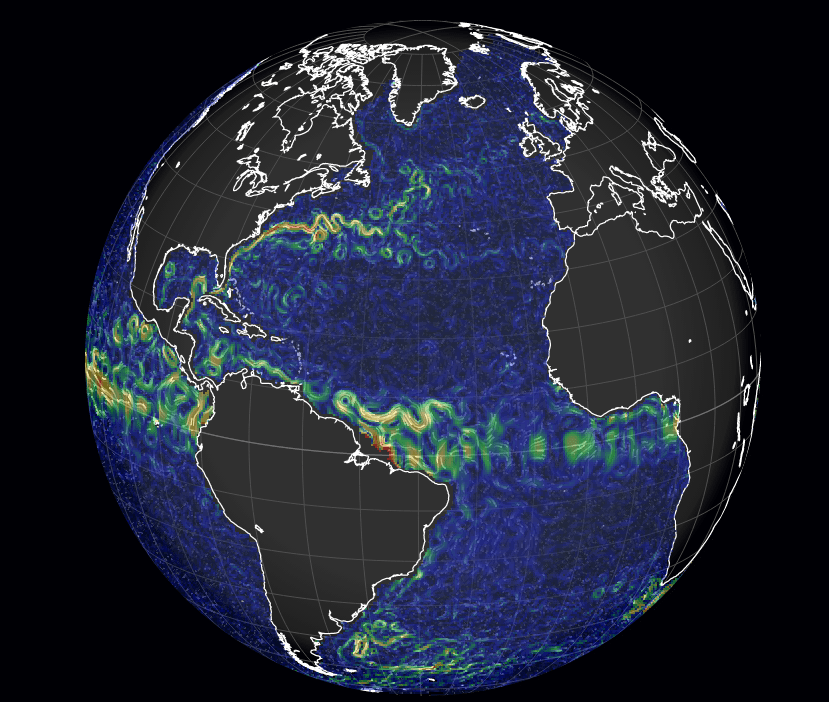
Wind and Waves Visualized

Much like the wind map we featured previously, designer Cameron Beccario’s visualizations of wind and ocean surface current data draw from near-real-time sources to create a stunning picture of fluid dynamics on a planetary scale. The number of options in terms of projections and data are really quite incredible, and you’ll want to play around to get a real sense for it. Want to see the wind and total precipitable water at 1000 hPa? Here you go. Maybe you prefer studying Pacific ocean currents. All the data are there to play with. People often wonder why weather forecasts aren’t always right, but, when you look at the scale and complexity of these flows, it’s almost a wonder that we can predict them at all. (Image credits:C. Beccario/earth; via skunkbear and io9)
Breaking Waves
Most beach-goers have probably wondered just what makes the waves coming in to shore rear up and break. The secret lies in the depths–or rather the lack thereof–beneath the waves. Far from shore, the wave’s length scale is small compared to the ocean depth, and the ocean’s bottom is effectively infinitely far away to all parts of the wave. But, as the wave rolls toward shore, the depth decreases and the ocean bottom begins to influence the wave. In the trough, the ocean bottom slows the wave. Meanwhile, the crest of the wave carries forward, rising until its height reaches 80% of the water depth, at which point it will tip over and break.(Video credit: BBC)

Glinting Off Waves
Sunglint on the ocean surface can sometimes reveal different patterns in wave conditions. In the satellite photo above, we see the Canary Islands with wavering silvery wakes stretching to the southwest. The predominant wind direction over the islands is from the northeast. The rocky islands act as a wind-break, redirecting the flow and shadowing the ocean in their wake from much of it. As a result, fewer waves are stirred up in the islands’ wakes, thereby changing the local surface reflection properties and making this image possible. (Photo credit: NASA Earth Observatory)
Bottle Rocket Shock Waves
This high speed video shows schlieren photography of a bottle rocket’s exhaust. The supersonic CO2 leaving the nozzle is underexpanded, meaning its pressure is still higher than the ambient atmosphere. As a result, a series of diamond-shaped shock waves and expansion fans appear in the exhaust jet. Each shock and expansion changes the pressure of the exhaust until it ultimately reaches the same pressure as the ambient air. This distinctive pattern, also known as Mach diamonds or shock diamonds, often occurs in wake of rockets. (Video credit: P. Peterson and P. Taylor)
Reader Question: More Standing Waves
corroding-touch asks:
So, further to the wave question, how about pressure? How does the pressure in a fixed spot beneath a wave vary, and how does this change with depth?
The primary factor for pressure at any point in the water is depth. Deeper water means a higher pressure. So if you imagine your fixed point at a particular depth relative to a flat ocean, it will have some nominal pressure dependent on its depth. Waves passing induce a higher-than-nominal pressure at the fixed point as the crest passes overhead and a lower-than-nominal pressure as the trough passes. Basically, the waves cause a fluctuation in pressure around some nominal point. As you increase in depth, the fluctuation will have less and less effect because the nominal pressure is ever increasing.

Reader Question: Standing Waves
captainandry asks:
What would happen to a fish or swimmer in a standing wave?
First of all, check out the video that inspired this question, which shows a standing water wave created in a wave tank. Before we tackle the standing wave, it’s helpful to know what motion exists in a typical water wave. For deep water waves, the motion of a particle as the waves pass is circular, with a decreasing radius with increasing depth. Below a certain depth the energy of the surface wave doesn’t penetrate. Here’s an animation, where the red dots represent massless particles and the blue circles show their paths:

In shallower waters, the circular paths get compressed into ellipses. The image below shows pathlines for particles at different depths as a water wave passes. Notice how the paths are circular near the surface, where the depth is much greater than the wavelength, while close to the bottom, the pathlines are elliptical.

So what about motion for a standing water wave? Such a wave has no apparent horizontal motion, as seen in the animation below:

Similar to the way that decreasing the depth compresses the circular particle motion into an ellipsoid, creating a standing wave compresses the horizontal motion of any particle near the surface. What this means is that anything floating near the surface of the standing wave will simply bob up and down. Unless it’s located at one of the nodes (marked by red dots), in which case it won’t move at all! As with the other types of water waves, the amount of displacement will decrease with depth. People and fish, of course, are not massless particles, so their motion will be damped by inertia, but the same principles apply.
(Photo credits: P. Videtich; R. L. Wiegel and J.W. Johnson; Wikipedia)
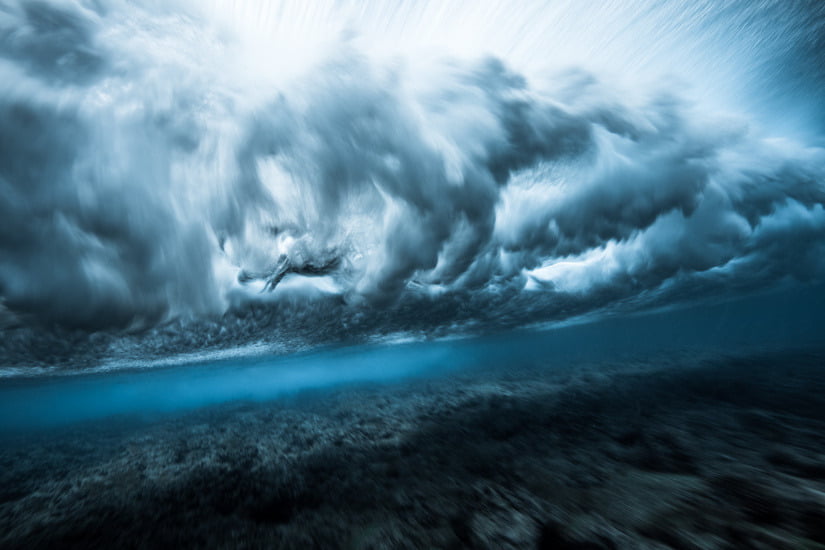
Under the Waves
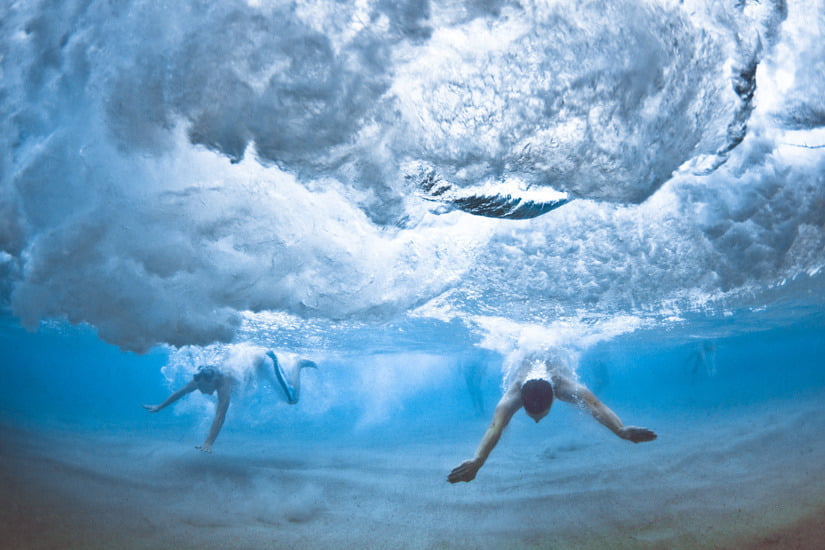


When I was a kid, I liked to dive underwater in the pool and sit at the bottom, looking up at the peculiar dancing sky the water made overhead. Photographer Mark Tipple takes it further, capturing images of the ocean from below the surface as waves roll in. His photos show swimmers and surfers diving to escape a roiling wave that, from below, bears a surreal similarity to the underside of a thundercloud in a summer storm. This is part of the beauty of fluid dynamics. Despite their differences, water and air obey the same physics. (Photo credits: Mark Tipple; via io9)

